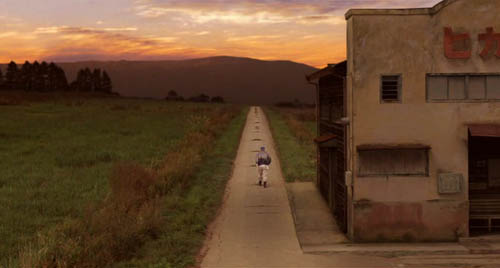
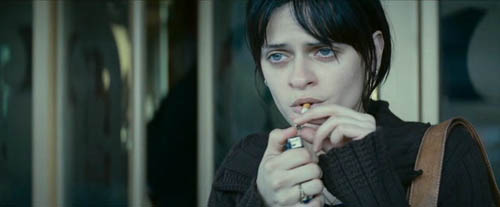
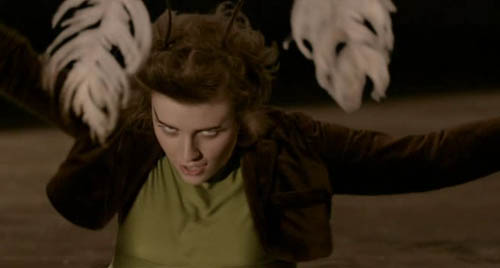
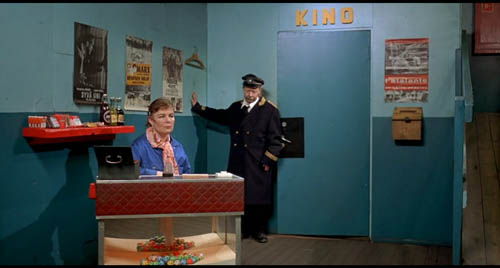
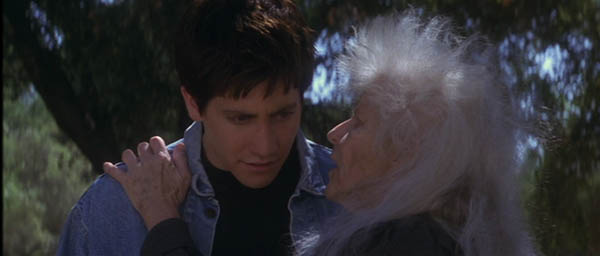
A sad ending to Anderson’s famed trilogy that began with If… (which I did not watch this week because Vdrome didn’t get it in) and O Lucky Man! (which I half-remember from watching on tape five years ago – a musical, right?).

If the first of the trilogy mixes “color and black and white as audaciously as it mixes fantasy and reality” and “remains one of cinema’s most unforgettable rebel yells”, according to Criterion, and the second was a fun, “surrealist musical [which] serves as an allegory for the pitfalls of capitalism”, according to the IMDB, then what’s left for this little apocalyptic satire? It feels flat, unfunny and bizarrely plotted, with Malcolm McDowell barely present and not much holding the whole thing together.

image

The final scene (after M. McD’s beheading death) features a long dull speech railing against all of human society by a mad scientist (Graham Crowden of O Lucky Man and The Ruling Class) who unveils a computer named Genesis that will somehow solve everything. Before that, McDowell is an ineffectual investigative reporter, with stoned colleagues Mark Hamill (post-Big Red One, pre-Jedi) and Frank Grimes.

image

Movie felt sucky at the time, but it had noble intentions, throwing all of British society into the title hospital, staging a joint protest against both the way the country (err, hospital) treats its less-wealthy citizens, and the way it coddles corrupt and brutal foreign dictators. It’s against both the boss who expects too much and the worker who provides too little, it makes a small mockery of the royal family (midget and tranny royal reps) but shows the Queen’s handlers to be resourceful, sneaking her past the mob incognito, it tosses hatred at the labor unions (portrays them as killing patients through negligence and unnecessary regulations) and it throws some police violence, mob rule and frankenstein medical experiments into the mix. The lead actor is actually hospital director Leonard Rossiter, who mostly keeps his composure, except when he murders a striking electrician to turn the hospital’s power back on.

image

Best online source I could find on the film, an unsigned article on britmovie.co.uk site, sums up:

The question posed at the end of the film is ‘Is man intelligent enough to survive?’ The speech concluding the film is not sentimental; it’s much more the speech of an angry rationalist who is appalled and irritated by the stupidity of mankind. He proposes that the only solution is intelligence. But, of course, having made this speech, which most people would agree with, he then proposes a solution that is even crazier and more horrifying than anything the establishment represents. He produces the idea of a disembodied intelligence, this brain we see, which he tells us will be combined into a silicon chip. So, the challenge at the end is a question, If only intelligence can save us how can that intelligence be controlled? The film does say, I hope, that we must mistrust institutions, power, the instincts for power within us, and in that way I think Britannia Hospital is an anarchist film. It puts the responsibility squarely on the individual to develop first the intelligence and the moral awareness by which alone man can control his destiny.

The film’s location manager is quoted as saying “Unlike a lot of directors, [Anderson] doesn’t make films just for money but because he has something to say.” This was clearly a low-budget effort, with big stars (McDowell, Hamill) working for free, and the film had too much of a social conscience to dismiss by saying “ehh, the plot didn’t grip me and McDowell wasn’t in it enough and it was too disjointed” and give it the C- rating it may deserve on the grounds of a pretty poor final product. I’m upgrading to a B- for honorable intentions.

Lead actor (hospital director) Leonard Rossiter would die of a heart attack in 1984, with director Anderson following a decade later.

image

Apparently seeing this movie four times is not too many, because I still enjoyed it. Katy liked it too. An underloved comedy classic.

Although now that I’ve heard the commentary, I spend a lot of time thinking about how cold it might be during the scene, and whether it’s raining.

Michael Showalter and David Wain’s next movie The Ten is coming soon.

These days, Jeaneane Garofalo’s voice is starring in Ratatouille and David Hyde Pierce is in nothing at all. Marguerite Moreau (the hot one) was the lead in Firestarter 2. Cafeteria worker A.D. Miles starred with Zach G. in fake-news show Dog Bites Man. The dick who dates the hot girl, Paul Rudd, is in Knocked Up and everything else. Lead cafeteria guy Gene (Chris Meloni) must’ve been unstable and Christopher-Lloyd-looking enough to land a part in Oz and both Harold & Kumar movies. Post-breakup pedophiliac counselor Molly Shannon starred in Year of the Dog. The drama counselors are apparently-hot-right-now SNL comic Amy Poehler and the CIA contact in Alias, Bradley Cooper. Cameo (as Molly’s ex-husband) by comedy guy Judah Friedlander, who will apparently be in Cabin Fever 2, and of course, the most famous person who has ever screamed at my brother in public, Jon Benjamin as the can of vegetables.

Related shows I miss:
The State
Viva Variety

Related shows I never really watched:
The Baxter (m. showalter movie)
Reno 911
Stella
Tom Goes To The Mayor

The extremely cute Diane Franklin (Monique) later starred in Terrorvision (with Jon Gries – Uncle Rico in Napoleon Dynamite) and played a princess in Bill & Ted’s Excellent Adventure.

Paperboy who wants his two dollars isn’t in anything else, sadly.

Funny damned movie, a little slack but still good. The racecar brothers, one of whom speaks no English and the other speaks like Howard Cosell, are the best part. Jimmy and Katy liked it, I suppose.

You hear about “cult films” and films with “a cult following” a lot, but where are these cults? Is there a basement in Des Moines where ten or twelve people get together monthly to watch Richard Elfman’s Forbidden Zone? Maybe a club in Montreal that meets at a different member’s living room every wednesday night to watch a different Mario Bava movie from one guy’s prize collection of DVDs and bootleg cassettes? An Alejandro Jororowsky society in Mexico City that watches a 16mm print of El Topo once a year followed by a ritual sacrifice of farm animals?

If these movie cults literally exist, I just hope there’s one for Werner Herzog.

“Little” Dieter Dengler was about seven when WWII ended. He lived through the rebuilding of Germany, when people were boiling and eating wallpaper to get the nutrients that were supposed to be in the glue. Later became a blacksmith’s apprentice and worked at a machine shop. Got toughened the hell up by all these experiences and finally left town for the first time ever to head to America and become a pilot at age 18. Joined the air force, worked shit jobs for a few years, then quit to get a college degree, become a citizen and join the navy where he finally started flying, which is all he ever wanted to do. Got sent right away to Vietnam, and first mission he’s shot down and captured over Laos. It gets hairier from there, with deadly escapes and all the adventures that Herzog’s upcoming Rescue Dawn will be recreating. Died in Feb 2001, and there’s a “postscript” scene of his funeral on the DVD.

image

Dieter lived an exceptional life, went through very extreme ordeals, and had a single driving obsession (to fly), all making him such an obvious Werner Herzog protagonist that, a decade after shooting this documentary, Herzog is returning to the same story with Rescue Dawn.

Never one to make a “straight” documentary, interviewing Dieter and his war buddies at a neutral location, zooming in slowly on old photos and showing stock footage… no, Herzog does all that, but he also takes Dieter back to Laos. Herzog “helps” Dieter re-enact his own capture and imprisonment with props, locations and some willing Laotian men. What a terrible, wonderful idea. Dieter seems totally up for it, never breaks down into post-trauma sobbing sessions, just reports his history matter-of-factly, with Herzog’s voice occasionally coming in to ask questions or observe in his godlike way.

image

(Grizzly Man connection) Dieter: “Duane, my friend, he was gone, and from then on my motions, my progress, became mechanical. In fact, I couldn’t care less if I would live or die. But then later on, there was this bear, this beautiful bear that was following me. It was circling me in fact sometimes. It was gone and I missed it. It was just like a dog, it was just like a pet. Of course I knew this bear was there, he was waiting to eat me. When I think about it, this bear meant death to me. And it is really ironic. That’s the only friend I had at the end, was death.”

But… Herzog: “Dieter took an early retirement from the armed forces and became a civilian test pilot. He survived four more crashes and flies to this day. Death did not want him.”

image

Completely awesome movie, short and gripping and moving. I might not join the Herzog cult (they’d never stop talking about the relationship between man and nature, and they probably all have dangerous and bizarre obsessions) but I’ll sure watch more of his films.

Unfortunately I returned this before I could get screen captures.

Lots of new-age philosophy collides with commentary on communist Yugoslavia in a way that doesn’t make much sense but involves much nudity.

Seems like this would be a fun movie, but I’m alarmed to say that I enjoyed watching critically-derided El Topo a second time more than I enjoyed seeing this acclaimed masterpiece once. This felt like a dated study or presentation, an essay of some sort. Ugly, non-sexy nude scenes in ugly, non-sexy locations, stock or documentary footage, handheld graininess and a bunch of stuff I didn’t understand. I must have missed a lot… didn’t check out Raymond Durgnat’s mash-up commentary or J. Rosenbaum’s booklet essay, so I don’t know what to do with this one, other than to compare it unfavorably to Jodorowsky and Underground and maybe rent Sweet Movie sometime to give the filmmaker another chance. Senses of Cinema: “Makavejev’s stated aim in Sweet Movie was to combine Eisensteinian montage with Buñuelian imagery.”

The film starts out talking about Wilhelm Reich, a therapist whose methods didn’t make much sense to me… his life, his followers and family, and how he was mistreated and ultimately died in prison. Blends into a tale of two women (roommates) and their chosen lovers and sexual politics. One of them is dating a stand-in for Lenin, an ice skater who finally beheads her and then sings a nice song to close out the film.

SoC: “The discontent of the New Wave auteurs was often toward the construction of fixed meanings through the approved systems of film language: Socialist Realism, Left-approved ‘orthodox’ Neo-Realism after 1948, wartime propaganda. Film should remain open to reality, be an aspect of that reality, and so incorporate the paradoxical, the contradictory, the ambiguous. In the East Bloc, this was a return of the repressed: the bourgeois “mystification” and dissembling that A. A. Zhdanov had railed against in 1935 at the First Soviet Writers’ Congress and the establishment of Socialist Realism. New Wave films should be, in Umberto Eco’s term, ‘Open Works’.”

Katy and I liked this one, a musical almost-romance drama about a struggling musician in Ireland.
We even bought the soundtrack.
On vinyl.

Not much to this one, plot-wise. Street musician (but with job, family, home) performs in the evenings, gets attention of young married immigrant mom with an ear for harmonies who practices piano in a shop. They encourage and inspire each other, he decides to pursue his dreams and record a demo, gets together some other guys and they hit the studio. Engineer is impressed by their sound, hangs out and helps all weekend. Guy goes his own way, girl reunites with her husband, and guy gets her a piano as a parting gift.

A not-quite-love-story… don’t think the two leads so much as kiss (maybe once), but they have more mutual respect than in most true-love movies. “Guy” (no character names) is Glen Hansard of The Frames and “Girl” is 18-year-old Czech musical collaborator Markéta Irglová. Nobody else I’ve heard of, writer/director included (turns out he’s a member of The Frames). Beautiful movie, plays each song all the way through, lingers long enough on each scene, each moment, well acted and written, with more restraint and emotion than one could rightfully expect from an indie musical.

Who Were Those People:
The Hero: Lauren German from Texas Chainsaw Remake and Crispin Glover’s next one
The Hot One: Bijou Phillips from Bully and some other horrors
The Dorky One: Heather Matarazzo from Saved and Scream 3
Evil Girl: Vera Jordanova from Finland
The Guy From Part 1: Jay Hernandez from World Trade Center
His Girlfriend: Jordan Ladd from Death Proof and Darkened Room!
Tough-guy torturer: Richard Burgi from Cellular and lots of decent TV
Repressed evil torturer: Roger Bart from Harold & Kumar 2
Writer/Director: Eli Roth, the guy who made Thanksgiving

No doubt this movie’s being accused of aestheticizing torture and murder. The posters do all that and more. The movie itself… well, definitely in the scene where the dorky one gets hung above a hot naked cult girl who slices her up and bathes in her blood… but not anywhere else.

Somehow after seeing Hostel 1, I decided Eli Roth was a terrible man. Don’t know why I rented Cabin Fever, but it got me liking the guy. The problem with Hostel is that I went to see it (and Wolf Creek the same night) for sheer entertainment. I watch Spiderman 3 and Stranger Than Fiction and Nightmare On Elm Street 3: Dream Warriors for entertainment, but not The War Tapes or Road To Guantanamo. Those two are practically horror/torture movies themselves, and are a reaction to the same current events as Hostel 1 & 2, so even if I don’t scrutinize the Hostels quite as much as, say, Inland Empire or Children of Men, they should be taken a lot more seriously than Elm Street 3. Watching Hostel 1 for thrills was like watching The War Tapes hoping to see some action… a psychotically stupid idea.

So, having reconsidered Eli Roth, I gave Hostel 2 a chance… and it paid off, mostly. This ain’t a superintelligent comment on post-9/11 society, but it’s closer to that than to the brutal kill fantasy it’s accused of being. More than anything, it seems to be a comment on Hostel 1, exposing the machinery behind the torture chamber itself, not how the whole organization works but at least the torturers themselves, sick rich Westerners who kill as a vacation, because they can afford it and get away with it. A very appropriate sequel, then, and probably better than the first one. The hardass torture-guy wussing out (and getting eaten by dogs!) and the wussy one turning out to be a repressed psycho was a trick I should’ve seen coming, and the post-escape revenge setup is just as formulaically sweet as in part one. Although I don’t remember Jay Hernandez being implicated by his own wealth and actions as much as Lauren German ends up in this one, paying off the torture camp then befriending the wild child gang to trap and behead the bitch behind her friends’ deaths.

Have to say I liked it, and felt pretty happy for having seen it… not gonna run out and recommend it or buy the DVD or anything, though. Katy stayed away, obviously.

How rare is this: a high-quality comedy in the multiplexes?

It-boy Judd Apatow casts Seth Rogen from Donnie Darko as a stoner/loser and Katherine Heigl from Grey’s Anatomy as the entertainment-news career girl who hooks up with him.

I’ve actually talked about this movie so much that I don’t want to write about it. If I forget parts of it later, I can always watch it again… would be worth doing anyhow.

A good movie, watched with Katy and the solo piano score. Very “modern” story of Louise “Lulu” Brooks with her bobbed black hair and grinning sexuality and the trouble she causes all the men in her life.

image

Lulu’s gonna marry Dr. Scho(e)n, but his son Alwa is secretly in love with her… as are Lulu’s former pimp (?) Schigolch, the first lesbian character in film history Countess Anna, and even at the end Jack The Ripper. Hilarity doesn’t exactly ensue… Lulu stays semi-oblivious as the situation gets worse. She gets Schon in trouble at the opening of her own big stage show, causing the cancellation of his wedding and the fight that leads to his death at Lulu’s hands. Alwa grieves his father for all of a minute before grabbing Lulu and running off to hide, taking Schigolch (a drunken load) along for the ride. They end up destitute with Lulu cheerfully offering herself to a serial killer by the end.

image

Louise Brooks is electrifying, and the film looks terrific and kept our attention easily. Great piano score, more interesting and complex than the little sound sample on the menu would imply. The rare Criterion-issued film that is more interesting from a star perspective than a director/filmmaking one… everyone then and now has been more concerned with Louise Brooks as/is Lulu than anything else.

image

image