The Simpsons Movie!
Opening night crowd laughed and clapped.
Disappointing? We didn’t think so.
Cameos: an incognito Albert Brooks plays the head of the EPA, and Tom Hanks and Green Day play themselves.
The Simpsons Movie!
Opening night crowd laughed and clapped.
Disappointing? We didn’t think so.
Cameos: an incognito Albert Brooks plays the head of the EPA, and Tom Hanks and Green Day play themselves.
Co-directed with Gunther von Fritsch, but I’ve never heard of that guy.
Watched the first Cat People again, and I still like it. Cool movie. Male lead Kent Smith (later of The Fountainhead and Party Girl) is like a ten-year-old in love, simple and naive, which only makes Simone Simon (who has the most excellent mouth of any actress) more interesting and mysterious. Smith’s character name is Oliver Reed. Oliver Reed the actor was only five when this came out.
Curse, the sequel, has Kent and his friend (now wife) Alice returning from the first movie, now with their young daughter Amy, who is seeing the ghost (?) of Simone Simon in the back yard. Not super interesting movie, and even if it was, I wasn’t paying much attention, but it did have a rollicking Christmas carol singalong. Has a nice spooky part at the end, when the reclusive Old Lady Farren (who the young girl befriends) dies on the stairwell and the woman’s grown daughter threatens to kill Amy since Farren preferred Amy to her own daughter (whom she accused of being an impostor, “my daughter is dead!”). So two “ghosts” in one movie, although clearly daughter Farren is not really dead, and the returned Simone Simon might be in the little girl’s imagination. So, it’s like Cat People, another spook movie that might not contain any actual spooks.
My first Bollywood movie. Idiotically simplistic script, a few nicely played musical numbers (annoying music though), and the most horrible constantly-gliding music-video camerawork. Are they all like this? The slickest, emptiest foreign film I’ve seen since Godzilla: Final Wars, as well as the loudest since Tetsuo The Iron Man adds up to an unpleasant viewing experience.
Apparently this was a scene-for-scene remake of Hitch with a bellybutton-pierced Indian dude in the Will Smith “love doctor” role. 42-yr-old Salman Khan has starred in almost 50 movies in the last 10 years, making him much more prolific than slacker Will Smith, but I’ll take Smith over the mugging Khan any day. Actually there’s no shortage of mugging in the movie so Khan’s antics hardly stand out except when he’s playing an 80’s gangster and lip-synching to “Pump Up The Jam”. There’s no way to look cool wearing a fur-lined coat and mouthing the word “pump! pump! pump!” in close-up, but he sure tries.
Similarly prolific Govinda is the dumpy friend, the screechy annoying “comic” role. You wouldn’t think he’d be such a good dancer from looking at him. Love interests Lara Dutta and Katrina Kaif have been less prolific only because they’re younger than I am.
One of the women has a kid, which is apparently the only detail not stolen from Hitch. There’s also a gay wedding planner (only character I liked) and an ineffectual gangster. I guess the movie fits the romantic comedy mold, though it didn’t seem too romantic.
On the plus side, I only saw the boom mic once. Even Katy didn’t like the movie (much).
UPDATE Aug 25: Yaaay, Salman Khan is going to prison today for hunting endangered gazelle.
Buster is a nonathletic college kid, stressing academic achievement over sport. But when his girl falls for an athlete, Buster’s gotta prove his versatility on the field to win her back!
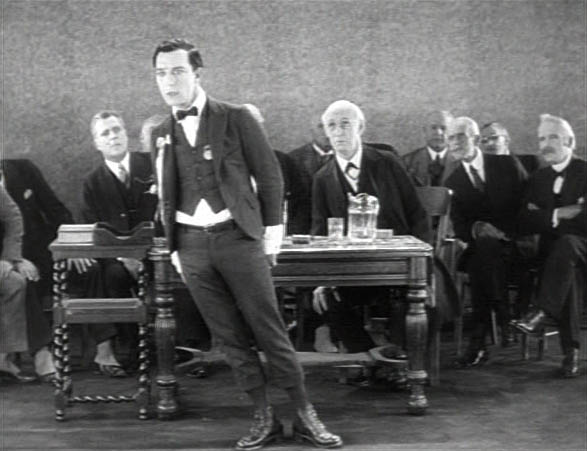
Or something along those lines. At the end, the jock is threatening to ruin her just by staying in her dorm room and not leaving. If it’s known that she was alone with him for more than a few minutes, her virginity will be in question, and she’ll have to leave college in shame. Fortunately, Buster pole-vaults through the window and pelts him with college memorabilia. A weird little movie, pretty funny but didn’t kill.
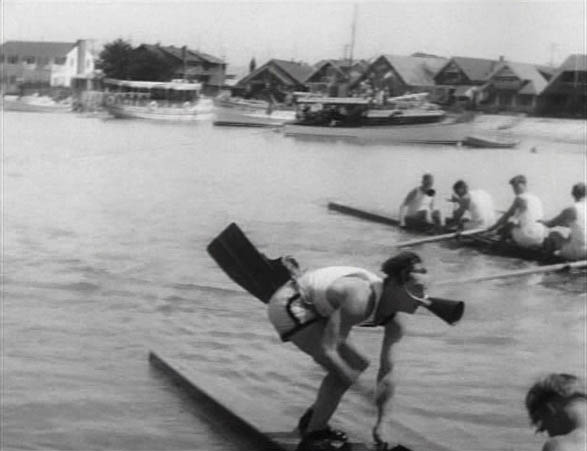
Also watched The Electric House (1922), a short from back when suicide was funny:
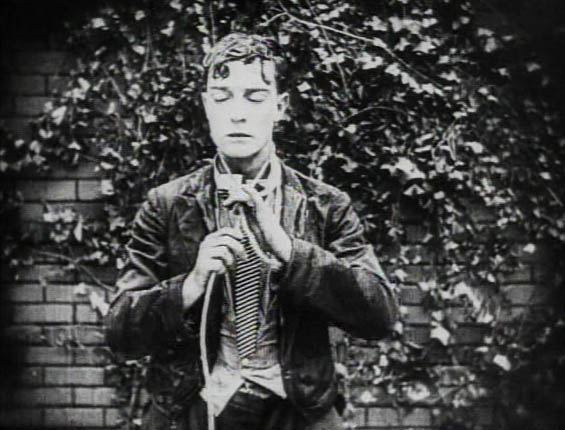
Man has accident. Needs new face.

Fortunately he’s friends with a brilliant tissue-replacement surgeon who wants to test his theories that facially-scarred people can reintegrate into society if their faces could appear normal again.

They find someone with a good face to copy (note: it’s the miner from Pitfall)

The doctor works hard in his all-glass laboratory.

The procedure is a success!

But the doctor’s psychological theories were wrong – the burnt man uses his new face to create a sociopath alternate personality, kind of like Hollow Man but not at all like Darkman.

Meanwhile, a young woman with a similarly deformed face has an unhealthy relationship with her brother.

Completely beautiful movie, obviously.

If Pitfall was a weird movie, this one just dives off a steep cliff of weirdness.

And it doesn’t end well. For anyone.

Technology of choice for this movie is electric light (was the telephone in Life On Earth and microphone/loudspeaker in Bamako). Of course there are radios prominent in all three.

BBC website:
Waiting for Happiness is a film about exile and displacement, based to some extent on Sissako’s own life experiences. Yet what makes it so remarkable is the way in which the director translates the psychological aspect of these issues to screen.
Having left Mauritania to study film in Russia, Waiting For Happiness seems to be Sissako’s therapy for his own time spent in exile. He describes his work as “…a portrait of people in departure, who have to a certain extent already left, without having actually yet moved.”

Another portrait of a town, like Life On Earth, but poetically far beyond that one. An east asian man sings English karaoke songs and wanders on the beach… a man (Abdallah) returned from another country wears different clothes from everyone else, doesn’t speak the language and tries not-too-hard to fit in… a boy tries to learn an elder electrician’s trade while a girl about his age is learning to be a singer… and on the beach, a man drowns and his death is investigated.
Visually, lot of people looking through windows, some looking through cameras. Static shots of static people who pause before moving offscreen, or sometimes leave the scene silently during a cutaway. The pace never lags and there’s always something interesting going on, even when the characters themselves aren’t too interested.
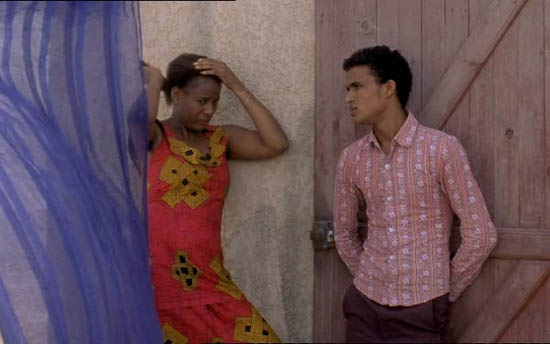
New Yorker Films: “Set in Mauritania, in northwest Africa, Waiting for Happiness is Mr. Sissako’s nod to a small hamlet’s ability – no, its need – to greet encroaching advancement with a shrug; eventually, the little place will be overtaken by the currents of modernity anyway.”
If this one didn’t cement A. Sissako as one of the best current African filmmakers, I’m sure Bamako did/will. New Yorker suggests that “Mr. Sissako is also using the movie as a way of dealing with the possibility that he’s being hailed as Africa’s next big thing. It’s a momentous responsibility to shoulder, and like Abdallah, the director is still in the process of establishing who he is.” If that’s true then maybe Bamako was Sissako’s way of accepting that responsibility, and using his status to create something of political importance, since he knew he had everyone’s attention.

This is the second African film this week for which I’ve read reviews comparing it to Claire Denis’s Beau Travail. Slant Magazine says the movie shows the people of this city struggling against foreign cultural invasion. “The old man walks into the desert with a light bulb in his hand. He dies and the bulb gradually lights up: a devastating transference of power between a spirit and the outside culture that sucks on its marrow.”
The same cinematographer shot the other two Sissako movies I’ve seen, along with Little Girl Who Sold The Sun, and a somewhat acclaimed 2004 movie from Angola. All actors were non-professional except for the Asian guy.

IMDB says it won two awards at Cannes, grossed almost two thousand dollars theatrically in the U.S., and they recommend the similar films Exils (Tony Gatlif), The Intruder (Claire Denis) and Lethal Weapon 2 (Richard Donner).
Sissako also made a 1998 documentary in Angola (it played the New York African Film Fest this year), a 30-min short for television, and a “medium-length feature” called October in 1993 when he lived in Russia, which is available on the British DVD of Waiting for Happiness. There’s one film that predates October called Le Jeu, a short about kids playing at war that hardly anyone online has mentioned (thanks Village Voice).

Sissako: “Aime Césaire has been a support for me most of my life. He is the author that I read and reread. But another very important author to me was Frantz Fanon. The introduction of Black Skin, White Masks is very close to this new film [Life On Earth].”
The photography & video quality on this are so excellent, the story could’ve been about nothing and I still would’ve enjoyed it. But the story is neat too.

A worker has deserted from the army, and runs off with his son in search of work. He’s lured to a mining town and then killed by a mysterious white-suited man. End of movie.

But no! First of all, he sticks around as a ghost… second, the same actor plays a lookalike union leader at one of the two mining communities. Nobody figures out who the white-suited man is, or what he’s up to, but he later kills a women shopkeeper also, the last person to see the first man alive. The union bosses flail around and finally kill each other, the dead wander among the ghost community of the town, and the murdered man’s son hides, observes, and lives off stolen candy from the shop as the movie gets quickly darker and stranger. Apparently it’s all a satire about corruption.

An excellent first feature. Teshigahara had his visual style down, wasn’t injecting as much surreal weirdness into the image as he later would. Reviews mention Antonioni and Resnais as visual influences, and Kafka, Beckett and Carroll as story influences. This came out right after Jigoku, Viridiana, Last Year at Marienbad, The Testament of Orpheus, Eyes Without a Face and L’Avventura, and fits right in with that early 60’s European art film scene.
Eureka says “Teshigahara coined the term ‘documentary fantasy’ for this study of the powerless, impoverished worker in postwar Japan.”

Film #4 of African Movie Month (I won’t count West of Zanzibar).
Not as complete and fulfilling a story as the excellent Dry Season, but nicely shot and interesting throughout.
IMDB reviewer: “When Tahir and Amine wake up one morning they find their father has already left the house. When he fails to return for their football match they begin to think something is up and their mother is no help, refusing to help find him and hoping to just move past this useless man. However when the two sons start to look for their father they find that he has not been to his job in over two years and they believe that they have seen him in a film shown at a local cinema. When they get in trouble for stealing the film, their mother sends them away to a Koran school where the boys quickly realise that things will not be as good as they have been told.”
Younger one dies of asthma at the end with his inhaler stolen, older one runs off with the mute girl he’s fallen for.
Movie posters are seen for Yaaba, Chaplin’s The Kid, and Stranger Than Paradise (the latter obviously placed to acknowledge Jim Jarmusch’s influence on Haroun, not because it’s likely to be playing Chad theaters in 2002).
“The Law”
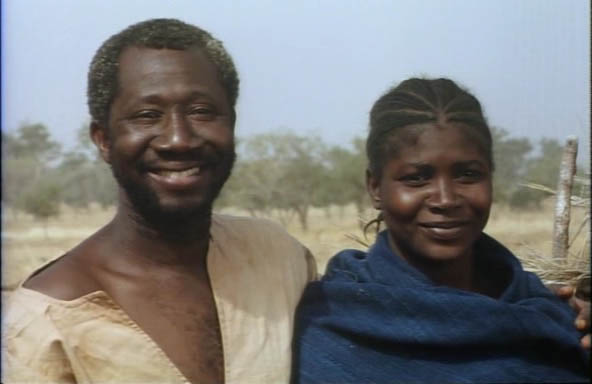
Ouedraogo, from Burkina Faso, was a student of Gaston Kabore, director of last week’s Wend Kuuni, and also worked with Ousmane Sembene.
Saga (actor also in Moolaade, Yaaba, Night of Truth) has been away for a couple years, and returns to find that the woman he was promised as a wife is now married to his father. She and Saga are in love and resume their affair, with disastrous results. Saga’s brother is sent to kill him, but allows him to escape, and the illicit lovers go off to Saga’s aunt’s house… but he comes back for his mom’s funeral, exposing himself to the townspeople. The father banishes the brother, who then shoots Saga, oh and the girl’s dad hangs himself for having a part in all this.
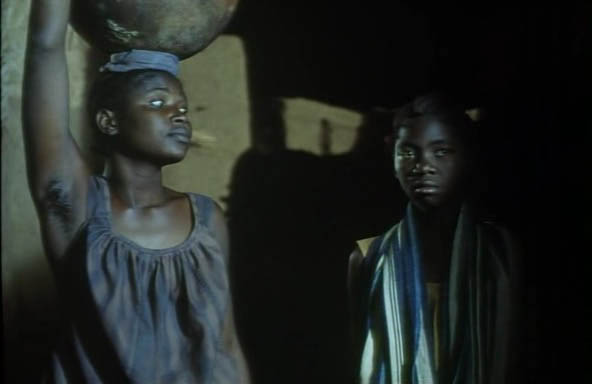
Fine story (a darker Ten Canoes?), fine acting, plays at a good pace, not at all as bleak and awful as it sounds from my plot description. Won the Cannes Grand Jury Prize (a step up from the prize Yeelen won three years before), second place to Lynch’s Wild At Heart and beating out Godard, Zhang Yimou and Ken Loach.

Little music. A vocalist sings “Tilai… Tilai” a couple times and that’s it. Long shots, but not distractingly long.
“Claire Denis, the director of the autobiographical film Chocolat, set in colonial West Africa, notes that in Tilai every sentence starts with the name of the person who is addressed, in contrast to what she calls the vacuousness of communication among white colonials.”
