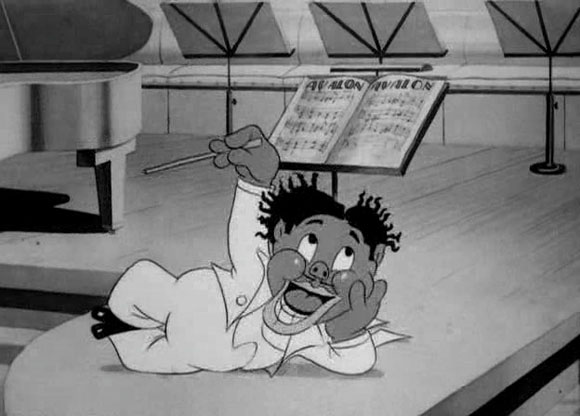
Porky’s Romance (1937)
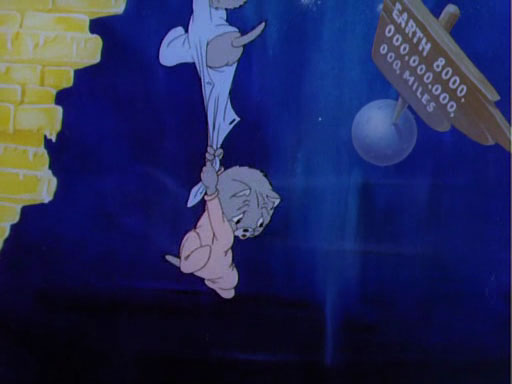
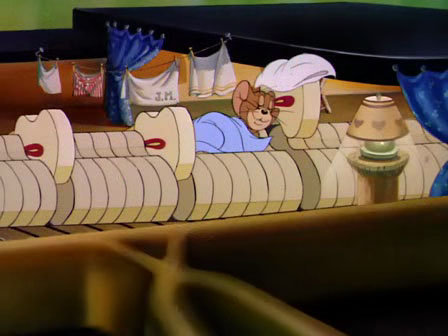
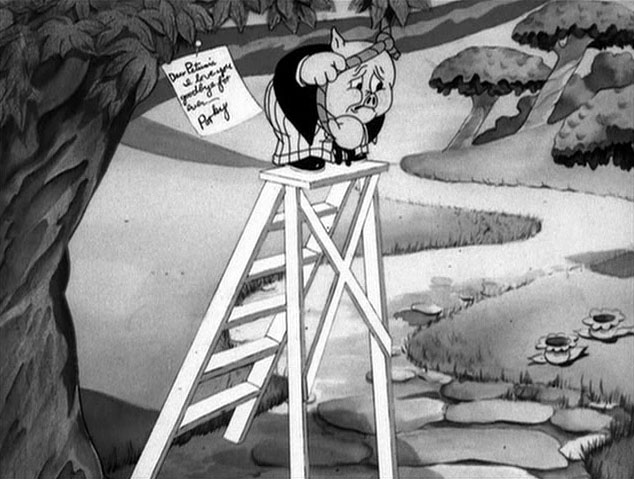
Porky has barely been introduced and he’s already attempting suicide. First Petunia Pig short – she’s stuck-up and candy-obsessed, with a fancy dog – rejects our man, changes her mind, then in a dream daze he predicts a miserable life with fat, lazy Petunia and flees. Some character introduction… no wonder Petunia didn’t take off. Song “I Wanna Woo” is featured. Don’t know much about 30’s music (despite once replaying the Singing Detective soundtrack for a whole month) but I suppose the Looney Tunes series would showcase popular songs onscreen, the Grey’s Anatomy of its time.
image

Porky’s Double Trouble (1937)
An escaped con looks just like Porky, kidnaps him and replaces him as bank teller for easy money. Two surprises: meek Porky kicks some criminal ass in the finale, and Petunia drops Porky to lust after the killer even as he’s being arrested.
image

The Case of the Stuttering Pig (1937)
The local lawyer takes Jekyll-and-Hyde Juice, calls the audience a bunch of softies and creampuffs, goes after Porky and Petunia’s family to steal their inheritance, defeated by having a chair thrown at him by a guy in the audience.
image

The Woods Are Full of Cuckoos (1937)
Hooray, more owls. Also, the word “esophogi.” The rest isn’t so amusing, all caricatures of 30’s personalities who I mostly don’t recognize.
image

Have You Got Any Castles? (1938)
Opens with a cuckoo – nice continuity. Another collection of caricatures, but this time it’s book titles and characters, something with which I’m more familiar. More excitedly animated and sung than Cuckoos as well. Named after the Johnny Mercer tune.
image

Porky’s Road Race (1937)
More celebrity caricatures, including a parody of the scene where Chaplin goes nuts with his wrenches in Modern Times. Hard to imagine, but that was a current film at the time. The plot is minimal, but among all the film references Porky manages to beat Borax Karloff in a car race. Future head writer Tedd Pierce voices W.C. Fields and Mel Blanc makes his debut.
image

Speaking of the Weather (1937)
Another musical caricature piece, this time with magazines come to life instead of books – even the exact same Thin Man gag. This one has more of a story – a criminal sentenced to Life (heh) escapes and a team of mag covers helps bring him in. Castles has guns firing from All Quiet on the Western Front and Weather has scout troops from Boy’s Life – same idea. Each seems to have been named after a song featured for only half a minute and having nothing to do with the rest of the picture. At least The Woods are Full of Cuckoos is set in the woods. Maybe it’s some contractual co-branding with the music companies, if they had such a thing in the 30’s.
image

Porky at the Crocadero (1938)
P.P., with a music degree from the Sucker Correspondence School becomes band leader at a jazz club, probably imitating other bandleaders of the time but the only one I recognize is Cab Calloway.
image

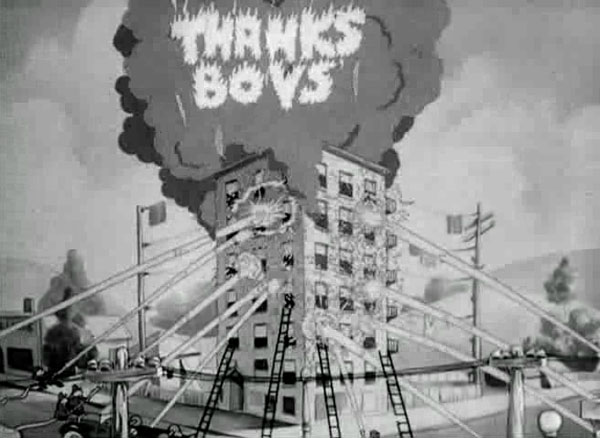
Porky the Fireman (1938)
Ooh, an animated (and multiplied) Keaton gag, circus tricks, smoke and ash turning frantic white people into lackadaisical black people, murder and mayhem. In the end, the fire wins.
image

Wholly Smoke (1938)
I can’t tell what nationality Porky’s mother is supposed to be: “nix on the mud-playing-in.” An anti-smoking ad with Porky as a stooge conned into trying a cigar by a tough kid. Cameos by the Three Stooges and I think Bing Crosby.
image

Porky Pig’s Feat (1943)
Porky and Daffy are broke, try unsuccessfully to escape from an absurdly high hotel bill. References to Dick Tracy and to other Looney Tunes, including a Bugs punchline at the end. Joe Dante commentary: “By the time he passed away, his career had falled on hard times with bad vehicles for actors of waning popularity.”
image

Swooner Crooner (1944)
Porky’s wartime egg factory is endandered when the hens’ attention is captured by a crooning rooster, leading to a Crosby/Sinatra showdown. Is it naughty that the crooners’ voices make the girls all lay eggs? Also the third Al Jolson caricature I’ve seen today. Oscar-nominated, beaten by a Tom & Jerry.
image

Hare Remover (1946)
I take it Tashlin didn’t do many Bugs cartoons. Elmer (looking a little primitive) is a wannabe mad scientist who recruits Bugs to test a formula which doesn’t seem to do more than taste awful (and explode when thrown).
image

Also watched a short doc on Tashlin’s career. Sounds like his comic strip Van Boring was the Dilbert of its time. Would’ve been great if they had clips from the live-action films instead of just a few stills.

Allegretto (1943, Oskar Fischinger)
All colored diamonds and circles, so lovely. In close sync with the music, where in Motion Painting #1 the music seems an afterthought.

image

Motion Painting No. 1 (1947, Oskar Fischinger)
Like it says, a motion painting – oil on glass, all small rectangles and big spirals. In The Mystery of Picasso the tension was in figuring how the painting would be finished, where he was heading, but in this the fun is in getting from one intermediate step to another. The process is the destination. There should be more of these!
image

Franz Kafka (1992, Piotr Dumala)
Is the movie supposed to be making that sound of a cat in heat beneath the music, or is my laptop freaking out? Dark and scratchy and slow-moving, nothing actually happening. Oh wait, there’s some sex. Fulfills almost all of the Robyn Hitchcock holy keywords: sex, food and insects (what, no death?). I’m sure it’s very technically accomplished but I found it dreary and ponderous. The filmmaker made a plaster-scratch version of Crime and Punishment eight years later (or more likely he worked on it for all eight years).
image

Tales from the Far Side (1994, Marv Newland)
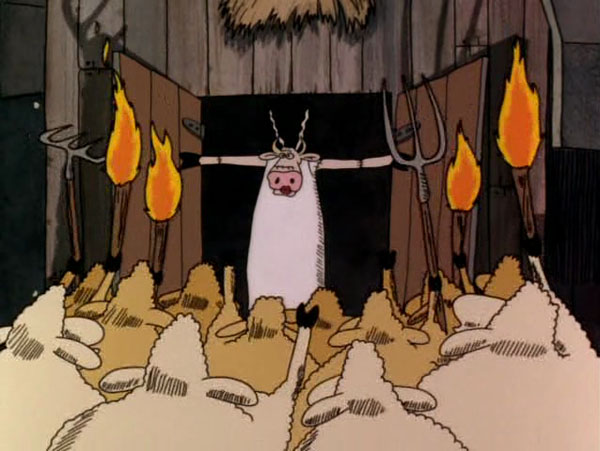
Very inessential, slow-paced animated half-hour of Far Side cartoons. Really the most interesting bit is seeing Marv Newland’s name, 25 years after his seminal Bambi Meets Godzilla. Either he’s no longer a master of timing, or there was too much Gary Larson interference… or maybe you just can’t turn a single-panel comic strip into a 30-minute TV special. Doonesbury worked out, but that was talky and story-driven to begin with.
image

Mr. Prokouk Shoots a Movie (1948, Karel Zeman)
Czech short, part of a whole series of Mr. Prokouk adventures.
image

Prokouk is pointing at us, telling us to get off our asses and join the workforce!
image

The Monkey’s Teeth (1960, Rene Laloux)
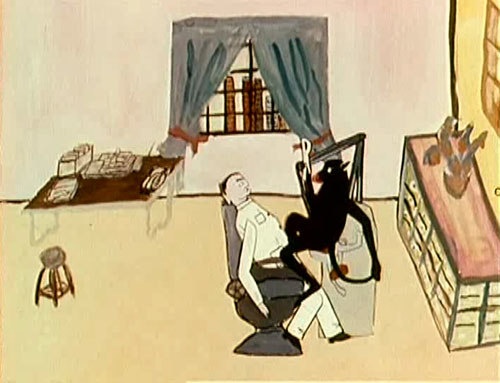
Intro is a three-minute doc of a group-therapy institution for depressed people, what follows is an animation of the film they wrote together. Sad man has a toothache, goes to a dentist who steals his teeth to sell to rich people (I wouldn’t think the teeth of the poor would be worth much, but maybe in France everyone practices excellent dental care). When the monkey wizard bicycles by, I figured the dentist would be put in his place and the stolen teeth returned, and that’s just what happens but first the sad man gets chased into a high school by some cops who get turned into children. Hmmm.
image

Dimensions of Dialogue (1982, Jan Svankmajer)
It’s been too long since I’ve watched my Svankmajer shorts. This is an all-time fave. Faces made of identifiable objects consume each other, becoming smoother until they resemble human heads. Two clay humans make love, create an unwanted clay baby then destroy each other. And so on. Not one for brevity, J.S. takes everything to its conclusion and explores all permutations of his object manipulations – this is what makes his features seem so tedious, but his shorts seem so excellently complicated.
image

Flora (1989, Jan Svankmajer)
A clay person tied to a bed and covered in rotting fruit and veg tries to reach a glass of water. Only a few seconds long, made for MTV (that’s czech for WTF).

Food (1992, Jan Svankmajer)
Oooh I love stop-motion using live actors. Guy enters a room facing a paralysed robot guy, reads instructions hanging on his neck (which are actually an MTV entry form: “Entrant must send a VHS or U-Matic, etc.”), manipulates the guy (puts money in his mouth, receives a sausage and mustard from chest, utensils from ears), then the robot guy leaves and the eater takes his place. Two guys sit at a restaurant, can’t get service so they eat their own clothes and the table. Finally, people are made gourmet meals of their own severed body parts. A classic, obviously.
image

I Love To Singa (1936, Tex Avery)
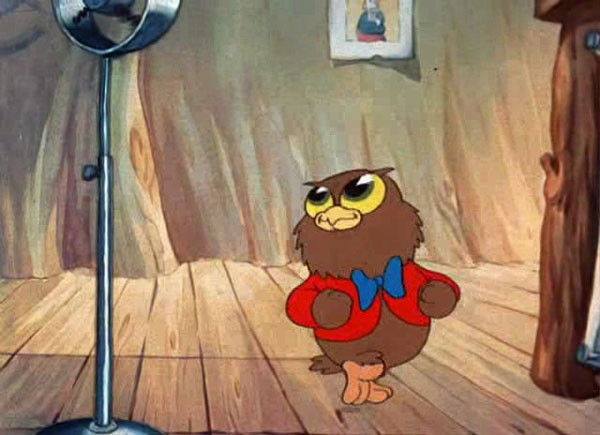
“Enough is too much!” An old favorite. Owl Jolson is of course a parody of The Jazz Singer, which I’ve still never seen. Jazz and owls: a combination you don’t see often enough.
image

Point Rationing of Foods (1943, Chuck Jones)
An extra tucked away on a Looney Tunes DVD, explaining the wartime canned food rationing system to the public through cheap quickie animation. Helpful to me, since I never bothered to learn how rationing worked before. Also tucked away is the Tashlin-penned The Bear That Wasn’t, probably not because of its unworthiness but because it was made at a different studio.

I Haven’t Got a Hat (1935, Friz Freling)
A variety show of children performers, with hijinks. Porky’s first appearance – the studio intended for a more generic troublemaker character (below, right) to take over, but the public demanded a shy stutterer instead. The title song is catchy, anyway.
image

Roof Sex (2003, PES)
Stop-motion of chairs having sex. The cat is blamed.
image

Methuselah (1927, Jean Painlevé)
The title character is a dog-masked shoe-obsessed megalomaniac. Painlevé himself plays Hamlet, and surrealist poet Antonin Artaud found time to appear in this between Abel Gance’s Napoleon and The Passion of Joan of Arc. Doesn’t really make sense on its own – five filmed episodes that were projected during a stage play, strung together here with a stereotypical silent-film piano score.

The Vampire (1945, Jean Painlevé)
Portrait of the South American vampire bat set to happy jazz. They put a bat and a guinea pig in a cage and let the one eat the other. Don’t think I’ll be showing this one to Katy.

Bluebeard (1938, Jean Painlevé)
An opera version of Bluebeard, comically told with awesome and elaborate claymation.

The High Sign (1921, Keaton & Cline)
Buster steals a cop’s gun, runs a shooting gallery, becomes a rich guy’s bodyguard and becomes the same guy’s hired killer. Gags involving ropes and dogs and a house full of traps – one of BK’s funniest and most complicated shorts. So many film scraches I thought it was supposed to be raining. Features Al St. John (the clown who would one day be known as Fuzzy Q. Jones in a hundred westerns) and the gigantic Joe Roberts.
image

One Week (1920, Keaton & Cline)
Opens with the same calendar we just saw in The High Sign and Buster getting married… nice transition from the last movie except that it’s a different girl. The one in which he builds a house. More acrobatic stunts than the previous movie – the two make a good pairing. Ooh, a meta camera gag and some near-nudity. I think more work went into this than all of Go West.
image

A Wild Roomer (1927, Charley Bowers)
Charley (who not-so-subtly calls himself an “unknown genius” in the intertitles) makes a God Machine which creates self-aware puppets.
image

Actually I’m not sure what that was about, besides being an extended stop-motion demonstration – the machine is supposed to take care of all your household chores. As with both of the other Bowers films I’ve watched recently, he has unquestionably made an excellent machine, so the conflict comes from the complications from having to show it off to others (in this case a cranky saboteur uncle with an inheritance at stake).
image

Zooming in further one finds… a baby exterminator??
image

Fatal Footsteps (1926, Charley Bowers)
“If there were a tax on idiots, Tom would send his dad to the poorhouse.” Well that makes up for the “unknown genius” line. Charley is trying to learn the Charleston to win a contest in the very house where the Anti-Dancing League (motto: “mind thy neighbor’s business”) is meeting. Just when I thought it was gonna be that simple, he invents some mechanical dancing shoes – stop-motion ensues. The shoes get mistakenly worn by Charley’s relative who offends his fellow Leaguers, then Charley wins (and escapes) the contest.
image

Even fish are learning the Charleston:
image

Haunted Spooks (1920, Hal Roach/Alfred Goulding)
The girl is first introduced kissing baby birds, so she’s got my sympathy.
image

Her grandfather dies – she gets the house and inheritance if she lives in it for a year with her husband – but she has no husband! I thought I’d be in for 25 minutes of haunted-house hijinks, but the husband problem has to be solved first (Harold Lloyd is rejected by his rich dream girl, picked up by our girl’s lawyer while attempting to commit suicide) so we don’t get to the house until minute 17. After introducing some superstitious-negro stereotypes, the girl’s crooked uncle proceeds to “haunt” the house to drive her away and steal the inheritance.
image

image

Cute movie, but what I liked best were the illustrated intertitles.
image

Chess Fever (1925, Vsevolod Pudovkin)
Fever has gripped the whole town. Chess breaks up a relationship, drives two people to attempted suicide, then happily reunites them. I guess from important-sounding Pudovkin, with his grim-looking video covers, I wasn’t expecting a comedy, but this was light (despite all the suicide) and wonderful. Wikipedia says it includes documentary footage of the 1925 Moscow chess tournament.
image

Charleston (1927, Jean Renoir)
A scientist from central Africa (a white guy in blackface and a tuxedo) flies in his aircraft (a marble on a string) to post-apocalyptic Paris, runs into a sexy Euro-girl and her pet monkey. The girl (Catherine Hessling, Renoir’s wife) teaches him the Charleston, filmed in cool slow-motion. Maybe this wasn’t as surreal in ’27 as it is today. The first (credited on IMDB anyway) film produced by Pierre Braunberger, who would go from Renoir to Resnais/Rivete/Rouch to Truffaut/Godard to Shuji Terayama.
image

The Little Match Girl (1928, Jean Renoir)
New year’s eve, a poor girl (Catherine Hessling again) can’t sell any matches, starves/freezes to death on the street after hallucinating a better life. The first Renoir film I’ve seen with stop-motion (there’s only a tiny bit) but not the first to focus on clockwork machines. Also reverse and slow-motion and a horse race through the clouds – much more ambitious than Charleston. In her fantasy she plays at the toy store, shrunk to toy size herself, and meets a handsome soldier who looks suspiciously like the handsome cop who was nice to her in the snowy street. It’s all fun and games until Death comes and wrestles her from the soldier. Both these shorts were shot by Jean Bachelet, who would be cinematographer on three separate films of The Sad Sack including Renoir’s.
image

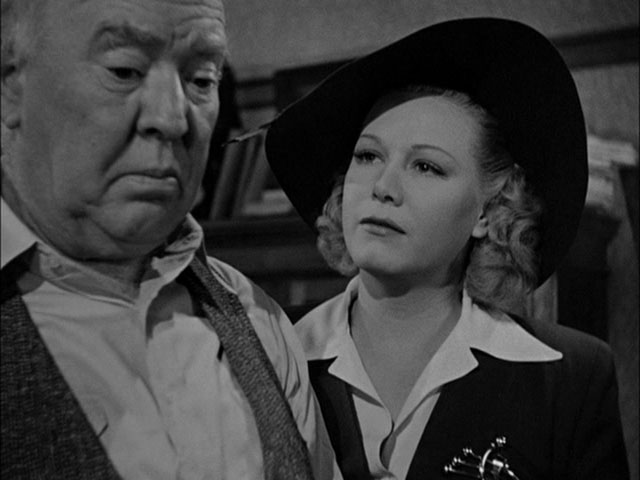
Seems safe to call this a screwball comedy. Cary Grant, a famous painter of Americana whose work we never see, gives a lecture before lovestruck Shirley Temple’s class a couple hours after being dismissed by Temple’s judge sister Myrna Loy for taking part in a bar brawl. An older-sister-younger-sister-Cary love triangle follows, complicated by serious man Rudy Vallee (guy with the constantly-broken specs in Palm Beach Story) who likes Myrna. Anyone who’s seen a romantic comedy before knows that two serious people should not end up together, so Myrna eventually warms up to the reputedly wild (we never see him misbehave much) Grant.

Cary, Shirley’s own-age love-interest Johnny Sands, and Rudy:
image

Shirley is too good for the bellboy:
image

Won a well-deserved oscar for writing, beating out Monsieur Verdoux and Shoeshine. Super enjoyable overall, and Shirley Temple is excellent. Can’t think of any other 18-year-old who would’ve equalled her performance. That’s the upside of being a child star. The downside is that the following year at 19, with a kid and an abusive husband (MST3K target John Agar), her film career was over.

Myrna Loy is not amused:
image

Also good: the girls’ uncle (Orson Welles regular Ray Collins) as a meddling, unethical psychologist, and grumpy oldster Harry Davenport (Meet Me In St. Louis, You Can’t Take It With You). Written by Sidney Sheldon (Anything Goes, Pardners, Annie Get Your Gun) and energetically directed by Reis, who’d be dead from cancer six years later.

How everyone in the 40’s saw Cary Grant:
image

Another great set of Clay’s 16mm cartoons, and it’s been too long since the last one.

Mysterious Mose (1930, Dave Fleischer) is a proto-Betty Boop (she looks like a dog; a sexy dog) cartoon in which she is haunted by a sorta ghost casanova. The Great Piggy Bank Robbery (1946, Robert Clampett) is a weirdly violent Daffy Duck gangster parody. Since his “Duck Twacy” fantasy is spurred by a knock on the head while reading comic books, it’d be a good short to play before Artists & Models. It’s Tough to Be a Bird (1969, Ward Kimball) is a Disney doc about birds and watchers with musical cartoon segments. And We Have Met the Enemy, and He Is Us (1973, Walt Kelly) is an unfinished Pogo cartoon with a harsh environmental message. I think all the voices were done by one guy.

Bunch of TV stuff. Spiderman fights a bank robber in a mole-man costume. There’s a Casper cartoon (in which Casper does not appear) about a watch repairman who gets attacked by an eagle at the end. Ralph Bakshi contributes an episode of Captain America. A horrible show called Hoppity Hooper (set in Wisconsin) with a Rocky-and-Bullwinkle-repetitive bit about “the traffic zone” was the low point. The high point was the hilarious 60’s-70’s commercials for Mr. Wizard, Hot Wheels, Cheerios and the like. Real fun program… too bad the next one is scheduled for the same night Art Brut is playing.

image

Pol Pot’s Birthday (2004, Talmage Cooley)
In 1985, the scrappy dictator’s men throw him a super-weak budget surprise birthday party, with grey cake and music on an old tape player. Awkward conversation ensues… P-P gets peed on by a dog and “Walking On Sunshine” plays over the credits. Kim Rew got paid?
image

Meet King Joe (1949, John Sutherland)
More generic propaganda with no direct sense of purpose. Joe is “the king of the workers of the world” because here in America, competition and investment in infrastructure make our jobs easier with more disposable income than anywhere else. Take that, dirt-poor chinaman! Statistics to be proud of: “Americans own practically all the refrigerators in existence. Bathtubs? We’ve got 92% of them.”
image

Hymn to Merde (2009, Leos Carax)
I agree that Merde/Lavant is wonderful to watch, but Carax doesn’t seem to know what to do with him. Protracted death-sentence courtroom drama wasn’t it, nor is a lo-res music video of him singing a Kills song translated into his own head-slapping language.
image

.tibbaR (2004, Leo Wentink)
Eerie music and nervous sound effects accompany time-remapped footage of lab rabbit breeding. I never know why anything is happening in short films anymore.
image

Go! Go! Go! (1964, Marie Menken)
So damn jittery it gave me an eye-ache, exactly what I was getting away from the computer in order to avoid. All nervous time-lapse footage shot around the city. Some real nice high-angle shots of construction sites and traffic patterns, superimpositions on a wedding, lots of boats and bridges. Color/picture looked perfect on my tube TV.
image

The Spook Speaks (1940, Jules White)
Not-at-all-good short full of corny sound effects and sub-stooges gags, but it’s better than the others I’ve watched on these DVDs since it has a roller-skating penguin. Buster’s costar Elsie Ames (she was in most of these shorts, then showed up 30 years later in Minnie & Moskowitz for some reason) is terrible, but then, Buster is terrible too. Thanks Sony for slapping warnings and disclaimers and legal shit before every short on the disc. They must’ve known it wouldn’t get tiresome because we’d only watch one before quitting.
image

Who Am I? (1989, Faith Hubley)
Things morph into other things, illustrating the five (or six or seven) senses. Short!
image

Blake Ball (1988, Emily Hubley)
Didn’t love the narration in this one. The woman who says “some are born to sweet delight/some are born to endless night” (without the preceding lines) has got nothing on Nobody. I guess all the lines are the words of William Blake, but they’re not making much of an impact, and I never figured out Blake’s connection to all the baseball stuff. There’s more five senses stuff anyway. A bit too laboriously new-agey, but some great moments (like below).
image

O Dreamland (1953, Lindsay Anderson)
Boy did I ever botch the Free Cinema box set, buying it then deciding I didn’t want to watch it after all and letting it sit on the shelf for years. Finally checked this out and I kinda really like it. Could do without the evil laughing clown all over the soundtrack. Kind of like Jean Vigo’s À propos de Nice which, given If….‘s resonance with Zero For Conduct, proves Anderson saw a Vigo retrospective at some point.

I pick these movies up one at a time on cable and elsewhere so I don’t have access to the Val Lewton box set bonus material which would explain why it’s his name I always hear associated with this and Cat People instead of Robson and Tourneur. This one is more eventful than Cat People, has quite a large cast and a packed, twisty plot for a seventy minute film.

Mary (Kim Hunter of A Matter of Life and Death in her first film role) is told by her school that her sister Jacqueline quit paying her bills six months ago so she’ll have to go home. Mary heads for scary, shadowy Manhattan to locate her sister and gets caught up in all kinds of intrigue. Turns out the sister joined a satanic cult (the most gentle, mild satanic cult I’ve ever seen in a movie) and mentioned it to her psychologist Dr. Judd. Well, the first rule of the satanic cult is you do not talk about the satanic cult, so the members have been hiding her away trying to get her to kill herself. Sorta. She found time to get married (to a dude named Greg Ward) and she continues to see Dr. Judd at least once a week, and she’s spotted around town, so the seclusion thing doesn’t seem to be happening – plus the cult sends a man with a knife after her towards the end, kinda defeating the get-her-to-kill-herself angle.

Mary falls sorta in love with her sister’s husband, and a poet who hangs out at the Italian restaurant under her apartment (called Dante) falls sorta in love with her, and I can’t tell whose side the doctor is on, exactly. A craggy-faced private investigator with no known motive tries to help Mary but gets killed by Jaq by accident. Jaq shows up then disappears then is easily located again. The cult members ask very politely and straightforwardly for her to drink poison, but she just won’t. Finally Dr. Judd and either the husband or the poet (it’s not important) tell off the cult by invoking the lord’s prayer (good luck with that) and Jaq has an intriguing chat with a sick, dying neighbor then goes and hangs herself.

Kim Hunter with private eye Mr. August (Lou Lubin, was a bartender in Scarlet Street)
image

(L-R): Jason the poet (Erford Gage of Curse of the Cat People), Dr. Judd (Tom Conway of Cat People, 12 to the Moon, The She Creature, Bride of the Gorilla) and secret husband Greg Ward (Hugh Beaumont of The Human Duplicators and The Mole People, also the Beaver’s dad on TV)
image

More weirdness: The woman who bought Jaq’s cosmetics company, Mrs. Reddy, uses a satanic symbol as her brand trademark (not too subtle for a secret society). The society has presumably coerced six others to kill themselves before (hence the title). And they go on about something that sounds like “the pilates movement.”

The Satanic Cult, led by a guy whose name I didn’t catch
image

Jacqueline (Jean Brooks of The Leopard Man and some 40’s serials) stares down a glass of poison
image

Poyraz (2006, Belma Bas)
Rural people sure live quaint and handsomely photographed lives!
Nuri Bilge Ceylan was thanked in the credits

Why Play Leapfrog (1949, John Sutherland/MGM)
Let’s hear it for capitalism! Clever cartoon describes why inflation is okay and raw material costs don’t mean much. A boring explanation of why America is so darned great that ends by telling factory workers to be more efficient and come up with smart cost-saving ideas which will lead to greater pay increases.

Balance (1989, Christoph & Wolfgang Lauenstein)
Ominous stop-motion – five mute guys with numbers on their shirts and telescoping fishing poles in their shirts are on a balanced platform suspended in space. One catches a sort of music box and the others get greedy, leading to a fight which ends with one guy on the far end of the platform from the box.

Broken Down Film (1985, Osamu Tezuka)
It’s a popeye-like cowboy cartoon except that the film’s projection problems (hair in the gate, scratches, countdown leader, etc) are part of the story. Cute.

and a few from the Unseen Cinema box set…

Paris Exposition Films (1900, James White)
Some one-minute films at the Eiffel Tower a decade after its construction. Best part is this guy on the left side of the screenshot. People were walking up to the camera and this guy saw his chance for stardom, so he prepares himself for some manuever (maybe a backflip) but blows it, stopping instead to shake hands with an acquaintance offscreen as the film runs out.
image

Captain Nissen Going Through Whirlpool Rapids, Niagara Falls (1901, Edison Co.)
It takes longer to type the title than to watch the film, which is of some submarine-looking craft bobbing in a river. Found a wonderful tale online of Nissen’s stupid death four years later, but unsure if it’s true.
image

Down The Hudson (1903, Frederick Armitage & AE Weed)
Much more interesting than the submarine thing – New York riverfront over a hundred years ago. I assume lots more of this stuff will be on disc five.
image

The Ghost Train (1903)
Oooh, someone learned to invert the black/white image AND to matte a moon into the upper corner. This is one of my favorites because it is neat-looking and twenty seconds long. If only you could say the same for Transformers 2.
image

Westinghouse Works, Panorama View, Street Car Motor Room (1904, Billy Bitzer)
Long factory tracking shot reminds me of the beginning of Manufactured Landscapes. Unlike in ML, all the workers stop and look at the camera.
image

In Youth, Beside the Lonely Sea (1925-ish)
Crazy three-panel layout illustrating the poem told with text above and below the picture. Lots of ghostly superimpositions. This was so damn cool I had to lay down for a while.
image

image

Rex “Henry Higgins” Harrison is a famed conductor. His brother-in-law (radio star and megaphone crooner Rudy Vallee, naive rich dude in The Palm Beach Story) hires a private detective to spy on Harrison’s wife (Linda Darnell, recently starred in My Darling Clementine), so Rex, against his own hatred of spying and his belief in trust, accidentally finds out that his wife may be cheating on him. While conducting that night’s three symphony movements, he has three fantasies in which he murders his wife (aided by a sound recorder gismo) and frames her illicit lover (Rex’s secretary) Tony, then he forgives her and writes her a giant check while making her feel small and unworthy, then he confronts the couple and kills himself in russian roulette. After the symphony Rex rushes home and bungles about in a painfully protracted slapstick sequence – he can’t make the recording gismo work, can’t find bullets for his gun, and spills ink all over his checkbook. Finally she casually explains away the circumstances that led detectives to suspect her of cheating, and we have our happy ending.

Recommended listening: Mad at a Girl by Robbie Fulks.

image

In the shot below, on right is secretary Kurt Kreuger (this must’ve been a relieving change of pace for him, after playing nazi flunkies all during the war), middle is brother-in-law Rudy Vallee, and left is Lionel Stander (Katy was appalled at his accent).

image

Caught some Sullivan’s Travels actors: valet Robert Grieg (here a butler, doing a different voice I think) and bus driver Frank Moran (here a fireman). There were more whom I didn’t recognize, but the standout scene was with a relative Sturges newcomer Edgar Kennedy (former Keystone Kop who starred in his own long-running shorts series) as the private detective who spied on the wife, confronted in his office by Rex. It’s one of my favorite scenes in any Sturges movie – beautifully written and acted, sharp dialogue becoming softer as the men bond over their love of music and hard truths they wish they hadn’t learned. William Demarest was around in ’48, acting in four films and voicing a cartoon character for Walter Lantz, so I don’t know why he couldn’t make it onto Sturges’s set.

Don’t think I ever realized that Sturges’s cinematographer is Victor Milner, who worked with Lubitsch in the 30’s and shot Trouble In Paradise. Both Paradise and this one have far more interesting camera work than your average comedy. This one is notable for the looooong zooms into Rex’s eye before each of the fantasy sequences.

Full of wordy dialogue like “August, what happy updraft wafts you hither?” and “You handle Handel like nobody handles Handel,” which enriches the movie to no end, but makes it wearying over its almost two hour runtime (and that’s after having a half hour cut by the producer).

Linda Darnell, unaware that Rex is behind her with a razor in his hand:
image

Nice DVD extras – Terry Jones says it’s a satire of the masculine self-image and Sandy Sturges tells of a romantic scandal involving a girl killing herself over Rex Harrison which made this movie impossible to promote. Commentary points out that this came out the year after Monsieur Verdoux, obviously similar in a few ways.

Meaning of Harrison’s line “my family’s product has kept England on time since Waterloo” is that the real conductor on whom the character was based inherited a family fortune from laxative pills.

This was a script from the early 30’s that Sturges considered as his directorial debut, but the studio didn’t want it at the time. It’s the subject of Sturges’s only remake to date, a flop 1984 version with Dudley Moore, Nastassja Kinski and Albert Brooks, scripted by the writers of And Justice For All.