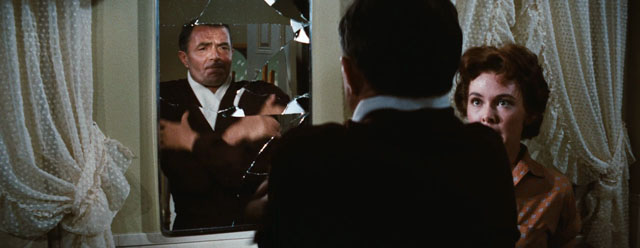
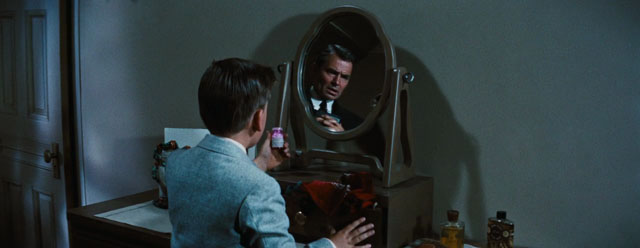
Katy not too impressed with Natalie Wood for some reason. I’m always happy to watch Sal Mineo splash about and Dean defy his tough-guy reputation with this oddball super-sensitive role. Was telling Katy I think history has gotten Dean’s rebel confused with Brando’s wild one. But watching this so soon after the death of Dennis Hopper, I couldn’t look away from him when he was on screen. Not that he’s completely electrifying in the part of “goon,” it’s just the fascination of seeing a teenage Hopper taking it all in.

I still don’t get Nick Ray, but this has always been a helluva interesting movie. Senses of Cinema on the director:

Among [Ray’s guiding concerns] are the relations between individuals and cruel, unforgiving environments or authority – in particular, the marginal status of adolescents; the nature of masculinity; and violence as a defining attribute of social relations. To express and reinforce this thematic coherence, and corresponding to the emotional turbulence of characters and actions on the screen, his films also display a visual flair and recognisable style marked by restless camera movement and quick editing generally uncharacteristic of the widescreen formats favoured by the director.

The Times review says the kids hide out in the same mansion used as Norma Desmond’s home in Sunset Blvd. – must look for that next time. Dean, forever a 24-year-old teenager, died a month before the movie’s release, having already shot his role in Giant.

JD Slocum:

In the 50 years since it first appeared, the film has continued to serve as a touchstone for imagining anxieties over coming-of-age rituals, traditional values of family and community, the provocations of mass or consumer society, and even threats from abroad. The specific sources of individual and social insecurity have changed, the specific motivations for rebellion have shifted, and the role of cinema and its heroes in the United States and other societies have been forever altered. What has persisted is Rebel Without a Cause‘s power to represent individual rebellion and the possibilities of social reconciliation, an affirmation of the cinema’s capacity to illuminate such realities and, through bold performance and bravura filmmaking, to serve as a bellwether of cultural change.

Susana (1951)

Big, obvious drama with overbearing music and vaguely supernatural elements. Not as excitingly Bunuelian as I would’ve liked, but way better than Gran Casino.

Susana (Rosita Quintana, who was still acting in 2005, if IMDB is to be believed) is locked in solitary at the sanitarium for misbehaving, in the company of rats and an awesomely fake-looking rubber bat; begs God for mercy and the jail bars come loose. Not as impressive as in The Rapture, but it’ll do. She crashes at the first place she finds, a peaceful ranch, and gets herself in with the family to wreak havoc from within.

Susana with ranch-hand Jesus: Víctor Manuel Mendoza, who went on to appear in some Hollywood westerns:

Felicia the maid doesn’t trust Susana from the start (her line, about the storm outside, “it seems there’s a demon loose out there” comes right as Susana’s face appears in the window), but Susana seduces all the men in the house: Jesus, Don Guadelupe (Fernando Soler, star of El Gran Calavera and Daughter of Deceit around the same time) and bookish son Alberto. Actually it doesn’t seem like she seduces Jesus, it more seems that he’s a slimy rapist stalker, but I’ll take the movie’s word for it. Dona Carmen, the woman of the house, eventually realizes what’s going on and joins the maid in trying to eject the interloper – but is it too late? Another rainstorm scene where S. brushes her hair in the window in silhouette while all three men watch her from different positions. Susana confronts Dona Carmen and says if Guadelupe is forced to choose, he’ll choose Susana. Jesus is kicked out of the house: one less rival for Don Guad’s affection. Finally the cops catch up with Susana and take her away, Jesus is hired back, and Don Guad’s prize horse, which had been sick since the initial storm, miraculously recovers.

Susana and Alberto hide in the well:

Very decent acting and cinematography (Jose Ortiz Ramos, who later shot the classics Brainiac: Baron of Terror and Samson vs. the Vampire Women). Bunuel likes to shoot Susana’s legs, incl. one weird scene where Jesus breaks the eggs she’s holding and they run all down her legs.

NY Times: “Though the movie means to be steamy, Bunuel is apparently more amused than shocked by Susana’s brazen ambition and the no-nonsense way she goes about her conquests. Toward the end, when the traffic in and out of Susana’s bedroom is fairly heavy, the movie has the manner of a grandly operatic farce.”

Deleuze says some quizzical shit about “the intrinsic qualities of the possible object.” I don’t know what that means, but three different sites I checked called this Bunuel’s worst movie (or his “most unspectacular” or “fairly insignificant”) – have they never seen Gran Casino?


Ensayo de un crimen (Rehearsal for a Crime), or,
The Criminal Life of Archibaldo de la Cruz (1955)

It’s the Mexican Revolution! Little Archibaldo’s mother acts like it’s a huge inconvenience that her theater date has been canceled because the revolution has arrived in town. Archie, alone with the nanny, wishes upon a music box for the nanny’s death and she’s immediately killed by a stray bullet through the window. Years later a grown Archie (Wuthering Heights star Ernesto Alonso) is threatening nuns with a razor when one runs down the hall and falls down an open elevator shaft. The movie carries on like this, Archie indirectly causing people’s deaths or not causing them at all, and thinking he’s got some unholy power via the magic music box, which he reacquires as an adult, buying it out from under a cute girl.

Archibaldo in triplicate with his killer razor:

Lavinia glimpsed through a wall of flame:

The cute girl, Lavinia (Miroslava, who killed herself before the movie was released) becomes wealthy Archibaldo’s full-time fascination. He buys a mannequin made in her image (she models for artists) and poses it around his house, then watches it melt in his kiln (he’s a part-time sculptor) when she angers him. Having taken his revenge on the fake Lavinia, he proposes to pretty young innocent Carlotta – but she has been seeing a guy named Alejandro. Archie’s revenge-fantasies kick in again (shades of fellow murder-comedy Unfaithfully Yours) and he dreams of shooting the cheating woman dead in their marital bed after the wedding… but Alejandro shows up to the wedding and shoots her instead.

Cut to framing-device authority figure (was it a psychiatrist or an officer of the law?) who says he can’t lock Archie up for dreaming people dead. Archie seems bummed that he isn’t believed to have done anything wrong, but runs into Lavinia, the girl who survived his wrath, and walks happily away with her.

Legs of the nanny:

Leg of the dummy (Tristana, anyone):

I wasn’t expecting a lot after Susana, but this was excellent. V. Canby in the NY Times agrees. “The sight of the boring, but very pretty, governess lying dead on the carpet, her skirts in a tangle around her upper thighs, makes a lasting impression on the boy, who thereafter goes through life confusing love, death and sexuality. … Archibaldo is a very polite, considerate and wise nut, aware of almost everything except that he is the inevitable (in Buñuel’s view) product of religious and sexual repression.”

Carlotta in her final moments:

The story annoys me in the same way as My Fair Lady (also by Cukor), setting up a woman as horrid and annoying, then having a smart white guy fix her and, inevitably, fall in love with her. While My Fair Lady still succeeds because of wonderful filmmaking and Audrey Hepburn, Born Yesterday succeeds entirely because of Judy Holliday. She’s hilarious, and I couldn’t get enough of her – no wonder she won an oscar. I’d forgotten that I also loved her in Adam’s Rib (also by Cukor, jeez) from the year before.

William Holden, whom I never seem to recognize even though I’ve seen him in Sabrina and Sunset Blvd., is a smartypants do-gooder reporter hired by boisterous, arrogant rich dude Broderick Crawford (good to see him out of the dark, depressing roles of Scandal Sheet and Human Desire). Holliday is Crawford’s dumb broad who gets too smart for her own good.

IMDB says the film was rehearsed like a play, in front of a live audience – wonderful idea. The story builds to a predictable conclusion, the intrepid reporter taking down the corrupt businessman and his in-pocket congressmen, escaping with the previously-ignorant woman who has become an avid reader. Before the plot machine kicks in, it’s a bunch of fun.

Resnais was making art shorts a decade before the official birth of the French New Wave, building up to his mindblowing first three features by practicing his filmmaking, not just by writing and dreaming. Le Chant du styrene and Toute la memoire du monde are both wonderful, and the latter looks forward to the themes and camera work of Last Year at Marienbad. Finally got my hands on some earlier shorts with subtitles, very exciting.

Van Gogh (1948)

This and Paul Gaugin tell abridged life stories of the artists with imaginative narration, the visuals composed solely of the artists’ works, using camera movement, zooms, fades and a musical cutting rhythm. Both artists lived in Paris but moved away, and worked over the same period of time (in fact, they knew each other).

On Van Gogh: “He was a preacher, but he preached badly. The violence of his faith frightened even the faithful. It was in the process of trying to find a way to express his love for mankind that he discovered himself to be a painter.” The film gets great mileage out of the artist’s descent into madness. Katy points out that the sunflowers lose some of their power captured in a black-and-white film.

image

Little about this online, besides that it won an Oscar. Auteurs: “The 1948 piece Van Gogh proved so successful in its original 16 mm form that it was subsequently remade in 35 mm, winning a prize at the Venice Film Festival as well as an Academy Award.” It’s also the earliest listed Resnais film that I’ve ever seen anyone mention, although an article by Rhys Hughes confirms the earlier shorts exist.

E. Wilson in her Resnais book:
“Resnais’s aim is not merely to use Van Gogh’s art as material evidence, substituting paintings for snapshots of the artist’s life; more subtly he uses the paintings to show us the world apparently as Van Gogh saw it, to show us not merely the object world of nineteenth-century Holland and France, but to conjure the subjective images of that world perceived by the artist and captured by him on canvas. Resnais’s investigation in the film is not merely art historical therefore: he seeks already, as he will in his later films, to reveal the work and process of the imagination, the shots of reality that we view, distorted, in our mind’s eye.”

Paul Gaugin (1950)

The opening narration summarizes: “A bank employee and head of family, well-to-do, middle-aged, comfortable, discovers that he has been lying to himself. He wants, indeed he must paint. From that point on, he devotes himself exclusively to painting, and after twenty years of poverty dies alone.”

Starts in 1883, just like the previous film. Instead of poor and insane, Gaugin ends up poor and sick in Tahiti, painting shirtless native women. The commentary on Van Gogh was written by co-producers Robert Hessens and Gaston Diehl, but this one is taken from Gaugin’s own writings. Produced by Pierre Braunberger, who assisted early works by Renoir (Charleston, La Chienne) and Truffaut/Godard, ending up with Terayama Shuji of all the weird people. I wish they’d done a Pierre-Auguste Renoir film in this series.

image

Maybe I didn’t like this as much as Van Gogh because I don’t like the artwork as much, didn’t figure out the painter’s style, or maybe because it seems a rerun of the previous film (artist starts painting, gets obsessive, flees the city, goes poor/mad). E. Wilson, the biography author, agrees and spends more pages discussing Guernica (1950) instead. She calls this “a largely pictorial film by contrast,” points out that in Statues he would be “more self-conscious about self/other relations, colonial and post-colonial tensions.”

Statues Also Die (1952)

I’ve watched this before, but without subtitles. It is immensely improved when I understand the commentary – not that the shots and editing are anything short of excellent, but the movie is making all sorts of points about images, history, culture and colonialism which are sort of essential.

image

Katy says she’ll do a guest write-up for Gigi, so consider this a placeholder. She liked the filmmaking very much, and I’m sure it was very good (Minnelli can do no wrong) but I was put off by the story.

Young Gigi (Leslie Caron, who was actually 26, so I guess it’s all okay) is being taught by her family how to please men, and super-rich Gaston (Louis Jourdan of Letter from an Unknown Woman, which we watched directly afterwards) is bored with every girl in town except Gigi. At the end he decides that he loves her, much to the delight of her family, including dirty old grandfather Maurice Chavelier (27 years after The Smiling Lieutenant), motherly (but not her mother – Gigi has no parents) Alvarez (Hermione Gingold of The Music Man) and stickler aunt Alicia (Isabel Jeans, star of two Hitchcock movies in the 20’s). Won an awful lot of oscars – pretty much everything but acting and special effects.

Why isn’t there already a Hollywood remake of this? Seems like the perfect convoluted rom-com plot. Boy (sweaty Leopoldo Trieste – replace with Matt Damon… or Steve Coogan, it’s not important) and new wife (Brunella Bovo of Miracle In Milan – maybe Katherine Heigl) are honeymooning in Rome. He has their trip meticulously planned, but she sneaks out while he’s napping and goes to visit the offices of her favorite magazine – meets the romance writer (Fanny Marchió of Variety Lights – I’m thinking Glenn Close) who gets the newlywed whisked away to a photo shoot with her idol the White Sheik (Alberto Sordi of Mafioso: Ben Affleck). Hijinks ensue.

I like the sweating James Gandolfini-looking hotel attendant, and that the sheik is introduced with a mighty crotch shot underneath a swing, and that there are apparently references to future Fellini movies (the husband is tempted by prostitute Cabiria). I like that Ivan covers for his wife, since he’d seemed the type to blame her in front of his family for his day going wrong, but he secretly searches for her whilst placating his family, and she gets increasingly caught up in the photo shoot (they’ve just put her in costume when the director yells “get ready for the rape scene!”), while the Sheik looks increasingly like a cad, making the inevitable happy reunion of the couple (moments before their audience before the pope) that much more meaningful.

Watched for the Shadowplay Film Club, which has a much better write-up, hence my lack of effort.

Faith Domergue is a gorgeous scientist of the type you’re not likely to find in a real science lab, smirks Robert Osborne in his TCM intro. How would he know? His intro sounded like a description of Godzilla, and sure enough, a serious newsman-sounding voiceover at the very beginning invokes the atom and prepares us for the worst.

First off, there’s a stiff young fellow named Griff (which makes up for the lack of Griffs in Sam Fuller’s submarine movie one year prior) and hunky Kenneth Tobey (Thing From Another World, later a Joe Dante cameo regular), who doesn’t generally act much like a military commander. Disturbances are detected, people are disappearing – what could it mean? Enter marine biologists Dr. Carter (Donald Curtis of Spellbound) and Joyce (Faith Domergue, of This Island Earth the same year, with heavy-looking eyelashes – she can barely keep her eyes open) who excitedly study evidence and declare it might be a giant octopus. Finally, 20 minutes in, we get to see a real octopus, and after another ten we see the real prize, Ray Harryhausen’s giant animated tentacles.

The narrator returns frequently, and he is welcome since not much else is happening, to make statements like: “In the weeks that followed, the North Pacific was closed.” After explaining to the audience what octopuses are, in typically patient cheapie science-film fashion, the marine biologists, who should’ve really been sent home by now, start ordering the military around. Between lessons about cephalopods we get an instructive speech about how women can be as capable as men, proven when biologist Joyce invents a new kind of torpedo. In California they meet local plaid-jacketed sheriff Harry Lauter (Escape from the Planet of the Apes) who is killed by the monster minutes later.

“The coastal waters of the Pacific were mined,” declares the narrator. I hope the Navy plans on cleaning those up later. Needing a device to keep piling on the exposition, the Navy is surrounded by inquisitive reporters, culminating in a LOL moment when a short newsman asks Joyce a question she doesn’t know, so he follows dramatically with: “If you don’t know, who does?”

When the radio announces the ferries are closed then a mob of peeved suit-and-hat wearing men rush down, elbowing past police to assert their rights to ride the ferries, I am just rooting for them all to be eaten by giant fish. Tentacles crawl aground, looking like giant tongues, but only grab a few people, falling upon them Blob-style. Disaster flicks had disappointingly low body counts in the 50’s. Old Dr. Carter gets in trouble as the monster attacks the Golden Gate bridge, in the first scene really worth watching, and I thought he was a goner for sure. After all, the commander and Joyce have shared a hot beach-love scene, so it’s time to kill off the elder third-wheel… but surprisingly, he makes it back.

As we began in a submarine, so shall we end, as the navy takes the battle down below (not too far – the octo stays about 50 feet down). Unexpected meta-humor when the octo grabs their sub and Tobey says “this is where we came in.” Of course, now it’s personal, so he and Dr. John grab scuba gear and harpoons to finish the thing off. I don’t think Tobey ends up with Joyce, dedicated as they are to their careers, but I was sleepy and can’t be sure.

The only sci-fi flick made by Robert Gordon, a former actor (played Al Jolson as a boy in The Jazz Singer). I’m hoping he’s the younger brother of MST3K “fave” Bert I. Gordon. I can find no proof of that, but this film’s writer George Yates wrote five of Bert’s films (the other writer, Hal Smith, was a major voice actor in 1980’s cartoons).

First Minnelli movie I’ve watched since Meet Me In St. Louis (and his 13th since then – I must catch up). Writers of Singin’ in the Rain (and it shows, with all the behind-the-scenes crossover) but different songwriters. I didn’t know much about it, besides its position on some lists of great films, but was still impressed at how great it was, in direction and dancing and music (in that order) more than anything else. Katy enjoyed, too.

Fred Astaire, a decade after Holiday Inn, is looking more alive and alert than ever, despite being in character as a has-been showman. He’s paired with (eventual love-interest, natch) young Cyd Charisse of Singin’ in the Rain by two enthusiastic show writers. They bring the project to an overbearing actor/director, but he turns their comedy into a dreary version of Faust, so after the investors have given up the writers reclaim the play and undo the director’s pretentious changes, touring to eventual acclaim. It’s all in fun.

Nanette Fabray (of not much else, but still alive, so there’s time) as a writer of the play holds her own in the singing and dancing scenes, but her comic foil partner Oscar Levant (a composer and pianist, also of An American In Paris and Humoresque) I found more hammy and grating. Maybe it was more his big clown face than his acting, but there’s something unpleasant about him. Jack Buchanan, as the director (who is good-natured enough to stay with the play after the rewrite), is far better here as a noisy, self-obsessed Orson Welles caricature than as the fey hero of Lubitsch’s Monte Carlo. The one scene with a major dancer who’s not one of our stars is when Astaire dances through an arcade with Leroy Daniels. It’s a wonderful dance, and even more wonderful that Daniels is apparently playing himself, known around Hollywood as a rhythmic shoe-shiner who had a hit country song written about him.

No Oscar nomination for the song “That’s Entertainment” – I guess it wasn’t considered an original song. I liked all the songs pretty well, though Katy notes they didn’t try to make any sort of unified sense out of them. We get Astaire and pals in baby clothes dancing on their knees to “Triplets,” country Nanette in “Louisiana Hayride,” and Cyd’s big-drama “New Sun in the Sky”. As the cast regains control of their play and starts to turn it back into an entertaining piece, these songs get added seemingly at random. It adds to the comedy that we never remotely see how these bits connect in the finished play.

Seems like a semi-remake of A Very Long Engagement. There’s a specific scene where Veronika says if she can count to fifty before the postman arrives at the door she’ll get a letter from Boris. Then there’s the overall story, a woman looking for her man who went to war, not even stopping after she hears that he’s died. Jeunet gave his film a happy ending, but Russia in the 50’s was still mourning the millions killed a decade earlier. So, not a simply fairy tale, Veronika does not get a letter from her Boris, because he did die in the war.

It opens with the two lovers happy together, and ends with her alone, smiling but heartbroken, handing out flowers to returning soldiers. In between it’s mostly her story. She loses her family in a bombing raid and stays with Boris’s parents, then is soon coerced into marrying his brother who dodged the war. Very impressively (for 1957) mobile camera, with always excellent, careful framing, none of the indifferent framing that characterizes most handheld today (ugh, I hate saying things like that). It seems like every shot in this film has more than one purpose, making the simple close-ups that much more powerful. No surprise that the director and cinematographer went on to make the great I Am Cuba, or that this won the golden palm (over Bergman, Satyajit Ray and Mon Oncle)

C. Fujiwara for Criterion:

The film is also exceptional in refusing to condemn Veronica for her involuntary infidelity to Boris while he is at the front. In Tatiana Samoilova, The Cranes Are Flying unveiled a magnificent screen personality: expressive, sexy, dynamic. Veronica is far from a traditional war-movie heroine (not only by the standard of Soviet war movies), and Feodor’s impassioned denunciation of faithless women is clearly meant to be taken as more than just the party line, but Samoilova makes her character completely sympathetic, down to her bittersweet apotheosis in the moving final sequence. The Georgian-born Kalatozov, who began his directing career in the silent era, spent several years in Los Angeles during the war on a diplomatic assignment, and seems to have been marked by Hollywood cinema. In The Cranes Are Flying, he treats melodrama with a formal complexity worthy of Frank Borzage, King Vidor, and Vincente Minnelli – finding, with no fear of excess, potent visual correlatives to emotional states.