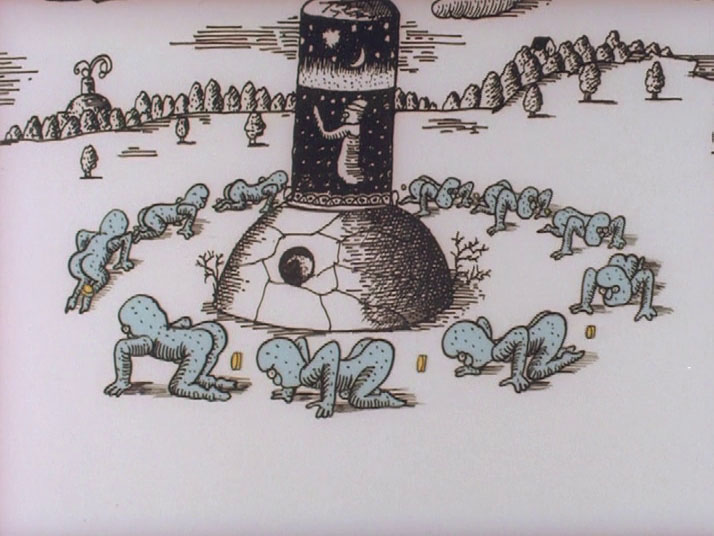
Opens with a blood drinking ritual in a slaughterhouse, 1905.

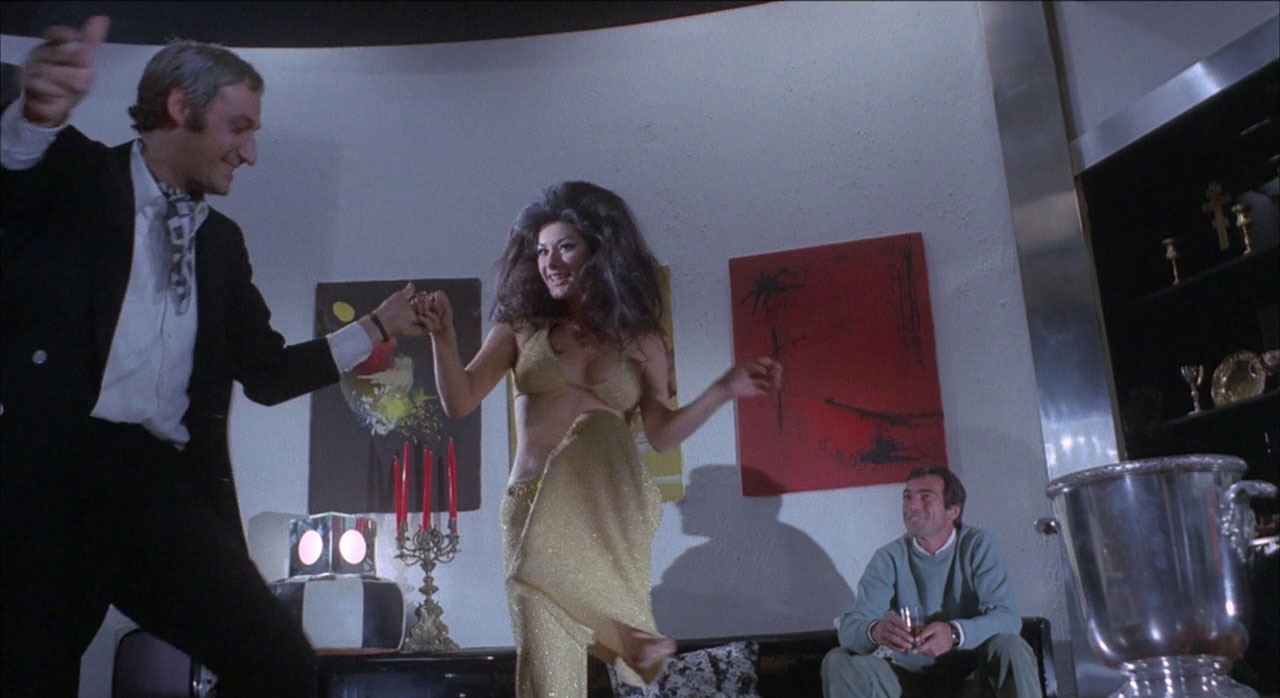
Infighting in a gang of thieves, blonde guy takes a girl hostage to escape, she gets away immediately, he runs and discovers a manor draped in fog and ominous music. The thieves lurk outside, confident they can move in and take him and his stolen gold. Inside, the runaway finds two hot girls. He locks them in a room and they start making out and getting gratuitously naked – ah yes, this is from the director of Shiver of the Vampires. Even not knowing French I can tell the dialogue acting is dry and unconvincing, but the nudity is legit.

Thief (Jean-Marie Lemaire of the Anthony Hopkins Hitler movie) and blonde Brigitte Lahaie (Calvaire and Jesús Franco’s Faceless) and brunette Franca Maï (whose wiki includes among her career achievements “co-creator of a website”) take turns threatening each other. Brigitte breaks the standoff by calmly delivering the gold to the people outside, then grabs the scythe from the poster art and dispatches a bunch of murderous thieves.

New woman arrives – this is Fanny Magier of Jesús Franco’s Hitler movie Convoy of Girls, which also stars Marc who is apparently a Hitler movie regular – and speaks of satanic rituals, everyone being calm and cool. I put this movie on because it’s short, but I’m the kid who held his breath in The Jaunt right now, as they play hilarious 1900’s blindfolded party games. Finally Brigitte is shot and the others devour her blood – I saw this turn coming since it’s in Criterion’s vampire collection.

This opens with scenes of death camp nazis bulldozing bodies… Indian starvation camps… mutilated Korean War orphans, and so on, a Faces of Death montage. Feels like an poor way to set the tone for your stupid horror movie, but it turns out they’re making a more socially conscious version of Village of the Damned, and the kids’ psychic murder rampage is payback for all the needless child death caused by adult decisions.

English couple travels to a Spanish island for vacation, having never heard of the Spanish language or culture before, and they happen to arrive on the day the kids rise up against adults. A good British person, he’s obsessed with never telling his pregnant wife what’s happening – when he witnesses the kids string up an adult as a human piñata and attack it with a scythe, he insists to her that it’s nothing, and everything’s fine. This is his fatal flaw, since he becomes convinced that the kids are monsters and she doesn’t, so she wrecks the car when he tries to run them down while escaping. Her own baby attacks her from inside, and he gets a Night of the Living Dead ending when a postman from the mainland sees him killing a kid and shoots him.

Serrador made The House That Screamed, which I didn’t love, but this was on some horror lists and proved to be good and messed-up. The lead guy was in Dr. Phibes Rises Again and his wife in The Secret of Seagull Island. DP José Luis Alcaine has been an Almodóvar regular since Volver.

It was instructive to watch a perfect 35mm print of a 1970’s movie at the Plaza the night after watching a 4k DCP restoration of a 1980’s movie from the same seat. The 35mm cost more to attend, since screenings are increasingly rare – this is probably my first time seeing a movie on film since The Grand Bizarre 3.5 years ago. I forget who it was who said digital projection is just watching television in public but… I couldn’t really tell the difference?

I remembered the very end of this – Hackman playing sax in his ruined apartment after failing to discover how he’s being surveilled – but not most of the rest, and especially not that his secretive rich client Robert Duvall is the one who gets murdered in the hotel – presumably by the client’s wife and bf whom Hackman’s group was recording in the park at the beginning.

Hackman’s character is especially memorable here – he’s catholic, lives by a strict code, appears to be a master of his craft, but keeps taking jobs that end in murders, getting tricked and betrayed and spied on. Nice spy-movie construction too – we never learn everything, like what the Director’s assistant Harrison Ford was up to. If this was influenced by Blowup, then Blow Out is kinda a remake of both movies.

Barbara Hershey, who also appears in two (but not all) of Scorsese’s movies where someone gets crucified, sees her cropduster daddy die then hits the Depression-era road. She and family friend Von (Bernie Casey of The Man Who Fell to Earth, In the Mouth of Madness) and railworker Bill (David Carradine, whose dad plays a railroad bigwig) meet up in various places and get into hijinks. Good performances, especially in the second half, and some sharp editing, but this is more a Roger Corman period adventure story than anything else.

Bertha caught between two Carradines:

The cops and strikebreakers in this are real pieces of shit. She meets a moneyman called Rake, she shoots a guy who calls everyone he dislikes a red, and she jailbreaks her friends… there’s a nice classic car wreck off a cliff, another gets smashed by a train, there are some shotgun murders, and Bertha and friends become professional bank robbers. She’s freed from a whorehouse by Von, but both guys finally get busted.

Von taking care of business:

Strikebreaker on the left would become a Scorsese regular, mustache guy would disappear.

Grungy camera work, uneven sound mixing, very Cassavetes-ish dialogue and behavior though apparently it’s an entirely May-created work, based on small-time gangsters she’d grown up around. It’s part 358 in my ongoing series “What Do People See in the Cinema of the 1970’s?” though it’s easy to admire after it’s over. Cassavetes is unpleasant to be around – racist, sexist, prone to fits of destruction and paranoia – and everyone wants him dead, including his friend Falk, who is informing hit man Ned Beatty of their movements across the city. As the peripheral women, we’ve got Joyce Van Patten (Monkey Shines mom) as John’s unamused wife, May regular Rose Arrick as Peter’s complicit wife, and the unknown Carol Grace as their lonely plaything/victim.

On Letterboxd: “Boyfriends and Girlfriends” by Low

Our happy boys, everything going great:

Ned, reflecting a marquee showing The Laughing Policeman and Fist of Fury:

Her Majesty wishes to have knowledge, so her whitehatted sorcerer summons the angel Ariel. This is awesome, and is the last awesome thing that will happen in the film, which jumps to present-day artpunk, deteriorating into campy self-satisfied in-jokes as the novelty wears off and it stretches painfully to feature length.

The Past:

Jarman’s second feature after a decade of shorts costars Adam Ant, who lip-sync-fronts a live band. One of the Bowie-wannabe youth is Nell Campbell who somehow specialized in maximalist rock films, also appearing in Rocky Horror and The Wall and Lisztomania. A spirit named Ariel and an actor named Orlando seem to productively predict future, better films.

The Present:

It’s strange to see space alien Bruno S. playing someone besides Kaspar Hauser. Here he’s playing a version of himself, as are many of the actors, who autobiographically collaborated with Herzog on his hastily-written Germany-to-USA adventure. Reformed criminal/music lover Bruno helps Eva Mattes (Petra von Kant‘s daughter) while she’s on the run from her thug pimps (one of whom would later play Vigo in Ghostbusters II). The thugs barge in, assault Bruno and break his accordion. The neighbor who looks after Bruno (Kaspar Hauser fan-favorite Clemens) is leaving for Wisconsin, so Bruno and Eva join him.

Bad luck right off the bat as customs confiscates Bruno’s mynah bird (using its real voice, which is a big deal for birds in cinema). Werner discovers Weird Wisconsin immediately, filming two neighboring farmers on tractors with rifles. Bruno’s house is taken away for non-payment… not making enough cash as a waitress, Eva returns to prostitution and runs off with some truckers… and Clemens is arrested for robbery (the bank was closed so he robs the barber next door). Everything around him going to hell, poor Bruno wanders a live-bird amusement park then kills himself on a ski lift.

The credits thank Errol Morris, Les Blank and the documentarian who discovered Bruno in West Berlin. Supposedly Ian Curtis killed himself right after watching this movie, and yeah it’s a downer, but one night earlier I’d coincidentally watched New Order’s live set from Coachella 2013, and after seeing what a crank Bernard Sumner can be, I wouldn’t be so quick to blame the film.

Jackie Chan is Wong Fei Hung, a versatile character last seen as a child in Millionaires’ Express, and previously in Once Upon a Time in China. Here he’s a prankster and scammer who needs to be taught discipline by his great drunken uncle. Jackie is put through weeks of tedious strength-training exercises, doesn’t see the point in it all until the final fight when he has internalized the teachings of the Eight Drunken Gods and he gets wasted and destroys the bounty hunters trying to murder his dad over a land deal. Karate Kid was a sober teen remake.

Wonder if I am the first person of 2022 to unsuspectingly watch this movie after buying the Party Dozen single.

New kid Jackie had started getting star roles in ’76. His drunken master Red-Nosed Su is the director’s dad Yuen Siu-Tien, also of Come Drink With Me and other films with drunky titles. Powerful hit-man Thunderleg is Hwang Jang-Lee of Game of Death II, and Jackie’s dad Lam Kau was in As Tears Go By.

States (1967)

I’ve watched this one before… was hoping I got a higher-quality copy, but nope. Sometimes the water is a torrent, sometimes slight drips that look like sparks. Fully white-on-black with no grey in between, all elements given the same visual character. Unfortunately that character is destroyed with standard-def interlacing, the horizontal artifacts interrupting the all-vertical movements. Silent, so I watched with a couple of Craig Taborn piano tracks from the Avenging Angel album, which accounted for at least 75% of my enjoyment of the experience.


Apparatus Sum (1972)

Color fields, sometimes gently crossfading, sometimes strobing. Lingers on red for a long time. then, holy shit, is that a dead body, or what is happening? Freaky little movie, the second one in a row affected by low video quality (this time compression artifacts in the color fields), but I’ve run out of films from the beautiful Criterion blu-ray, so you get what you can get.


Not the First Time (1976)

A pier, shore birds, a person in red on the beach, always double-shot and superimposed out of sync, like a misaligned 3D camera, with frequent cuts to pure white. Short, silent.


Cadenza XIV (1977-80)

Prolonged marching band beat over black…
then… a smokestack with a laugh track
As the camera lingers on the flame atop the smoke stack, the obvious loop point of the repeated laugh track makes me wish for the return of the marching band.


Mindfall I & VII (1977-80)

Cartoon sfx as the camera goes, I dunno, just all over the place. Jittery footage of nature and architecture and what not. Wipe/iris transition mattes standing on their own between shots – like it cuts from the footage to the transition, instead of the footage itself wiping or irising. Between the video effects and the sound effects library and the single-frame flash edits before cuts to black, it feels like a prank, and one that last almost a half hour too long. I spaced out somewhat, reconsidering that dream of attending a complete screening of Frampton’s Magellan project. At least it has a closing shot that isn’t just a random rock or cactus, but approaching the shadow of the filmmaker on the side of a building. Sicinski liked this one, anyway.