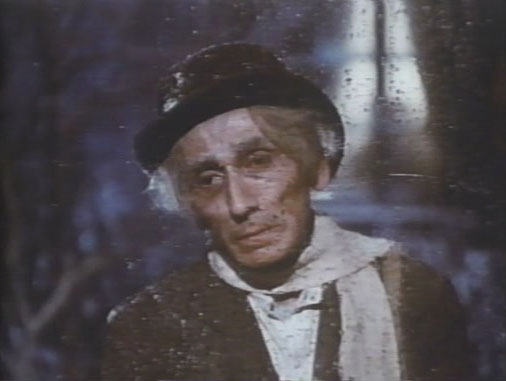
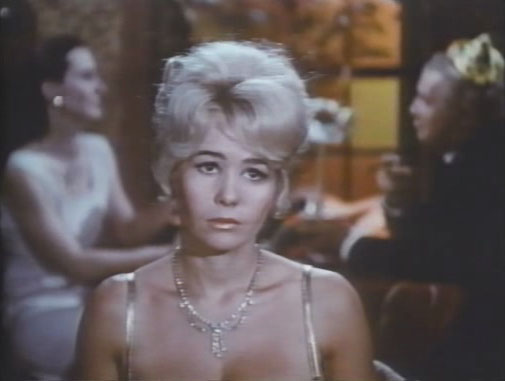
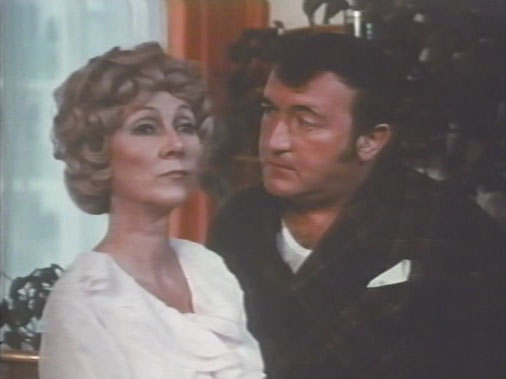
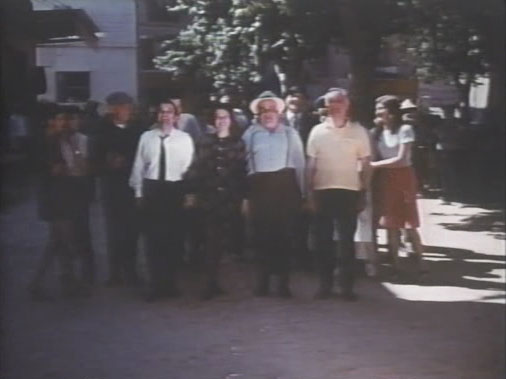
“A comic strip in 7 episodes on the life of Richard Strauss 1864-1949” Strauss is played as a power-hungry megalomaniac by Christopher Gable (also of Russell’s Tchaikovsky film The Music Lovers). The film itself is fanciful and alive, and surely one of the best biographic movies I’ve seen.

image

Only two years after 2001: A Space Odyssey, Russell accompanies that film’s big opening song with shots of a caveman who soon runs into religious mania and screaming nuns (both of which would be rampant in The Devils the following year).

image

“Alas, the time is coming when man will give birth to no more stars. The dead end of mankind is approaching.” I could quote every line and display stills from every shot. This seems way too extravagant to be a made-for-public-television movie, and too good to be a long-censored rarity. Only ten years until this can be shown legally despite the Strauss family’s objections, unless copyright law is extended like it always is.

image

We get a love triangle in the box seats at the opera, scenes of Macbeth, Don Quixote, a fun Salome with two lead actresses, and the infamous garden party with the nazis. Yes, the film does feature Strauss giving Hitler a piggyback ride, both of them grinning and playing violins. Various fantasies, both nightmarish (Allied soldiers interrupt Strauss’s innocent mountain vacation and murder his family) and wishful (his glorious music pounds critics into submission).

image

Kenneth Colley (Jesus in Life of Brian) – the only actor to play both Jesus and Hitler?
image

“A life completely away from politics and war – that is what I’ve always longed for.” Ends with a speech by an aged Strauss distancing himself from the nazi party, “There’s no stain on my character. These nazis are criminals, I’ve always known that.” But a minute later complains about “Jewish stubbornness” before catching himself. Russell partly credits Richard Strauss with scenario/dialogue, saying he used the man’s own words in the script. A scathing portrayal.

image

IMDB has incomplete credits. Judith Paris (a nun in The Devils) played Strauss’s wife Pauline, Vladek Sheybal (camp classic The Apple, Russell’s Women In Love) was Goebbels and Imogen Claire (appeared in and choreographed Lisztomania) was one of the two Salomes.

image

Tape number at top of screenshots provided so the BBC can locate their tapes and release this properly. Timecode (below) provided so you can easily find your favorite scenes. Thank me later.

The MBC:

The complete title reveals Russell’s intention to create a satirical political cartoon on the life of the German composer, who Russell saw as a “self-advertising, vulgar, commercial man . . . [a] crypto-Nazi with the superman complex underneath the facade of the distinguished elderly composer.” And, although, according to Russell, “95 percent of what Strauss says in the film he actually did say in his letters and other writings,” many critics and viewers found Russell’s treatment of the venerated composer itself to be vulgar.

Oh, man. I was really expecting a classic, great horror film, something at least as awesome as God Told Me To. After all, this had sequels and a remake. That adds up to horror classic, right? But I guess even Maniac Cop had sequels and a (sorta) remake, so no guarantees. Not that It’s Alive sucked – it’s got that 70’s low-budget 16mm look which I always mistake for gritty realism, and an interesting central dilemma: a couple’s child turns out to be a murderous monster, so they help in the manhunt for the creature, but parental emotions win out and they end up trying to protect it.

Glimpse of the creature:
img

Dad: John Ryan of the Wachowskis’ Bound, Class of 1999:
img

Mom: Sharon Farrell of Out of the Blue, The Stunt Man:
img

Ultimately more exciting than the plot were the 70’s fashions on display.
img

This one brings back memories:
img

My favorite shot, by far:
img

Stinger: “Another one’s been born in Seattle.”

An awful lot like Inferno, with the ludicrous plot, hysterical acting and silly deaths. But also like Inferno, the visuals are excellent enough that I can forgive all that. I think I actually prefer Inferno, even though this one has better music and funnier death scenes.

Eva Axén went from working with Visconti in classy period pieces to getting stabbed, thrown through windows and hung by Argento:
img

Eva up there escapes from a prestigious dancing school, goes to stay with a friend, and is dramatically killed (along with the friend) by an unseen evil which cares little for logic or reasonable dialogue, only for the picturesque posed deaths of young women.

Our heroine in the middle is Jessica Harper (Phantom of the Paradise, Pennies From Heaven). At left is Stefania Casini, an older sister in Blood For Dracula.
img

New student Suzy picks up the narrative from there, discovering right off the bat that her school is creepy but not figuring until the end that it’s a front for a coven of witches run by a hundreds-year-old evil mother.

The Mother Of… something:
img

One thing the movie’s got going for it: casting Udo Kier. But it loses points for casting Udo Kier in a tiny, talky role, essentially letting everyone BUT Udo Kier overact. Bad call. Maybe Kier was busy in Fassbinder’s The Stationmaster’s Wife at the time.
img

While Suzy has fainting spells, deals with a plague of maggots falling from the ceiling, and talks with Udo Kier and some professor (Rudolf Schündler, actor since the 30’s and director in the 50’s and 60’s, also in The Exorcist and Wenders’ Kings of the Road and The American Friend) about historical nonsense, more deaths occur. Her friend Stefania Casini is murdered by the unseen hand in a similar over-the-top manner to the first death (barbed wire, razor stabbing, nails through the eyes). And the blind pianist is kicked out of school and walks through the abandoned square at night. The music warms up, the lighting declares the buildings to be a threat, and suddenly a stone gargoyle comes alive and flies overhead… but in the end, he’s simply killed by his guide dog.

Blind Daniel (Flavio Bucci of Il Divo) getting kicked out of school by mistress Alida Valli (star of Eyes Without a Face, Senso, Il Grido, The Third Man, played a caretaker in Inferno)
img

Joan Bennett (30+ years after Scarlet Street), in her final film role, has got some wicked wallpaper.
img

Amazing cinematography by Luciano Tovoli (from Antonioni to Argento to Barbet Schroeder to Titus), who shines red and blue colored lights on simply everything. The dubbing is mostly good, and I liked the pumping Goblin music surprisingly well. I dig when Goblin sings along quietly with a sinister “la la la.”

Argento’s debut seven years prior was titled The Bird with the Crystal Plumage.
img

OCT 2017: watched the new 4k restoration at the Alamo, wowie wow wow.

“Count Dracula may not seem like the ideal husband. … Of course he’s deadly pale, but then he’s a vegetarian and they all seem to look like that.”

image

The director admits the film is slow, even uses the word “boring,” but says they figured it’d be more poetic that way. He also claims little familiarity with the original Dracula story and vampire mythology, but says he’d try to respect it whenever a crew member would point it out (“hey Paul, Drac can’t walk out in sunlight like that”).

On the plus side, it has very nice piano music, decent well-lit cinematography by Luigi Kuveiller (who shot Avanti! and is as fond of zooms as Brian De Palma), Udo Kier acting off his nut, a humorous array of atrocious accents, and the longest blood-vomiting scene I’ve ever watched. Morrissey’s got the right idea about horror movies drawing in the viewer through slow buildup, but he misses the creepy horror atmosphere. Udo Kier’s Dracula is a pale weakling who gets ordered around by his enthusiastic German servant (Arno Juerging) and is eventually, humiliatingly killed by a loser rapist houseboy wielding an axe. Without the horror, or the over-the-top 3D humor of Flesh For Frankenstein, this one just sorta drags along.

Arno Juerging with Maxime McKendry:
image

Dracula is sent from Romania to Italy to find virgins, since Romania is fresh out. Stays at a house run by the shabby, formerly wealthy couple of Maxime McKendry (seems like the best actress here, but never in another film) and the great Vittorio De Sica, below.

image

Drac is interested in the family’s four girls and tries to figure which is a virgin so he can drink her bl… I mean marry her. Unfortunately, the oldest two are having kinky sex regularly with beefcake houseboy Joe Dallesandro (Rivette’s Merry-Go-Round, a hitman in The Limey), the middle one has been engaged before so Drac writes her off (turns out she’s still a virgin so Joe kindly rapes her to save her from becoming vampire food) and the youngest is 14 (so unmarryable, but Drac is chasing her at the end).

Milena Vukotic:
image

Stefania Casini (Suspiria, a hitwoman in Bad, 1900, Belly of an Architect):
image

Not pictured: Fellini/Bunuel/Tarkovsky actress Milena Vukotic, and youngest Silvia Dionisio. It was a bitch to figure out the above screenshots since all four sisters look the same. See comment below for some clarification/corrections (thanks Jenna).

“What about your sister? What does she do all night? I’d like to rape the hell out of her.” “She’s only 14!”

image

The reason I watched this in the first place, kicking off an early start to SHOCKtober on the 29th, is Roman Polanski. During all the controversy while he sits in a Swiss jail I thought I’d watch myself a RoPol movie, but I can’t find my copy of Knife in the Water so I went for this instead. Apparently Udo Kier needed to take a day off for reshoots on another film, so they hurriedly wrote a scene in which Arno Juerging gets scammed by Roman (on left with the mustache) in a tavern.

image

Udo is as fun to watch as always (well, maybe less fun than always), but he’s surrounded by the usual sordid 70’s misogyny of a Morrissey/Warhol production. Dracula comes to a sad end, limbs all chopped off like the Black Knight and then staked by the gross houseboy. Better luck next time…

image

“Blue… blue is very important.”

I’ve mostly been giving Chabrol a pass in favor of other French filmmakers who seem more interesting, but I checked this out as part of Shadowplay’s Film Club. It has already received the proper attention there, so I’ll just skip through…

image

Wild intro and last 15 minutes, not much heated activity in between. Hélène Régnier (Stéphane Audran, star of Babette’s Feast, lead girl’s mom in Thieves After Dark, also Coup de torchon, Discreet Charm, Dead Pigeon and numerous other Chabrol pictures) is our lead, and she’s pretty great. Her drug-addict husband Charles (Jean-Claude Drouot, playing the opposite of his overjoyed husband in La Bonheur) frankensteins out of his room one morning, attacks her, then clubs his son’s head into the corner of a dresser. She spends the rest of the movie dealing with the repercussions and gathering her wits. The kid is practically forgotten – total plot device.

image

Everyone turns out to be pretty well decent except for the husband’s rich dad (Michel Bouquet of The Bride Wore Black) who wants to use this incident to kick lowly Helene out of the family, and Paul, the two-faced creep he hires (Jean-Pierre Cassel, above, fresh from Army of Shadows and previously star of Renoir’s Elusive Corporal).

image

Helene stays at a boarding house near the hospital populated by nice, handsome Dr. Blanchard (Angelo Infanti, who experienced death-by-montage in The Godfather), a crazily-bearded hammy actor, three card-playing old women (“the Fates,” screams the DVD commentary), landlady Mrs. Pinelli, her drunk husband and their movie-fakey impaired daughter.

image

Intrigue: Paul, in collaboration with his always-nude sex-fiend girlfriend Sonia (Catherine Rouvel: Black and White in Color, Va Savoir), gets the loony idea to kidnap the landlady’s daughter, show her satanic sex films and pin it on Helene. But she’s not as dumb as Paul thought, and knows the difference between our Helene and Sonia in a wig. Paul then drugs Helene to keep his plan from crumbling – meanwhile Drouot is on the rampage, having killed his poor, sympathetic mother, runs into Paul who panics and stabs D. to death while a tripping Helene and the three card-playing women space out in the park watching balloons.

image

Funny to me: Marguerite Cassan plays the mother of Jean-Claude Drouot. She was in Renoir’s Picnic on the Grass which inspired Le Bonheur, which starred Drouot.

Movie is more musically interesting than visually. The commentary agrees: “It’s music that announces itself as music – it’s not to be forgotten, it’s to be paid attention to… an element of the filmmaking.”

image

English title was The Break-Up.

More hits from the commentary:
“Things in Chabrol’s universe do not happen for a reason.”
“The tension… is between civilization… and the beast within.”
“I’d say if the film has a flaw, she is a saint.”

image

“This is almost a caricature of a retarded girl. This has no basis in naturalism whatsoever. The existence inside this house is an existence on a different plane in a different style. This is a horror movie, it’s just a very strange, muted…” Comment makes me think of Celine & Julie Go Boating, but the movie doesn’t. The other common comparison is Sunrise because of a train ride scene. I think people are stretching.

image

Another great set of Clay’s 16mm cartoons, and it’s been too long since the last one.

Mysterious Mose (1930, Dave Fleischer) is a proto-Betty Boop (she looks like a dog; a sexy dog) cartoon in which she is haunted by a sorta ghost casanova. The Great Piggy Bank Robbery (1946, Robert Clampett) is a weirdly violent Daffy Duck gangster parody. Since his “Duck Twacy” fantasy is spurred by a knock on the head while reading comic books, it’d be a good short to play before Artists & Models. It’s Tough to Be a Bird (1969, Ward Kimball) is a Disney doc about birds and watchers with musical cartoon segments. And We Have Met the Enemy, and He Is Us (1973, Walt Kelly) is an unfinished Pogo cartoon with a harsh environmental message. I think all the voices were done by one guy.

Bunch of TV stuff. Spiderman fights a bank robber in a mole-man costume. There’s a Casper cartoon (in which Casper does not appear) about a watch repairman who gets attacked by an eagle at the end. Ralph Bakshi contributes an episode of Captain America. A horrible show called Hoppity Hooper (set in Wisconsin) with a Rocky-and-Bullwinkle-repetitive bit about “the traffic zone” was the low point. The high point was the hilarious 60’s-70’s commercials for Mr. Wizard, Hot Wheels, Cheerios and the like. Real fun program… too bad the next one is scheduled for the same night Art Brut is playing.

image

I think most Jacques Demy studies begin with The Umbrellas of Cherbourg and end with The Young Girls of Rochefort, pausing to mention that he died young and was married to Agnes Varda. I enjoyed those two so much that I figured his other films couldn’t be that bad, so I checked this out since the video store didn’t have Lola. Not only is it not-bad, but I challenge anybody to find anything wrong with it.

Catherine Deneuve (the same year as Tristana) plays a young princess. A few months after her mother passes away, the king (Jean Marais, not looking too different 25 years after his other fairy-tale film, Beauty and the Beast), with no other attractive princesses in the land, decides to marry Catherine.

Funeral for a queen:
image

Catherine, a sheltered princess who spends her days with parrots and blue-painted dwarfs sees nothing wrong with this – after all, she loves her father. Fortunately, her fairy godmother Delphine Seyrig (the year after Mr. Freedom, and looking much classier) knows it’s a problem so gives Catherine a series of costume-design challenges to pose to her father to delay the wedding. When he passes them all, making her dresses the color of the sky, the moon and the sun, she asks for a dress made from the skin of the prize donkey which shits gold and jewels. Seems like a cruel slap at the kingdom, but he does it, and she flees for the country wearing the freshly-killed donkey.

image

Doing small-town drudge work in public, but secretly sleeping comfortably in her shack with some magical fairy help, Cath attracts the attention of Prince Charming (Jacques Perrin, who starred in Z after playing the military poet who is driving away in the final shot of Rochefort). He meets her, loses her, then does the Cinderella thing with all the girls in the land, only instead of a slipper it’s a ring that fits only her hand, and announces they are to be married.

image

Just then, a helicopter (!) drops in carrying the king, who is going to marry the fairy godmother – a hilarious ending to a story that started pretty dark (death, incest, donkey-killing).

image

Demy (in homage to Cocteau?) uses slow motion and reverse effects as cheap movie magic to enhance the fairy-tale atmosphere. Hmmm, and painted people hiding in the walls and Cocteau’s name in the credits and his leading man in the cast – I guess he was an influence after all.

image

Lovely music by Michel Legrand and lovely cinematography by Ghislain Cloquet, both returning from The Young Girls of Rochefort.

Dialogue that prefigures the helicopter:
CD: “Can a spell wear out like a dress?”
fairy godmother: “No, but it can weaken like a battery.”
“A battery? What is that?
“Nothing – I’m getting old!”
“But fairies don’t get old.”
“You’re right. I had forgotten.”

Also: birds galore… a giant stuffed white cat as a king’s throne… iris-fades to solid colors a la Le Bonheur… force fields… talking flowers… horses painted red… pretty much a must-see movie.

image

Katy, Jan 2013: “I mostly liked it.”

Koko’s Earth Control (1928, Dave Fleischer)
Koko the Clown walks the planet with his dog until they find the Earth Control station. The dog willfully and maliciously pulls the end-of-the-world switch and then acts all panicked when the world begins to end. What did he think would happen? Fun mix of live-action (tilt camera while people pretend to fall to the side, the dog skittering atop an animation table) and animation (earthquakes, volcanoes, the sun melts the moon).
image
image

Dutch Bird (2004, Kirk Weddell)
Ridiculous comedy – old man is sad and alone, so his friends convince him to go out again by pranking him with a story about drugged racing pigeons. On my TV the color was way off, which was really the main interest in the movie. In the below shot, everyone had green skin against a pinkish sky. It was eerie – as the 20 minutes stretched on and on, I liked to imagine that green-faced aliens had gotten a hold of The Full Monty and Waking Ned Devine and were producing Brit-com films of their own. Sadly, getting screenshots on my PC the color turned out normal.
image

Tale of Tales (1979, Yuri Norshteyn)
At least two jury competitions have named this the greatest animated film of all time. It is really good, but we all wished it’d been half its 30 minute length, and its symbolism was extremely obvious. Not that I ever get less-than-obvious symbolism, so that’s not something I ought to complain about. Wild Things are playing jump rope and a little dog kidnaps a baby, and there’s war and peace and what not. Supposedly the director has been working on his film of Gogol’s The Overcoat ever since – for 30 years. He must be the Jeff Mangum of Russian animated films.
image

Harpy (1978, Raoul Servais)
Kind of an absurd, funnier Tales from the Darkside episode. Guy saves a poor harpy from being beaten to death by an angry man and takes it home. But it keeps eating and eating and making his life hell. Finally it eats his legs off when he tries to escape, so he attempts to beat it to death, it gets saved by another man, etc. Same ending as Argento’s Jenifer, then. Mostly appealing for the crazy harpy visuals. The Belgian director has also made films called Siren and Pegasus, must find those sometime.
image

Grasshoppers (1990, Bruno Bozzetto)
Cute, no-frills cartoon that looked like something out of Mad Magazine. Civilization rises out of the grass only to fight war after war after war, represented by a few dudes at a time, not by whole armies. The kind of thing that would’ve played on O Canada if it wasn’t Italian.
image

Out of Print (2008, Danny Plotnick)
A dude yearns for the days when cult movies were actually rare and you could only get crappy unwatchable dubbed versions if you knew a guy who knew a guy. As someone who enjoys being able to see cult movies easily and in relatively good quality, I don’t see the dude’s point.
image

World Cinema (2007, Joel Coen)
Llewelyn from No Country stops at an arthouse movie theater playing Rules of the Game and Climates. Gets advice from the ticket guy, watches Climates and likes it. Having seen Climates myself I’m not sure this is too realistic. Also not sure why it was cut from the DVD of To Each His Cinema.
image

I don’t know much about Ashby – I’m sure he’s wonderful, but it’s Sellers and the writing that make this one of my favorite comedies. It’s not Ashby’s last movie (he made 5-7 more) but it’s the last one I’ve heard of. He lets scenes linger longer than most comedy directors would, stretching the movie out over two hours, but not to its detriment (like Avanti!). Since most of the fun is in Sellers’ delayed reactions to the world around him, slowly taking everything in, the pacing works. Besides, the movie is called Being There, not Getting There.

Sellers vs. MacLaine:
image

Round 2:
image

Jack Warden was a good choice to play the president, and 80-year-old Macon native Melvyn Douglas (of The Old Dark House) brings essential humor to the role of the dying rich “kingmaker” with whom Chance the Gardener accidentally finds himself after getting hit by Melvyn’s wife Shirley MacLaine. MST3K punchlines Richard Dysart and Richard Basehart play the old man’s doctor and the Russian ambassador whom Chance talks up at a party, respectively.

Melvyn & Sellers:
image

More Melvyn, More Sellers:
image

Peter & Jack:
image

Katy might’ve liked this, but the day I rented it she was mad at me for not wanting to watch a girl movie with her, and I figured suggesting we watch a male-centric political satire wouldn’t help anything. Actually I think I did suggest and it and she got madder, oops.

image