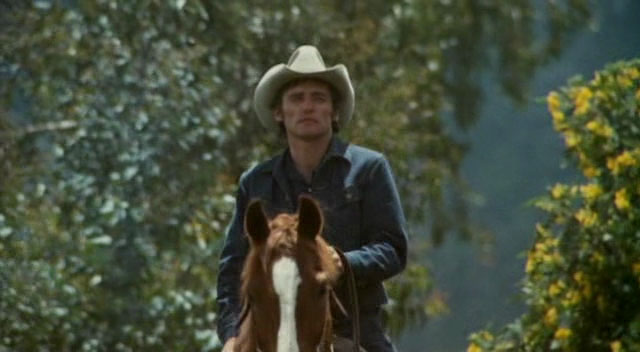
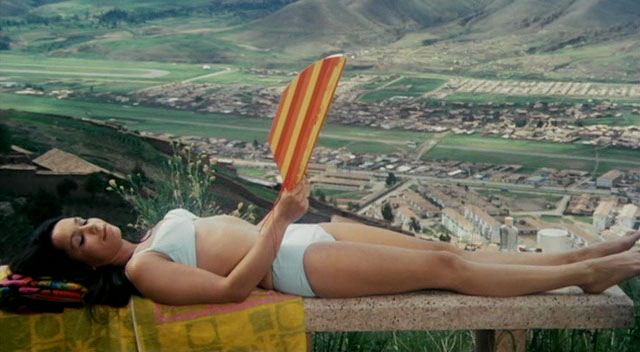
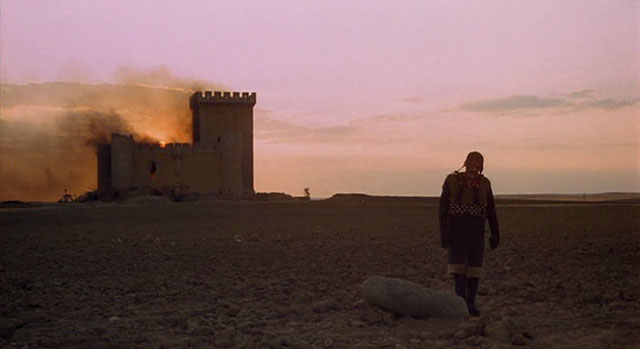
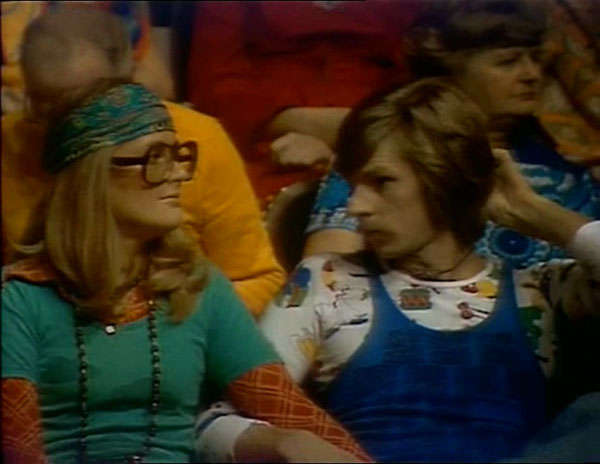
Another sci-fi time-travel political-conspiracy comedy from 1970’s Czechoslovakia. How many could there be? Unsurprisingly, this shares its writers (and some actors) with Tomorrow I’ll Wake Up and Scald Myself With Tea.

In the future year of 1999, a group of terrorist physicists drop “G-bombs” that make all women grow beards and become infertile. Instead of falling into chaos like the stupid civilization in Children of Men, they do what any reasonable person would do – invent a time machine to travel to 1911 and kill Einstein before he can invent the bomb. A historian tells them Einstein will be at a party where a chandelier will fall and narrowly miss him, so they plot to see that his chair is underneath it when it falls. This from scientists who have guns that can kill, work as jetpacks, tie someone up in toilet paper, nullify gravity and make nifty ‘ptoo ptoo’ sound effects – they’re gonna use a chandelier. One guy meets his own father (aged 10-ish) in the past. There are hijinks (film is sped up, slapstick is achieved) and the kid is killed by mistake.

Back in 1999 they explain what happened and try again – but this time things get stupid complicated because at least one other group (incl. the terrorist physicists) go back in time as well. Lots of people are tied up and some cops are confused. Things happen in the dark that I could not make out. Einstein is shot and our guys return home happy – but the historian has fallen in love with Einstein, so she had him fake his death, and she convinces him to follow his other passion and be a violinist instead of a physicist.

Problem solved – the bomb never existed – but back in 1999, a group of terrorist chemists has caused all the men to become effeminate and afraid of women, so the future of the human race is still at risk! Luckily, our hero who invented the time machine now “invents” the atomic bomb and they blow the evil chemists to bits. Einstein (who would be 120 years old in ’99 – I’m guessing they did their plot calculations from 1970 and only added the year 1999 at the last minute) shows up with the historian to play violin.

It’s hardly a hilarious movie, but entertaining enough – and nice widescreen picture. I’m glad someone is out there taking good care of cult Czech films. 25 years later, the guy who played Einstein would star in Svankmajer’s Faust. Lipsky followed up with a kids movie called Six Bears and a Clown, which actually played on CBS.

Not the last film by Billy Wilder, though it feels like someone’s last film – he later made two Lemmon/Matthau comedies and a William Holden drama.

Katy disagreed with the romantic comedy term, saying just because a few funny things happen doesn’t mean it’s a comedy, and suggests the term dramedy as a solution. Long, static master shots are probably praised to the heavens by the critics responsible for landing this on the TSP1000 list for being elegant, masterfully composed, or god forbid, “rigorous”. I found that it sucked energy away from a too-slow movie, which was already disappointing for not being a comedy as advertised. That’ll teach me to trust the IMDB genre listings.

One of multiple chances to see Jack Lemmon naked:
image

Okay, so it is a comedy, it’s just not very funny. Jack Lemmon travels to a vacation resort in Italy to pick up his father who died in a car crash and he meets Juliet Mills (mostly a TV actress, but she’d starred in a British comedy film a decade earlier) who is there to pick up her mother who died in the same crash. Jack is acting like a terrible, entitled jerk American but Juliet finally manages to corner him and tell him that their parents were having an annual affair at this hotel. It’s only a matter of time before she softens Jack and begins carrying on their parents’ affair with him – not that she does much besides smile and look like she’s having a great time. Oh, and there’s a half-hearted side plot when the Trotta family whose grapevines were destroyed by the car crash steal the bodies for ransom.

The Trotta family:
image

The hotel maid is your typical fiery, hot-tempered, lovestruck movie Italian woman – she kills her husband (boyfriend?) for plotting to leave her, so when a U.S. government man shows up to help Jack, acting like the asshole Jack had been seventy minutes prior, Jack gives the guy a coffin with the dead Italian in it, and he and Juliet bury their parents together in Italy. It’s actually kinda sweet. “Avanti!” we learn at the beginning means “come in!” for door-knocking servants and hotel personnel, and inevitably for our romantic couple.

A big deal is made of Juliet being overweight:
image

Carlucci, who runs the hotel and makes sure Lemmon has everything he needs, was played by Clive Revill, a New Zealander in a fake mustache who went on to voice the Emperor in Empire Strikes Back. Crude American diplomat Edward Andrews’ final role was in Gremlins. And at least one of the vineyard Trotta family was in a Fellini movie.

Carlucci with Jack:
image

Set over one year in the mid-to-late 30’s, mostly follows high-school-aged Titta and his family but leaves breathing room for the rest of the town and its inhabitants. The rare ensemble movie that gives everyone a memorably distinct identity without resorting to stereotyping.

On one hand, it would be worth renting the Criterion DVD and poring over the hours of extras. On the other hand, there’s no outside explanation needed for Amarcord. Need to watch this again and again… I’m pretty sure Katy would like it.

The title is slangy for “I Remember.”

I can’t account for why this won an oscar one year (best foreign film) and was nominated for more oscars (writing, directing) the following year.

I always think of “fascism” as a bad word, an insult thrown at your government by foreigners, forgetting that once Italians were screaming their support of fascism in the streets. Nutty buggers.

I don’t think this was packed with movie stars. Red temptress Magali Noël had been in Satyricon, Titta’s mom would appear in Cinema Paradiso 15 years later, and mad uncle Teo would direct a parody of The Exorcist.

So, another great Fellini film, combining the circus-film group atmosphere of 8 1/2 with touches of the tragedy of La Strada, with fortunately no La Dolce Vita influence to be found. I didn’t let the dubbing get me down, but I’d thought a new print of a new restoration of an only 30-year-old film would have more vibrant color than it did.

“If you strangle me, don’t stop midway. It’s too painful afterward.”

image

Kichi runs an inn, makes explicit advances on one of his workers. They begin passionate secret, explicit, OH-so-explicit sexual affair. Eventually he leaves his wife, the girl (Sada) and he move in together having continual sex, the sex gets more dangerous and starts involving knives and choking, and finally he lets her strangle him to death.

I liked Empire of Passion so I thought I’d like Oshima’s celebrated, scandalous arthouse porno even more, but was surprised not to. It’s got less cinematic flair than Passion, and less of a story too. I hate to say it, but all that sex gets boring after a while. Okay I take it back – there’s interesting stuff in here… some cool high shots (see below), a wildly fucked dream sequence where the woman grabs a naked six-year-old’s penis and won’t let go, a geisha gang rape, and some political business (nationalism on the streets, an army march – this is the year before the bombing of Shanghai) completely ignored by our sheltered protagonists, making me think this is a predecessor to Bertolucci’s The Dreamers.

image

Finally, a ridiculous closing voiceover tells us this happened in 1936 and she was arrested a few days later. I thought this was wedged in by the producers, but in his excellent commentary, Tony Rayns tells us that’s Oshima’s own voice.

There’s more weirdness involving an egg, pubic hair consumption, fantasies of Sada killing Kichi’s wife, and a quirky dancing man. The girl has a scorpion tattoo on her ear – Tony didn’t tell us the relevance of that, so perhaps it has no relevance, because Tony knows all. The two have a fake marriage ceremony at an inn (not his inn, this is after they’ve run away) which leads to the geisha gang-rape and the quirky dancing man (below). I am already out of things to say… it’s a pretty simple movie for something so controversial.

image

Produced by Wakamatsu Koji (United Red Army), produced and suggested by Anatole Dauman (Hiroshima mon amour, Masculin Féminin, some Walerian Borowczyk features, Fruits of Passion, La Belle captive, Wings of Desire and Marker’s Level Five – wow).

Original title was Empire of the Senses. I assume the Mekons song Empire of the Senseless, with its lyrics about censorship, is referencing that. Oshima’s chosen Japanese title Ai no corrida (translated: Love’s Bullfight) looks to me like Spanish for Hey! No Running.

image

Tony Rayns:
“Oshima sees himself as standing apart from the consensus. For him, anybody who breaks the bounds of convention, anyone who dares to think for him or herself is in some sense an admirable figure,… hence an overall focus, I think, on the figure of the outlaw in many of his films.”

Most of the people in the film are women, including all the voyeurs (and there are many voyeurs). At the very beginning, a woman tries to initiate some lesbian sex with our hero and is rejected outright. Tony tells us these things explicitly delineate Senses from standard porn films.

image

More Tony:
“No two Oshima films look alike – there is no thing as the Oshima style.”

The geishas all falling upon each other as Sada has painful menstrual sex is “not a realistic detail.”

image

Girl who played Sada appeared the next year in a Kinji Fukasaku film with Sonny Chiba, otherwise not too many acting roles, while Kichi became a fairly successful actor. Typical. Although he was also a known actor before this, while she was just starting out in movies (previously in Terayama Shuji’s theater group). The actor playing an old tramp (glimped in the top screenshot) played the father in Kaneto Shindô’s Naked Island. Oshima didn’t finish his l’amour fou trilogy, and only made three more features and a couple documentaries over the next twenty years.

Seki (Kazuko Yoshiyuko of Lady Snowblood 2, Kikujiro) is married to a decent guy, the town’s rickshaw driver Gisaburo (Takahiro Tamura of 24 Eyes, Seisaku’s Wife), but young Toyoji (Tatsuya Fuji, the killer’s father in Bright Future) falls in love with her and ruins all that. One night, in an unexpectedly frank bit of sexuality (later note: not frank at ALL after watching In the Realm of the Senses), he’s going down on her and orders her to shave. A couple hours later he matter-of-factly tells her that since she’s shaved, her husband will suspect them, so they’d better kill him. So they do, strangling the guy and dropping him down a well. Three years later the townspeople haven’t seen their taxi driver around but his ghost has been spotted, Toyoji seems to spend an awful lot of time at Seki’s house and is seen lingering at the well, Seki’s daughter is asking questions and nobody doubts what’s going on… only a matter of time before the cops (led by Takuzo Kawatani of The Burmese Harp and Battles Without Honor & Humanity) catch up and hang ’em. But things get worse before that – Toyoji kills the young master of the property where he works and Seki goes blind.

As with Senses, this is based on a true murder from 1896. This one has more town life in it, more theatrically heightened colors, maybe more traditionally studio-looking shots. A very Japanese (pre-Ring) ghost, Gisaburo dressed as he was when he died with an all-white face, wordless. Some wonderful shots from inside the well, as seen on the box art. I failed to get screen shots, so I’ve stolen a couple from DVD Beaver. I liked the movie a whole lot… not a groundbreaking story, but well told with a nice visual style.

image

If I may quote heavily from Tony Rayns’ great essay:

What intrigued Oshima so much in the story of Gisaburo and Seki? First and foremost, the fact that it bore witness to an eruption of amour fou in a social setting where such passions were previously unrecorded. Western literature from the Middle Ages to the nineteenth century—from Geoffrey Chaucer to Émile Zola—had acknowledged and explored the sex lives of the rural peasant class, but there was no real Japanese equivalent; the bawdy fiction of the Edo period had dealt exclusively with the love lives of the samurai and merchant classes. Oshima responded to the factual account of a torrid affair between a married mother of two and a recently discharged soldier twenty-six years her junior. … He recognized the story as an interesting counterpoint to the one he had told in In the Realm of the Senses. Sada and Kichi had retreated from the increasingly militarized Japan of 1936 into a private world powered by their own sexual fantasies; Seki and her lover, Toyoji, lived out their adulterous passion in a world circumscribed by the laws of nature and the rural traditions of village life. For Oshima, the key element in the story was their defiance: the realization that their affair and their murder of Seki’s husband would be exposed rekindled their passion and made them recklessly indifferent to their punishment.

Oshima has said that he reads the tradition of vengeful spooks as a phenomenon related to the militarist code of Bushido—which he has always vehemently rejected. He sees Gisaburo’s ghost as coming from somewhere very different; he once told me, “The ghost in Empire of Passion is a farmer’s idea of a ghost, not a samurai’s.” Gisaburo, in fact, accepts his sad fate as passively as Kichi succumbed to Sada’s murderous fantasies in In the Realm of the Senses. He doesn’t return to the village as a ghost because he wants revenge but because he’s an unquiet spirit; he appears beside his old rickshaw because he wants to go on serving his wife and the villagers, and beside the hearth in his old home because he still wants the comforts of a pot of warmed shochu liquor. He represents, of course, the guilty conscience of his murderers, not assuaged by emptying dead leaves into the well where his body was dumped, and the collective disquiet of the community that a crime has gone unpunished.

Where is Oshima himself in all of this? … The figure he is closest to is the village’s young master, who also represents the author in Nagatsuka’s novel; he’s the most educated person in the community, the most clear-sighted, and the most ineffectual. First seen at his wedding ceremony, he’s played by Kawarazaki Kenzo, the same actor who stood in for Oshima in the tortured family saga The Ceremony. The young master stands for modernization and “progressive” ideas, but he’s fated to be silenced by an ex-soldier who can think no further than self-preservation. The character’s death suggests that the pessimism that led Oshima to abandon filmmaking in the early 1970s was undimmed.

image

Oshima:

The space in Senses was delineated by the different rooms of love. It was artificially created, completely designed for voluptuousness. On the other hand, in Passion it is all about nature. Seki has a house where she lives with her husband, and Toyoji a small hovel that he shares with his young brother. Neither of these places is artificial. The two lovers live in fear because they constantly feel threatened by nature. I am trying to depict the human condition in its primal stage. In that sense, my new film goes back to the roots of all life, much more deeply than Senses ever did. The lovers seem cast into hell because of their sexual urges, but in my opinion, the rumbling of the earth, the murmur of the wind, the rustling of the trees, the songs of the birds and insects, in short, all of nature, is guiding the couple into hell. And the ghost itself is part of nature. Neither sex nor love has any meaning. Life itself has no meaning. And if it doesn’t have meaning, isn’t it hell? All I can do is express and project before you this human life devoid of any meaning, this hell that for me is always beautiful.

I found, several years after directing my first films, that I was very attracted to these two topics, sex and crime. Subsequently, my films have addressed them in a very analytic way. Today, I’m at a stage where I simply like to project the naked reality of sex and crime before the spectator’s eyes.

Marsh, director of Wisconsin Death Trip, weaves stock footage (shot by the participants), current interviews and re-enactments to show how Philippe Petit and associates snuck to the top of both Twin Towers one night in ’74 and shot a line across their roofs for Petit to walk and dance upon. Pretty unbelievable stuff, kinda sad and inspiring. I flashed back to Maddin’s comments on lost buildings of his youth in My Winnipeg as much as I paid attention to the screen.

I wanted a lock-groove Michael Nyman score to propel the movie into a screaming intensity, but that never happened. Recognized a few other music pieces, which I suppose were “In The Hall Of The Mountain King”, “A Fifth of Beethoven” and Erik Satie.

David Edelstein: “It goes without saying — and happily, Man on Wire doesn’t say it — that all this took place in a more naive time, that the notion of foreigners with fake IDs slipping past guards into the Twin Towers has a different meaning now. So does the prospect of falling from the top.”

I’ve always wondered about this one. In my mind it represented all the non-musical Potter plays, the other half of his career, and so I had to coax myself into finally watching it for fear it’d damage my image of the great man. Liked it for sure, but don’t think I would’ve been hooked if this was the first one of his plays/adaptations I’d seen. Well-written, subversive, but dark as all hell… I am surprised this guy was allowed to work in television.

Over two decades before The Blair Witch Project:
image

Michael Kitchen (Out of Africa, recurring role in recent James Bond flicks) is Martin, an evil young man who bumps into strangers on the street and tries to convince them that they know each other. Denholm Elliott (A Room with a View, Bad Timing, best known as a good guy in the Indiana Jones movies) almost falls for it then ditches him, but Martin stole Elliott’s wallet, takes it home and easily talks his way into the house with the wife Patricia Lawrence (in Potter’s Son of Man a few years earlier). Martin sees that their daughter Pattie is lying brain-damaged at home and fakes that he was an ex of hers who was turned down for marriage, offers to help care for her, acts ever so polite. Elliott is suspicious but doesn’t move fast enough, and Martin integrates himself. The wife might be gullible, but she’s also so weary from taking care of Pattie constantly and jumps at the chance to leave her in compassionate hands for a few hours each day. One night when Martin is about to rape Pattie for at least the second time, she wakes up screaming, aware of herself at last, and Martin flees, immediately starts looking for a new family.

Move mouse over image to see Michael Kitchen get over-excited:
image

Barry Davis (who also directed Potter’s Schmoedipus the same year) keeps things lively on a miniscule budget. The not-at-all-naturalistic lighting effects (see first screenshot) are especially nice. From the initial street scene on, it stays remarkably intense, bizarre and horrifying. Martin has supernatural powers and hairy demon feet. He talks politics with the family, encourages their own worst impulses. Potter writes: “Deport them, that’s what I say. England for the English” into the mouth of the devil. Then of course there’s the home invasion aspect, the rape of a mentally damaged girl and the miracle ending. This was banned for eleven years (“brilliantly written and made, but nauseating”) – that’s why IMDB lists it as a 1987 release. The theatrical remake starring Sting was actually the first version released in the UK.

Denholm Elliott:
image

My favorite line… having some brandy – “There’s fluoride in the water, so are you able to drink it neat, dear?”

“He was the first and only zoopraxographer.”

image

Hour-long doc about the man who invented a form of motion photography (the famous series of tripwire-triggered photos of horses running), spending half his career as a successful still photographer, and the other half capturing and studying human and animal motion with his zoopraxiscope.

Visually, the movie is mostly composed of Muybridge’s work, nicely assembled and presented, including moving reproductions of his motion series. Voiceover tells us his story (memorable detail: he was acquitted for murdering his wife’s lover in 1875).

For his location still photography Muybridge (pronounced “Edward Mybridge” – people added extra letters to seem fancy back then) travelled with a “darkroom wagon”, foreshadowing Medvedkin’s cinetrain.

Muybridge photographed the effects of the Great San Francisco Earthquake… but not the one in 1906 – this is from October 1868!
image

Muybridge died in 1904, having seen the birth of Edison’s cameras and Lumiere’s cinema which shuttled his own inventions to the sidelines. It would be 90 more years before The Matrix would combine Edison’s motion photography with Muybridge’s circular camera arrays to create the bullet-time effect. Muybridge’s photographs of San Francisco are valued as a record of the city before it was leveled by the Even Greater Earthquake of 1906.

Movie is narrated by two-time Cannes best-actor-winner (and future Blue Velvet crooner) Dean Stockwell. Editor Morgan Fisher went on to make that movie I read about which is composed of all insert shots, and the same year, director Andersen made the stock-footage masterpiece Los Angeles Plays Itself. All Movie Guide says this film took ten years to make, and J. Rosenbaum calls it “one of the best essay films ever made on a cinematic subject.”

Muybridge self-portrait:
image

Fifth movie by writer-turned-director Cohen, and it’s surprisingly good – better and less campy than The Stuff. Tightly written (gets a lot done in 90 minutes) and fun to watch, kinda the opposite of Cohen-penned-but-not-directed Maniac Cop. Has that dull 70’s color, with get-the-job-done cinematography, but some odd creative shots keep things lively.

image

A sniper starts shooting citizens with fake-blood paintballs, causing them to boogie wildly in the streets. Pained-looking detective Peter Nicholas (Tony Lo Bianco of The Honeymoon Killers) goes up to talk to the killer. Asks his motivation, and we have our title. In a TV montage, the killer’s mom provides a sweet JFK-conspiracy reference and an announcer with a washcloth in his mouth gives us exposition.

Our freaked-out hero:
image

Our cop Tony goes home to his girl Casey (Deborah Raffin of Scanners II, who wears giant joke glasses throughout the film for some reason) and fakes like he’s going to finally divorce his separated wife Martha (doomed-looking Sandy Dennis of Who’s Afraid of Virginia Woolf, 976-EVIL)… but Tony is super-Catholic, which means lying to his live-in much-younger girlfriend is okay, but divorce is absolutely not.

image

More crazed killers take out more innocents, and obsessed Tony makes it his job to confront them all and ask “why did you do it” right before they commit suicide. He seems to be the only cop working on the biggest case in town. In middle of the St. Patrick’s Day Parade, cop Andy Kaufman (!!!!!!!) shoots some people. Mesmerizing scene, both because I’m wondering what Kaufman (a year after his mighty-mouse SNL debut) is doing in this movie, and because the crowd is so well-integrated into the scene that it looks like the parade was staged for the film, unlike the crappy parade shootout in Maniac Cop.

I’m not kidding – you can ask anyone. That’s Andy Kaufman.
image

This time Tony was warned beforehand of the killings by a beardy cultist (Sam Levene of Sweet Smell of Success and some 40’s noirs). Tony sleuths out that each of the killers had talked to a blurry-faced young man named Bernard (who later turns out to be Full Moon Pictures regular Richard Lynch). Movie now goes wacky… Tony finds the suspect’s mom, who reveals (via a sepia-toned nudity-filled flashback) that she was impregnated by God, a virgin when her hermaphroditic “son” was born – but due to some visual details in the flashback, the audience suspects not God but aliens. Tony talks a War of the Worlds-referencing polka-dot-hatted science editor at the newspaper into printing the story, which refers to Tony as a “suspended lieutenant” (we didn’t get a scene of his suspension, but if we were wondering why he never spends time at the station with other cops, now we know – that’s some script efficiency!). Meanwhile, seemingly undoing that script efficiency, a velvet-jacketed pimp stabs a cop on a stairwell with no connection to anything else.

image

Tony tracks down God, who turns out to be a glowing, nightie-wearing hippie basement-dweller who makes our cop see fires everywhere but seems to be unable to control his mind like he can control others. Why is this? Well, in the next scene, Tony visits a woman in a derelict nursing-home with a similar story (alien abduction, virgin birth, this time shot with greens and oranges with a disturbing closeup on a rubber vagina) played by Sylvia Sidney (of Fury and You Only Live Once in the 30’s, and recognizably the Slim Whitman-loving grandma in Mars Attacks!) and finds out he is her son, therefore the half-alien kin of God.

God:
image

Back to Tony’s personal life, Martha (who now looks like she has a cold) meets Casey for the first time, and the third line Casey ever speaks to the wife of her boyfriend is “why weren’t there any children?” Tacky, but there’s that efficiency again! Tony catches up with the cop-killer pimp and practices his God-powers by making the guy kills his friends then himself, then confronts Bernard-God, who has a vaginal Jesus-wound in his side (a born counterpart to Marilyn Chambers in Rabid) and strangles him (willowy, psychic Bernard-God doesn’t have much practice with physical activity).