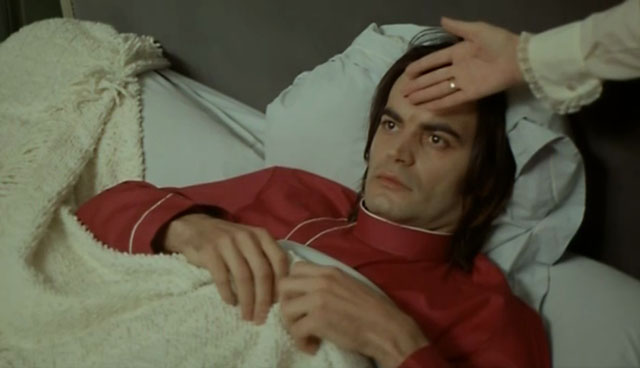
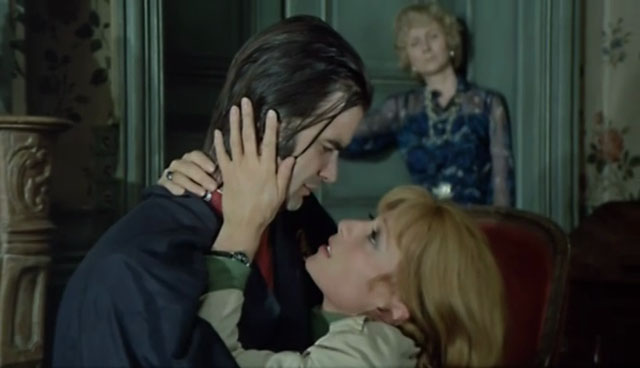
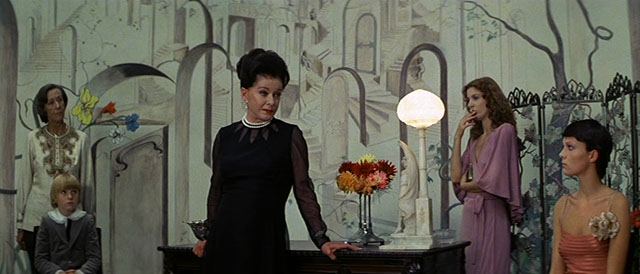
Think this is one of those seminal films that make people foam at the mouth about the 1970’s being the best-ever movie decade. Usually I’m skeptical, but this one lives up to the rep. Can’t believe it took me this long to watch it. One of Altman’s scattershot ensemble pieces illustrating life, sex, violence, media and politics over one weekend in the mid-70’s, closer to the messy truthfulness of Short Cuts than the more conceptually-unified Prairie Home Companion. Plot, then, defies simple description, so here are a bunch of character sketches instead.

Solo Opry stars:
Tommy Brown and Haven Hamilton (Henry Gibson, suspicious neighbor in The Burbs) are the friendly male stars, while Connie White (Karen Black of Burnt Offerings, House of 1000 Corpses) and Barbara Jean (Ronee Blakley, Nancy’s fred-krueger-killin’ mom in Nightmare On Elm Street) are bitter rivals. BJ is recovering from exhaustion, acts slightly crazy throughout the picture.

The Trio:
Up-and-coming band “Tom, Bill & Mary” consists of relatively uptight Bill (Altman regular Allan Nicholls), Mary (Christa Raines of Ridley Scott’s The Duellists) who is married to Bill but secretly sleeping with Tom, and bearded free-spirit Tom (Keith Carradine of Street of No Return) who sleeps with near every girl in the movie.

Politicians:
Third-party candidate Hal Phillip Walker (inexplicably running in state “primaries” in a misuse of political language) is often heard but never seen. His campaign manager John Triplette (Michael Murphy of Tanner ’88, X-Men 3) is everywhere, trying to recruit music stars for a rally. Del Reese (Ned Beatty of Deliverance, Network, Stroker Ace) is a heavy dude assisting Triplette. Triplette basically tricks Haven and Barbara Jean into appearing at the climactic rally.

Media:
Off on her own is BBC journalist Opal (Geraldine Chaplin, the year before Noroît). I was happy to see her at first, but her character is so awfully self-absorbed and oblivious to the world and personalities that she’s purportedly researching, she soon became mere comic relief.

Crazies:
The ever-present magician-looking guy on a three-wheeled hog was Jeff Goldblum’s third movie role (California Split was his second). Shelley Duvall, in the middle of her Altman film streak (ended with Popeye) plays a flamboyant girl often explained away with “she’s from California.” A boarder at her house named Kenny shoots Barbara Jean at the rally in the final scene, and the guy who tries to stop him, army private Kelly (Scott Glenn, just played Rumsfeld in W.) has been stalking B.J. throughout the movie. Poor Sueleen Gay (a great name, played by Gwen Welles of California Split) is an enthusiastic red-haired waitress who wrongly thinks she can sing, reduced to strip-teasing at a pre-rally bar party.

The Rest:
Sueleen’s coworker Wade looks out for her. Sad Mr. Green (Keenan Wynn, guy leading the attack on General Ripper in Dr. Strangelove, also in Point Blank, Piranha, Laserblast, Parts: The Clonus Horror) is the California girl’s uncle; his wife dies in the hospital. Barnett (Allen Garfield of Brian De Palma’s early films) is Barbara Jean’s controlling husband/manager. And Lily Tomlin, in her first film, is campaign fella Del Reese’s wife, mother of two deaf kids, who sneaks away to sleep with former flame Tom of the trio.

Movie made piles of money. Won piles of awards except at the oscars (lost to Cuckoo’s Nest), baftas (Alice Doesn’t Live Here Anymore) and grammies (Jaws). Acting awards were difficult – Golden Globes gave it four nominations just for best supporting actress, surely a record. Lots of gossipy maybe-true bits online: Nashville was going to be two movies, the unused footage was to become a miniseries, and a sequel was written and cast before falling apart.
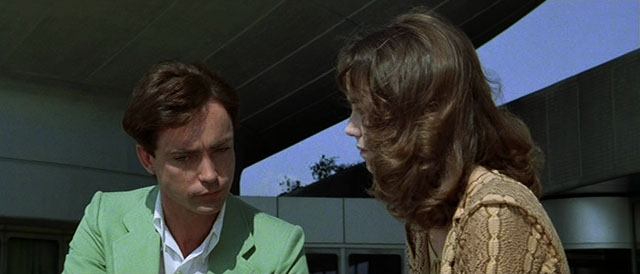
Shot in wide-ass cinemascope with no close-ups (by the D.P. of Coffy and Silent Movie), so screenshots aren’t much help. Would be reeeeal nice to see on the big screen someday. Did not play the DVD commentary by Robert Altman because I didn’t want to listen to him drift in and out of sleep for 2.5 hours.

Since Fantoma is not ever going to release this on DVD (with Christa Lang commentary) like they promised to do, the dirty rats, I found a copy elsewhere and finally watched it. And it’s good! Criterion started our national reappraisal of the great Sam Fuller mid-career with The Naked Kiss and Shock Corridor, then moved on to the early films with that Eclipse set, now this week they’re hitting his late period with White Dog, so I’m participating with this pre-Big Red One episode from his forgotten days in the ghetto of television.

This is an episode of a German cop show from 1970 which is still running. I can’t imagine why an American director was allowed to write and direct a German TV episode in English… we’d certainly never invite Werner Herzog to shoot an all-German episode of Law & Order. The producer must’ve been a Naked Kiss fan. Anyway, it’s over 90 minutes long and there’s no indication of regular characters or a running plot or a teaser for next week’s episode, so I’m not sure what format this cop show takes… this played like a standalone film in TV picture-ratio.

I enjoyed the movie quite a lot. It’s technically excellent at times, but when time or budget didn’t allow for excellence they played it loose and fun. Acting isn’t so strong – Christa (Sam’s wife) overdoes it at times, and lead man Sandy (Glenn Corbett of The Crimson Kimono) is generically TV-crappy. I wouldn’t call the incidental music by “The” Can amazing, but has its moments. Fuller (or whoever) gets points for hiring the ultra-hip Can in the first place. The double-agent spy story is pretty cool, but the way it’s pulled off visually is beyond cool. Check it:

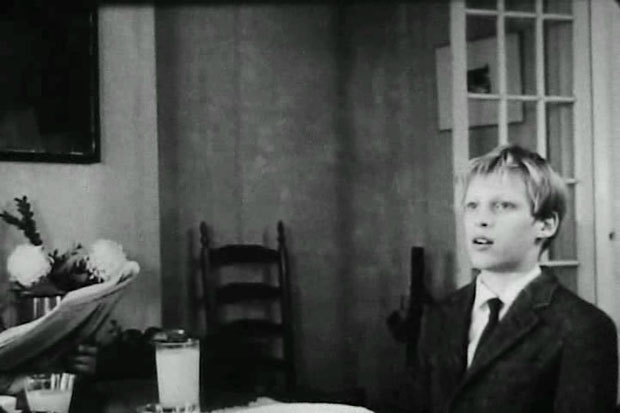
How our hero is introduced – he’s the dude in the middle, and that’s his murdered partner on the table:
image

How Christa is introduced, walking past a giant poster of Frank… this movie is very clued-in musically:
image

Some Citizen Kane hole-in-the-floor cinematography:
image

Fuller is having fun with this movie. They watch Rio Bravo, there are characters named Novak and Bogdanovich, and Fuller cameos offscreen as The Senator with a framed picture of Nixon on the wall and a novel by one Samuel Fuller prominently placed on the desk.
image

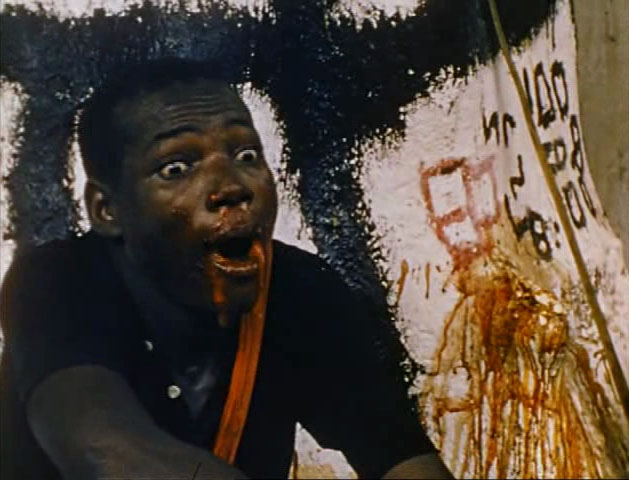
And then there’s this guy, with the fantastic name of Charlie Umlaut. I’m not sure what his deal is – I think he might’ve killed our cop’s partner, then at the end he shows up in a parade in clownface, screaming his own name until he’s caught and killed. Whatever it meant, it certainly livened up the picture.
image

Very nice cinematography of German cities (Bonn, Cologne) by Jerzy Lipman, who shot early Wajda films and Knife in the Water.
image

Oh right, the plot. Christa works for fey evil rich guy Mensur. She drugs famous people, poses with them in lewd positions, then blackmails them with the photos. Sandy, our cop, shows up far-fetchedly claiming to be in the same business and happening to pick Christa to perform the same job she does for Mensur. Eventually she’s in on his plot and supposedly helping him, but it all gets twisted up, and in the end he’s challenged to a hilariously unconvincing fencing duel in Mensur’s office, which Mensur inexplicably loses.

Mensur, top, is Anton Diffring (of Tusk and Fahrenheit 451).
image

Christa:
image

Christa:
image

Christa!
image

Even in a year of crazy films like The Wicker Man and Touki Bouki, ain’t nothing crazy enough to sit with The Holy Mountain. This was the last of Jodorowsky’s fully-realized features until Santa Sangre (nobody, AJ included, seems to like The Rainbow Thief or Tusk).

Third shot of movie: Director/Alchemist with women who will soon be shaved:
image

First half-hour is free-flowing. A Thief (who I didn’t realize never speaks) wanders with a deformed dwarf, getting beaten up and attending a toad-and-chameleon circus, while around them dissidents are executed, riot police hold a dead-animal parade, and priests pick up underage prostitutes. Finally the thief breaks into a mighty tower occupied by The Alchemist (Jodorowsky himself) who cleanses him, turns his shit into gold, and then introduces our other characters and their corresponding planets:
– Fon/Venus – narcissist who runs fashion & cosmetic companies, slave to his dad
– Isla/Mars – major arms manufacturer
– Klen/Jupiter – sex-obsessed artist
– Sel/Saturn – makes war toys to prejudice kids vs. countries we plan to invade
– Berg/Uranus – murderous bureaucrat
– Axon/Neptune – ruthless mohawked police chief with testicle collection
– Lut/Pluto – futuristic architect, designing sleep-chamber apartments
(I had to look some of those up – movie is sensory overload, I forgot stuff)

Three chameleons prepare to defend Mexico from the toad invasion:
image

Kind of a Jesus/disciples thing, but is the Thief Jesus or is the Alchemist? They go through intensive spiritual training, then Alchemist leads them to the Holy Mountain atop which nine ancient immortals control our planet, with the goal of deposing them and becoming immortal themselves. Each traveler has a dream of their own bizarre death, but they continue to the table at the summit, where they find dolls in the seats. Sitting down, camera pulls back to reveal Jodorowsky’s lighting and sound crew, and he proclaims the truth: “We are images, dreams, photographs,” freeing them from the film itself.

Atop The Holy Mountain:
image

Haven’t checked out the commentary yet (tried to listen at work, but of course it’s in Spanish), but in a modern interview online, Jodorowsky says he never killed animals for his movies – not even the rabbits in El Topo. That’s surprising, but I’ll take the guy at his word. He also says he became a feminist during the making of Holy Mountain, and indeed it’s hard to think of movies less feminist than his previous two. He’s a fan of Lynch, Cronenberg and Starship Troopers, and I wish him luck with his long-delayed Lynch-produced next movie.

Alchemist & Thief in chamber of mirrors:
image

Cinematographer Rafael Corkidi shot The Mansion of Madness the same year. A few of the actors have popped up elsewhere… Lut/Pluto had a small part in The Exterminating Angel, Axon/Neptune was an Oliver Stone collaborator throughout the 90’s, and Fon/Venus plays the lead girl’s dad on the show Rebelde.

Our director:
image

After Calvaire and Frontier(s), it’s the third movie this week with a hair-shaving scene.

Shot immediately after Nosferatu. Kinski looks worn out, stupid and insane. IMDB says “The entire 80-minute film was shot with only 27 cuts.” but I remember five or six in the opening credits alone, so nice try. I didn’t know there was a best supporting actress award at Cannes, but Eva Mattes won it. Movie was trounced by Tin Drum and Apocalypse Now for the grand prize, though, and it’s not on either of the top 1000 movies lists that I track, but it’s now on mine. Looks just like Nosferatu, same crew worked on it. All giant buildings and city and space dwarfing our characters. Feels like a play – you can totally tell the way people talk to themselves that it was written for the stage. Dialog is awesome. Writer Georg Büchner is famous mostly for Woyzeck, and this is one of twenty film adaptations of it.

image

Kinski is a soldier, or a military barber I guess, in the 1800’s. He’s seeing Marie, and has been for a while since they have a son together. Lately Marie likes a drum major, no surprise since Kinski is completely nutty and nervous, due in part to the all-peas diet his doctor (above) has him on. After a movie’s worth of foreshadowing that crazed Kinski will kill someone and most likely his wife, he kills his wife down by the river. That’s it, except the film and script are way more poetic than my description.

The Noroit-ian band:
image

V. Canby in the Times: “At the heart of each Herzog film is a mystery, not because information is arbitrarily withheld, but because every Herzog film is a record of the director’s questions and speculations about his subject — which is, I suspect, why he chooses to do the films he does. To do anything else would be storytelling of a kind that doesn’t interest him. Questions for which the answers are simple aren’t worth asking.”

image

The Drum Major had been in Herzog’s Heart of Glass, would eventually turn up in Haneke’s Code Unknown. The Captain had been in Herzog’s Signs of Life after small parts in Rivette and Welles films. Eva Mattes had been in Strozek and In a Year of 13 Moons.

image

Shadow of the Vampire should’ve portrayed Klaus Kinski as a demon instead of Max Schreck. Anyway, I’d like to see Malkovich playing Werner Herzog.

Watched this the same month as Trouble In Paradise, not having guessed how connected the two would be – the book/script of Stavisky even mentions that they stole shot ideas from Paradise. This one seems like a correction to the other, set during the same year with some of the same reference points (such as Trotsky) but here the upper-class gentleman thief is revealed to be a sham, and rather than escaping at the end to start over with his true love, the thief ends up dead, his widow in prison. The final shot is the chauffeur (of the period Rolls they drive everywhere) placing a bouquet of white flowers for her outside the prison.

Bright and lively music by Stephen Sondheim (who had already won three Tony awards in the 70’s) kept the doomed inevitability away until it was too late. Sondheim had already won three Tony awards in the 1970’s by the time Stavisky came out. It’s one of the very few times he’s written music (more than one song, anyway) for films – the other cases were Warren Beatty’s Reds (another movie featuring Trotsky!) and Dick Tracy.

image

Another story by Jorge Semprún, who wrote the exile-themed The War Is Over. One of Stavisky’s associates (Juan Montalvo, a slimy guy who hits on Arlette but can provide Serge with lots of money) was funding the attempted coup in Spain which led to the Spanish Civil War. In researching the film Semprun found that the same police inspector (named Gardet in the movie) assigned to watch over Leon Trotsky in France was also assigned to report on Stavisky, so Trotsky’s exile was written into the movie, as witnessed by a kid named Michel Grandville. The movie is bookended with Trotsky – first arriving in France, beginning his exile from Russia, and at the end after the Stavisky scandal, being moved further into exile, far from Paris, his political influence feared by the conservatives. Stavisky himself is a Russian Jew in exile – so there are a few connections to the previous film.

The paperback book says it “represents the final scenario” for the shooting of the film, and the intro by Richard Seaver addresses something I had wondered about after reading The War Is Over and believing that Semprun’s script was shot word-for-word with very little added by Resnais: “Once the subject is established, the writer does an initial draft, or treatment, after which writer and director discuss it scene by scene, often line by line, in excruciating detail, until the distinction between writer and director blurs or disappears.” So in fact the books by Semprun represent the collaborative vision of he and Resnais – my beloved auteur is no longer in peril.

The real Serge Alexandre Stavisky was involved in ever-larger finance fraud and was connected with people high up in French government, and when this was made public in January 1934 it led to riots, deaths (incl. the semi-suicide of Stavisky himself), trials for his friends and widow (all acquitted the following year) and political upheaval. Not knowing much about French politics, the Wikipedia articles are hard to follow, but it seems the ultra-conservatives tried to overthrow the leftists in power – eventually one leftist resigned, a conservative replaced him, and somehow socialists ended up in power.

Belmondo, a decade after Pierrot le fou and still looking the same:
image

Jean-Paul Belmondo as Stavisky/Alexandre is dazzling, a con-man with absolute confidence in himself. Arlette is his glamorous wife, and he’s surrounded by associates, some complicit in his underhanded dealings like assistant Borelli and Serge’s in-pocket doctor (Michael “Thomas” Lonsdale) who keeps declaring Stavisky unfit to stand trial for a six-year-old fraud offense… and some are just content to spend time with Stavisky, enjoying his company and not asking questions, like friend Baron Raoul (an outstanding Charles Boyer).

Arlette: Anny Duperey’s debut was seven years earlier in Godard’s Two or Three Things I Know About Her.
image

The book says “Barol Raoul’s looks, gestures, diction and bearing are those one would expect a baron to possess in those films where barons play a part.” That’s hilarious… I hope those are the character notes they gave to Charles Boyer.

This was French superstar Boyer’s second-to-last film. I saw him as the star of Fritz Lang’s not-so-good Liliom. He is the second actor I’ve seen lately (after Maurice Chevalier) claimed to be the inspiration for Pepe le Pew.
image

As Stavisky’s right-hand man, beloved character actor Francois Périer of Nights of Cabiria, Orpheus, Le Samourai, also narrated some Chris Marker films. From the book: “Albert Borelli’s face is impassive, but he has a sharp eye. He is a man of few words but not of few thoughts.”
image

No wonder I had trouble with inspectors Bonny and Boussard – it’s complicated. Boussard arrested Stavisky years ago, and a couple years afterwards Serge became Boussard’s “informant” – actually Serge pays Boussard to keep an eye on things inside the police department, and the informant thing is just a front so they can meet. Bonny has it out for Serge, hires the blackmailer who comes to the theater during auditions to extort money from Stavisky by threatening to expose his past, and later engineers the police raid during which Stavisky shoots himself. Plus I always have to look hard to tell which Inspector is which, since they look and dress the same.

Inspectors Boussard (left, Marcel Cuvelier, also played an inspector in The War Is Over) and Bonny (right, Claude Rich, star of Je t’aime, je t’aime):
image

Bad Boy Bonny:
image

Michel Grandville (Jacques Spiesser of The Man Who Sleeps and Black and White in Color) and Erna Wolfgang (Silvia Badescu), who auditions for a part at Stavisky’s theater (he reads with her, playing a ghost – see quote below):
image

Lonsdale, after “Serge Alexandre” tells him to get rid of Stavisky and his problems: “The person he once was has become someone else: a ghost he despises. But a ghost who worries him.” And later: “To understand Stavisky sometimes you have to forget files. You have to dream of him and to imagine his dreams.”

Dream doctor Michel Lonsdale:
image

Gérard Depardieu got his break as a star just two months earlier. Here he has one scene as an excited young inventor trying to get Stavisky to invest in his product:
image

And back to Erna Wolfgang. I just liked this shot.
image

One more look at Thomas:
image

I wasn’t in love with the movie after I watched it, seemed like a really well-done portrayal of a controversial man with great acting and an over-complicated plot, but reading the book afterwards cleared up all the characters and the structure of the whole thing, and thinking back on the story, acting and photography, I’m now liking this better than The War Is Over. Nobody here is a good guy – not even Bonny, who goes against police corruption but for personal & political reasons – but the movie doesn’t judge them, or go into the details of the scandal. It just gets inside their characters and shows where the scandal came from, how one guy’s belief that he could fake his way into the upper echelon ended up shaking the country.

image

Fast, Cheap and Out of Control was the last movie in my documentary month series with Katy, but now Jimmy is doing his own documentary month. Katy didn’t come to this one (sadly, since it was better than almost any of the movies we watched at home). Story of coal miners in Kentucky who decide to join a labor union. The mine won’t recognize the union, so they strike. Tensions escalate between the old miners and the new scab workers, finally one of the old miners is shot and killed. A day or two later the mine lets them back to work, the union in place. Then a couple months after the year-long strike, another strike, this organized by the union leaders for higher pay and safer conditions.

Wonderful story, engrossing movie, with great bluegrass music. I’ll bet Chris Marker liked it.

Won best doc at the ’77 Oscars. Barbara Kopple went on to co-direct Dixie Chicks: Shut Up and Sing, a movie I was just mocking in the video store the other day. IMDB trivia: “When filming began, the film was intended to be about the 1972 campaign by Arnold Miller and Miners For Democracy to unseat UMWA president Tony Boyle, in the aftermath of Joseph Yablonski’s murder; but the Harlan County strike began and caused the filmmakers to change their principal subject, with the campaign and murder becoming secondary subjects.”

“Why sometimes do images begin to tremble?”

From the film:

1967 saw the arrival of a rather peculiar breed of adolescents. They all looked alike. They would immediately recognize each other. They seemed to posses a silent but absolute knowledge of certain issues but to be totally ignorant about others. Their hands were unbelievable skillful at pasting up posters, handing paving stones, spraying on walls short and cryptic messages which stuck in the memory, all the while calling for more hands to pass on the message they’d received but had not completely deciphered. Those fragile hands have left us the mark of their fragility. Once they even wrote it on a banner. “The workers will take the flag of struggle from the fragile hands of the students.” But that was the following year.

image

Watched the 3-hour 2008 edit with English narration. There are so many versions of this out there… maybe next time I can watch the 2008 or 1977 French with subtitles.

I thought I’d have more to say about it… three hours’ worth of Chris Marker’s most celebrated film, but I don’t really. Marker is mainly credited as an editor here, arranging others’ footage to show a bigger picture. There’s no wall-to-wall narration, just pops up occasionally. And I’m starting to notice a real sadness beneath many of Marker’s films… the same feeling in Chats Perches is present here. Glad I prepped a little by watching Sixth Side of the Pentagon and Battle of Chile, but I still had to check on wikipedia to see what exactly happened in Bolivia (Che Guevara killed Oct. 1967) and Prague (Jan-Aug 1968, attempted reform of Czech socialism led to 30 years of Soviet military occupation). The movie isn’t here to teach basic history of revolution – assumes you know something already, and since I quit reading The People’s History of the United States before it reached the 1900’s, I do not. Still, was able to follow the movie, thought lots of the footage was excellent, enjoyed watching and learned a little. Some segments have little gems of Marker wit in their editing or narration, but much of it is making connections between different scenes of revolution, both real and wishful, and thinking about what has been achieved, what might have been achieved. Really have to watch again sometime.

image

Either this was an early use of the electronic soundtracks that Marker would use in Sans Soleil and beyond, or the sound on my copy of the movie was pretty badly distorted. Or, more likely, both. The sound got worse during part two – there were some sections when I couldn’t make out any of the (English) dialogue.

image

Video and audio footage by: Pierre Lhomme (Mother and the Whore, Le Joli Mai, Army of Shadows), Etienne Becker (The Spiral, Le Joli Mai, Malle’s Calcutta), Michele Ray (Latcho Drom), Francois Reichenbach and his crew, Harald & Harrick Maury (The Owl’s Legacy, Day For Night, In the Year of the Pig), Théo Robichet (Band of Outsiders), Pierre Dupouey (Silence… on tourne), Raymond Adam (Jodorowsky’s Tusk), Paul Bourron of the Dziga Vertov Group, Willy Kurant (Far From Vietnam, Masculin-Feminin, Pootie Tang), Peter Kassovitz (Jakob the Liar), Paul Seban (Welles’s The Trial), Michel Fano (Rivette’s The Nun), Fernand Moskovitz (Last Tango in Paris), Yann Le Masson (Je t’aime moi non plus), Mario Marret & Carlos de los Llanos (À bientôt, j’espère), Jimmy Glasberg (Sans Soleil, Shoah), Robert Dianoux (Africa, I Will Fleece You), Jean Boffety (Thieves Like Us, Je t’aime je t’aime, Adieu Philippine), Robert Destanque (Joris Ivens’s The Threatening Sky), Hiroko Govaers (Terayama’s Fruits of Passion), Michel Cenet (Celine and Julie Go Boating), and an excerpt from Volker Schlöndorff’s The Lost Honor of Katharina Blum. That is quite a list of collaborators, though you never hear anyone talking about them.

image

English voices: Jim Broadbent (Brazil), Cyril Cusack (Fahrenheit 451), Robert Kramer (dir. Ice, Against Oblivion), Alfred Lynch (The Hill), and numerous British 1970’s TV actors.

“You can never tell what you might be filming.”

Quotes and other reactions:

Icarus Films calls it an “epic film-essay on the worldwide political wars of the 60’s and 70’s: Vietnam, Bolivia, May ’68, Prague, Chile, and the fate of the New Left.”

image

J. Hoberman: “Marker begins by evoking Battleship Potemkin, and although hardly agitprop, A Grin Without a Cat is in that tradition—a montage film with a mass hero. Unlike Eisenstein, however, Marker isn’t out to invent historical truth so much as to look for it. (The untranslatable French title, Le Fond de l’air est rouge, is a play on words suggesting that revolution was in the air but not on the ground.)”

Paul Arthur: “In its rhythms and editing structures, Grin tries to embody the very shape and textures of historical transformation, rendering the abstraction of change as an amalgam of rapid, plurivocal, uneven, and, at times, contradictory forces aligned in provisional symmetries encompassing past, present and future perspectives.”

image

Y. Meranda: “The editing de-emphasizes the narrative structure and instead stresses the poetical interrelationships of the sequences by putting almost all of them out-of-context. … Paralleling the visual editing, the sound editing is more based on poetical considerations than on intellectual ones. … Because there is very little attention paid to the intellectual arguments and because the style goes beyond making statements about a political ideology, A Grin Without a Cat becomes much more than a left wing documentary about the left: It achieves to be a poem about revolting against the system (and not just the political system), the conformity and the order. It suggests that it is an eternal struggle that is supposed to fail (as was in the case of the New Left) most of the times. This universality, achieved by Marker’s distinctive style, is what makes the film great.”

image

Excerpts from the Lupton book:

“Marker explicitly pitched the film against what he saw as the historical amnesia surrounding the period promoted by its treatment on television, where ‘one event is swept away by another, living ideals are replaced by cold facts, and it all finally descends into collective oblivion.'”

Movie is partially composed of outtakes from other projects. “Introducing the published script, Marker wrote that he had become curious about all the material that had been left out of militant films in order to obtain an idealogically ‘correct’ image, and now wondered if these abandoned fragments might not yield up the essential matter of history better than the completed films.”

“As a groundbreaking work of visual historiography, Le Fond attempts nothing less than to give cinematic form to the chaotic and contradictory movement of world history during the tumultuous decade that it covers.”

“The reappearance of cats, even in this thoroughly politicized context, is a signal that Chris Marker was beginning to re-emerge from the anonymity of unsigned militant productions and to reintroduce into his work the familiar tokens of his own distinct presence.”

image

Chris Marker:

Scenes of the third World War 1967-1977

Some think the third World War will be set off by a nuclear missile. For me, that’s the way it will end. In the meantime, the figures of an intricate game are developing, a game whose de-coding will give historians of the future – if they are still around – a very hard time.

A weird game. Its rules change as the match evolves. To start with, the super powers’ rivalry transforms itself not only into a Holy Alliance of the Rich against the Poor, but also into a selective co-elimination of Revolutionary Vanguards, wherever bombs would endanger sources of raw materials. As well as into the manipulation of these vanguards to pursue goals that are not their own.

During the last ten years, some groups of forces (often more instinctive than organized) have been trying to play the game themselves – even if they knocked over the pieces. Wherever they tried, they failed. Nevertheless, it’s been their being that has the most profoundly transformed politics in our time. This film intends to show some of the steps of this transformation.

More images:

image

image

The Chairman:
image

Funeral in Prague:
image

Last footage ever shot of Salvador Allende:
image

Allende’s daughter, who would commit suicide in 1977:
image

Fidel in Russia:
image

Enormous cats (no owls):
image

Nixon looks on:
image

image

The always-fascinating adventures of Big Edie and Little Edie. I’d picked it as a must-see for our short-lived Documentary Month, then decided there was no time to waste since there’s a fictionalized version with Drew Barrymore and Jessica Lange later coming out this year. Katy liked it, I think, or at least we talked about it a lot. I love how Little Edie draws the Maysles into her arguments, flirts with them, tries to knock them over…

image

Listened to the commentary at work. Albert Maysles says when they were done editing, the first people they showed the film to were the Beales… they took it to the house and set up a screening in a room of the house they’d never been in before. After the movie ended, a long silence while little Edie paced the floor, then she looked up and announced “The Maysles have created a classic.”

image

IMDB says it’s “believed to be Africa’s first avant-garde film”. Think it’s the earliest African film I’ve seen period other than the not-so-avant-garde Black Girl & Borom Sarret.

It’s a semi-comic story of horned-motorcycle-drivin’ Mory and his college student girlfriend Anta riding around Dakar, Senegal looking to steal enough money to get them to the paradise that is Paris. After successfully robbing a gay rich dude and unsuccessfully robbing a wrestling match, she boards the boat but he is overcome by nationalistic cow-related panic and runs back into town. There’s a woman “Aunt Oumy”, local griot, yells at them, they imagine returning to town rich and famous, Oumy singing for them. I did kinda like it even though I don’t have much to say about it.

Rosenbaum says “one of the greatest of all African films and almost certainly the most experimental … The title translates as Hyena’s Voyage, and among the things that make this film so interesting stylistically are the fantasy sequences involving the couple’s projected images of themselves in Paris and elsewhere.”

From wikipedia, Mambety “sought to expose the diversity of real life”, and his “editing and narrative style are a confluence of the ancient griotic tradition of tribal storytelling and modern avant-garde techniques. Mambéty was interested in transforming conflicting, mixed elements into a usable African culture, and in his words, reinvent[ing] cinema.”

Shortly before he died, Mambety was asked what he would do next. “I will finish the third part of the trilogy about ordinary people. After that, I will make Malaika, the third part of the trilogy about the power of craziness. The first two were Touki Bouki and Hyènes. Then I will consult God about the state of the world.”

Sex on the beach:
image

Wild child in a tree:
image

Griot in a riot:
image

Fantasy riches:
image

Also watched Episodes from the Life of Jekyll and Hyde by Paul Bush, a few-minute piece using the soundtrack to one (or a few) Jekyll & Hyde movie and ultra-fast-cutting two actors together into some kind of stop-motion nightmare… where the Secret Adventures of Tom Thumb meets Alone, Life Wastes Andy Hardy. Cool.

image

image