Part of a Late Horror Masters’ Lesser Works double-feature. Opens with a disclaimer about the treatment of the movie’s monkeys, but they never appeared to be in any convincing danger, except maybe in the final scene. No mention of the treatment of the movie’s parakeets. Monkey tricks are the primary reason to watch this movie, except for George Romero and/or Stanley Tucci completists.

Allan’s car accident:

Allan and monkey giving the same steely expression:

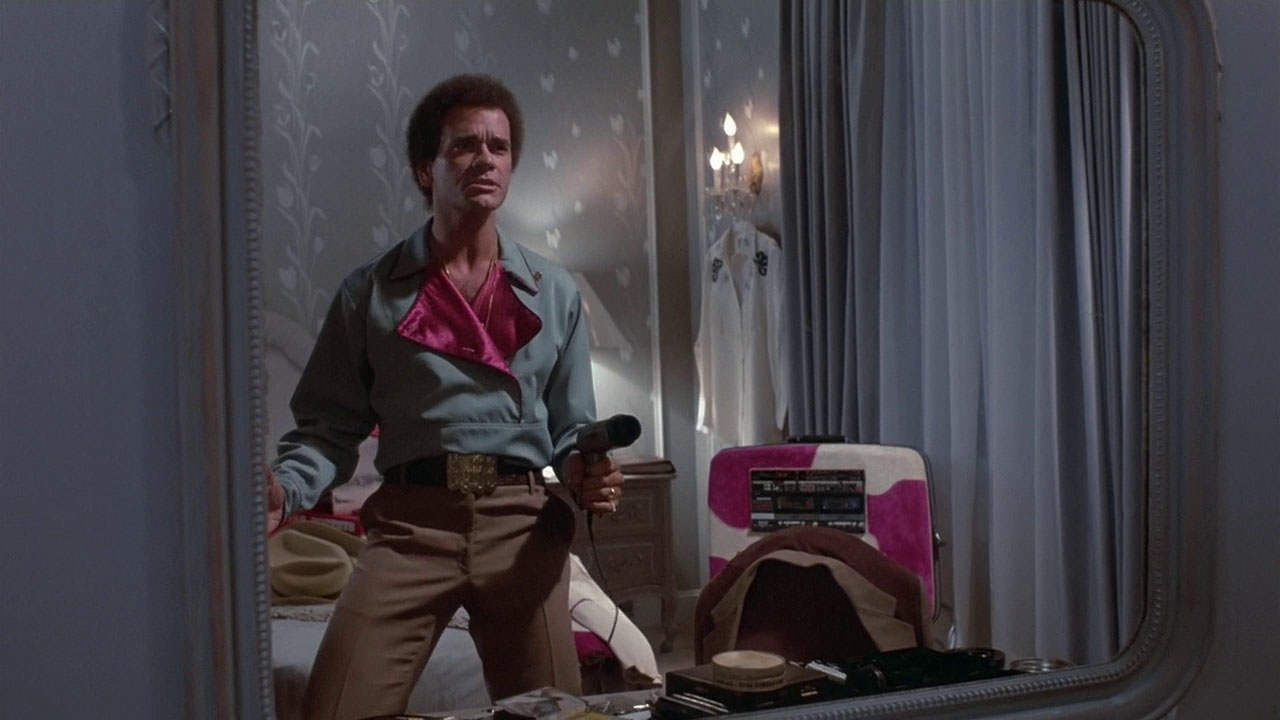
Moody Allan (Jason Beghe of One Missed Call Remake) is badly crippled, so his monkey-researcher friend Geoffrey (John Pankow of Talk Radio) donates a brain-eating monkey to service-animal trainer Melanie (Kate McNeil of The House on Sorority Row) to get Allan a furry helper buddy. Brain-eating monkey in a George Romero movie – what could go wrong?

Mad scientist Geoffrey:

Geoffrey’s boss Stephen Root:

Moody Allan is a bad influence on the monkey, who starts to murder everyone who she perceives as a threat – first setting fire to Allan’s ex (Lincoln NE’s Janine Turner of Northern Exposure) who has run off with his doctor (Stanley Tucci), then electrocuting Allan’s annoying mom (Joyce Van Patten of Bone), killing Geoffrey via drug injection, and most horribly, murdering the parakeet of Allan’s hateful catetaker (Christine Forrest, Romero’s wife). After she threatens Melanie in a rage, Allan manages to dispatch the monkey using only his neck and mouth. We also get a monkey-surgery dream sequence and blurry monkey-POV shots. Mostly dullsville compared to the space vampires. My birds reacted to the monkey chatter, but not to the parakeet.

In memory of two recently-departed horror directors, who made some of the best horror films in history, I caught up with two of their worst pictures…

To begin with, a bullshit voiceover lets us know that this spaceship, created with colored lights and 1980’s computer graphics, has some inexplicable gravity technology – just trust us, we’re on a spaceship but there’s gravity. I don’t recall Star Trek worrying themselves with explaining the ship’s artificial gravity, except when it broke in the sixth movie.

Discovering nude-vampire crystals inside the space anus:

Fallada, looking like an apocalyptic preacher:

“I almost have the feeling I’ve been here before” as they fly into a giant vaginal-looking tunnel. Astronauts discover nude, crystal-encased space vampires and bring them home via a badly failed first mission plus a second rescue mission. The sole survivor of the first mission is Steve Railsback (later of Scissors and Alligator II: The Mutation), who couldn’t help but sexually harass the female alien (Mathilda May, later of some Chabrol and Demy films) and becomes psychically connected to her. Railsback works with Peter Firth (Tess, Equus) and alien-invaded doctor Patrick Stewart to track down the vampire girl, while dapper white-haired Professor Fallada (Frank Finlay, one of Richard Lester’s Musketeers) and barely-competent Dr. Bukovsky (Michael Gothard, Oliver Reed’s executor in The Devils) try to contain the evil – and fail utterly, as most of London falls to the vampire-zombie plague.

Patrick Stewart Replica:

Return of the Living Dead Zombie Phantom Alien Vampires:

More perverted and apocalyptic than most 1980’s horror movies, at least. The movie’s pretty okay, but the concept is cool as hell, so it’s got my respect. Tobe’s follow-up to Poltergeist, produced by Cannon Films, cowritten by Dan O’Bannon, who made Return of the Living Dead the same year, which ties into our next filmmaker

I’ve watched these before, in their Decalogue versions, but since the extended movie versions appear on certain lists of great films, I always wanted to watch ’em and compare. It has been nearly a decade, so it’s hard, but I’d have to say I prefer the Decalogue series as an interconnected project than either of these movies individually.


A Short Film About Love (1988)

Deep-voiced teenage creep Tomek watches neighbor Magda through the window with a stolen telescope, then tries to interfere in her life. She is dismissive, then taunts him, and finally becomes concerned after he tries to kill himself. I guess they’re a couple of doomed losers who might just end up together, but Kieslowski is up to something more twisty, closing on Magda in Tomek’s room, watching herself across the street. It’s got the mutual torment of White mixed with the surveillance of Red, set to some nice Priesner music.


A Short Film About Killing (1988)

Another movie about a deep-voiced creep! A hanging cat in the opening credits brings to mind Cosmos, but this movie’s a slog, the most unpleasant Kieslowski I’ve seen. I covered the story pretty well last time – main difference here is that it’s longer, and the inky blackness and distorted colors of the picture comes out more clearly on the blu-ray. I love the sudden time jump from Jacek sitting in his stolen cab dreaming of escaping to the mountains, to the moment of his conviction for murder.

Happy SHOCKtober!

This is pretty advanced for a low-budget hour-long mid-1980’s British horror, beginning with a closeup of a sleeping head, crossfading to a naked tree, its branches recalling the nervous system. “Just a bad dream” – Marion (1970’s TV actress Heather Page) is awakened by gentle husband Alex (Scottish filmmaker Bill Douglas). They’re having guests for dinner: her old friend Angela (Joanna David of Secret Friends) and husband Richard (Nickolas Grace of Salome’s Last Dance), who we’ll soon learn is an absolute ass. The home-cooked meal is ruined by a window blown in by the storm, so they go out to a restaurant run by the Captain from Fraggle Rock, and the bulk of the movie seems to be an extremely painful dinner conversation. Drunken sniping rules the meal, mixed with references to sleepwalking and hypnosis.

L-R: Alex, Marion, Richard, Angela:

What with the storm and the drinking and the late hour, Angela and Richard reluctantly agree to spend the night. And as the dark synth music rises, a sleepwalking Marion kills everyone in the house with a knife. Perhaps that’s what happens, anyway.

A process movie, which shows you what is happening, letting you guess about the why. Extremely precise in framing and editing, focusing as much on objects as people. I’m generally sympathetic to Bresson films, having loved A Man Escaped and Pickpocket, and have been underwhelmed or confused by some of his others, so wasn’t sure how this one would hit me… and it’s a masterpiece.

Schoolboy Norbert owes money, so his buddy Martial pulls out some counterfeit cash, which they change at a picture frame store. Later, the frame shop owners get pissed at their employee Lucien for accepting the phony bill, and conspire to pass it off to a workman Yvon Targe (Christian Patey, later of Adieu Bonaparte).

Yvon is caught passing the fake bill at a restaurant, unaware, starts a fight and gets in trouble. The frame shop owners pay off Lucien to lie in court, and Yvon loses his job. Lucien loses his job as well when he’s discovered to be pocketing money, then robs the shop and starts stealing ATM cards, is eventually caught. Norbert is also caught, and his mom pays off the frame shop to hush the scandal.

Yvon takes a darker turn, gets hired as a getaway driver and caught during a bank robbery, his daughter dies while he’s in prison, he attempts suicide, rejects help from Lucien (who is caught trying to escape) and is eventually released. Yvon immediately steals from the hotel where he’s staying, then apparently follows a woman home, is allowed to stay with her and her father, and kills them both with an axe, then turns himself in.

Adrian Martin for Criterion:

Bresson told his stories in astoundingly matter-of-fact ellipses or leaps in time; only the most significant moments of information and sensation counted for him. He fragmented the spatial relations of each location and incident, making the world both a fiercely angular labyrinth and an abiding, disorienting mystery.

Based on a Tolstoy story. Bresson tied with Tarkovsky for best director at Cannes, the palme going to Imamura. Great Cannes interview on the disc – Bresson always gives the best answers. “The question is null and void” … “I can’t explain a film. It explains itself.”

Chloe Sevigny (early-career, between Gummo and Boys Don’t Cry) works in publishing with her coworker/roommate/frenemy Kate Beckinsale, and they frequent the disco run by Chris Eigeman (Metropolitan). Kate dates ad-man Mackenzie Astin (star of The Garbage Pail Kids Movie a decade earlier), and Chloe dates Matt Keeslar (Waiting for Guffman, Rose Red), who turns out to be a district attorney investigating the club owners. Not being Stillman obsessives (yet) we didn’t recognize cameos by the Metropolitan and Barcelona casts.

M. ditched the movie halfway in, because she hated all the characters, but I thought hating the characters was part of the point (maybe not, since it’s based on Stillman’s own experiences) and greatly enjoyed. This came out a couple months before 54, less than a year after Boogie Nights, and I skipped it at the time, which was maybe smart since it’s more to my tastes now than in 1998.

Griffin Dunne (An American Werewolf in London) is a hopeless single dude working a boring job with Bronson Pinchot. After work he meets diner patron Marcy (Rosanna Arquette of Desperately Seeking Susan the same year), bonding over their shared love for Henry Miller, and she refers him to her artist roommate Kiki (Linda Fiorentino of Jade). After an undercranked cab ride to their loft, his night spins out of control in tragicomic fashion. Not to get all auteurist on a 1980’s wild-crazy-night picture, but it’s better-looking and more intricately designed than this genre generally gets.

O’Hara and Bloom:

Buncha people with tendencies to panic and lose their cool about small things, not excepting our main man – in Marcy’s bed smoking a bad joint he suddenly sneaks out ranting about needing paperweights. He gets into a barter situation with bartender Tom (the late John Heard), gets shamed by Kiki’s dom boyfriend, wanders over to waitress Teri Garr’s place, then to Catherine O’Hara’s place, then a beardy guy’s place, then Verna Bloom’s place – what is it about Griffin Dunne that makes everyone want to take him home? Verna paper-maches Griffin to hide him from an angry mob who believe he’s responsible for a string of break-ins, then the actual thieves Cheech & Chong steal him, believing he’s art. It’s a very good ending, pulling Griffin abruptly out of the situation and back to his office, which could make the whole thing seem like a harmless dream if not for Marcy’s suicide.

Teri Garr is skeptical:

John Heard is skeptical:

Made by Scorsese between King of Comedy and The Color of Money, after a first attempt to make The Last Temptation of Christ fell apart. Reportedly the flashy camera moves were designed as a Hitchcock parody. Joseph Minion wrote (with some help from Kafka), also wrote Vampire’s Kiss and Scorsese’s episode of Amazing Stories. Tied with Blood Simple at the first Independent Spirit Awards, but it was better-loved in France, where it got a César nomination and won best director at Cannes.

Mouseover to make Dick Miller wink at you:
image

Relatively normal-seeming indie film – it took me a while to recalibrate my expectations to the lower budget, the subdued Denis Lavant, these two artists still so young and unaware of the great works they’d eventually achieve. It’s new-wavey, and in love with love, and just wonderful, so it’s my problem that I can’t help but compare it to the later films.

Mireille Perrier (later the sorta-narrator of Chocolat) is “Girl” – both of them are going through breakups when they meet and hang out at a party after Alex has a long night walking dazed through the city. He goes off on his own again but comes back, too late to save her from bathtub scissor suicide.


Mr. X (2014, Tessa Louise-Salome)

A talking-heads interview doc about the films of Leos Carax, with clips. I watched this after catching up with Boy Meets Girl, the last of his major features I hadn’t seen before, and revisiting clips of his other films was pleasure enough, but this doc was remarkably good on its own, projecting interviews visually over film footage and showing outtakes and on-set footage and rehearsals and auditions.

Richard Brody: “[The] enduring enemy in his films is ordinariness, routine, mediocrity. And just as the men in his films are willing to go to dangerous extremes to poeticize their life, so the kinds of women his male characters are attracted to are also poetically extravagant.”

The camera prowls a nice house full of artworks and memorabilia, two visitors conversing on the soundtrack, their footsteps clomping through the halls, but never seen, as a piece of music comes and go in scraps.

Then Manoel de Oliveira introduces himself (“Cinema is my passion”), speaking directly to us. He walks to a new room, the color of his sweater changing and a small picture of the Mona Lisa following him into every camera angle, then shows us home movies with loud projector noise.

Back to the visitors, who were supposed to be meeting someone at the house and feel self-conscious about their intrusion, but not enough to leave… back to Manuel, and so on. Manuel’s deliberately-paced stories of the past in plain language feel like a school report, conflicting strangely with the poetry and superstition of the visitor segments. He eventually tells us that he’s a visitor here himself, having sold his childhood home to pay for his films.

Halfway through, we interview Manuel’s wife Maria Isabel, only the second person we’ve seen in the film. Manuel gets less narrative and more philosophical after this break. He talks about his recent films (and the one he was writing: Non), and we head unexpectedly into reenactment territory with the story of his arrest by the fascist government soon after the premiere of Acto de Primavera.

Oliveira spoke like he was at the end of his life, not realizing that another 22 years and half his body of work was still ahead of him. His final narration, “and I disappear,” then a quick slideshow from the family album until the film runs out of the projector. This was withheld from public release until after the maestro’s death, a fitting finale.