Unusual tone: quirky people in absurd situations, but not a comedy, as signaled early on when mom drops off her two daughters at grandma’s then drives herself off a cliff. When Grandma dies a couple of ill-suited aunts take over, then eagerly hand off to wandering aunt Sylvie (Swing Shift‘s Christine Lahti, excellent), who moves in with the kids and (kinda) takes care of them. Still not a comedy, the kids grow apart as one wants to fit in at school and the other wants to stop even attending school. When things get tense in town, Sylvie responds per family tradition: by running away, taking the remaining kid with her.

Mom’s last ride:

Burning down the house on their way out of town:

Children (1976)

Watched this after an episode of Shifty to reinforce how terrible is England. Everyone’s catatonic or an arsehole or both. Kid is bullied, his mom cries on the bus, his dad is violent, has fits, then dies. The kid also appears a decade later, gay and depressed. As far as miserable British youth movies, it’s no The Wall, whose soundtrack I happened to hear last week.

Hearse reflection:

Lawrence Garcia in Cinema Scope:

From the perspective of Davies’ later work, the film is most notable for its eschewal of a causal dramatic progression — and I use that term advisedly, for Davies’ construction refuses the temporal asymmetry that one might be inclined to impose on the film, resisting one’s impulse to fix the adult Tucker’s scenes as the stable present from which the childhood sequences would be merely reminiscence. Children is unique in that it is as much premonition as recollection. Although not yet marked by Davies’ singular use of music, it established something arguably even more central to his cinema: the principle that the tides of time flow backward as well as forward.

Every inch of England is filled with horrors, but this sign was the worst thing I saw:

–
Madonna and Child (1980)

Same guy (different actor) dotes on his mum, prays, suffers extreme catholic guilt. He goes to work (as an accountant, possibly). He puts on his leather and goes out to clubs or tattoo parlors or to pick up men at the toilets. Both have lot of stillness and prayer, but I liked this one better than Children. Not as much of the mother as you’d expect from the title, and she’s asleep in half her scenes (Sheila Raynor also played a mother in A Clockwork Orange).

–
Death and Transfiguration (1983)

Same guy (now Wilfrid Brambell of A Hard Day’s Night) old and dying, having flashbacks to when he was played by different actors. Finally Davies is using melodramatic pop songs mixed in with the christmas carols and hymns.

Garcia:

With even more concentrated force than the films that would follow, it depicts an entire life as a kaleidoscopic whirl of disjunctive images and sounds, most notably the alarming, unabated death rattle of an elderly man on his hospital deathbed, gasping for breath as the screen fades to white. It is a haunting distillation of a remark Deleuze attributes to Fellini, that “we are constructed in memory… simultaneously childhood, adolescence, old age and maturity.”

Date is a psycho criminal, played by Japan’s coolest man Yûsaku Matsuda, but in this movie’s world violence tends to be awkward and clumsy and nobody is cool. Date is already being tailed by beardy detective Hideo Murota (also beardy as the first doctor in Dogra Magra) when he comes across an aggrieved waiter with frizzy hair (Rikiya of Tampopo and Stray Cat Rock: Sex Hunter) and enlists him in a bank robbery plot.

Turns out Date is a shellshocked war photographer (always you lose points when you bring real war atrocity footage into your dumbass crime picture, let this be a warning), which is why he “walks like a dead man” and acts weird around his girl even though he’s supposedly a classical music fan and she’s a hot concert pianist. The shellshock doesn’t explain why he tells really long stories though. Having recently watched Heat, I’m gonna be comparing all cops and robbers movies to that – these guys are more intense than Kilmer and company, killing both their girls before/during the big heist.

Pre-game pep talk:

Detective with 30 seconds left to live:

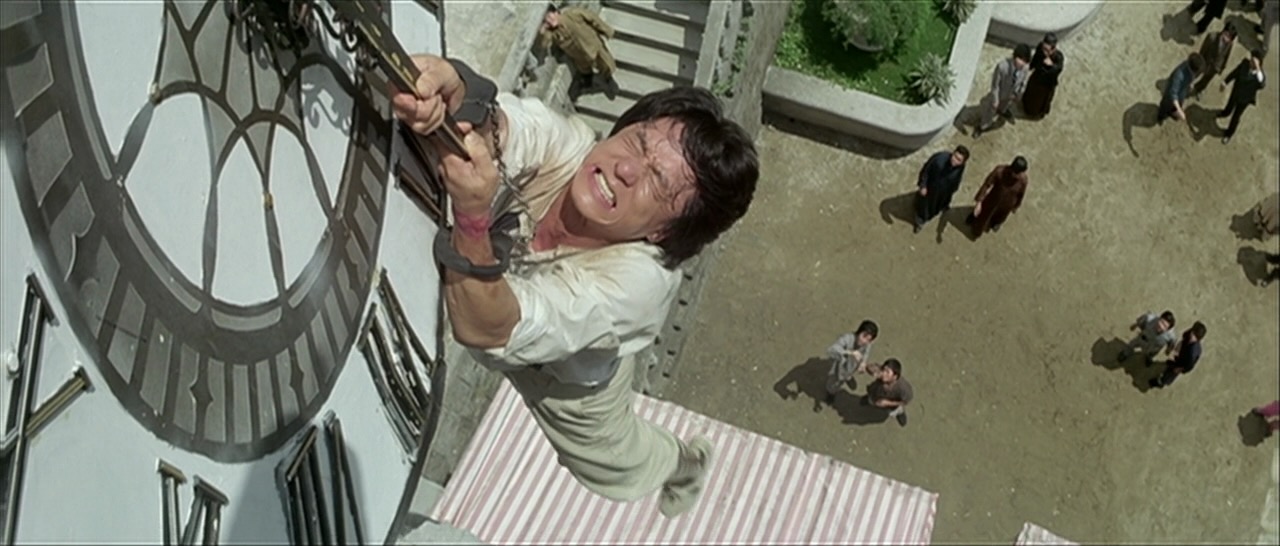
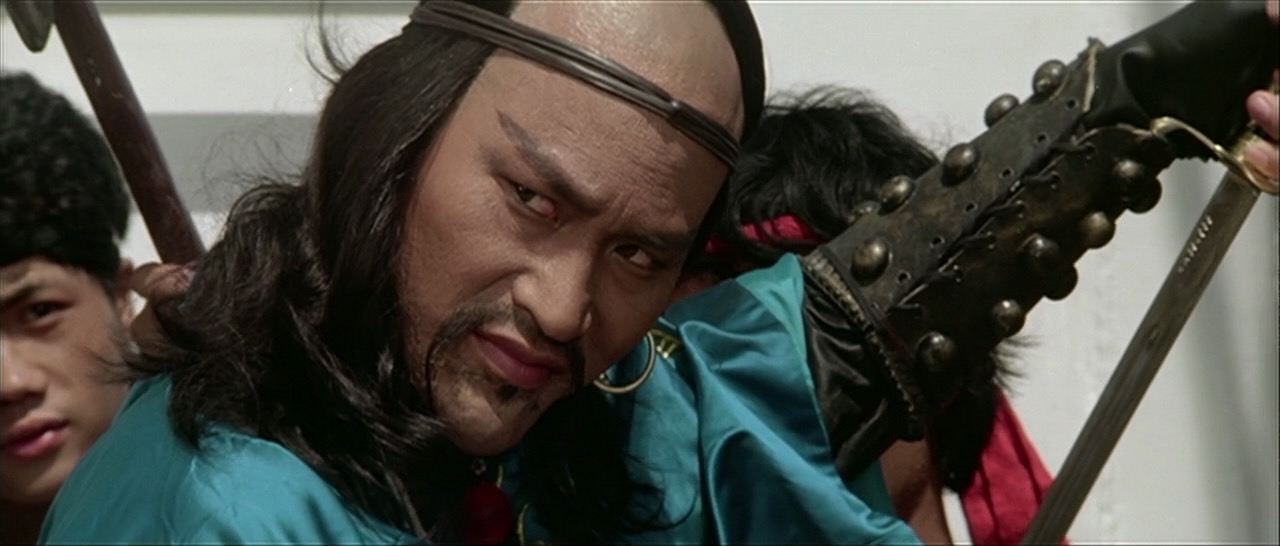
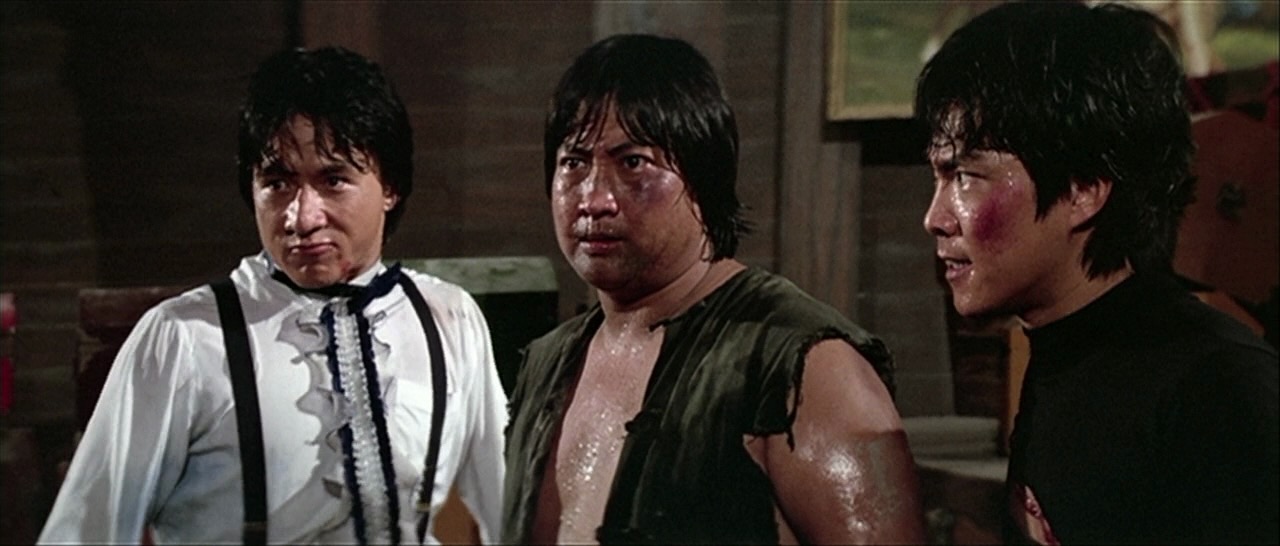
There’s a lotta plot here, but Jackie ends up working for his bar-brawl rival Yuen Biao (Rat/Weasel of Eastern Condors) and teaming up with gangster-gambler Sammo to fight corruption and then take on pirates. After a dumbass white admiral gets captured by dread pirate Lo (Dick Wei of Visa to Hell), Chan’s ex-coast-guarders go rogue, beat the shit out of a pirate collaborator to figure out how to contact them, and smuggle Sammo aboard in a barrel. When Chan goes through some gears then hangs from a clock tower, it’s hard to miss the classic silent comedy references, and since this is the week for great bicycle scenes, we get a chase where he beats up guys with a bike in ten different ways.

Jackie was just in Locarno:

I think back to when we made those films, and we had so many problems [on the set]. It would be raining terribly. Something serious not working. On Project A, we got seasick, the [scenes of the] pirates on the sea were so difficult to do… but we kept going, and no matter what, we finished the movie. Then when it came out it was a success, and 40 years later people are still watching it. That’s what I signed up for. You see so many movies, so many directors – and nobody remembers them today. But then a few movies, 100 years later, are still there. At some point, I said to myself: I want to make this kind of movie, no matter how difficult it will be. When I pass away, I want the next generations to say there’s Bruce Lee, there’s Chaplin, there’s Jackie Chan.

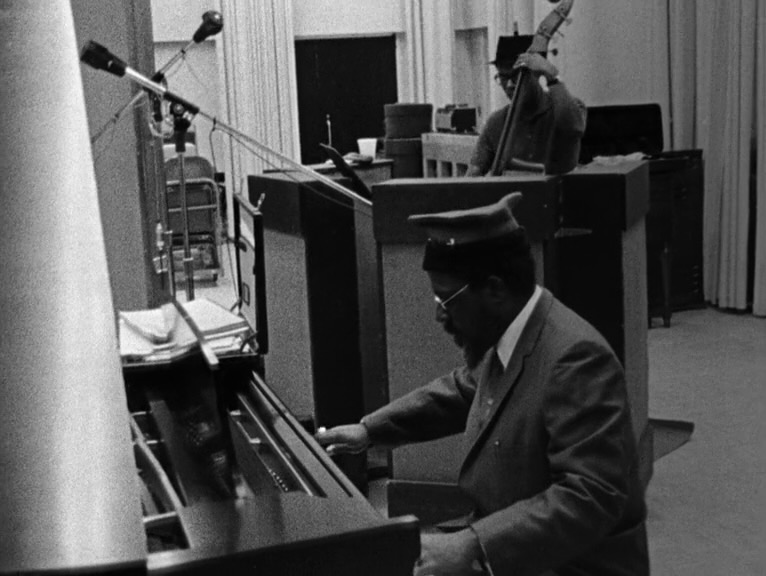
Really good rock doc, because the talking heads feel like punctuations to the flow of music instead of vice-versa. Like most movies, it is 90 minutes long when it could be LP-length, but say la vee. A musician’s musician, impenetrable as a person, at least in the movies I’ve seen. I first heard him in another doc, his mouth wide open, playing technically-imperfect tunes, immediately striking, a true jazz weirdo. That movie’s archive footage was shot in 1969, this one’s in 1967, both released decades later.

Paul Grimstad for Criterion:

From the [1967] Blackwood footage, interspersed with other archival film, photographs, new interviews, and narration, Zwerin distilled an hour-and-a-half-long structure not all that different from a Monk composition: jumpy, elliptical, catchy, moving … As a counterpoint to the archival material, Zwerin shot new footage of pianists Tommy Flanagan and Barry Harris (both Detroit natives, like Zwerin) playing through Monk tunes as four-hand duets. We see how much fun they’re having, how generous and congenial their sharing of the music is, and how a Monk song like “Well, You Needn’t” allows for endless elaboration without its melodic outline ever becoming blurred.

Tuba guy (Kenny Bee of some early Hou movies) barely meets short-haired Shu (Sylvia Chang of some early Edward Yang movies) under a bridge when the war started, now trying to meet her at war’s end as planned. They each get pickpocketed and rip off pedicab drivers, identities and intentions are mistaken, it works out.

An atrociously dubbed comedy. After buying the Once Upon a Time box set and watching some twenty Tsui Hark movies, it cracks me up that this is the one that’s universally loved by the letterboxders I follow. Them: “just pure joy and beauty at every turn” … “A work of pure balletic grace, and a reminder that Hong Kong’s romcoms are every bit as ahead of the pack as their action movies.” Only Dave Kehr makes sense: “Hark’s colors have the almost startling intensity of old Technicolor; combined with his stroboscopic cutting, they make the film seem to fizz and sparkle on the screen.”

Pure joy and beauty?

Joan, Juliet, and Joely (whom Greenaway probably stunt-cast based on their first names) each drown their husbands, and also the conspirator-turned-blackmailer coroner Captain Smith, while the captain’s doomed son helps the movie count to 100. Watched on the fourth of july (movie had fireworks).

Lot of recent references to spa town in films: Road to Wellville, Cure for Wellness, Days, now this. In the late 1960s DDL meets Juliette Binoche on a business trip but he’s already with hat girl Lena Olin, wants to keep both girls and for everyone to be friends. He’s a professional surgeon and casual writer, Juliette’s getting into photography, and when the Soviets invade Prague, his story gets him in trouble, and her photos of street protests get a hundred protestors in trouble. They escape to Switzerland but Juliette returns and he follows her, arriving smugly principled to a fallen society, where he’s demoted from brain surgeon to general practitioner to window washer, until they decide to live the rest of their (few) days with a friendly pig farmer. Director and actors (esp. Lena) do their best to save the movie from its clunky script, which is somehow by Bunuel’s writer and also got an oscar nomination.

Christy needs a job, finds one in the box office of a porno theater alongside Luis Guzman. Inspired by her new job, she starts writing dirty stories and reciting them to people. This all scares away her uptight boyfriend Will Patton (boyfriend #1 of Janet Planet), so she lets stalker-customer Louie take her out to a Yankees/Red Sox game. When he leaves abruptly she goes detective mode and follows him to a shady under-bridge deal. After a few days of this she tells Louie she’s been following him and to meet her on a corner. This seems like a dangerous move, but the movie ends with a street shot (the corner?) over some nice John Lurie music, so maybe it worked out. Some lovely scenes of a fish market at night, though I wish they wouldn’t pick up the fishes by their eyeballs, and the meditation handshake montage is great. Written by sometime-Mekon Kathy Acker.