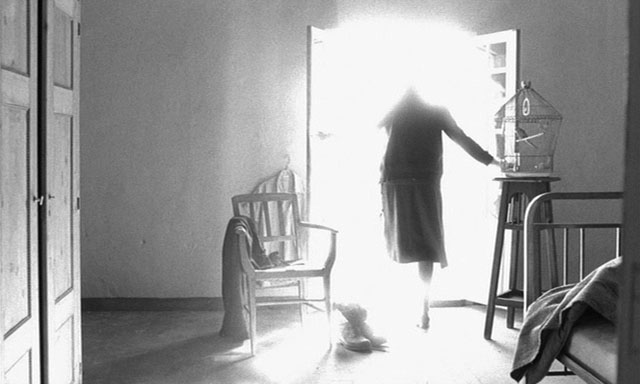
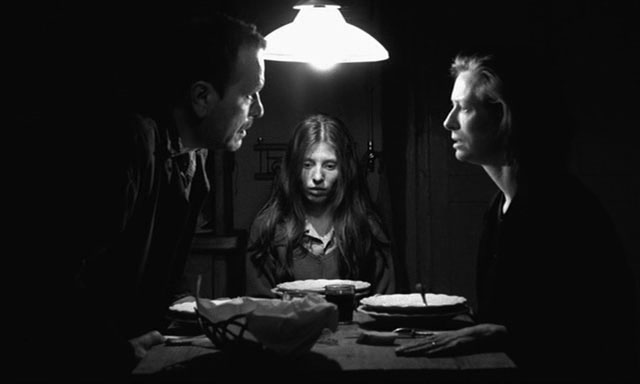
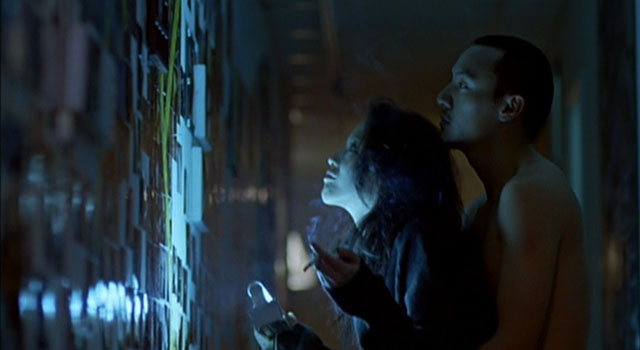
Didn’t stick with me very well the first time, maybe because it didn’t make enough narrative sense for my brain to properly hold on to, like a wacked dream that I remember clearly when I wake up but is already gone by the time I hit the shower, not related enough to reality to survive my beginning to ponder my work day. Should have watched it a couple times originally. But now I see I should watch more than a couple times, maybe annually from now on. Lynch’s most free, most trippy and loose movie, existing almost entirely in dream state, but also his most dirty and real looking because the DV photography feels like a home movie. Completely inexplicable and entirely worthwhile.
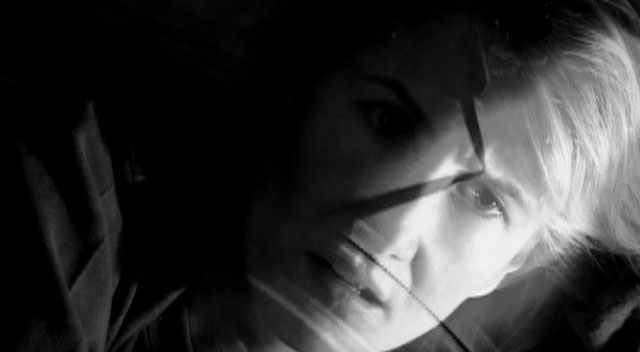
Hard to watch at home. The three hour runtime, the almost entirely black scenes, and the very dynamic audio levels (quiet whispers turn into sudden shock sound effects and screams) work best when I’m home alone and wide awake on a winter’s night. I think it freaked out my birds more than anything else I’ve watched. Next time I’ll watch on my laptop, in accordance with Lynch’s dreams of an all-digital cinema.

The plot, thanks to Cinema Scope:
Dern’s first incarnation, Nikki Grace, is an actress who lives in a cavernous Hollywood mansion and lands a coveted role in a Southern melodrama titled On High in Blue Tomorrows opposite suave ladies’ man Devon (Justin Theroux). She soon learns that the film is a remake and that the original Polish production was aborted when both leads were murdered.
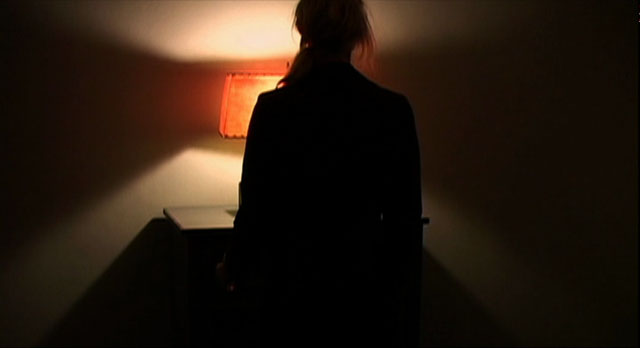
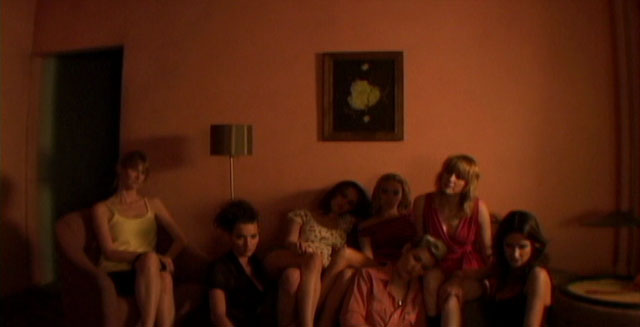
Nikki begins to merge with her character, Sue, and the script’s adulterous affair spills over into real life. But what’s real, and who’s dreaming whom? The boundary between the film and the film-within-the-film — indeed between all levels of reality — vanishes completely. Besides Nikki and Sue, Dern plays at least two other overlapping variations on the character: One lives in a shabby suburban house, sometimes with a harem of gum-chewing, finger-snapping young women. The other, a tough-talking Southern dame, is spilling her guts out in a dank room, telling floridly vulgar tales of sexual violence and terrible revenge. Interspersed throughout are scenes from a Beckettian sitcom with a rabbit-headed cast. Certain phrases, often pertaining to identity confusion (“I’m not who you think I am,” “Look at me and tell me if you’ve known me before”), repeat in varying contexts and start to acquire talismanic power. (The key to transcendental meditation, which Lynch has practiced for over three decades now, is the repetition of a personal mantra.) Meanwhile, the film we are watching is beamed to a TV in a hotel room, and a mystery brunette watches along with us, silently weeping.
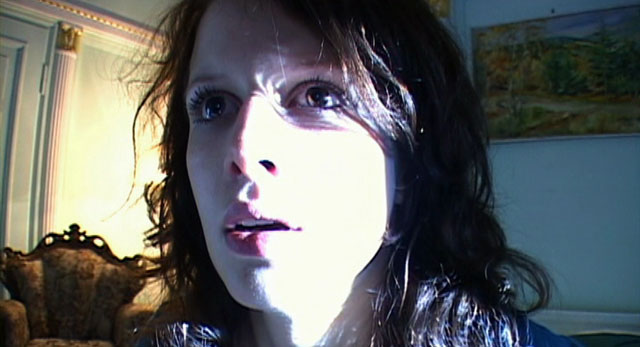
Did I write this weeks ago, or was I quoting from a website?: “Dern changes identities and locations, each with only a faint memory of the others, giving her a constant sense of unease.”

The neighbor who visits her is awfully good in a Twin Peaks sort of way. A choreographed dance to “The Locomotion” manages to be one of the spookiest parts. Seeing father Rabbit leave his locked-down living room set is thrilling. Cameo by the girls from Darkened Room (actually only Jordan Ladd is strictly from Darkened Room, but I like to think they’re the same characters). William H. Macy in a big cheesy cameo as a radio reporter and Harry Dean Stanton as Irons’ sad assistant, always bumming money off people.

Bright Lights:
“It sounds complicated, but it makes clear emotional sense, just as Mulholland Drive did.”
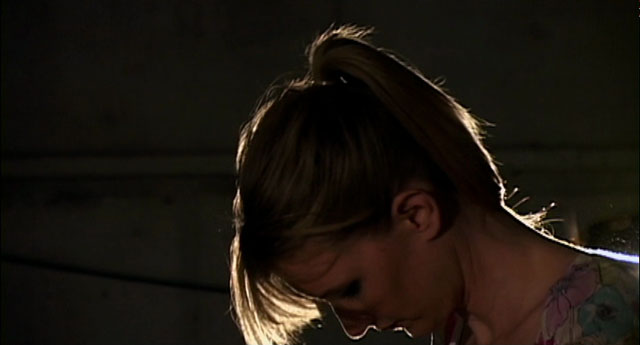
House Next Door calls the ending hopeful, and I guess you could say that. Dern escapes from at least one of the films she’s trapped within, wakes from the dead and goes back home where, per HND, “Lynch returns to the face of Grace Zabriskie’s Neighbor and, before our jaundiced eyes, this formerly intimidating and ugly figure becomes suddenly beautiful and ethereal. Moreso than Dern’s final close-up (a stunner in its own right) I think the answers to the film’s many mysteries, for those who need them, are contained in Zabriskie’s sideways glance and virtuous smile.”

Extras on the UK DVD are all interview-style. One is by The Guardian, one is by Mike Figgis at a hotel in Poland.

Interviewer: “If T.M. creates positiveness… some people might ask: what about all the darkness that’s in the films?”
Lynch: “Exactly.”
On the inclusion of Rabbits in Inland Empire: “Sometimes we start something and we think it is that, and later… it sprouts and becomes a bigger thing.” Okay it’s not a great quote.
“Really the only difference [between IE and the earlier films] is Inland Empire was shot with DV… and it was a low-grade, bad DV.”

“It is true that the 50’s gave birth to rock and roll and that early rock and roll holds a very special power, I think. It started the whole thing rolling, but in my mind it drifted away a little too quickly. And I think there’s more gold to mine from that feel of the first rock and roll.”
Repeats the same information over and over, not saying much for long periods, interviewers asking stupidly general questions hoping Lynch will tell them a nice story. He does tell a couple light ones, but three times each. So the final segment, The Air Is On Fire, comes as a happy surprise. It’s a biographer (who knows enough about Lynch not to ask pedestrian questions) viewing and discussing Lynch’s paintings and sound installations.
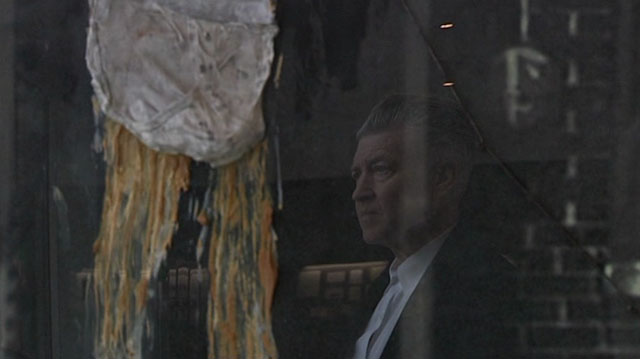
–
“We’re cooking quinoa.”
“This pan is unbelievable.”
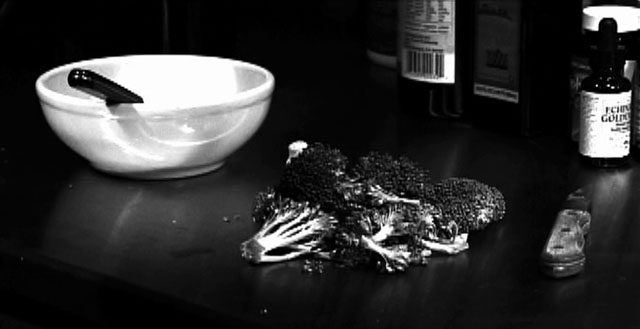
The U.S. DVD is already better than the U.K., with a b/w video of Lynch in his kitchen and a nice stills gallery, and that’s before I even get to the meat of the disc. Hey, he times his cooking the same way I do, by yelling out numbers from the clock instead of setting a proper timer.
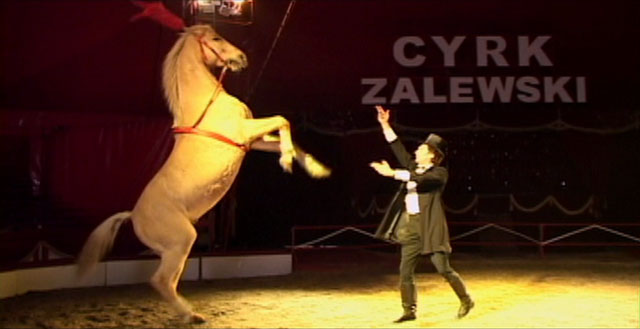
More Things That Happened is outtakes from IE. First 20 minutes are scenes with Dern’s circus husband. He comes home late. He sells a girl a watch.
Dern continues talking to the man at top of the stairs. She has a crossed out “LB” tattoo on her hand. A girl with earrings talks to Dern about meeting Billy at a bar. Mostly people telling each other stories.
Ballerina
A ballerina performs behind cloudy overlays and blobby digital soft focus to ambient music. Some neat effects in there but too long by half.

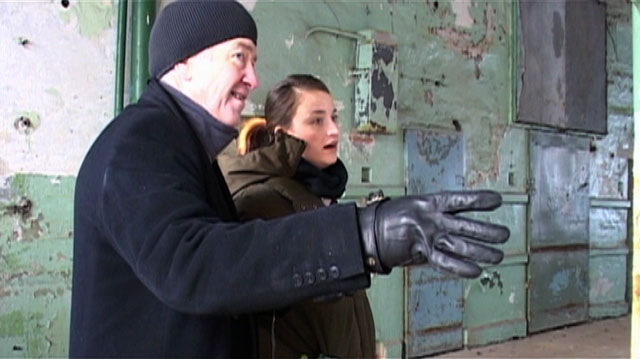
Lynch (one) is a full-length documentary by BLACKandWHITE, whatever that is, company or person, on the making of Inland Empire. Lots of behind-the-scenes dealings, set construction, some talk with the actors, Lynch in every scene. Lynch 2 on the IE disc is presumably deleted scenes from that doc, another half hour of material. Not tremendously eye-opening, just gives you the impression that IE is completely Lynch’s artistic vision, if you couldn’t have figured that out before, down to the smallest detail. He yells at his crew on set then praises them up and down in interviews. We hear a lot about the improv nature of the film and script, but we see careful planning and scheduling of shots and scenes. Watching David choreograph the closing credits musical number, telling the lumberjack not to cut all the way through the log because “we’ve only got one log,” you realize that all the backstage footage in the world might be fun to see, but still wouldn’t explain a thing.
“It’ll be more than a mouthful, which will look real, and it looks great. And you can throw up a lot of blood. Two times you’ll throw up.”
“There was a thought for a long time that you had to suffer in order to create, and this is just about opposite of the truth. If you’re suffering, even a little bit of suffering cuts into your creativity. In fact, the happier you are, and the more wide awake and rested you are, the better it goes… then the ideas can flow way better, way smoother and faster, and more of them.”
Stories is Lynch talking for 40 minutes, maybe excerpts from the website Q&A segments, about IE and digital and meditation, the usual topics. This is where the famous quote about watching a film on a fucking phone is from. His hatred extends to computers as well, but I think if he was here and took a look at my television setup and laptop setup, he’d have to grudgingly admit that I’m getting better picture and sound off the laptop.
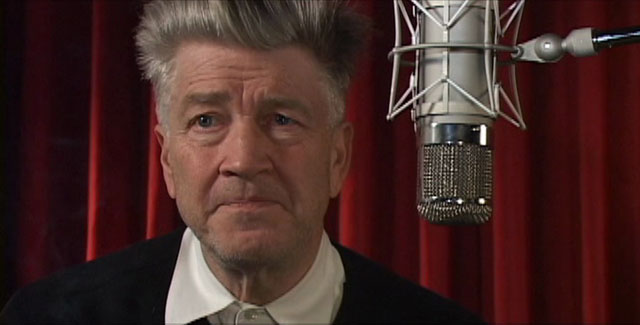
On a separate disc, Room To Dream: David Lynch and the Independent Filmmaker is mostly Lynch talking about himself and his working methods, and partly an advertisement for Avid systems. Best of all, it includes an extra scene related to Inland Empire. Windowboxed and interlaced, unfortunately – nice going, Avid.
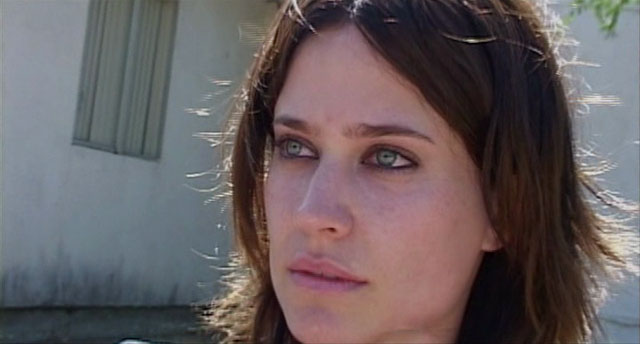
Sur la route de Mulholland Drive is a half-hour behind the scenes, interviewing all the principals and watching the filming. More interesting than most backstage press-kits if only because I’m unusually interested in the film. Following that is a cutdown of the film’s Cannes press conference.

Le Son de David Lynch, another doc, from French television in 2007, interviews Lynch and a bunch of people I didn’t understand. Hmm, Wild at Heart was called Sailor et Lula over there. He and Badalamenti (below) recorded music for Twin Peaks and Lost Highway before shooting, and he’d play the music on set… wonderful.
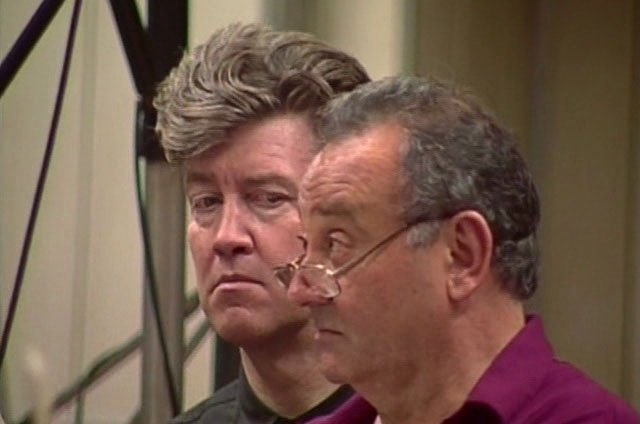
On the Lime Green box set, Out Yonder is a three-actor stilted-humor throwback to The Cowboy and the Frenchman, only Lynch is one of the actors this time. Not really interesting at all, a conversation where all forms of the verb “to be” are replaced by “bees bein'”, with fart jokes, tooth pulling and a distant cavalry. In the next episode, a girl with gonorrhea seeks her missing chickens.

Scissors is a Cannes short previously known (to me) as Absurda. A Flash-looking dream-cinema piece incorporating bits of the ballerina footage.

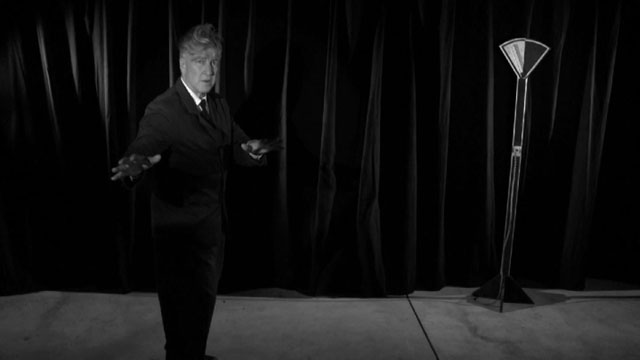
A couple of greetings for film festivals, both in b/w, filmed in reverse, starring Lynch himself and just awesome.
Fictitious Anacin Commercial is exactly that, a half-minute gag commercial. A Real Indication is an amateur music video (if amateurs had a crane). And Early Experiments is 16mm footage from the Grandmother/Alphabet/Six Figures era set to overdramatic string music, with some cool motion paintings and lots of mirror symmetry.

Then there’s Dynamic 01: The Best of Davidlynch.com
David answers member questions about favorite pieces of music, how to write a screenplay, his box full of ideas on scraps of paper, Marilyn Manson, coffee vs. cappucino, and meditating with Roy Orbison.
Intervalometer Experiments:
Ambient videos with slow, rumbling music. The first consists of trees and a distant mountain at sunset, the video grain threatening to destroy everything. The second is a spooky set of stairs molested by an encroaching shadow. The third is the corner of a sunroom in time-lapse, with scary trees and a dormant alarm system.

Industrial Soundscape is a lock-groove computer animation three times as long as it needs to be. Maybe we were supposed to use it for meditative purposes. Bug Crawls is animation of a bug climbing a mad science house in slow-motion as a blimp passes by. Lamp is a half-hour doc of David making a lamp, which isn’t as funny as when he makes quinoa. And there’s another episode of Out Yonder, which I think I’m gonna skip. No, I guess I’ll watch it. “You bees bein’ barkin’ right up the tree which bees bein’ the wrong one!”
Darkened Room
A Japanese girl dances with the camera, talks to us about bananas before introducing her crying fried (must be Jordan Ladd of Death Proof) in the other room. I think I hear the Rabbits music. Third girl (Ladd’s Cabin Fever co-star Cerina Vincent) comes out to torment the crying girl. Hmmm, my note three years ago said this is six minutes long, but now it’s ten. Maybe last time I lacked the intro with the bananas. A few visual cues and mention of a mysterious watch purchase tie this in with Inland Empire and More Things. Little did I know the first time I watched it. Little did Lynch know, probably.

Boat / “When things go wrong, it gets like this.”
David takes his boat (the “Little Indian”) out for a spin, takes low-grade blown-out video then adds a woman-in-trouble descriptive voiceover. He goes fast enough to go into the night.