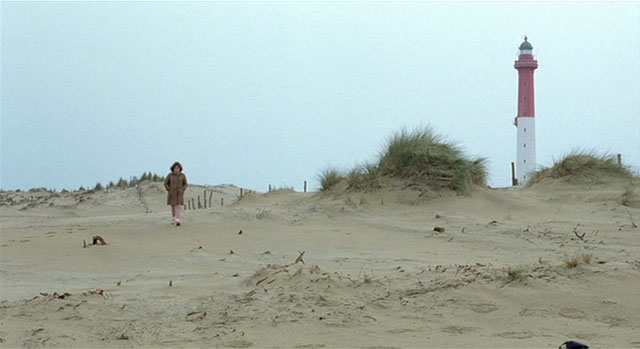
“You’ll be your own downfall.”

The Lady of the title is Grace Elliott, a Brit in France during the 1789-93 French Revolution. Actually the French title is L’anglaise et la duc but Grace is Scottish, claiming English nationality for simplicity when it’s suddenly very dangerous to be a French aristocrat in France. The movie’s intertitles and much dialogue are taken directly from her diaries.

image

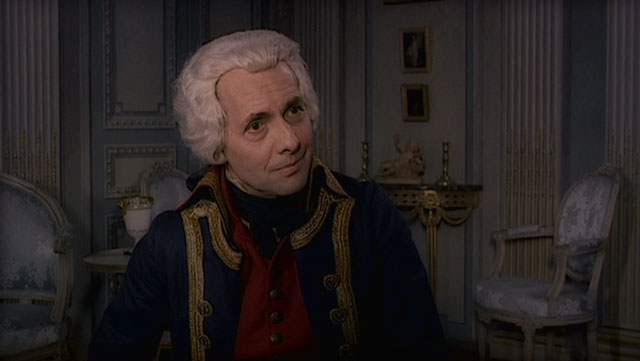
The Duke is one of my favorite Jean-Pierre Jeunet actors, but I didn’t recognize anyone else. Star Lucy Russell has failed to break into the Hollywood mainstream (landing such roles as “female restaurant guest” and “classy shopper #3” in recent big films). Ach, I missed Alain Libolt (Renaud in Out 1) as the Duke of Biron.

Renaud plus 30 years:
image

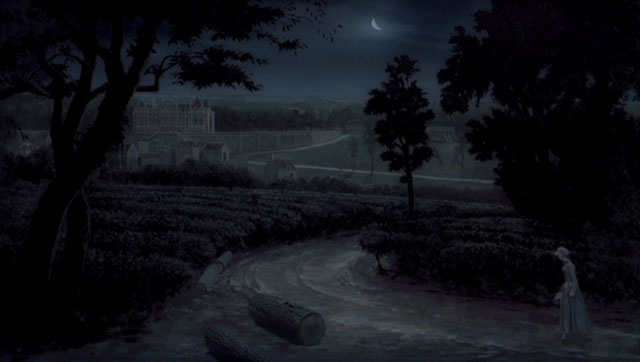
Grace is pure aristocracy, the very target of the revolution, and her sympathies lie with her friends whom she sees being rounded up and killed by the brutish masses. Steadfast in her devotions (though lying to stay alive), she’s contrasted with her friend the Duke, who changes with the times and ends up voting for the execution of the king. Plays like one of Rohmer’s Moral Tales only with more action, more heads on stakes, and more awesome digital backdrops of period Paris standing in for the usual stifling production design and avoidance of outdoor shots (except by filmmakers with Scorsese-budgets). Slant, in fact, called it an “economical antidote to the bloated costume drama.” Grace tries to negotiate the changing world without compromising her belief in the class system, while the Duke either adapts his morals or never had any to begin with. The main thing this movie has over the other Rohmers I’ve seen is historical interest… I delighted in the details of the revolution, about which I know very little. I thought the movie rather anti-revolution, which seems shockingly out of fashion, and one “Grunes” confirms that this was a problem:

Rohmer pitches the action from Elliott’s perspective, with which his own Roman Catholic penchant for order prompts him to identify—hence, the controversy the film engendered in France. Thus the street mobs are unwashed, grisly, barbaric, obscene; poor Louis XVI!
image

It’s hard to know what to make of the movie’s politics. There’s also a long scene where she successfully hides a Marquis from the police. We don’t get to know the guy very well, but he’s not made out as a man who deserves to die, so bravo, I guess. When Grace is finally arrested and held for two days for possession of a letter from an Englishman, the letter ironically turns out to praise the French revolution to the heavens. These examples and the duality in the title make it seem relatively even-handed, despite being adapted from Grace’s own horrified writings.

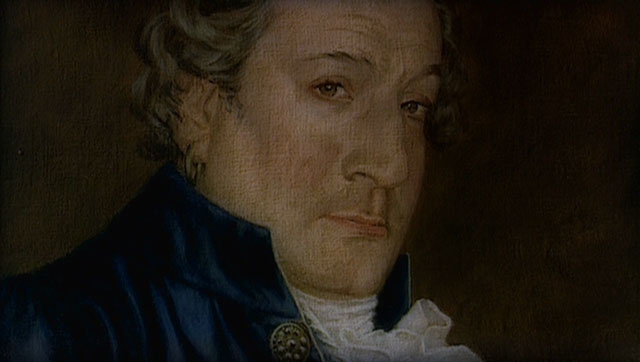
Duke Jean-Claude Dreyfus:
image

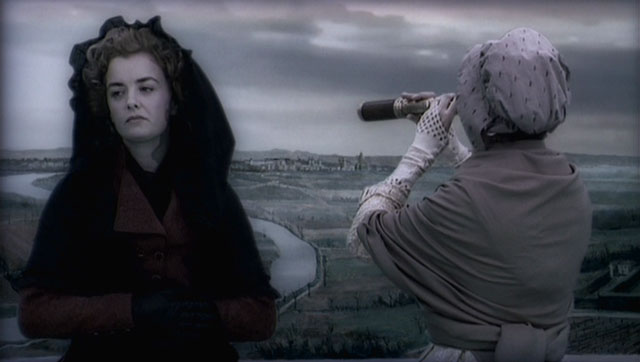
Watched this the night the director died. It got mentions on decade-end lists, with some screenshots that got stuck in my head (like the one below, peering into a painting with a telescope), so I’d planned to watch it soon anyway. I didn’t hear much when it came out, probably because of the timing (sept-oct, 2001). Beaten out for its only two César nominations by Amelie and Brotherhood of the Wolf.
image

NY Times:

The moral dilemmas that Grace and the Duke face are diagrammed, in Mr. Rohmer’s inimitable fashion, with equal measures of clarity and complexity. The director manages to evade both the stuffy antiquarianism and the pandering anachronism that subvert so many cinematic attempts at historical inquiry. His characters are neither costumed moderns, just like us only with better furniture, nor quaint curiosities whose odd customs we observe with smug condescension. They seem at once entirely real and utterly of their time. And the time itself feels not so much reconstructed as witnessed.
image

I’ll close by outright stealing an entire blog post by from Glenn Kenny, only because I want to always be able to find this Rohmer quote.

My films, you say, are literary: The things I say could be said in a novel. Yes, but what do I say? My characters’ discourse is not necessarily my film’s discourse.

There is certainly literary material in my tales, a preestablished novelistic plot that could be developed in writing and that is, in fact, sometimes developed in the form of a commentary. But neither the text of these commentaries, nor that of my dialogues, is my film: Rather, they are things that I film, just like the landscapes, faces, behavior, and gestures. And if you say that speech is an impure element, I no longer agree with you. Like images, it is a part of the life I film.

What I say, I do not say with words. I do not say it with images, either, with all due respect to partisans of pure cinema, who would speak with images as a deaf-mute does with his hands. After all, I do not say, I show. I show people who move and speak. That is all I know how to do, but that is my true subject. The rest, I agree, is literature.
—From “Letter to a critic [concerning my Contes moraux]”

Refreshing to see a period (early 70’s) flick that relies only on props, fashion and speech with no TV news montages, shouts-out to topical issues or drenching the soundtrack in pop hits of the time. Unfortunately that’s the only thing refreshing about this movie, in which Peter Jackson seems to be Taking Himself Seriously and not having any fun anymore. He’s got himself a serious, dark dramatic novel and damned if he’s going to do anything to dilute it with his own manic energy and kooky camera angles. Unfortunately it doesn’t seem to be pleasing anyone, not the reviewers, not the fans of the book sitting near me who complained that the film turns the rapist/murderer into just a murderer (though Stanley Tucci gets a rapist-mustache so I thought it was implied) and not me, who wished I was tired enough to fall asleep through the interminable digital “heaven” scenes in which Saoirse Ronan from Atonement pulls faces (surprise! sadness! delight! ennui!) while the sky turns colors, tree leaves turn into a flock of birds, mountains part, gazebos crumble, fields turn into swamp and other murdered girls throw a picnic. Sometimes she tells us “it’s so beautiful,” which failed to convince me that it actually was. I dug the Super Mario Galaxy-looking planet effects, but Jackson’s swirly heavenly skies seemed significantly less beautiful than every single shot in the A Single Man trailer, which I’m gonna punch myself if I end up missing. The real sadness, sadder than the death scenes and the grieving parent scenes (The Sweet Hereafter or In The Bedroom this ain’t), was that nothing happened in the heaven scenes. They weren’t beautiful or terrible. Saoirse didn’t do anything, the eskimo girl she befriends didn’t do anything, nothing happened at all. Okay, so she touched the hand of creepy loner girl Amanda Michalka causing Ronan’s almost-boyfriend Reece Ritchie to kiss her, and she made dad Marky Mark (not half as convincing on his obsessed search for the truth as Jake G. in Zodiac) see flickering candle reflections and dead roses bloom.

For all its dragged-out length, certain parts seem too skimpy, like mom Rachel Weisz skipping town to pick fruit in California while working through her grief. Susan Sarandon has fun as hard-drinkin’ gramma in the movie’s only comic relief. It’s little sister Rose McIver who gets the best scene, pure tension as she breaks into the killer’s house searching for (and finding) evidence before making her narrow escape. Second-best would be Tucci’s random demise, year(s)? later trying to pick up a girl in a parking lot he’s hit by a supernatural icicle and tumbles horribly down a cliff, Jackson’s cartoonish gruesomeness making a late appearance in the PG-13 movie. PG-13 is how it felt overall, not through lack of swearing or smoking (Sarandon does) or blood or sex but lack of anything challenging. I got the early speech about obsession and hobbies, the parallels between Marky/Saoirse and Marky/Tucci, the snow-globe penguin in his perfect isolated world, and the goofy director cameo in a camera shop but didn’t get any sense of wonder or sadness from what’s supposed to be a splendorous film about mourning, just some pretty pictures.

Reverse Shot calls the movie “profoundly disingenuous,” accusing Jackson of being primarily interested in Tucci’s killer, not the victim and her family. Also: “Even Jackson’s celebrated CGI wizardry feels off; his color-saturated vision of the afterlife has all the visual dexterity and emotional weight of an iTunes screensaver.”

Assayas’s idea of a good, fun b-movie, except he forgot the “good” and the “fun.”

Asia Argento used to do demeaning sex work for powerful businessman Michael Madsen in order to turn him on and steal business secrets, and now after years she is back. Long push-pull dialogue segments prep us for twisty psychological intrigue, but nothing is ever especially twisty. Oh wait, Madsen has a big-money disagreement with Alex Descas (scientist/vampire-boyfriend in Trouble Every Day) but that couldn’t possibly be important. Asia pulls a gun and kills Madsen, planned by her new boyfriend Carl Ng, whose wife Kelly Lin (Zu Warriors, ex-wife/cop in Mad Detective) is in on the plot.

Girls still faint in movies:
image

But will Kelly really let Asia get away with the crime and leave with her husband? No, well, yes, sort of. Shocker: Alex Descas shows up at the end. It was his idea to kill Madsen! None of the surprises are surprising and none of the tension is tense… Demonlover had more twists in its last five minutes than this one can manage in ninety. If I’d seen this when it first came out I might have skipped Summer Hours, which would have been a mistake. Guess Assayas can be inconsistent but still makes great films.

image

It might hurt Michael Madsen’s feelings to be cast in what the director calls a b-movie, but he’s not any good, nor is Sonic Youth’s Kim Gordon as a Hong Kong crime boss, and even Asia isn’t giving a knockout performance. I’d think Kelly Lin stole the show if there was much of a show to steal. Turns out most critics agreed with me – I didn’t re-check the reviews, probably got this confused with Go Go Tales in thinking it was well-loved.

image

Truth 24FPS agrees:

The project must have seemed promising, at least on paper – a globe trotting thriller with kinky sex, drug deals gone awry, murder, double and triple crosses, gun fights. But the film comes across as tepid, warmed over trash, and strangely, contains none of the kinetic forcefulness of the Hong Kong films Assayas champions. Assayas’ view of the world can at least partially be gleaned from his casting choices – an Italian who speaks French and English, with American and Chinese lovers, who travels from Paris to Hong Kong and eventually encountering a crime boss played by an indie rock icon. … The first half of the film consists of [Argento & Madsen] squaring off in increasingly repetitive encounters, with a kind of will they or won’t they do it sexual tension (answer: who cares?).

Asia Argento only liked the movie thiiiis much:
image

Dissent from G. Kenny:

His mastery of the camera and his always innovative approach to setting are constant, knotty pleasures; the Paris of the film’s first half is as alien to our recieved ideas of Paris as Godard’s Alphaville was, while his Hong Kong is a crumbling labyrinth where the only clues about which corner to turn are provided by cell phone rings.

image

But my favorite comment is from a forum poster on Premiere: “It made me want to punch Asia Argento in the face, but that would probably turn her on.”

On one hand, this guy’s got a point that his is a life worth documenting… I mean, he and his boyfriend directed a musical version of Blue Velvet in their high school using Marianne Faithfull songs.

On the other hand, this is a guy who filmed himself in closeup while on the phone hearing that his mother overdosed on lithium. Reminds me of the Grizzly Man setting up his camera and doing retakes of himself jumping down a hill. Too much information sometimes, too personal, blogging-as-filmmaking.

image

But it’s an engaging movie, edited to death with music video segments and as many cheap visual effects as he could find. Frequent use of intertitles (which refer to himself in the third person) help make it less narcissistic, and in fact it looks like the film was supposed to be about his mother, documenting her history and personality as a warning against electro-shock therapy, but she’s not always around since he moved away from the family for a few years. Don’t think I’d agree with the “best doc of the decade” raves I was reading last week but it’s definitely a good one.

image

Movies that open with a rape scene have a lot of catching up to do. Then two dead guys floating in a pond. These events bookend a minutes-long tracking shot through the woods. Dead guys could be the rapists if we were going in circles. Sets up a movie in which I’m never quite sure if we’re going in circles, especially when traveling these woods.

image

Nop is a photographer, married to May who works in an office and sleeps with her boss (and never with Nop). Nop is briefly seen shooting an interview with someone talking about spirits. Now we’ve got a disorienting forest, sex, death and vague mention of spirits. That’s all the answers we’re ever gonna get out of this movie – no big final scene where all the mystery is explained. If I’d read what I’m writing now before watching the movie I’d think it’d remind me of K. Kurosawa’s Charisma, but while watching it, didn’t remind me of nothing. I also tried to draw Tropical Malady connections (couples and spirits in Thai forests) but that didn’t work either. Best I’ve got is Antichrist. A couple in trouble retreats to the forest, ends up permanently changed by supernatural events and only one makes it back home (not to mention a sex-upon-tree-roots shot, below, that seemed directly related).

image

May likes her cellphone, takes sleeping pills, does anything to avoid Nop, but searches for him frantically when he goes missing in the woods. She’s taken home by her boss, where she finds Nop the next morning, sleeping on the couch, acting bizarre, obsessed with plants and consuming only water. Back to the forest to attack a mystical tree with a machete, Nop is in the woods too, tells her and the boss to leave. Or, he tells the boss to leave… May is unconscious at this point, since she spends half the movie getting knocked out or fainting or sleeping through important events. Was Nop ever really back home or has he been in the woods this whole time? Is he walking the forest in his pajamas or a naked and helpless captive inside a hollow tree? What exactly is the naked nymph doing to him? This would be a good time to know more about Thai mythology.

image

Wikipedia says it’s a Greek thing, that they’re female personifications of nature, tied to a specific location. Not much help elsewhere… Twitch says the film is slow to a fault and calls it “the least commercial film of Ratanaruang’s career,” Ion says it’s “deeply rooted in non-discourse.”

image

Pen-Ek himself: “It’s more of a mystery than a horror story. The filmmakers have sided with the ghost in this film, therefore the humans in the film are scarier than the ghost. … I am preoccupied with bad relationships and lonely people,” and about his change in style before shooting Last Life in the Universe and apparently continuing today, “I wanted there to be no story – I wanted to film mood.”

image

First feature of Bigelow’s I’ve seen (and only the third she’s made) since Strange Days in the mid-90’s. As good/intense as they say. Plot is just a series of dangerous situations strung together, with minimal character/story crap getting in the way – and I say that as a compliment. Doughy-faced star Jeremy Renner (seen him before in two not-so-good movies), replacing a blown-up Guy Pearce, defuses bombs with his team Anthony Mackie (charismatic star of Spike Lee’s forgotten She Hate Me) and Brian Geraghty (hundredth-billed in Art School Confidential). David Morse shows up to talk (where’s he been since The Green Mile?) and Raifffienes plays a desert bounty hunter (pffft, “security contractor”) who catches a bullet to the neck during an ambush.

Geraghty, Mackie, Pearce:
image

Movie builds tension further by counting down the days (30-some) till the company is relieved – keeping in mind that movies historically love to kill army guys when their tour is almost up, or kill cops a few days away from retirement (see also: Exiled). Jeremy goes a little mad chasing after a boy who sells bootleg DVDs, thought dead so a revenge plan is set in motion, it goes wrong, then the boy shows up alive and well. Brian gets kidnapped and shot, but the three guys live. Renner can’t deal with home/family life (shades of The War Tapes), re-enlists in the final scene, with a chilling “365 days left in tour” title card.

J. Renner assesses the situation, find it unsatisfactory:
image

It’s unsurprising that cinematographer Barry Ackroyd works with Paul Greengrass, but curious that he also shot The Wind That Shakes The Barley.

image

Since we didn’t see this when it played theaters this summer, I skipped all the articles about it. Found one still lingering on Bright Lights, arguing that it “combines two cinematic subgenres that no one ever thought to put together before – the bomb disposal film, and another subgenre that has scarcely been recognized as such, the Steve McQueen military film.” Apparently I must see The Small Back Room, a Powell/Pressburger British/Nazi Hurt Locker.

Stephen (dreamboat Jackson Rathbone from M. Night’s Last Airbender and the Twilight series) is a black haired film student who meets Quaid (edgy dude who studies fear). Stephen’s editor is a vegetarian girl, and I remember what happens to her from the short story. Abby is a girl with a dark goth birthmark all over her face and body – I liked her best.

image

The ol’ “kid upstairs watches his family get killed by a maniac below” bit. Didn’t I see the same scene in Giallo last week? Everyone in this movie has tattoos and listens to teen hard-rock. It’s like the vision of underground youth culture put forth by 8mm or Blair Witch 2. Whoops, there’s my favorite M83 song over a clubbing/sex/film editing montage so I guess I’m guilty too. They hang up their fear-study flyers (on red paper, of course) among gratuitous ads for the new Dresden Dolls album.

A stupid, awful, violent little movie. Makes sense that the vegetarian-trapped-in-room-with-rotting-meat scene from the short story would make it to the movie intact. There’s nothing horror movies enjoy more these days than a psychological (yet gruesome) torture chamber. This also shared a hint of the ending of Martyrs, the torturer gaining enlightenment by staring into the dying eyes of his victim, but that movie somehow seemed both far more violent and less gratuitous. Stephen ends up killing everyone, gets away, ho-hum.

The writer/director has his hands on most Barker-related movies of the recent past and near future, including Midnight Meat Train, Book of Blood, something called The Plague and the upcoming Hellraiser remake.

I probably shouldn’t say I watched this at all, since I was focusing more on cutting out CD tracklists than on the screen, but I looked up often enough for this to remind me of Chop Shop. Seemed like one of the modern indie movies that are trying to outdo each other with their raw realism, with traces of The Wrestler follow-cam. I’m not so into the gritty Dardenne school, but this didn’t overdo it. Sugar dreams baseball, makes furniture, gets into the U.S. major-league farm teams, is the next big thing, then thinks he’s losing his edge so runs off to NYC to work on furniture, play small-time ball in his spare time.

Regular collaborators Fleck and Boden are both credited as director, but Fleck took sole director credit on breakthrough Half Nelson so Boden doesn’t get as much mention in the reviews. I don’t know who either one of ’em is, so it’s all the same to me.

Cinema Scope liked it, said they “pared down the dialogue, kept the plot off to the side, and invested everything in looks, gestures, space, and atmosphere.”

Clooney fires people for a living, is always flying, gives speeches about dropping all your attachments and being free of troublesome possessions, hobbies, pets, family and friends which only weigh you down and lead to death (he didn’t explain exactly how his way of free living equals happiness or longevity). Doesn’t sound like a winner of a guy, but we’re talking George Clooney here. He cruises by on charisma, intensity and confidence, never looking back or down until he crashes, hard, in love with a fellow traveler. Movie ends beautifully with him rethinking his priorities, gazing at a departure board.

Equally excellent: George’s happily-married affair Vera Farmiga (the only woman in The Departed, the two-timing psychiatrist) and George’s possible successor, super-confident young Anna Kendrick (Rocket Science, Edgar Wright’s next film).

I found nothing wrong with the movie, enjoyed almost as much as Michael Clayton. Katy liked it too, but disagrees with the award talk for George’s performance – said he just plays George Clooney. Some real call-attention-to-themselves cameo appearances by Zach Galifianakis, JK Simmons and Sam Elliott still aren’t as distracting as Clooney’s own cameo in The Thin Red Line, so I give them a pass. I guess none is distracting if you don’t know the actor. Katy misidentified Zach, and I was probably the only drooling Big Lebowski fan in the theater who got excited over Sam.