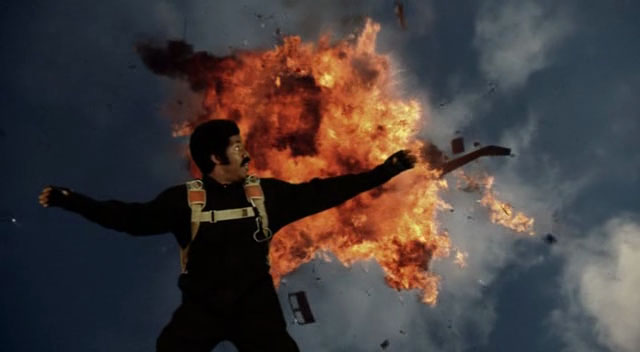
One of the funniest movies I’ve seen all year. And it’s the kind of humor that makes the film nerd in me very happy, lovingly referencing 70’s cheapie Blaxploitation movies, even down to the shitty edits, overacting and pointedly sloppy dialogue, such as “your mama would turn over in her grave if she were here to see this.”

image

Beautiful lines like “Ain’t nothing in the world get Black Dynamite more mad than some jive-ass sucka dealin’ smack to the kids” are just icing on the cake.

image

That’s Tommy Davidson, the only star of In Living Color who didn’t go on to much of a movie career (unless Booty Call and Bamboozled count). Our star is Michael Jai White, Spawn himself, finally back on top where he belongs.

image

Plot isn’t important. BD avenges the death of his brother, wipes smack off the streets, foils Fiendish Dr. Wu’s evil chemical plot and then defeats Richard Nixon in a nunchuck battle.

image

Obviously destined to be a cult video classic alongside Wet Hot American Summer.

image

As the title character in childhood flashback sits for minutes at a time on the floor while his mom quietly cooks hamburgers I’m thinking that Tsukamoto is punishing the people (fans? studio?) who insisted on a sequel to the great Nightmare Detective. I didn’t ask for this, just enjoyed the first one and trusted the director enough to watch another, but he gave me some bullshit, reminiscent of Noriko’s Dinner Table following Suicide Circle (fortunately not quite that bad).

image

Seems like horror series usually save the long, unnecessary backstory scenes for part three (or for the remake, in Halloween‘s case), but we’re gonna explore the ND’s troubled past right here in part two, making a third movie unnecessary. His mom was psychic, became afraid of everything and everybody including her own son, and finally hung herself. ND can hear thoughts as well, but he’s less afraid than perpetually miserable. Somehow that two-sentence backstory takes up half the screen time, mostly through ND’s dream sequences which don’t do much to build atmosphere or further character development, but just begin to hang around and repeat themselves.

image

Meanwhile some high-school girls (led by Yukie) terrify another girl Kikukawa (Hanae Kan, a star at 11 in Pistol Opera then the unrelated “family member” in Nobody Knows) who proceeds to haunt them Elm Street style. ND is interested because Kikukawa has the same fear issues as his late mother, gets belatedly involved after the deaths of two girls.

image

At least Shinya’s got enough energy and interest to pull off a mysterious dream-murder scene among all the boredom and backstory. Yukie and friend Mutsumi nod off in class and dream a restroom in the gymnasium. K. appears, face hidden, walks backwards towards them and tosses a glass of water into Mutsumi’s face. Y. awakens, sees M.’s head has fallen through her school desk. Shades of Elm St. 4 minus the fumbled inhaler and sucking-face joke.

image

Same video look but little of the epilepsy camerawork of the action scenes in part 1. Some cool imagery near the end, especially the N.D. stepping through Yukie’s body, dropping it like a rubber suit (which in fact it is), entering her dream to confront the out-of-control Kikukawa.

image

“If things could talk…”

Our hero Lily Rabe, doing something quirky:
image

Mona (Lily Rabe, a little Drew Barrymorish) is on the run from her mom, dealing with mysterious strangers and memories of her deceased father who used to play a Calvinball version of tic tac toe with her on the beach. A boy finds her wallet, uses her cash to take piano lessons from teacher Kevin Corrigan (Jerry Rubin in Steal This Movie). Five animated commentators (including the voice of David Cross) play a game involving the plot and props of the movie.

D. London on guitar:
image

Mona likes elevator operator Daniel London (the guy who isn’t Bonny Bill Oldham in Old Joy) but they have a falling-out when Jane Lynch (of A Mighty Wind, possibly my favorite performer here) spills beer on Mona. The cartoon characters intervene, causing the woman who hired Mona (to sort through and retype mysterious papers) to have a seizure in order to reunite Mona with the elevator man and reconcile her with her mother. Possibly.

Cartoon gramma torture:
image

A quirky indie drama, not realistic in the slightest, but the animation and the digital tomfoolery let us know that’s intentional. Playful and childish and full of cameos (John Sayles is Mona’s landlord, Eugene Mirman is the night elevator man, Jon Benjamin is a cop, and Jon Glaser is an open-mic performer named Toooot). The first voice we hear is Robyn Hitchcock, appropriately as a train conductor.

Jane Lynch (Role Models, Smiley Face) poses next to Hubley artwork:
image

Hubley’s first feature, very good as far as Sundancey indies go.
Yo La Tengo provides a chill soundtrack (and connections to half the guest stars).

Watercolor self-images by Jeff Scher, whose short films I’ve been enjoying:
image

That’s Steve McQueen the artist who everyone pretended to have heard of when this came out, a naked Warholian who recreates Buster Keaton stunts and projects them onto art gallery walls, not Steve McQueen the actor who everyone has actually heard of, who jumped a nazi barbed-wire fence on a motorcycle.

image

For a director who talks up innovation and rulebreaking, he’s made a rather classic-looking film, with much attention paid to capturing beautiful shots in what should be an ugly story – a hunger strike unto death by physically abused political prisoners inside the shit-smeared walls of a British prison. I expected more subjective views, more filmic art-stuff a la Diving Bell and the Butterfly (also by a former art-gallery sensationalist) but it seems most of the experimentalism was narrative, and who knows if that’s due to McQueen or experienced co-screenwriter Enda Walsh.

I ultimately got less, narratively and emotionally, than from the more conventional IRA/prison flick In the Name of the Father.

Extremely-long-take centerpiece, in which priest Liam Cunningham (Wind That Shakes The Barley, The Mummy 3) fails to talk Bobby (Michael Fassbender, the Inglorious Basterds brit who gets shot up in the basement bar):
image

Prison guard who gets his own arc, ending with execution in his senile mum’s lap:
image

Another prison guard, who does not enjoy beating prisoners:
image

Secret messages:
image

The stop-motion in Coraline seemed untoppable, and now a few months later this seems untoppable. Coraline felt slicker and this had more rustling animal hair which gave it a rough feel without ever looking less than terrific. Anderson’s controlled compositions and affinity for tiny visual details are a perfect match for the rigorous stop-motion process, and the writing and voices and action were all wonderful – this was better than I dreamed it would be.

So I don’t know the original story, but in the movie Meryl Streep agrees to marry Fox on the condition that he stop stealing livestock from farmers. Years later Fox, still a “wild animal,” has a midlife crisis, enlists his buddy and his nephew and sets out to defeat the security systems of the three farmer fatcats in town. Bandit hats are handed out (seems to steal too obviously from Bottle Rocket) and all kids have major parental issues (Anderson would’ve added those if they weren’t already in the book), and Fox ends up getting all the animals in trouble when the fatcats team up to retaliate. Ends happily with a grocery-store hoedown.

Katy liked it, too.

The Coens follow up their grim oscar-winner with the star-studded, absurd and murderous Burn After Reading and then a star-less (recognized one guy from Spin City) return to excellence. Like Miller’s Crossing, it’s a series of perfect scenes, building and building, and leading to… ambiguity. Would need to watch a few more times to work out the film’s philosophy. Part of the problem is all the biblical references (IMDB trivia: “His son Danny’s looking at the oncoming tornado recalls God speaking to Job from out of the whirlwind, saying He will not explain why these bad things have happened to him.”) and I’ve only skimmed Revelations looking for the parts about the seas running red with blood (I think that’s actually in the Necronomicon), so I miss certain allusions.

Michael Stuhlbarg as Larry leads a pitch-perfect cast (relative unknowns or not, the actors must be the best ensemble of the year, Inglorious Basterds their only rival). His wife is leaving him for a smarmy neighbor just as he’s up for tenure, a student is threatening/bribing him, his kids are pains in the ass, his brother is a closeted, medically-impaired couch physicist, and the rabbis offer no help at all. The story builds to a final tragedy (presumably bad news from the doctor, which we never hear, directly after Larry caves on the bribery issue) and a final mystery (a tornado outside the son’s school) but shortly before the denouement comes the son’s quiet, nervous post-bar-mitzvah visit with the elder rabbi which just explodes the movie’s long-held tension when the old man’s handed-down wisdom consists of quoted Jefferson Airplane lyrics.

G. Kenny calls it “something new in the Coen oeuvre: A completely seamless hybrid of their putatively mature mode with their outrageous cartoonish one.”

Bright Lights:

To watch A Serious Man – their most morally sophisticated work – is to feel what it’s like to be Joel or Ethan Coen, to see the world as a pointless series of endless sufferings and inconveniences, surrounded by insufferable buffoons and irrational cretins. This is not a world of their making. This is the world they live in.

Slate:

You could know the Kabbalah inside out and still struggle with these mysteries every bit as fruitlessly as Larry does. And that’s just how his creators want it. Though the movie concerns a specifically Jewish crisis of faith (and paints a satiric but lovingly precise portrait of Jewish-American culture), A Serious Man unfolds in a moral universe that’s recognizable from earlier Coen films. It’s a cruel and ultimately inexplicable place. What Anton Chigurh, Javier Bardem’s pitiless mass murderer, was to No Country for Old Men, the Hebrew God is to this movie.

I should also mention that this movie had one of the best trailers of the year, a montage of annoying sound effects and cries for help set to the rhythm of Larry’s head being banged into a chalkboard. If not for that propulsive Arcade Fire song on Where The Wild Things Are, I’d have to give it top honors.

Nicolas Cage’s first good part since Lord of War and Val Kilmer’s first good movie since Kiss Kiss Bang Bang. Cage hurts his back rescuing a prisoner, starts taking lots and lots of drugs and racks up gambling debts. He robs kids outside clubs, gets a violent dude mad at Cage’s hooker girlfriend and loses a key witness. Surely he is a bad lieutenant, but he has a few principles, and Cage’s charismatic intensity keeps us on his side even as he’s waving guns at grammas (lovable Irma P. Hall of the Coens’ Ladykillers). Ultimately he takes down a drug baddie (Exhibit, fifth-billed in the second X-Files movie), saves his girl (Cage’s Ghost Rider costar Eva Mendes) and pays off his bookie (Awwww Brad Dourif is getting old. Life is too short).

Nic, Brad and red beans:
image

The story (from a lead writer on Cop Rock) isn’t great, and the idea (remaking Abel Ferrara’s Bad Lieutenant) is awful, but Herzog pulls it off with flair. The occasional weirdness (extreme closeups of reptiles, including an iguana music video – what is it about drug movies and visions of reptiles? See also Fear & Loathing in Las Vegas), the sense that Cage is having too much fun to take anything seriously, and a lovely tacked-on ending where Cage meets the ex-con he saved and they get philosophical at an aquarium rescue this doomed movie and turn it into something I’d actually recommend. Can’t wait to see Werner’s other 2009 movie (star Michael Shannon, the contagiously crazy dude in Bug, shows up here as a police property guy).

image

Cage pulls up at a building I think I saw in Wild At Heart. Maybe lots of buildings in New Orleans look like that. Jennifer Coolidge (Pootie Tang), Fairuza Balk and other names I know or faces I’ve seen pop up regularly. Surprising that so many actors wanted to be associated with a cheapie indie remake of a cult film, but I guess you can’t discount the Herzog factor.

Salon:

Your ending really defies expectations. I’m not quite sure what to think about it, in fact. We expect one of two possible endings — the bad lieutenant triumphs, or he is punished for his misdeeds. And you really don’t give us either one.

Herzog:

In my opinion, it’s a very beautiful and very mysterious ending. You see, according to the screenplay, it ended with a false happy ending that became a real abyss of darkness. And I thought, no, we should not dismiss the audience like that, out into the street. There should be something vague, something poetic, something mysterious.

Based on the bestest-selling novel which everyone in the world has now read. I’d heard it would be relentlessly bleak, and so that’s what it was. Hillcoat and Nick Cave and Viggo Mortensen and Javier Aguirresarobe (also cinematographer of Talk To Her, The Dream of Light, the Twilight saga) and Charlize Theron and the boy all did terrific jobs, first-rate, award-deserving and everything else.

But it’s kinda like Polanski’s The Pianist… a perfectly-made film in service of the most depressing story ever. One person survives a (nuclear/nazi) holocaust, and while that’s somewhat encouraging, the movie spends its runtime rubbing your nose in the terrible enormity of said holocaust making for a mega-bummer experience. If a great movie makes you feel crappy for having seen it, is it still a great movie?

I suppose Theron is only alive in flashback. She doesn’t have the survival instinct of her husband, just wants to kill her son and herself peacefully before cannibals catch them or they starve to death. Viggo won’t agree, so she wanders out into the cold alone. Viggo goes from being the only honest man in the world, protective and generous to his son, ruthless in his survival, to seeming slightly savage, giving a thief a death sentence, unable to ever trust anyone. When he dies from cold & sickness, the son is immediately picked up by Guy Pearce and family, and you get the feeling that he’s better off. Robert Duvall is unrecognizable as a decrepit man who may not be as feeble as he lets on. Viggo gets shot by an arrow, discovers a hidden food bunker, avoids cannibal camps, shoots a guy in the head – it’s hardly Children of Men as far as slam-bang action but it’s creepier as far as apocalyptic atmosphere.

Visions of Europe is a 2004 anthology film with shorts by various directors about the current state of the continent, which I’ve already started to watch earlier and still may never finish. Pretty hit or miss.

The Miracle (Martin Sulik)
An immaculate conception story, the girl’s parents and priest trying to get answers. God’s message, via the girl, “We mustn’t build tower blocks. The big ones must heed the small. We need to travel more to resist the false messiah.” Weird, kinda spooky. Not sure if the floating coffee cup at the end helped or not.
image

Anna Lives In Marghera (Francesca Comencini)
Briskly edited montage of an Italian student who participates in Rage Against The Machine-soundtracked political protests and prays when she’s not working on her thesis about industrial pollution.
image

Children Lose Nothing (Sharunas Bartas)
A girl collects frogs. Two boys fight over a girl. A paper boat! Finely photographed brownish little art short. Symbolic of something!
image

Room For All (Constantine Giannaris)
Talking heads tell us about the immigrant experience in Greece. Giannaris just made a movie called Gender Pop – the title alone is more interesting than this.

Prologue (Béla Tarr)
Loooong black-and-white dolly shot (imagine that) with pretty music by Mihaly Vig showing hundreds of people waiting in line to get food. Tibor Takacs was one name in the credits – could it be the director of The Gate?
image

Invisible State (Aisling Walsh)
A serious man in a suit tells us angrily about human trafficking. “They will tell of Irish eyes not smiling.” Walsh made a teary Aidan Quinn drama the previous year.
image

Crossroad (Malgorzata Szumowska)
The adventures of a catholic cross outdoors at a crossroad. Eventually some coroners take down the classic Jesus and replace it with a blobby new plastic Jesus. Was it supposed to be funny? I found it kinda funny.
image

Paris By Night (Tony Gatlif)
Immigrants on the run, one of them injured, run through the Paris streets to some good music. Jarmuschy. Same year as Gatlif’s acclaimed Exiles.
image