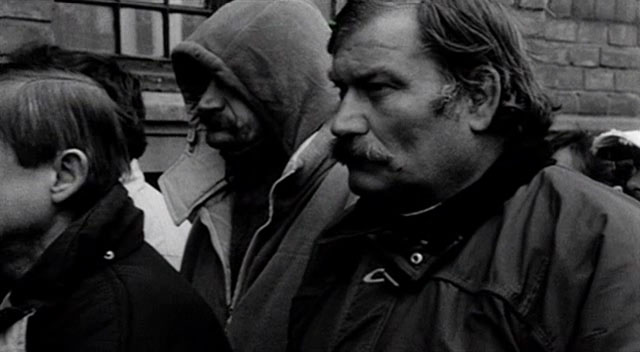
Glorious (2008, Guy Maddin)
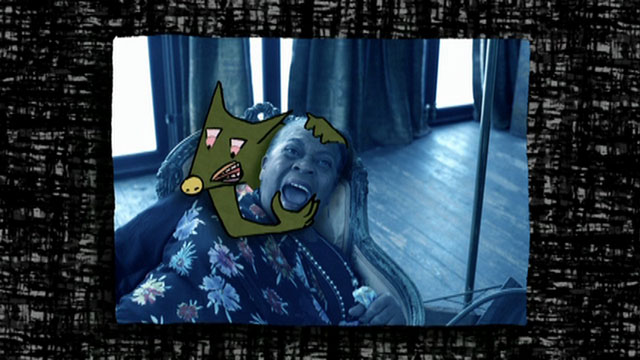
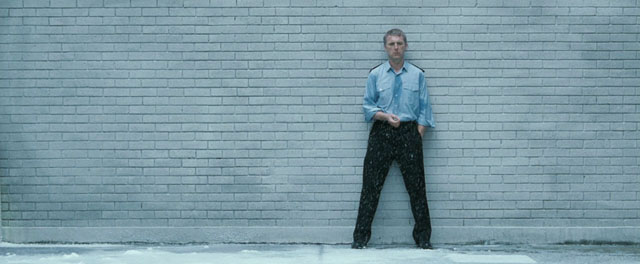
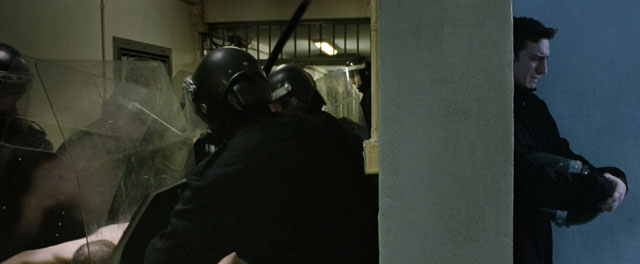
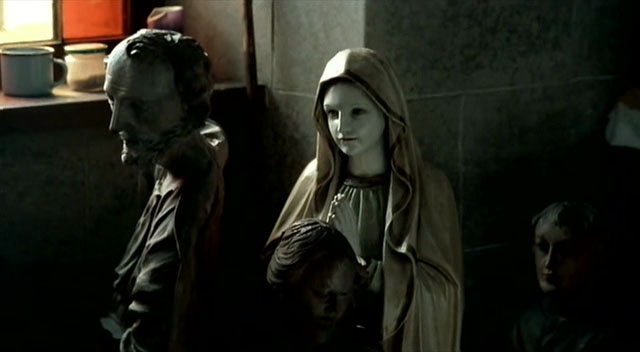
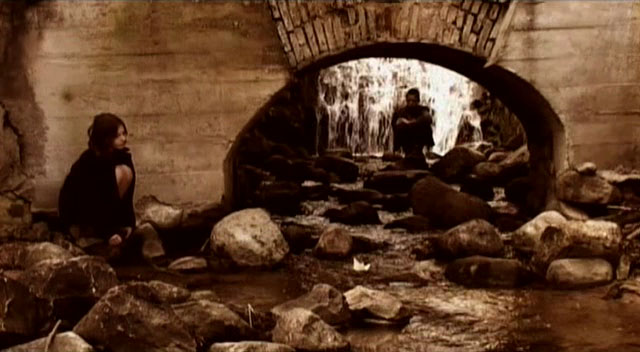
Far more guns, gangsters and cocksucking than has ever been in a Maddin film before. Features Louis Negin as a single-frame apparition turned fellatio-ghost. Must pay more attention to the music next time. In other news, when I looked up Louis Negin on IMDB, it says he played a zombie in Pontypool.
image

image

image

image

Yay, got me a 2007 disc of cartoons based on the work of Jim Woodring. Jim himself kicks off the collection with the one-minute Whim Grinder: A Frank Adventure, in which Frank and his pet… box? intercept a transmogrifying eggbeater from a mischievous devil.
image

Frank (Pushpow) (Taruto Fuyama)
I dig the use of the “meet george jetson” music cue. Watched twice because there’s a second audio track with elektronischy music by James McNew. Black and white and very stripey. Done in Flash, maybe? then transferred off a videotape from the looks of the credits. One of the greatest things ever.
image

Frank (Eri Yoshimura)
Next one, done in a puppet cutout style, is very different. Frank seems to be having a picnic with his buds until a rampaging pig beast tears them all apart. Seems about two minutes of animation edited into four. The closing credits are pretty nice – not so much the rest.
image

I’ve Been Twelve Forever (Michel Gondry)
Gondry talks with his mom, storyboards his dreams, builds a spinning camera-spirograph triggered by strings tied to Bjork’s fingers, makes cartoon farts with cotton balls, invents new animation methods, films himself in stop-motion, and discusses his best music videos. This turned out not to be a short at all, though I thought it would be when I started watching it, and much more elaborate and creative than its status as a DVD-extra on a music videos disc would suggest. I’m pretty sure I like this better than Be Kind Rewind. Co-directed with four people including Lance Bangs.

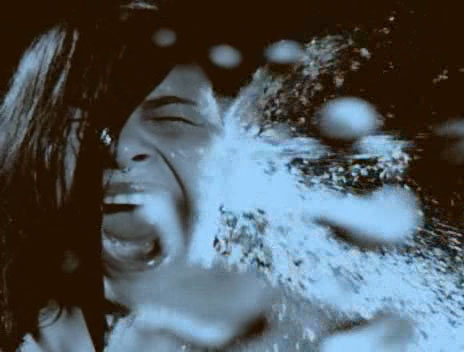
Wet Chicken (2003, Myznikova & Provorov)
A woman’s hair blows in the breeze, then she shakes her head, then she’s shot with a stream of water. Seems like the kind of rough materials that Shinya Tsukamoto would make something interesting from, but these guys forgot to make something interesting and accidentally released it like this. Too late to re-edit now that it’s on the internet.
image

The Marker Variations (2007, Isaki Lacuesta)
One ruler of Dijon uses photographs to rule, and the next uses them as execution aids. 12th century monks composed Bach concertos 900 years before Bach did, inscribing the notes into their stone architecture. Buenos Aires is “the divided city” so a story of two mirroring authors is told using split-screen images.

Opening with these unbelievable stories reminded me more of Magnolia than Chris Marker, but an exploration of the images and possible existence of Marker is what follows. He goes over Marker’s references, he asks his own Japanese friend the questions asked of Koumiko, and eventually he gets caught up in his own essay, his own connections, but accompanied by so many images from Marker’s films (not to mention the music) that none of it escapes, sticks in my mind. To a Marker-phile such as myself it’s just too much.
image

Allegretto (1943, Oskar Fischinger)
All colored diamonds and circles, so lovely. In close sync with the music, where in Motion Painting #1 the music seems an afterthought.
image

Motion Painting No. 1 (1947, Oskar Fischinger)
Like it says, a motion painting – oil on glass, all small rectangles and big spirals. In The Mystery of Picasso the tension was in figuring how the painting would be finished, where he was heading, but in this the fun is in getting from one intermediate step to another. The process is the destination. There should be more of these!
image

Franz Kafka (1992, Piotr Dumala)
Is the movie supposed to be making that sound of a cat in heat beneath the music, or is my laptop freaking out? Dark and scratchy and slow-moving, nothing actually happening. Oh wait, there’s some sex. Fulfills almost all of the Robyn Hitchcock holy keywords: sex, food and insects (what, no death?). I’m sure it’s very technically accomplished but I found it dreary and ponderous. The filmmaker made a plaster-scratch version of Crime and Punishment eight years later (or more likely he worked on it for all eight years).
image

Tales from the Far Side (1994, Marv Newland)
Very inessential, slow-paced animated half-hour of Far Side cartoons. Really the most interesting bit is seeing Marv Newland’s name, 25 years after his seminal Bambi Meets Godzilla. Either he’s no longer a master of timing, or there was too much Gary Larson interference… or maybe you just can’t turn a single-panel comic strip into a 30-minute TV special. Doonesbury worked out, but that was talky and story-driven to begin with.
image

Mr. Prokouk Shoots a Movie (1948, Karel Zeman)
Czech short, part of a whole series of Mr. Prokouk adventures.
image

Prokouk is pointing at us, telling us to get off our asses and join the workforce!
image

The Monkey’s Teeth (1960, Rene Laloux)
Intro is a three-minute doc of a group-therapy institution for depressed people, what follows is an animation of the film they wrote together. Sad man has a toothache, goes to a dentist who steals his teeth to sell to rich people (I wouldn’t think the teeth of the poor would be worth much, but maybe in France everyone practices excellent dental care). When the monkey wizard bicycles by, I figured the dentist would be put in his place and the stolen teeth returned, and that’s just what happens but first the sad man gets chased into a high school by some cops who get turned into children. Hmmm.
image

Dimensions of Dialogue (1982, Jan Svankmajer)
It’s been too long since I’ve watched my Svankmajer shorts. This is an all-time fave. Faces made of identifiable objects consume each other, becoming smoother until they resemble human heads. Two clay humans make love, create an unwanted clay baby then destroy each other. And so on. Not one for brevity, J.S. takes everything to its conclusion and explores all permutations of his object manipulations – this is what makes his features seem so tedious, but his shorts seem so excellently complicated.
image

Flora (1989, Jan Svankmajer)
A clay person tied to a bed and covered in rotting fruit and veg tries to reach a glass of water. Only a few seconds long, made for MTV (that’s czech for WTF).

Food (1992, Jan Svankmajer)
Oooh I love stop-motion using live actors. Guy enters a room facing a paralysed robot guy, reads instructions hanging on his neck (which are actually an MTV entry form: “Entrant must send a VHS or U-Matic, etc.”), manipulates the guy (puts money in his mouth, receives a sausage and mustard from chest, utensils from ears), then the robot guy leaves and the eater takes his place. Two guys sit at a restaurant, can’t get service so they eat their own clothes and the table. Finally, people are made gourmet meals of their own severed body parts. A classic, obviously.
image

I Love To Singa (1936, Tex Avery)
“Enough is too much!” An old favorite. Owl Jolson is of course a parody of The Jazz Singer, which I’ve still never seen. Jazz and owls: a combination you don’t see often enough.
image

Point Rationing of Foods (1943, Chuck Jones)
An extra tucked away on a Looney Tunes DVD, explaining the wartime canned food rationing system to the public through cheap quickie animation. Helpful to me, since I never bothered to learn how rationing worked before. Also tucked away is the Tashlin-penned The Bear That Wasn’t, probably not because of its unworthiness but because it was made at a different studio.

I Haven’t Got a Hat (1935, Friz Freling)
A variety show of children performers, with hijinks. Porky’s first appearance – the studio intended for a more generic troublemaker character (below, right) to take over, but the public demanded a shy stutterer instead. The title song is catchy, anyway.
image

Roof Sex (2003, PES)
Stop-motion of chairs having sex. The cat is blamed.
image

I told Katy I wanted to call this “post-feminist cinema” but she said “anti-feminist” would fit better. I’m gonna read what everyone wrote about this later on, but for now my first impression was that it’s a beautiful film of a less-beautiful story. Charlotte and Willem lose their young son and since he’s a psychologist he tries to help her through it using dodgy methods like taking her to the place she’s most afraid of. So he’s either doing a good job, or he’s misguided but still trying to help the best he knows how, or he’s an awful person who hopes to further incite his wife’s trauma so he can write an exciting book about it. I go back and forth, but what I’m sure about is that Charlotte turns out to be an evil witch. She watched her son die and did nothing to stop him, she drilled a metal rod through Willem’s leg, and she acts generally psycho until he stops her and is confronted by the ghosts of a hundred dead forest witches. Or something. Gotta say I actually liked it a whole lot, found it an effective and gorgeous horror movie, despite any political or character misgivings.

Spike has turned a beloved ten-page kids book into a dark, psychological grown-up divorce drama acted out by a confused kid and large, brown, dangerous puppets. We’re not sure how we feel about this. I’m pretty sure I like the movie. It’s different as hell, seems a ballsy move to have made it at all. Don’t know how much of Spike’s (or co-writer Dave Eggers’) vision made it intact, vaguely recalling rumors of delays and studio-mandated CG puppet-enhancement. Whoever meddled in whose affairs, the monsters came out looking great.

Trouble: handheld camerawork provides no sense of composition most of the time, and fantasy world and characters are all painted in shades of brown. The filmmakers are creating a ten-year-old’s escapist fantasy realm, and all we get is brown? Suppose it’s a natural-environment thing, since he’s fleeing civilization for the wilderness. The music is alright, but the quiet version of Arcade Fire’s “Wake Up” on the trailer was so beautifully suited to the imagery, I’m tempted to say I liked the preview better than the film.

Young (imaginative, loner, duh) Max and his older sister live with beleagured mom Catherine Keener. Divorced dad isn’t in the movie, except once by phone, but mom is dating a guy, probably third-billed Mark Ruffalo who I didn’t recognize for the 45 seconds he was in the film, when Max goes on a rage, runs away in his monster pajamas and dreams a perfect world where he gets to be king of the monsters and have fun all the time.

Just kidding – Max dreams up monsters who are as moody as himself, always quarrelling and splitting up like his parents or going off to hang out with their cool friends like his sister, building beautiful things then destroying them in temper tantrums, hurting each other accidentally or on purpose, and often threatening to eat Max up. After an hour of this, nothing is resolved and Max goes home… just like real life, but not much like the hollywood spectacle we were all expecting.

Brooding designer Coco Chanel meets visionary Igor Stravinsky, and sparks fly in this fictionalized bio-romance… oh wait, no that’s a different movie entirely. So what happens in this one? Coco (Audrey Tautou) is a young seamstress in a song-and-dance routine with her sister (Marie Gillain, the girl from My Father The Hero), but dreams of independence. Shacks up with an older, thin-mustached guy Etienne (Benoît Poelvoorde, Belgian star of Man Bites Dog) then falls for young thick-mustached guy Boy (Bostonian Alessandro Nivola of Junebug and Jurassic Park III). After she’s made enough money selling hats with help of actress friend Emmanuelle Devos (star of Resnais’s new Wild Grass, Mathieu Amalric’s girlfriend in A Christmas Tale), she leaves them both, becomes a solitary superstar and never loves again (except, assuming either movie is true, Igor Stravinsky).

Seemed slightly better than your average “famous historical person in love” kinda movie. They pull off a bit of drama, and one memorable image (postscript-Audrey sitting on a mirrored staircase as very modern-looking models descend, applauding). But remove Coco Chanel from the title/script and replace her with a nameless fictional character and this never would’ve made it into theaters. It’s supposedly exploring the mystique of this famous designer, but never really does so, barely touching on the design elements she is known for, just throwing together (or making up) biographical details. Katy didn’t love it either, or I’d try to be nicer.

Vincent Gallo is on a plane to Paris with his lovely new bride June (Tricia Vessey, the girl who witnesses a hit in Ghost Dog), but he has dark dreams of blood.

image

Leo (Alex Descas of Irma Vep and plenty of Claire Denis movies) is cleaning up a dead body left by his wife Coré (Béatrice Dalle, Isaach De Bankolé’s blind passenger in Night On Earth).

image

Turns out Vincent and his ex-lover Coré are vampire/cannibals, and Vince is in town looking for Leo, a doctor who was working on a cure. It’s not much a honeymoon for June, nor much of a marriage for Leo – the vampires feel strong lustful urges, but always resulting in the death of their sexual partner, so June stays frustrated, Leo works in his labs, Coré sucks dry a kid who breaks into her house and Vincent rapes/eats the maid beneath his hotel.

image

That’s already an unusually juicy plot for a vampire flick, but this is also no vampire flick, it’s a Euro-Art-Film with long wordless sections and gorgeous images, my favorite Claire Denis movie so far.

image

Surprisingly, the day after I watched this it was notcoming.com’s horror movie of the day. They say:

Claire Denis seems at once unlikely and ideal as the director for a horror film. On the one hand, she seems incapable of making a purely genre film; on the other, no film director in the world more gracefully explores the physical, more pointedly employs cinema to trace the ambiguities of body, persona, and landscape. In this way, a vampire film, with its themes of metamorphosis and the alien nature of appetites is perfectly suited to her abilities as a filmmaker, even if she is unlikely to satisfy our own appetites for genre pleasure. … There are few genre signifiers to reassure us of the presence of that strong moral center so (paradoxically) common to horror films, and the narration of events is characteristically obtuse, reliant on gesture rather than dialogue. …

The metaphor is not finally about a vampire’s exertion of will or power over his victim, but more about the inadvertent draining that happens in a relationship. Shane fears that he will hurt June, that he will tear her apart, that his sexual desire will destroy his wife. It is a metaphor for intimacy and its dangers…

Gallo acts like Frankenstein for his wife’s amusement:
image

image

And a few days later the movie was the subject of a discussion on The House Next Door. It is unbelievably long and I haven’t read the whole thing yet… excerpts:

JB:

If I’m properly connecting the film’s vague dots (and I might not be), Coré and Shane are essentially infected. They are diseased. Without this infection, they wouldn’t have these perverse needs and thus wouldn’t act this way, and without the mysterious drug that caused this whole mess they wouldn’t be infected. As a result, I don’t look at Coré and Shane as portals to our dormant demons. I see nothing that reflects my own soul. What I do see in Trouble Every Day is a chilling portrait of addiction. Coré and Shane aren’t addicted to the drug that made them want blood but to the blood itself. Same difference. Now infected, they want to do nothing but “use.” Coré’s husband looks out for her, tries to protect her from herself, hopes to cure her and over and over again gets stuck cleaning up her messes. Shane, meanwhile, sleepwalks through his daily life, unable to connect with anyone outside of his addiction. If I wanted to pick a film that would exemplify the disease model for addiction, it would be hard to do better than Trouble Every Day, which shows how chemical imbalances in the brain obliterate normal rational thought so that ethics are meaningless.

image

EH:

Scenes like this make the film at least partly about the damaging cycle of an unhealthy love affair, about a man who knows he’s no good for the woman he loves but keeps trying to convince himself that he’s going to do better, that he’s not going to hurt her anymore. But we always hurt the ones we love, right? In some ways the film is about an abusive and often absent spouse, perhaps in contrast to the perverse loyalty of the marriage between Coré and Léo (Alex Descas). We feel June’s confusion and pain when she waits out in the rain, desperate for some sign of her missing man, or when she goes to visit one of his old friends, hoping for some explanation for his inconstant behavior but getting only nostalgia and vague comforting words.

image

So we can agree that the movie is about lots of things, but not necessarily that it’s a horror film. I, for one, think it’s a definite horror film, and the only reason I can think for anyone to feel otherwise is that it towers above the kinds of movies that “horror” usually brings to mind (see my upcoming writeup on the Puppet Master series for an example). I’m glad that among the direct-to-video Clive Barker junk, I stumbled across two modern horror masterpieces (see also: Pontypool) this SHOCKtober.

“The dead have highways…”

It’s the only line I remember from the (very) short story, so of course it’s spoken five or six times in this 90-minute movie. I watched this in hi-def, only perhaps the third feature I’ve watched at home in HD (hello, The Fall and Night of the Creeps), and the first where I’ve sat close enough to the screen to notice how awesome it is. Actually sometimes I forget, it’s not that HD is awesome, it’s that SD is terrible and it has been hanging around far too long. Down with the tyranny of standard-definition… we welcome our new masters! I’d love to welcome them further but I can’t afford blu-ray or a nice TV – this $200 widescreen computer monitor will have to do for the next few years.

Oh, right, the movie… so as we’ve discussed I am a sucker for movies based on Clive Barker stories. I’ll watch any old shit as long as his name is attached (except the made-for-TV shit and Underworld/Transmutations). Therefore, Book of Blood, based on the titular story which served as an introduction to his anthology, and another I don’t remember called “On Jerusalem Street.” This was halfway decent, not as much a waste of time as Midnight Meat Train, maybe even worth watching. That’d be the first Barker-related movie to hit the high mark of “worth watching” in nine years, so this is a big deal.

image

The plot doesn’t sound so great: mystical whiz-kid Simon (TV’s Jonas Armstrong) is taking some college course in supernatural hoo-ha (lucky bastards – all my courses were about operating systems and design fallacies and thermodynamics and Thomas Kuhn) taught by over-serious Mary (Sophie Ward of the Crispin Glover Crime and Punishment – yes, there is such a thing and I must see it), who hangs around haunted houses in the evenings with tech guy Clive Russell (supposedly in Spaced and Neverwhere, but I don’t remember him). They find a house that is seriously badass haunted and they pay Simon to sleep there while they monitor the goings-on. Sure enough, he is haunted as hell, but they fail to record it because Simon’s actually faking the whole thing, jamming their signals and scrawling on the walls because his parents didn’t pay him enough attention.

image

The action stops for an hour or two while each character recites his or her traumatic back story. There’s the same scene of a guy with big headphones and a shotgun mic walking around a haunted house as in Spooked. I love that.

Finally the actual ghosts have had enough of this, haul Simon to the CG-riffic GHOST REALM and take turns carving their stories into his skin. Simon escapes back into the framing story – have I mentioned there is a framing story? – in which a dude is stalking Simon at a restaurant. The dude captures him, listens to his story (that’d be the bulk of our movie), kills Simon and removes his skin, then drowns when his cabin fills with Evil Dead amounts of blood and the door won’t open (funny how the doors never open). Who hired the dude to skin Simon? Could it be Mary, the only other character in the movie? Yes!

image

From the director of Versus and Godzilla: Final Wars, two movies I didn’t like at all. Guess I should’ve looked that up before I rented it, but I’m a sucker for anything Clive Barker-related, so it probably wouldn’t have stopped me. Barker’s elliptical story has been handily adapted into a full-length movie by the writer/director of Insanitarium, a little-seen horror starring Peter Stormare. Add a hundred producers and the cinematographer of Soul Plane and you’ve got yourself a movie.

img

Bradley Cooper (Jennifer Connelly’s cheaty husband in He’s Not All That Into You and an enthusiastic drama counselor in Wet Hot American Summer) plays a dullard photographer who wants to get deeper, go further into the depths of the city to get the most real, unflinching photographs anyone has seen, to the frustation of girlfriend Leslie Bibb (who was she in Iron Man?). They have a good-looking friend (Roger Bart of Hostel II) and they know a couple of other undeveloped characters, so much the better since a horror flick needs bodies. Oh and Bradley’s photo guru is Brooke Shields, whose name you hear a lot though she’s hardly been in anything I’ve heard of.

20 minutes in it announces itself to be slapstick horror, with a three-person train massacre filmed in the hammiest way possible with all From Dusk Till Dawn 2 POV shots. I didn’t think it would stoop to that. Then it straightens up and goes serious suspense for a while – can’t figure out what it wants. Maybe the slapstick thing would’ve worked if they’d stuck with it. Clashes with Barker’s style, but I’m sure Vinnie Jones would’ve been game.

Clearly game for anything:
img

Oh, so Vinnie is “Mahogany,” butcher by day, filler of train cars with murdered naked bodies for subterranean mutants to eat by night. They pull the thing where Bradley finds out, fights Vinnie and wins, but now has to replace Vinnie as the purveyor of bodies for mutants under the guidance of he sinister magic conductor. Neither as good as I’d hoped nor as bad as I’d feared.

img

Good to see this again. Funny that all I really remembered is one of the first scenes with Agnes asking a couple reluctant women about gleaning, and Agnes talking about her own hands.

image

I’m feeling uninspired, so we’ll let Senses of Cinema do the talking:

The official subject of this film is gleaning, the act of gathering remnants of crops from a field after the harvest. As Varda demonstrates, people can be discovered throughout the French countryside gleaning everything from potatoes to grapes, apples to oysters, much as they did hundreds of years ago (though no longer in organised groups). More figuratively, there are also urban gleaners who salvage scraps from bins, appliances from the side of the road, or vegetables from stalls after the markets have closed. And then there’s Varda herself, a gleaner of images, driving around France with a digital camera and a tiny crew (at times, she wields a smaller camera herself, permitting an even greater degree of intimacy).

image

Varda has a (sometimes contested) reputation as a feminist, left-wing artist, and this is very much a political film, though it offers a series of poetic metaphors and concrete encounters in lieu of an explicit, closely reasoned argument. My guess (based mainly on anecdotal evidence) is that the political outlook of The Gleaners And I has a lot to do with its popular success – even if Varda herself, who began filming back in 1999, wasn’t fully aware how thoroughly she was tapping into the zeitgeist. Without specifically referring to political movements or events, the film embodies a quasi-anarchist ethos now in the air in all sorts of ways – a resistance to consumerism, a suspicion of authority, and a desire to reconnect politics with everyday life.

Agnès enjoys a pilfered fig:
image

Katy liked the movie, and the next day she felt like going out to pick figs. Shot on a handheld digital videocamera. The picture/framing isn’t always beautiful, but she keeps things quirky enough to stay interesting amongst all the talking heads.

image

As with Le Bonheur, Varda has taken over the DVD’s special features section herself with a whole hour-long follow-up film entitled Gleaners & I: Two Years Later (2002) Gleaners was her most locally popular and globally well-distributed films in decades, and she racked up awards and fan mail, so here she addresses concerns and gaps in the previous film and catches up with some of its stars.

image

Killer finale, the heart potatoes, symbol of the Gleaners film, old and wrinkled as it sprouts new life. As the credits roll, sudden cutaways to closeups of the potatoes, exactly as in the opening credits with the sunflower in Le Bonheur.

image