image

A film by a guy who I’m surprised hasn’t been killed, based on the novel by an author who I’m surprised hasn’t been killed (IMDB says he’s living under police protection). Won every Italian academy award and every European Film award, got second place to The Class at Cannes. After watching the beginning of Fellini’s 8 1/2 on TCM a few nights ago, I was just glad to watch an Italian flick without rampant dubbing.

image

Multiple story threads that manage not to crash (see: Crash) together into one narrative, but stay where they belong, illustrating different parts of the problem. The problem is the Camorra, the Naples crime organization which, as the end titles claim, is widespread enough to have invested in reconstruction of the world trade center in New York. Movie is well-shot, but mostly handheld, not stylish like most classic gangster movies (such as Scarface, referenced here a few times). Scary as hell in that non-horror, Collapse sort of way; I would never ever like to visit Italy after watching this.

image

Toni Servillo is a busy man, playing Franco the illegal dumping magnate and the lead in Il Divo the same year. Two dumb-as-fuck youth steal some guns and get predictably killed at the end. Clothing manufacturers spy on each other. A kid helps get his neighbor killed, desperate to join the local gang. All is sadness and violence with no hope. To hell with Italy.

image

Didn’t stick with me very well the first time, maybe because it didn’t make enough narrative sense for my brain to properly hold on to, like a wacked dream that I remember clearly when I wake up but is already gone by the time I hit the shower, not related enough to reality to survive my beginning to ponder my work day. Should have watched it a couple times originally. But now I see I should watch more than a couple times, maybe annually from now on. Lynch’s most free, most trippy and loose movie, existing almost entirely in dream state, but also his most dirty and real looking because the DV photography feels like a home movie. Completely inexplicable and entirely worthwhile.

image

Hard to watch at home. The three hour runtime, the almost entirely black scenes, and the very dynamic audio levels (quiet whispers turn into sudden shock sound effects and screams) work best when I’m home alone and wide awake on a winter’s night. I think it freaked out my birds more than anything else I’ve watched. Next time I’ll watch on my laptop, in accordance with Lynch’s dreams of an all-digital cinema.

image

The plot, thanks to Cinema Scope:

Dern’s first incarnation, Nikki Grace, is an actress who lives in a cavernous Hollywood mansion and lands a coveted role in a Southern melodrama titled On High in Blue Tomorrows opposite suave ladies’ man Devon (Justin Theroux). She soon learns that the film is a remake and that the original Polish production was aborted when both leads were murdered.

image

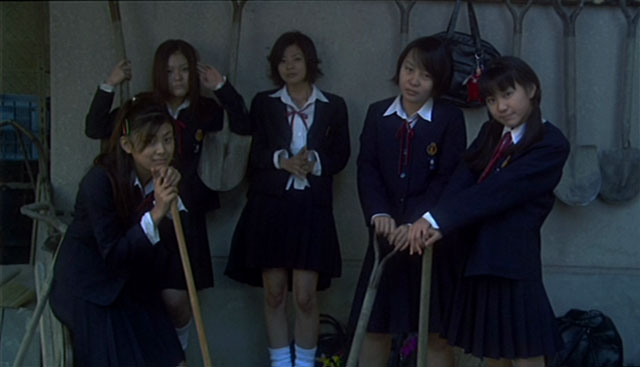
Nikki begins to merge with her character, Sue, and the script’s adulterous affair spills over into real life. But what’s real, and who’s dreaming whom? The boundary between the film and the film-within-the-film — indeed between all levels of reality — vanishes completely. Besides Nikki and Sue, Dern plays at least two other overlapping variations on the character: One lives in a shabby suburban house, sometimes with a harem of gum-chewing, finger-snapping young women. The other, a tough-talking Southern dame, is spilling her guts out in a dank room, telling floridly vulgar tales of sexual violence and terrible revenge. Interspersed throughout are scenes from a Beckettian sitcom with a rabbit-headed cast. Certain phrases, often pertaining to identity confusion (“I’m not who you think I am,” “Look at me and tell me if you’ve known me before”), repeat in varying contexts and start to acquire talismanic power. (The key to transcendental meditation, which Lynch has practiced for over three decades now, is the repetition of a personal mantra.) Meanwhile, the film we are watching is beamed to a TV in a hotel room, and a mystery brunette watches along with us, silently weeping.

image

Did I write this weeks ago, or was I quoting from a website?: “Dern changes identities and locations, each with only a faint memory of the others, giving her a constant sense of unease.”

image

The neighbor who visits her is awfully good in a Twin Peaks sort of way. A choreographed dance to “The Locomotion” manages to be one of the spookiest parts. Seeing father Rabbit leave his locked-down living room set is thrilling. Cameo by the girls from Darkened Room (actually only Jordan Ladd is strictly from Darkened Room, but I like to think they’re the same characters). William H. Macy in a big cheesy cameo as a radio reporter and Harry Dean Stanton as Irons’ sad assistant, always bumming money off people.

image

Bright Lights:
“It sounds complicated, but it makes clear emotional sense, just as Mulholland Drive did.”

image

House Next Door calls the ending hopeful, and I guess you could say that. Dern escapes from at least one of the films she’s trapped within, wakes from the dead and goes back home where, per HND, “Lynch returns to the face of Grace Zabriskie’s Neighbor and, before our jaundiced eyes, this formerly intimidating and ugly figure becomes suddenly beautiful and ethereal. Moreso than Dern’s final close-up (a stunner in its own right) I think the answers to the film’s many mysteries, for those who need them, are contained in Zabriskie’s sideways glance and virtuous smile.”

image

Extras on the UK DVD are all interview-style. One is by The Guardian, one is by Mike Figgis at a hotel in Poland.
image

Interviewer: “If T.M. creates positiveness… some people might ask: what about all the darkness that’s in the films?”
Lynch: “Exactly.”

On the inclusion of Rabbits in Inland Empire: “Sometimes we start something and we think it is that, and later… it sprouts and becomes a bigger thing.” Okay it’s not a great quote.

“Really the only difference [between IE and the earlier films] is Inland Empire was shot with DV… and it was a low-grade, bad DV.”
image

“It is true that the 50’s gave birth to rock and roll and that early rock and roll holds a very special power, I think. It started the whole thing rolling, but in my mind it drifted away a little too quickly. And I think there’s more gold to mine from that feel of the first rock and roll.”

Repeats the same information over and over, not saying much for long periods, interviewers asking stupidly general questions hoping Lynch will tell them a nice story. He does tell a couple light ones, but three times each. So the final segment, The Air Is On Fire, comes as a happy surprise. It’s a biographer (who knows enough about Lynch not to ask pedestrian questions) viewing and discussing Lynch’s paintings and sound installations.
image


“We’re cooking quinoa.”
“This pan is unbelievable.”
The U.S. DVD is already better than the U.K., with a b/w video of Lynch in his kitchen and a nice stills gallery, and that’s before I even get to the meat of the disc. Hey, he times his cooking the same way I do, by yelling out numbers from the clock instead of setting a proper timer.
image

More Things That Happened is outtakes from IE. First 20 minutes are scenes with Dern’s circus husband. He comes home late. He sells a girl a watch.
image

Dern continues talking to the man at top of the stairs. She has a crossed out “LB” tattoo on her hand. A girl with earrings talks to Dern about meeting Billy at a bar. Mostly people telling each other stories.
image

Ballerina
A ballerina performs behind cloudy overlays and blobby digital soft focus to ambient music. Some neat effects in there but too long by half.
image

Lynch (one) is a full-length documentary by BLACKandWHITE, whatever that is, company or person, on the making of Inland Empire. Lots of behind-the-scenes dealings, set construction, some talk with the actors, Lynch in every scene. Lynch 2 on the IE disc is presumably deleted scenes from that doc, another half hour of material. Not tremendously eye-opening, just gives you the impression that IE is completely Lynch’s artistic vision, if you couldn’t have figured that out before, down to the smallest detail. He yells at his crew on set then praises them up and down in interviews. We hear a lot about the improv nature of the film and script, but we see careful planning and scheduling of shots and scenes. Watching David choreograph the closing credits musical number, telling the lumberjack not to cut all the way through the log because “we’ve only got one log,” you realize that all the backstage footage in the world might be fun to see, but still wouldn’t explain a thing.
image

“It’ll be more than a mouthful, which will look real, and it looks great. And you can throw up a lot of blood. Two times you’ll throw up.”

“There was a thought for a long time that you had to suffer in order to create, and this is just about opposite of the truth. If you’re suffering, even a little bit of suffering cuts into your creativity. In fact, the happier you are, and the more wide awake and rested you are, the better it goes… then the ideas can flow way better, way smoother and faster, and more of them.”

Stories is Lynch talking for 40 minutes, maybe excerpts from the website Q&A segments, about IE and digital and meditation, the usual topics. This is where the famous quote about watching a film on a fucking phone is from. His hatred extends to computers as well, but I think if he was here and took a look at my television setup and laptop setup, he’d have to grudgingly admit that I’m getting better picture and sound off the laptop.
image

On a separate disc, Room To Dream: David Lynch and the Independent Filmmaker is mostly Lynch talking about himself and his working methods, and partly an advertisement for Avid systems. Best of all, it includes an extra scene related to Inland Empire. Windowboxed and interlaced, unfortunately – nice going, Avid.
image

Sur la route de Mulholland Drive is a half-hour behind the scenes, interviewing all the principals and watching the filming. More interesting than most backstage press-kits if only because I’m unusually interested in the film. Following that is a cutdown of the film’s Cannes press conference.
image

Le Son de David Lynch, another doc, from French television in 2007, interviews Lynch and a bunch of people I didn’t understand. Hmm, Wild at Heart was called Sailor et Lula over there. He and Badalamenti (below) recorded music for Twin Peaks and Lost Highway before shooting, and he’d play the music on set… wonderful.
image

On the Lime Green box set, Out Yonder is a three-actor stilted-humor throwback to The Cowboy and the Frenchman, only Lynch is one of the actors this time. Not really interesting at all, a conversation where all forms of the verb “to be” are replaced by “bees bein'”, with fart jokes, tooth pulling and a distant cavalry. In the next episode, a girl with gonorrhea seeks her missing chickens.
image

Scissors is a Cannes short previously known (to me) as Absurda. A Flash-looking dream-cinema piece incorporating bits of the ballerina footage.
image

A couple of greetings for film festivals, both in b/w, filmed in reverse, starring Lynch himself and just awesome.
image

Fictitious Anacin Commercial is exactly that, a half-minute gag commercial. A Real Indication is an amateur music video (if amateurs had a crane). And Early Experiments is 16mm footage from the Grandmother/Alphabet/Six Figures era set to overdramatic string music, with some cool motion paintings and lots of mirror symmetry.
image

Then there’s Dynamic 01: The Best of Davidlynch.com
David answers member questions about favorite pieces of music, how to write a screenplay, his box full of ideas on scraps of paper, Marilyn Manson, coffee vs. cappucino, and meditating with Roy Orbison.

Intervalometer Experiments:
Ambient videos with slow, rumbling music. The first consists of trees and a distant mountain at sunset, the video grain threatening to destroy everything. The second is a spooky set of stairs molested by an encroaching shadow. The third is the corner of a sunroom in time-lapse, with scary trees and a dormant alarm system.
image

Industrial Soundscape is a lock-groove computer animation three times as long as it needs to be. Maybe we were supposed to use it for meditative purposes. Bug Crawls is animation of a bug climbing a mad science house in slow-motion as a blimp passes by. Lamp is a half-hour doc of David making a lamp, which isn’t as funny as when he makes quinoa. And there’s another episode of Out Yonder, which I think I’m gonna skip. No, I guess I’ll watch it. “You bees bein’ barkin’ right up the tree which bees bein’ the wrong one!”

Darkened Room
A Japanese girl dances with the camera, talks to us about bananas before introducing her crying fried (must be Jordan Ladd of Death Proof) in the other room. I think I hear the Rabbits music. Third girl (Ladd’s Cabin Fever co-star Cerina Vincent) comes out to torment the crying girl. Hmmm, my note three years ago said this is six minutes long, but now it’s ten. Maybe last time I lacked the intro with the bananas. A few visual cues and mention of a mysterious watch purchase tie this in with Inland Empire and More Things. Little did I know the first time I watched it. Little did Lynch know, probably.
image

Boat / “When things go wrong, it gets like this.”
David takes his boat (the “Little Indian”) out for a spin, takes low-grade blown-out video then adds a woman-in-trouble descriptive voiceover. He goes fast enough to go into the night.
image

Anthology film, with segments listed in decreasing order of greatness.

IRAN
A schoolteacher, an Afghan refugee in Iran with no equipment or facilities, tries to convey the 9/11 attacks to children whose world doesn’t extend far beyond the local well. By Samira Makhmalbaf (At Five in the Afternoon)
image

BURKINA FASO
“Bin Laden, come back, please. We all need you here.” Idrissa Ouedraogo, director of Tilai, turns in an unlikely comedy. A kid has to drop out of school to support his mother, thinks he spots Osama Bin Laden, so he and his friends set out to capture him for the reward money. Osama gets away, the kids pleading for him to return so they can get paid. Kind of hilarious and awesome.
image

INDIA
Mira Nair, following up Monsoon Wedding (and working with the same writer), recounts a based-on-true story of a woman whose son goes missing on Sept 11, is accused by the authorities of being a terrorist before he’s discovered to have been trying to help. The mother (Tanvi Azmi, I think) is excellent in this. When first questioned by the FBI, she points to her son’s posters, saying he’s American, he loves Star Wars, but she doesn’t say it defensively, just as a mother delightedly telling someone about her son. The final shot in this segment is my favorite of the whole anthology.
image

UNITED KINGDOM
Ken Loach, between Sweet Sixteen and Tickets, takes a completely anti-sympathetic approach, choosing to discuss the American-backed Sept. 11, 1973 coup that killed Salvador Allende, including footage from The Battle of Chile. There was probably a time I would’ve considered this tacky, but now I’m thinking “good for you, Ken Loach.”
image

USA
Sean Penn, recently off The Pledge (and I Am Sam, shhh), shoots an Ernest Borgnine one-man show in a grubby apartment in the shadow of the towers. Ernest putters around, laying out clothes for his absent wife, talking constantly, in his own crazy world, tending to a pot of dead flowers. Tower 1 goes down and sunlight flows through Ernie’s window for the first time in decades, bringing the flowers magically to life but waking him up to the reality that his wife is gone. Weird, sad one… I liked it better than Katy did.
image

JAPAN
The final film of Shohei Imamura (The Eel, Vengeance Is Mine), with writer Daisuke Tengan (Audition, The Most Terrible Time In My Life), and if Shohei were alive he’d have some explaining to do. A man returns from the holy war (WWII) a spaced-out wreck, thinking he’s a snake (Katy did not appreciate the scene in which he swallowed a rat). Closes with the line “There is no such thing as a holy war.” Very odd way to end the anthology… still not sure what I think of it, though Mr. Grunes has named it one of his ten faves of the decade.
image

FRANCE
Claude Lelouch (Roman de gare) directs an offbeat story of a French tour guide for the deaf in NYC. His girlfriend is writing him a note saying she’ll leave him unless there’s a miracle, then he comes home covered in dust. I liked it better the second time through.
image

BOSNIA-HERZEGOVINA
In 2002 director Danis Tanovic was high off his oscar-win for No Man’s Land. Since then, he’s adapted a Kieslowski script (Hell) and made one with Colin Farrell and Christopher Lee that played in Toronto. Women are going out for their weekly protest of something (local war/genocide) when 9/11 hits. They don’t know what to do, go protest anyway. Lightweight.
image

ISRAEL
None of my Amos Gitai experiences have been happy ones. Starts with a guy disarming or examining a bomb after another explosion has already killed a few people, then the news team covering the event is told they’re not on the air because of coverage of 9/11. Gitai could be saying local problems feel humble compared to the scope of the 9/11 attacks, or maybe that America is hogging the spotlight away from his country’s problems, or possibly that it’s all Palestine’s fault.
image

EGYPT
Youssef Chahine seems like a humorless Elia Suleiman, not that I know more about either of them than their Chacun son cinema segments. Here, Chahine pulls the same trick as in that anthology, a piece where I think he’s full of himself, then I think maybe he’s joking and it’s modesty in disguise, but no, he is just full of himself. Someone said “Youssef, write a September 11th movie” and he scribbled down every thought that came to mind then filmed them in that order.
image

MEXICO
Alejandro González Iñárritu, between the great Amores Perros and the not-great 21 Grams, shot ten minutes of black punctuated occasionally by shots of people falling from the towers and closing with this quote.
image

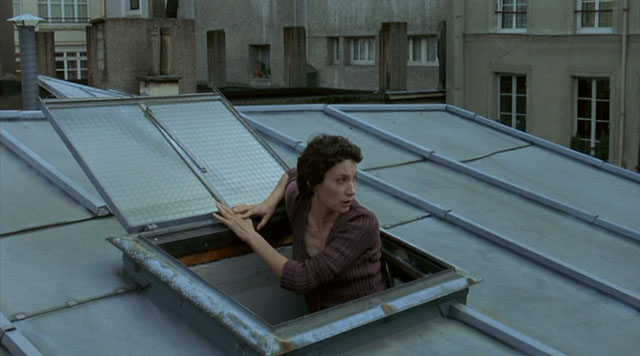
Movie opens on a border patrolwoman (Florence Loiret Caille, the eaten maid in Trouble Every Day, also in Time of the Wolf), then moves to her husband (Grégoire Colin, upstairs neighbor in 35 Shots of Rum), then quickly to the husband’s father Louis (Michel Subor of Topaz, Anatomy of a Marriage, Le petit soldat) with whom it remains, more or less, for the duration.

image

Along the way we meet a pharmacist (attractively-freckled Bambou, best known for her relationship with Serge Gainsbourg) who sleeps with Louis, Louis’s dog-owning neighbor (Béatrice Dalle, cannibal Coré in Trouble Every Day, also in Clean and Inside), a sinister blonde woman (Katya Golubeva of Twentynine Palms, Pola X, I Can’t Sleep) who stalks him obsessively, and Louis’s ex in Tahiti who will not help him find his estranged son Tikki. Oh, “and Alex Descas,” proudly proclaims the opening credits, but he only appears in one scene, in close-up, as a priest.

image

Nobody I’ve talked to seems sure of exactly what happens in this movie. Much of that can be explained by the director’s comment that some of the characters don’t actually exist except in Louis’s imagination – I’m guessing that accounts for his blonde stalker, but I’m not sure who else. Louis abandons his dogs at his wintery shack in northern France, goes to Switzerland to withdraw piles of cash, negotiates the purchase of a ship in Korea, then heads to Tahiti to look for his son (not caring half as much about his other son in France). Along the way, probably in flashback, he gets a heart transplant in Russia, the memory of which seems related to the mysterious stalker. Oh, and back in France he kills somebody with the knife he always carries.

image

Guy from Tindersticks did the music without his band – it’s quiet and upsetting and wonderful. Played at Venice with 3-Iron, The World, Kings & Queen and The Sea Inside, but lost to Vera Drake. Between this movie and Trouble Every Day, I’m thinking the director of Martyrs could be a Claire Denis fan.

image

Story interpretations vary, although apparently it helps immensely to read the essay by Jean-Luc Nancy on which the script was based. In the DVD interview, Denis describes the physical feeling the book gave her, talks about the film being a vehicle for Michel Subor as much as an adaptation of the book. “My producer also was absolutely the most perfect producer for that film, but he was also suffering from a very severe depression, and he killed himself before we finished.” – this is the same producer who worked on The Man From London.

image

Carson:

The Intruder is loaded with Marxist Dialectics, the kind of suggestive cutting collisions that were pioneered by Sergei Eisenstein. A man describes a scene in the woods to his wife as a way of setting an erotic tone between the two of them, followed by a cut to the man’s father sitting amidst tall pine trees relaxing with his dogs. A priest speaks about the variety of immoral beings in the world, followed by a cut to the film’s blank protagonist, Louis Trebor. … In order to gather any semblance of narrative momentum, one has to look towards the way that the film is essentially divided into three parts, each comprised of a different locale, though not entirely limited to it, and connected by the theme of travel and intended self-renewal. … his lonely woodland cabin on the French-Swiss border, Pusan [South Korea], and Tahiti. … The film’s tempo steadily decreases … By the finale in Tahiti, The Intruder feels like a completely different work than what its opening anticipated. The shots lengthen, the soundtrack becomes quieter, comedic scenes appear, and Denis begins interspersing the action with footage from an unfinished 60’s film called Le Reflux, also set in Tahiti and starring Michel Subor.

image

Claire Denis in Senses of Cinema:

My films are not highly intellectual, and L’Intrus is like a boat lost in the ocean drifting, you know? I think that’s the way I picture it … Even if it’s the dream of a voyage, I think it was very important for me that the film offer the two sides of the globe, the north hemisphere and south hemisphere, as the two sides of the heart.

He’s not aware of the people still around who love him. He has no respect for that. The only woman he’s gentle to, the woman with the dogs played by Béatrice Dalle, it’s because she doesn’t care for him that he’s attracted by her beauty. I would imagine that if she would let him enter her house and open her heart to him, he would disrespect her immediately. So I think Trebor is not a very lovable man. Politically, I would say he represents everything I dislike in my country, this sort of selfish-solitude mentality … So I’m happy that he is condemned at the end: He is defeated, and I think it’s only fair. But it’s interesting to me that this main character is someone I do not respect. I understand I can suffer from his anxiety, but I don’t like him. When I wrote the script, I called him A Man With No Heart, a heartless man.

[Subor] had read the script and I gave him those new [Johnny Cash] songs to listen to because I wanted him to be inspired. I told him, “Probably I will never use this as music for the film”, but I wanted him to feel that death is coming closer, to hear that voice, that man in Cash’s last two records whose life has been rich and full of love and emotion. And there is a trembling, as if the moment is coming.

For further study I rewatched Claire Denis’s episode of Ten Minutes Older in which L’Intrus author Jean-Luc Nancy talks endlessly in a train car about French homogeneity and foreigners as intruders, but didn’t find it any more interesting than last time.

This shouldn’t have worked… a typically overstuffed Gilliam fantasy, riddled with CGI, with a lead actor who died in the middle of filming. But if there’s anything Gilliam seems to be great at, it’s dealing creatively with catastrophe, so this came out miles better than the relatively smooth Brothers Grimm (oops, nevermind, research indicates that Grimm was ruined by fights with studios).

No surprise that the cowriter of Baron Munchausen and Brazil is along for the ride, since this is crammed with dreams and costumes, little stories and bizarre images. Parnassus (Christopher Plummer, having a good year with this, Up and The Last Station) is immortal thanks to a deal with devil Tom Waits (his own sinister self plus a little mustache), who will claim Doctor P’s daughter Lily Cole (Rage) when she turns sixteen in a few days. Dr. P and his gang of circus misfits (including a shockingly good Verne Troyer and young Andrew Garfield, star of Boy A and the Red Riding trilogy) kidnap citizens within a magic dream-mirror, and try to make them pursue their ideal selves instead of succumbing to the devil’s lazy temptations. A bet is made, and they race to save enough souls to win back P’s daughter.

Enter Tony (Heath Ledger) as a charismatic con-artist who attracts Tom’s interest as he begins helping the carnies win the bet, modernizing their look and sucking people into the show. He’s a mysterious dude, which makes his shapeshifting into three other immensely likeable actors inside the dreamworld work, both narratively and visually. I didn’t even notice for a while when Johnny Depp replaced him. Way to save the movie there, Terry and gang. The movie tells us and tells us that Tony is a bad guy, a liar who steals from children, but it still came as a shock when he’s killed at the end. Charisma counts for a lot.

With all the negative-nellying I’ve heard about Parnassus, I’m glad to see it’s got a high IMDB rating and a couple oscar nominations. I was especially suspicious of the computer graphics, but they are bright and cartoonish, fake without trying to seem real, and work great in context, shaming Tim Burton’s Willy Wonka flick and Terry’s own Brothers Grimm. I’d already like to see it again… maybe rent the DVD and listen to Gilliam’s commentary when it comes out.

I like to go into movies not knowing anything about them, but my only prior Claire Denis movies were the dreamily sexy Friday Night and the violent vampire flick Trouble Every Day. So there’s a scene early on in 35 Shots of Rum where a young guy (Grégoire Colin of Beau travail, Sex Is Comedy, Sandrine’s brother in Secret Defense) stops in an apartment building, overhearing the sounds from a room down the hall, and I thought “oh shit, he’s going to murder the people in that room,” then, “or maybe he’s in love with them!” With no frame of reference, it threw me for a few minutes. Turns out the latter was closer to the truth… it’s a (mostly) nonviolent love poem of a film.

Later I read some descriptions of the movie and found them misleading. IMDB: “The relationship between a father and daughter is complicated by the arrival of a handsome young man” – I got the impression that he’d been their neighbor for years, so what arrival? Landmark: “father and daughter realize they must confront a painful aspect of their past in order to embrace what lies ahead” – implies suspense where there is none. Presumably it refers to them visiting her mother’s grave towards the end of the film, but no dark secrets are painfully revealed there. The same description calls the film “gloriously delicate and sublime,” which is right on. It feels like that spectacular final scene of Summer Hours playing on repeat.

Lionel (Alex Descas, scientist in Trouble Every Day and airport rendezvous in Limits of Control) and daughter Josephine (Mati Diop, Djibril Diop Mambéty’s niece) live together, take care of each other, and hang out with neighbor Gabrielle (who likes Lionel) and Noe (who likes Josephine). They each attend to their own careers of train operator, student, cab driver and [something involving lots of travel to Africa], respectively. Third-world debt and Frantz Fanon are mentioned, the anthropology students at Josephine’s school go on strike, and a boy in her class likes her, but the main struggles are Lionel’s former coworker, unable to adjust to retirement, who eventually kills himself, and Noe threatening to move away. Correct me if I’m wrong – I’m not too good with story points told entirely through costume design – but Josephine and Noe decide to get married at the end, after father and daughter confront a painful aspect of their past.

I’ll join everyone else in mentioning the soft, lovely cinematography of Agnès Godard and the perfectly suited music of Tindersticks.

D. Kasman

Let us get the Ozu out of the way: 35 Rhums starts with Late Spring’s playbook, where a widowed father (Alex Descas) is living with deep affection with his marriageable daughter (Mati Diop) at a point in both their lives where each should move on. And there are many trains, and a great deal of rice. … If Denis’ push towards minimalism in her run of films from 1999 until 35 Rhums made anything stunningly obvious, it was just how expressive and perceptive films could be while paying nominal attention to explicit plotting and narrative clarity. 35 Rhums is a bit different, as its story holds on more than usual to traditional lines of character and action, but Denis’ sensibility transforms it from an obvious revision of the Late Spring paradigm to something else entirely.

J. Weissberg:

Claire Denis’s latest may appear whisper-thin on the surface, yet it’s marvelously profound, illuminating the love between a father and daughter but also highlighting the difficulty of relinquishing what most people spend a lifetime putting into place.

Denis:

I’ve been dreaming for many years of making an homage to Ozu, and this particular film was possible for me to use as an homage to Ozu, because actually it’s the story of my grandfather and my mother. She was raised by her father. And once I took her to see a retrospective of Ozu, and she really had a sort of shock to see that film [Late Spring]. That was like maybe ten, fifteen years ago, and I told her, “Maybe, once, I will try to make a film like that for you.”

Trivia from interviews… the “family” was supposed to be on their way to a Prince concert, and “Little Red Corvette” was to be playing in the cab, but this was deleted due to time and money constraints.

Tarr Noir! Tarr doing suspense/crime drama seems unnecessary since his use of the camera and film editing are suspenseful in itself. The crime doesn’t seem that important (until the very end) and the lead guy is kind of an ass, so the suspense remains in the shots and editing, not much carries over into the story. To get my other complaint out of the way (I quite liked the movie), the sound is off because everything is distractingly dubbed into French and English (voices include Edward Fox of Gandhi and The Duellists and Michael Lonsdale of Stavisky and Out 1). It must be for commercial reasons, but I don’t see it playing anywhere except a few film festivals, so what commercial reasons? Seeing the cast of Satantango hanging out in the bar only makes the dubbing seem weirder. Research indicates that there’s a Hungarian version out there, so I guess Tilda Swinton (French-dubbed in my version) gets screwed in both.

image

Big-time Euro film producer Humbert Balsan (who worked with Youssef Chahine, Merchant/Ivory, Elia Suleiman, Lars von Trier) committed suicide during production, complicating things. Based on a novel by Georges Simenon (Night at the Crossroads, Betty, Magnet of Doom) which has been filmed before in the 40’s. I dig the Mihály Vig music, but it’s no Werckmeister Harmonies, which I listened to obsessively for a month.

image

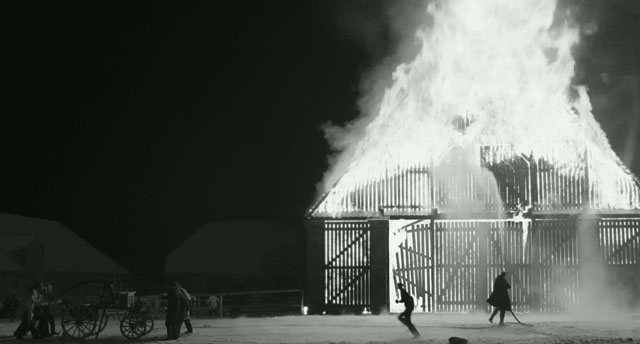
Offscreen, a man is selling his theater for a suitcase full of money, which gets stolen. The thieves get the suitcase onto the docks, under the watchful eye of stoic Maloin, then one kills the other and runs. Maloin snags the money and hides it. That’s the first half hour in maybe six or seven shots, with no dialogue at all. Crisp b/w images with achingly slow, fluid camera movements, as can be expected.

image

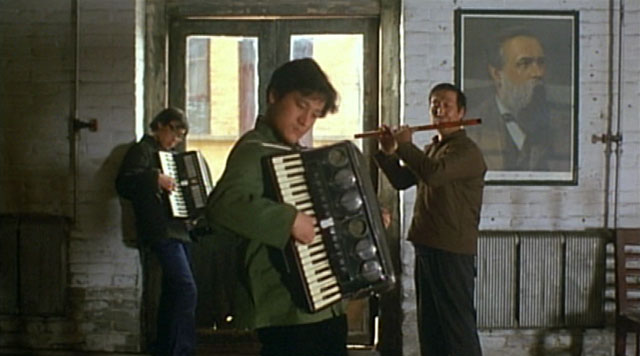
Maloin takes time out from the crime drama to torment his family. He pulls daughter Henrietta (cat-torturing poster girl from Satantango) out of work, buys her furs, then gets screamed at by wife Tilda Swinton. Inspector (from London) questions blond killer Brown. We don’t find out exactly how Maloin kills Brown at the end before returning the money to the Inspector. That’s about it for the plot. Most of the time a very enjoyable flick. Moments of otherworldly Twin Peaks-ish parody during dubbed dialogue scenes are immediately forgiven when we come across some Satantango actors performing random hilarity in the bar, urged on by an accordianist. If Tarr fans can’t have the sustained magic of the last couple movies, at least we can all enjoy some drunken accordian antics together.

image

Film director Mateo Blanco (Lluís Homar of Bad Education) reinvents himself as novelist Harry Caine after an accident, both out of trauma from losing his lover Lena (Penélope Cruz), and to stay in hiding from the men he suspects caused the accident. Millionaire Ernesto Martel (José Luis Gómez of Goya’s Ghosts), producing Mateo’s film which stars Ernesto’s young wife Lena is one of those men, and his closeted son (Rubén Ochandiano of Che, Biutiful), stalking Mateo and Lena with a videocamera, is the other. Those four plus the always excellent Blanca Portillo (pot-smoking friend in Volver) are the core of the movie, which stays twisty and exciting due to Almodovar’s withholding of major story elements (like the car crash) until the end. As with Volver, it didn’t seem to burst off the screen and declare its excellence, just came off as another solid Almodovar pic. But thinking of those two in hindsight they seem so good I want to watch them again right now. Maybe that’s why the Almodovar movies I’ve seen more than once (All About My Mother, Talk To Her, Women on the Verge) are my favorites… all his work needs to be examined a second time, to appreciate the filmmaking once the shocks of the plot twists have worn off.

Cruz:
image

T. Stempel:

Almodóvar is very aware that he is borrowing, and to save us from having to make a list of films and filmmakers he is referring to, we get a later scene of Diego going through Harry’s DVD collection, reading off titles and directors. One thing that struck me in watching the film is that it makes more sense as you watch it than any summary I have seen in the reviews of it. That is Almodóvar’s skill as a screenwriter.

Portillo:
image

Ernesto’s son (in the present-day scenes calling himself Ray X) comes off as cartoonish (no disrespect to the actor; he’s given a cartoonish role to play). Mateo/Harry is very good as the star of the story, but as usual with Pedro’s films, my eyes are glued to the women: Cruz, Portillo, Lola Dueñas (The Sea Inside, Volver) as a lip-reader employed by Ernesto, and the unforgettable Rossy de Palma in a brief cameo.

Lola:
image

An obscure one from the decade lists. I read a write-up in Cinema Scope while standing in the airport and it sounded fascinating, but maybe it only seemed so in relation to my surroundings. Watching it was dullsville. I should’ve known – here’s the Toronto Film Fest’s writeup:

A film that both partakes in and dismantles traditional ethnography, opts for mystery and natural beauty over annotation and artifice, and employs unconventional storytelling as a means toward historical remembrance. A rigorous, exquisite work with a structure at once defined and winding, the film traces the extensive journey of two unidentified brothers who venture from the outskirts of Paramaribo, Suriname, on land and through rapids, past a Maroon village on the Upper Suriname River, in a rehearsal of the voyage undertaken by their ancestors, who escaped from slavery at the hands of the Dutch 300 years prior. A path still travelled to this day, its changing topography bespeaks a diverse history of forced migration.

See that word “rigorous”? I’ve seen it before, and it means “dullsville”. I’m betting that Reassemblage and Wavelength and Jeanne Dielman regularly get described as rigorous. Although, I like Hollis Frampton and he is pretty rigorous, so it’s hard to say.

Since the movie only has 13 shots over its 130 minutes, here’s a screenshot from each of them.

1. washing up, setting some plants on fire
image

2. walking (rural)
image

3. riding the bus listening to auto-tuned songs
image

4. walking (urban)
image

5. mining/wheelbarrow
image

6. panning for gold
image

7. loading the boat
image

8. on the boat
image

9. walking (town)/sitting by river
image

10. walking through jungle – gunshot!
image

11. more jungle: chainsaw and machete
image

12. costume festival
image

13. canoeing
image

Katy says Suriname is in N.E. South America – good to know!