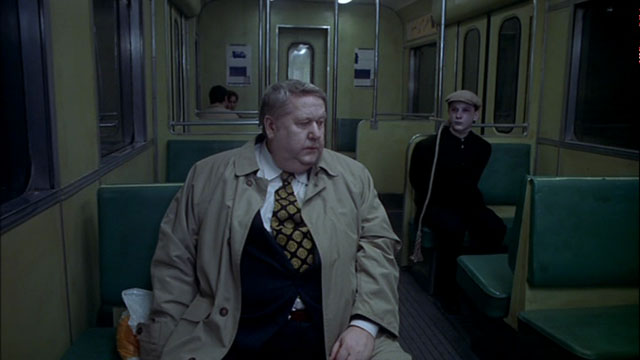
“Beloved be the one who sits down.”

image

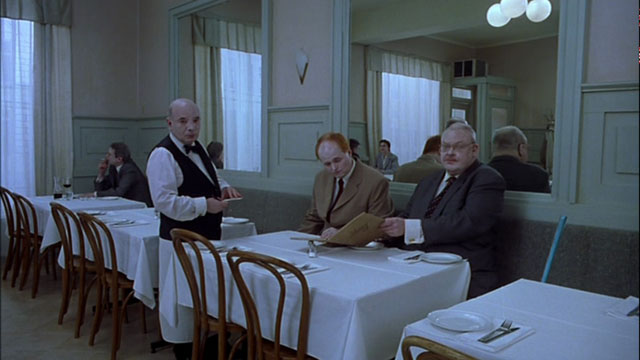
I heard this was a Scandinavian deadpan comedy, so half expected something in the Kaurismaki/Jarmusch vein, tempered by my recent memory of the unexpected Holocaust content in Andersson’s short World of Glory. At first I found this understated to a fault, and not funny at all, but I was fascinated by the composition and content of each scene. Seemed like a depressive view of various social ills (including religion, ha). But I spun the disc again with commentary and caught on to the humor and overall themes. Really, if I had the time and inclination, I should watch EVERY movie twice before talking about it. Ultimately, Songs gets closer to the first half of Playtime than anything else I’ve seen, in terms of directorial obsession with sets and compositions in what’s supposed to be a comedy. But unlike Playtime, this one seems more admirable than enjoyable. Has its moments of pleasure, but when dude is fat, broke, unloved and literally haunted by ghosts at the end it doesn’t send ’em out laughing.

image

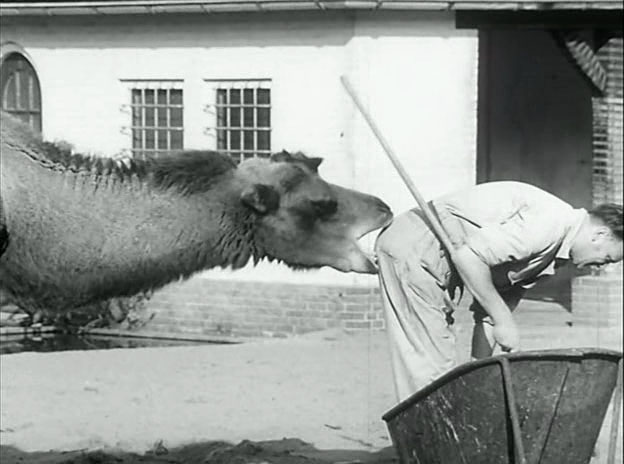
A magician performs the ol’ saw trick poorly, sending a man to the hospital and leaving him unable to do anything without pain. Government finance ministers lose their paperwork and instead peer into a crystal ball. A young girl is ritually sacrificed at a quarry in front of a thousand spectators. At the airport there’s a slow-motion oversized-luggage exodus. Best of all, military leaders visit the country’s former commander-in-chief in a rest home on his 100th birthday, and the senile man responds to the official-looking activity with a smiling nazi salute, embarrassing everyone in the room.

image

Eventually a central character emerges: Kalle, with two sons, one of whom “wrote poetry until he went nuts.” Kalle has burned his business down for the insurance money. He doesn’t seem to have a goal until, pursued by the ghost of a man he owed money, he joins a friend’s doomed business selling Jesus crosses for the millennium. At the end Kalle stands facing us before a Jesus-cross dumping-ground as the ghost plus a hundred others rise from the ground and slowly approach from behind. Andersson definitely has a knack for striking images.

image

Andersson, from the commentary:

“This movie is about power, the abuse of power and highhandedness.” I love filmmaker quotes that begin with “this movie is about…”

“I want a scene or a film to surprise the viewer,” he says, exactly as a nude housewife walks into the room.

image

“People have wondered how to classify my film. Absurdism or surrealism… what the hell is it? This film introduces a style that I’d like to call ‘trivialism’. Life is portrayed as a series of trivial components. My intention is to touch on bigger, more philosophical issues at the same time. Life is full of trivia, after all.”

image

On one hand, I thought this was a bad movie.

image

The script seems to have been written for fourth graders, and every camera shot is from a helicopter so you start to get the feeling that all the slow gliding movements are on purpose and you’re watching a giant slow-motion Bollywood video. Narrator Glenn Close throws huge numbers and statistics at us until they become meaningless.
“faster and faster…”
“billions and billions…”
“There’s no time to be a pessimist.”
The slow pace, lingering on each beautiful helicopter shot, and precious repetition-heavy voiceover stinks of pretentiousness, as does the stereotypical music (the kinds of howling African female singers that Martha Wainwright listens to). Sometimes the music turns new-agey, and the voiceover says stuff like “The earth is a miracle. Life remains a mystery,” I’m thinking as a concession to hippie-minded creationists. I wasn’t sure if the doc advocates vegetarianism as part of its packaged hippie agenda or because meat is actually worse for the earth than veggies. And in the length between cuts, I had time to reflect on the irony of a conservationist riding over the whole globe in a helicopter. Maybe their copter ran on biofuel, but more likely they paid a farmer in bolivia a dollar fifty to plant some trees then declared their film “carbon-neutral” in the credits.

image

But speaking of the credits, jeez, this was shot in twice as many countries as The Fall, and there’s no doubt that the visuals are amazing, especially in the high-def version that I watched. And the point of the movie is to keep the viewer hooked with these visuals while impressing upon us how severely we have destroyed the earth (for people like me who missed that Al Gore doc), and what consequences we will soon face. Glenn Close tells me that “humanity has no more than ten years to reverse the process,” then I turn off the movie and, no shit, read the headline “global warming skeptics growing in numbers,” along with the usual business about war, politics and health care. A few windmills in Florida are not gonna be enough to forestall the wrath of Glenn Close’s global-warming pandemic.

image

We are severely screwed. Movie ends up being scarier than Collapse, Wolf Creek and Martyrs combined. I bought ice cream.

image

I think I get Ten, that it’s a discussion between everyday people about their real problems, somewhat politically charged but mostly a realist drama minus much of the drama, with two digital cameras bolted inside a car. He says the story could be anyone’s story, and that anyone’s story would be worth filming for a movie. I didn’t dislike it, but I prefer Kiarostami’s other work, or the kind of scripted social dramas that Jafar Panahi makes (or made, since he’s currently in prison).

At the center of the movie, a mother gets in terrible arguments with her son who resents her for divorcing his father. We also have scenes (exactly ten total, each with countdown leader) with the woman’s sister, a prostitute who accidentally hops into the car (the most contrived part of this realist experiment) and an old woman hitching a ride to pray (the least contrived – reportedly she was really hitching a ride, and had no idea she was appearing in a movie).

image

Better is the documentary 10 on Ten, or I should say it’s better to watch them both together, as A.K. explains in-depth his thoughts on filmmaking, actors, writing and so forth. The doc opens where he shot the end of Taste of Cherry, the hill with winding paths and the distictive trees, which overlooks the streets of Tehran, where he shot Ten. He talks about the immediacy of video, its portability and ability to capture natural performances, which he used by accident in Cherry after the final scene was botched by the film lab, then halfway on purpose in ABC Africa. “This camera allows artists to work alone again.”

He no longer writes screenplays, just sketches his movies over a few pages. “I only remain faithful to the original idea of the film, and even that is not something you can be sure of. When I write a full and accurate screenplay, I’m no longer interested in making it, and usually hand them over to colleagues.” Hence Crimson Gold the year after Ten came out. The shocker is the last chapter of 10 on Ten, a miracle of an ending involving ants in a hole in the road, reviving my faith (shaken by Ten) that A.K. can make cinema out of anything.

image

E. Hayes:

Ten centres on a divorced woman and her relationship with her son, Amin. The actress Mania Akbari is herself a divorcee, and Amin is her own son. We watch the son, without inhibition in the way today’s children can be with parents, caught between his separated mother and father in their battle for possession, self-possession and respect. Through the mother’s struggles with the child, a little tragedy is played out. Pride and possessiveness make communication hideously painful. Meanwhile, various aspects of womanhood are embodied by the women who catch a lift with Akbari. This is a drama of the deferred nature of human fulfilment – a tragedy most people in any audience are all too able to identify with, in any country.

lead actress Mania Akbari:

This film, in my opinion, talks about how relationships today are empty and distant from love. All women in the world, and men for that matter, thirst for love. This film isn’t anti-men. Relationships have become transactions, have become materialist. I think this is what the film shows.

I read very little about this, conscious of spoilers, but certain things, as with Antichrist, were unavoidably overheard (or given away in the trailer). So I knew it was set near the start of WWI and that the evil children in the trailer represent the birth of fascism, but I didn’t realize how subtly that point is made. There are unexplained events, the children increasingly seem responsible, then some major characters disappear and the narrator leaves town, with no ends neatly tied up.

Two things for sure: it’s an excellent movie and the camerawork (DP Christian Berger, his fifth with Haneke) is perfect, beating Cache by a mile. Apparently was shot digitally, in color, then post-processed. Very classic feel to the entire production, except to the acting, especially of the children, which is better than anything from the WWI or WWII eras (sorry, Wild Boys of the Road). Won awards almost everywhere (the BAFTAs preferred A Prophet and oscars preferred something from Argentina), beating out Basterds, Antichrist and Wild Grass at Cannes.

image

Interesting to have a non-omniscient narrator, schoolteacher Christian Friedel, who goes on long sidetracks from the town mysteries to chase after a girl, nanny of the baron’s young twins. Town authority figures are painted as corrupt. The doctor (Rainer Bock, small role in Inglorious Basterds) is abusive and perverse to his daughter and to his girlfriend (Susanne Lothar, lead in Funny Games). The pastor (Burghart Klaussner, was just in The Reader) is a tyrannical father. The baron (Ulrich Tukur, The Lives of Others) exercises his power to throw families into poverty at will. The children don’t exhibit the usual responses of sullenness, fighting and petty power games, but band together to commit acts of planned vengeance, terrifying the town. Their crimes go officially undiscovered and unpunished at the end, Haneke’s point, I suppose, being that they grew into fascists and nazis.

image

There is, of course, an absolute ton written about this movie already. The Times says “it lacks the intellectual and emotional nuance that would make this largely joyless world come to life,” but that’s just the common criticism that Haneke’s films are cold and unfeeling, which applies less to this film than to his others so I don’t see the point in bringing it up.

Indiewire: “With this detailed exploration of anonymous retribution, Haneke returns to the haunting terrain he last explored in Cache, although in this case, the retribution expands from a personal level to a larger critique of religious zealotry. … However, these events remain notably off-screen. Absence in The White Ribbon is the quality that makes it a harrowing work of art, rather than a historical soap opera.”

Salon: “It definitely can’t be reduced to a fable about the roots of fascism. The White Ribbon is a dense account of childhood, courtship, family and class relations in a painfully repressed and repressive society, which seems to channel both early Ingmar Bergman and the Bad Seed/Children of the Corn evil-tot tradition.”

image

Haneke:

The film opens with the narrator saying, “I’m not sure if the story I’m about to tell you corresponds to what actually took place. I can only remember it dimly. I know a lot of the events only through hearsay.” So both those elements, then, raise mistrust in the audience as to the accuracy of what they’re going to be seeing, and the reality of what they’re going to be seeing. Both the black-and-white and the use of a narrator lead the audience to see the film as an artifact, and not as something that claims to be an accurate depiction of reality.

It’s only in mainstream cinema that films explain everything, and claim to have answers for anything that happens. In reality, we know so little about what happens. It’s far more productive for me to confront the audience with a complex reality that mirrors the contradictory nature of human experience.

I remember with my first film that was shown in Cannes, The Seventh Continent, there was a screening and afterward we had a discussion. The first question came from a woman who stood up and asked, “Is life in Austria as awful as that?” She didn’t want to accept the difficult questions being raised in the film, so she tried to limit them to a specific place and say, “That’s not my problem.” You could make the same mistake with this film, if you see it as only being about a specific period.

image

Supposedly the first Japanese film shot in 24p digital video, which accounts for its unique look, esp. the wild color in outdoor scenes, but also its annoying handheld shakiness which would become widespread by the end of decade. The middle/high-school kids are obsessed with pop singer Lily (according to shady IMDB trivia, inspired by Faye Wong), are also incredibly shitty to each other. Prime focus is on two boys, Hoshino and Hasumi, former friends but now tormentor and tormented. Each has his own problems at school, but is secretly (and online, hidden behind screen names) deeply moved by Lily’s music. At the end, I think (nothing is quite clear, at least not to me) the bullied Hasumi, denied entrance to Lily’s concert by Hoshino, knifes the bully to death after also discovering that Hoshino is junior member “blue cat” on the forum. And I’m thinking young Hasumi is forum admin “philia,” but again, not sure.

Hoshino with Hasumi over his shoulder:
image

Forum posts appear in the middle of the movie screen, sometimes overlapping the scene but usually just white text over black. This should get tiresome (it did for reviewers, I see) but I never got sick of the texting conceit or the length of the movie (hello, Noriko’s Dinner Table), just of the brutality between/among the kids. Just as I’m never visiting Italy after watching Gomorrah, I am never attending middle school in Japan after watching this

Bad girls:
image

I love that outdoor night scenes are shot with big green spotlights on the actors, complete with obvious shadows. It’s stylish and effective. In the middle of the movie, Hoshino and friends use stolen money to go on vacation to Okinawa, leading to a lengthy, punishing overuse of the handheld aesthetic.

image

Movie had a few beautiful moments, a few embarrassing ones (middle school was terrible, and I used to talk that way about music I loved), but mostly I felt like I’m about ten years too old to be watching it and wondered if the people putting it on their best-of-decade lists weren’t all 17 in 2001.

Suicidal Shiori Tsuda:
image

Older boy Hoshino: Shugo Oshinari was in Battle Royale II. Other boy, Hasumi, Hayato Ichihara stars – stars! in Miike’s new God’s Puzzle. The girl who’s raped and shaved bald (did I mention it’s a cruel movie?), Kuno, is Ayumi Ito of nothing else I’ve heard of, and the girl who’s coerced into prostitution, Shiori Tsuda, played a title character in the director’s follow-up, Hana and Alice. After that, I lose track of which kid was which, and, in fact, what happened and when. Reviewers mention the jumbled timeline of the story, and I thought it was linear so I obviously missed more than I realized. I did like it overall, but I don’t think I’ll ever be watching it again to get my facts straight.

Shaved Kuno:
image

Reverse Shot:

Iwai returns to the image of students standing alone in glowworm-green fields, attached to headphones. It’s risky, a consummate music-video image, especially with Iwai’s phosphorescent digital palette, and I’m not even sure it ever entirely escapes that. But with its repetition after the murder at the end of the movie—one of the students standing and listening is Shugo, killed a few minutes earlier—these Elysian fields come to replace the traditional blackout’s “return” to reality out of the dream life of cinema. As the text of credits are superimposed, the uniquely personal experience of these lonely bucolic listeners becomes inseparable from the chat rooms and concerts, where they are unified with that pop-culture infinite—the fan base. As if communing with an angel across great distances but with special intimacy, the students and Lily Chou-Chou contain one another as they share that experience with millions.

image

Rouge:

What is interesting, however, is that the film not only does not proffer to give answers but, intentionally or otherwise, feeds into our bafflement, in two ways. Firstly, the world in Lily is presented as one in which not only are its teenagers behaving as such, but its adults are also, at best, powerless, ignorant and, at worst, in complicity. Witnessing the ostracising of the class pianist, the teacher capitulates to the persecution by entreating the bullies to perform and promising that the pianist will play no part. A female teacher’s only response to the assaulted Kuno (Ayumi Ito), now also shaven, is to offer her a wig.

All About Lily Chou-Chou transforms into a mood piece, self-consciously eschewing account and explanation, less concerned with analysing our bafflement than it is with simply our bafflement itself, as if with the detached curiosity of an observing alien.

An unusual Rivette film. First thing I noticed was that it’s strange to see an in-film performance of a finished play in front of an actual, paying audience. I thought none of his plays-within-a-play ever made it past their planning stages. The characters go about their business in a straightforward way. Minor mysteries from the past crop up, some coincidences seem almost magical, but the weight of the drama never sets in. Even the lighthearted Celine & Julie felt weighty. Finally towards the end (during the drinking duel in the rafters) I accepted that Va Savoir is purely a comedy, and a very fine one.

image

From the shot above, which is used in the poster art, I’d assumed there’d be more Feuillade influence. People upon Paris rooftops conveys Feuillade, and with Rivette’s ever-present sense of mystery I thought a feature-length homage would be wonderful, but that’s not what we get. Oh well, there’s always Franju’s Judex.

image

The play performed is the Italian “Come tu mi voui” by Luigi Pirandello, being performed (in Italian) in Paris for a week. I think we see a scene from each night’s performance, each time a different scene, and not in chronological order. They’re probably arranged to comment emotionally upon that day’s off-stage action, but I’ll have to watch it again to be sure (I also missed the on/off-stage connections in Rivette’s previous film Secret Defense). That’s Camille (the lovely, angular Jeanne Balibar, of Don’t Touch the Axe and Comedy of Innocence) in the middle with her lover/director Ugo (Sergio Castellitto of Around a Small Mountain) at left. Their relationship is strained with her return to Paris after three years away, now closer than ever to her long-term ex Pierre, but ultimately they’re good together.

image

I’m getting out of order here, but Pierre (Jacques Bonnaffé, at right, of Lemming and Prénom Carmen) ultimately duels Ugo over Camille. I was never quite sure if Ugo is a nice guy, since he acts like such an ass when first meeting Pierre, but this clears it up. His dueling method of choice is heavy drinking while standing high in the rafters above the stage, but he repeatedly tells Pierre not to look down because there’s actually a safety net below them. This scene made me extremely happy.

image

While in Paris, Ugo seeks a lost play by Italian author Goldoni. He checks with an autograph/letter collector (filmmaker Claude Berri), but to no avail. Funny casting a filmmaker in this role, since thirty years earlier Rivette had Eric Rohmer playing a specialist librarian in Out 1.

image

Ugo bounces to this family, descendants of a friend of Goldoni’s who maintain a library of the playwright’s works. The woman (Catherine Rouvel – oh my god, she’s the always-nude girlfriend of the scheming guy in La Rupture) invites him to stay as long as he likes, but after he can’t find the unpublished play all week, he suspects it was secretly sold by her thieving son Arthur (Bruno Todeschini, at left, of Code Unknown and Haut bas fragile)

image

Arthur is also meeting secretly with Sonia (Marianne Basler, who costarred with Gabriel Byrne in a WWII drama), coincidentally the live-in girlfriend of Camille’s ex, Pierre. The affair would be harmless but that Arthur steals a precious ring from Sonia, which Camille sleeps with him in order to steal back.

image

Finally, there’s Arthur’s sister Do (Hélène de Fougerolles of Innocence, maybe in the scene with Edith Scob in Joan the Maid). She helps Ugo search for (and ultimately find) the play, getting ever closer to him as Camille gets closer to her ex (before he locks Camille in a closet). Peace is restored in the end with everyone happy and dancing, the viewer comforted in knowing that the only really crappy character, Arthur, in debt trouble, will soon find out that his stolen ring is gone.

I only noticed this because of the similarly oval-shaped mirror near the end of Out 1:
image

Reportedly there’s an extended cut called Va Savoir+, but little is known about it besides that it had a one-week run in Paris. A message board posts claimed it “wasn’t even an official director’s cut, just an alternate cut Rivette put together for a few screenings, mostly for himself and the other actors,” so I’m not going to worry too much.

Trounced at Cannes (along with decade-faves Mulholland Dr., I’m Going Home, What Time is it There?, In Praise of Love and The Piano Teacher) by a Nanni Moretti film. That must be a good one!

image

Filmbo:

In Va Savoir we are spectators instead of participants. And while there are moments when this pays off rather humorously — take for instance the detective work of finding the missing ring in the flour jar or the duel between the rival male suitors — it falls short of being a top-notch Rivette experience. … there was also the more palpable concept of a theater company producing works that only a few are interested in seeing, accompanied by a quest to find a lost work by an obscure writer… should we be thinking of the oeuvre of anyone in particular?

I don’t really know what happened or what it all meant, but I know I enjoyed every moment of this movie. Strange how that can happen, and it’s more rare than I would think. It’s a LOT funnier than Tropical Malady, which was unexpected. That short I watched a few weeks ago, Letter to Uncle Boonmee, prepared me well for Syndromes, which had its share of lush trees and repeated action. Halfway through, the movie appears to start over (do all of AW’s movies start over halfway through?) with doctors Nohng and Toey going through an interview scene they’ve already played out, but in a new setting. Anyway, I’m not going to analyze and read about the movie all night long, just leave this placeholder for myself to watch it again sometime.

image

Part of that Mozart festival that I read about four years ago in a magazine while standing in line at the airport. Sticks in my mind very well for some reason… I believe Opera Jawa was mentioned in the same article. Too bad I watched Opera Jawa as a low-res video projection and Syndromes on a crappy interlaced DVD with burned-in subs. I hope standard-def video dies pretty soon.

Ah yes, here’s A.W. in a Criticine interview talking about the Mozart thing:
“It is funded by Austria. It does not have to be about Mozart, but it has to have the spirit of Mozart. I see his music to be about miracles and its connection to everyday life. My film will look back at the past in order to see into the future. Just people living life, inhaling and exhaling, meeting each other—these are already miracles. It’s a film about beauty.”

image

I’m leaning heavily on Grunes these days… his nice intro:

Thai writer-director Apichatpong Weerasethakul has said that Sang sattawat is a tale of two trees representing his doctor-parents, one on the grounds of a rural hospital in the 1970s, the other on the grounds of an urban hospital in the present day. The film is divided into two parts—the bifurcated structure begging a series of questions, including: What is the present without the past? city without the country? one parent without the other? One gauge of the success of this film, which is full of talk about reincarnation, is our sense that the breeze animating one tree is the same as the breeze, eternal, animating the other.

image

So there’s a monk (above, played by a lead actor from Tropical Malady) and his dentist (Dr. Ple), a flower breeder named Noom and his girl Pa Jane. The interview participants Nohng and Toey must represent A.W.’s parents, but as M. Koresky puts it, “if we’re truly seeing some version of the meeting between Apichatpong’s mother and father, then the director is much more interested in the settings surrounding them and the forces controlling them—architecture, nature, medicine.” Stories are told which take over the movie; the sidetracks become the new main tracks. There’s possibly a fantasy scene or two, a flashback or flash-forward, and gentle talk of philosophy and love. And trees.

image

An exercise session in the park cuts to credits (including one for “ringtone composer”) with loony upbeat music, giving the giddy impression that you’ve just watched a madcap comedy. Maybe you have. A.W. seems to have no regard for familiar storytelling or filmmaking conventions, so maybe besides the sex jokes in the dialogue the form itself was meant to be humorous.

The first post of my special four-part In Over My Head series, in which I watched some movies I didn’t fully understand, and can’t adequately describe, or even remember properly. I must have been tired last week.

image

A big title on the decade list. Not only did it show up on multiple lists, but it’s one of Jonathan Rosenbaum’s top 100 of all time, and the Telegraph called it the masterpiece of the “sixth generation”. I’ve now seen five of Jia’s movies and I probably like this one second-best to The World, but I don’t even love The World very much. I watched it once in theaters, then a year later when Cinema Scope sent me the DVD (to replace the announced Colossal Youth) I just tossed it onto the shelf, thinking “don’t suppose I’ll ever watch this again.” I find a great Jia movie less desirable than a pretty-good Brian De Palma movie, and since Jia won the consensus critical vote for auteur of the decade in Film Comment while winning my own WTF Award of 2009 for Dong and Still Life, I am clearly missing something.

First, a quote from the esteemed Acquarello. Despite all the big, big words he uses, this is my favorite short description of the film that I’ve found:

An estranged and depersonalized chronicle that illustrates the marginalization of humanity under the turmoil of profound national change…
Similar to the plight of the perennially dislocated acting troupe in Theo Angelopoulos’ epic film, The Travelling Players, the evolution of the itinerant performers – from disseminators of peasant propaganda, to champions of an eroding, indigenous culture, and eventually, to gauche (and unintentionally comical) assimilators of commercial pop culture – is a poignant articulation of a generation foundering in their own seeming irrelevance and figurative exile from within their homeland, desperately struggling for inclusion and a sense of place in their country’s future. It is this sentiment of cultural displacement that is illustrated in the repeated encounters between Ming-liang and Ruijuan among the ruins of a disused ancient fortress: an elegiac image of unrequited love lost in the expansive and formidable landscape of a silent, unarticulated, and disconnected human history.

image

During the first hour of the movie (the “peasant propaganda” section) I wrote: “it must be tiring to be that nationalistic all the time.” During the last hour (the “unintentionally comical” section) I noted the group was calling themselves The All Star Rock ‘n’ Breakdance Electronic Band.

Cui Mingliang, is our sorta-hero, a glasses-wearing bellbottoms-wearing so-called artist who doesn’t seem to believe much in anything he’s doing, just going along with the group. He meets with his girl regularly, but they never seem to fully connect, and when he comes home from a tour at the end, she has become a cop or a commie or something. Camera is mostly stock-still, but not afraid to pan around when outdoors. Whoa, does the movie really end with some girl and her baby playing around a teapot? Since I have no wisdom, here are more helpful quotes.

image

AO Scott: “The story, which unfolds episodically over more than three hours, might be described as a Boogie Nights about socialist cultural politics instead of pornography.”

Senses of Cinema:

That Jia shows the negative consequences of this economic revolution goes without saying but his imperatives are non-judgmental and totally undogmatic. His cinema belongs to a humanistic tradition in the larger ecumenical sense but Jia’s style is buffeted by postmodern means and a dedication to realism. At the same time, Jia associates his humanity with a feeling for home. Home is Fenyang, which to Jia, acts as a microcosm of China itself. Fenyang shows the “original face” of China. Jia depicts the fundamentally harsh conditions of the backwater that is Fenyang as the wheels of the market economy turn, driving the residents of Fenyang into the modern age and leaving many by the wayside.

Jia himself makes a surprisingly good interview subject.
“A hundred years ago, if you felt lonely, you would write a poem. A hundred years later, if you felt lonely, you might make a movie. Such problems persist.”

S. Teo: “But your movies are banned inside China, and in fact, they have been mostly seen outside of China, in foreign countries.”
JZ: “This is a fact. This is the most embarrassing and tragic aspect of being a Chinese filmmaker. … Then again, Xiao Wu is quite widely seen in China because there are pirated VCDs being circulated. So I have conflicting emotions. My film is being pirated on the one hand, but on the other hand, it is one method of getting my film shown. I feel embarrassed and helpless.”

image

Jia again:

I use a lot of long shots. If the audience can see things in there, that’s good, if they can’t, so be it. I don’t want to impose too many things onto the audience. For instance, in Platform, I used only two close-ups. One was the close-up of the postcard that Zhang Jun sent from Guangzhou. It’s not that there are special situations where I wanted to hold back some information. I don’t want to impose a message onto the audience. I want to give them a mood and within that mood, you can see things that you want, or you can’t see things. My films are rather challenging for the audience. They are not very clearly stated to the extent where the audience can see clearly the objects they want to see – this pen or this watch. If they don’t notice it, they don’t notice it. It’s not that I am being indifferent. Through all these, I am imparting a director’s attitude, how he sees the world and the cinema. What I mean to say is that it’s only an attitude because you can never be absolutely objective. When you need somebody to look at something, it’s no longer objective. There is no absolute objectivity, there is attitude, and through this attitude, there is an ideal.

Mr. Grunes: “Some reviewers have called the film ‘static’ – technically, an odd claim given the film’s prolific use of moving cameras (pans, trackings, fixed cameras in moving vehicles), but a claim that makes emotional sense.”

Aha, Jia also says the whistling teapot at the end is meant to evoke a train whistle, the train having the same meaning of escape from the small-town ordinary as it does in Pather Panchali. He gives a very good interview, plainly explaining his style and intentions – and, horror of horrors, he says he prefers the shorter cut of the movie, the version I watched, not the elusive 3+ hour so-called director’s-cut.
Eat it, Film Comment.

Tracey is in therapy for teen-rebellion issues. One day while hooking up with a boy she likes from class, she loses her cute little brother, who presumably drowns in the icy river. Tracey can’t deal with what she’s done, wanders the city getting into dangerous situations looking for her brother. Part of her actually expects to find him but mostly it seems like a grief/catharsis journey.

image

Rotten Tomatoes and Metacritic say the movie was mostly disliked, the IMDB reviewers say it “sucks,” but a lone blog (Subtitle Literate) put it on their best-of-decade list alongside nine other movies I saw and liked, so I sought it out. And I’m going to side with the lone blogger. It’s a teen family-problems death-and-grief depression drama AND it’s presented via extreme split-screen, with frames within and beside each other, displaying memory and fantasy and foreshadow and unrelated footage, and the timeline of the main narrative is scrambled as well. Sounds like the kind of thing I would hate, but it’s done very, very well. I liked Ellen Page (Juno, Hard Candy, Whip It, X-Men 3, gee I watch a lot of Ellen Page movies) and loved her little brother (pretending to be a dog), her cross-dressing psychiatrist (would anyone visit a cross-dressing psychiatrist?), the questionably dangerous guy she befriends in the city (“Lance From Toronto”) and dream sequences of her behind-the-music imagined future with new kid in school Billy Zero. But mostly I was bowled over by the editing, which doesn’t seem arbitrary like 21 Grams, but carefully thought-out to make emotional sense.

What’s it say on the board? Pontypool (changes everything).
image

Bruce’s first theatrical flick since 2001 (I’m not sure that it opened here). McDonald once again has book’s author write the screenplay (see also: Pontypool). Shot on Inland Empire-looking “bad” DV and populated with the finest Canadian actors, including Ari Cohen (Archangel) as Tracey’s dad, Max McCabe (Land of the Dead) as Lance From Toronto and Julian Richards (Hard Core Logo, Survival of the Dead, opening scene of Cube) as the psychiatrist.

image

D. Sallitt, 2007:

Knowing that he’s discovered the philosopher’s stone, McDonald tirelessly generates new formal prototypes every few seconds, and leaves us at film’s end with the sense that he could have kept going forever. What makes Tracey more than an impressive demo is its unity of form and feeling, the sense that its screen may have been shattered by its young protagonist’s hormonal violence, McDonald’s wild-eyed punkish sense of drama, and Medved’s vivid dialogue

image

D. Sallitt, 2008:

McDonald and his admirable writer Medved did not choose random subject matter for this experiment. Not only does the style seem intended to reflect the streaming consciousness of Medved’s material, but there is also a strong underlying musical structure to the film, with music and dialogue working together to organize the story into movements that almost resemble musical numbers.