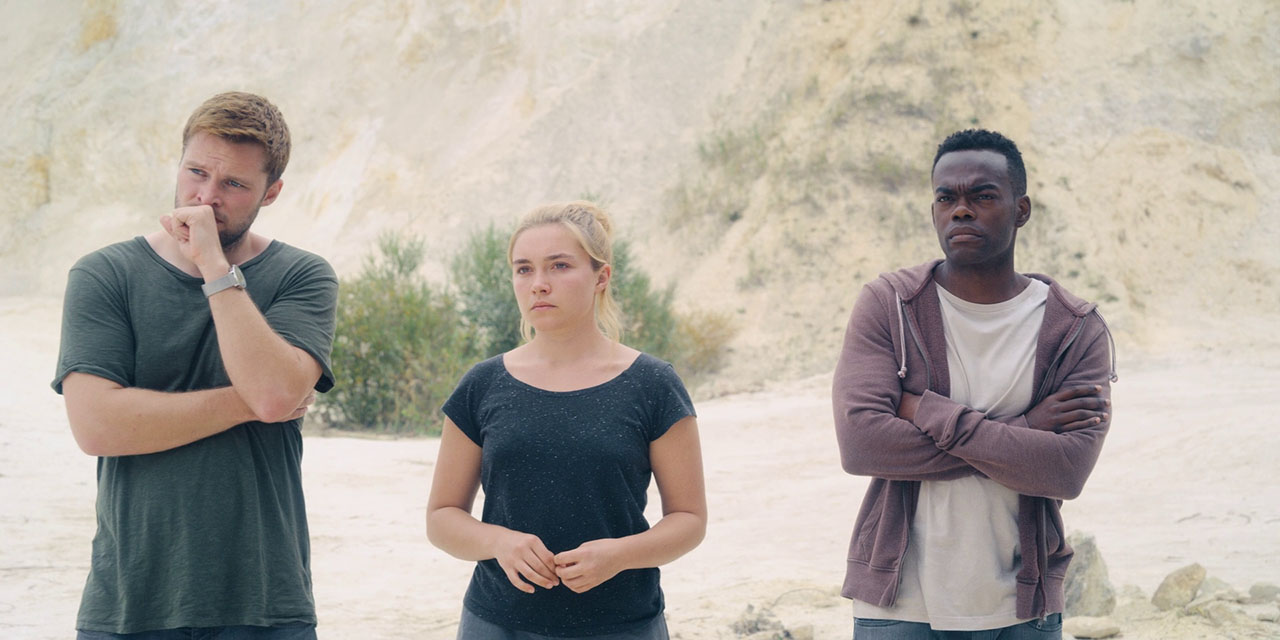
Mostly shot in Hungary, haha. I’d been saving this Sweden-set horrorfilm for our own trip to Sweden, but with our flight cancelled and SAS absconding with our ticket money, suppose I’ll just watch it now. Florence Pugh, known for having the most emotionally expressive face in the business, mostly expresses sullen sadness here after her whole family dies then her boyfriend who wanted to break up with her reluctantly lets her join his friends’ trip to visit a psychedelic pagan cult in rural Sweden.

The trip is for Chidi’s research, and I sorta buy his part in the academia subplots, but not Pugh’s boy Christian (get it? Jack Reynor, the cool older brother in Sing Street). Christian doesn’t read as a grad student, and unapologetically tries to steal Chidi’s research topic just by saying so, with no background or theory or actual, uh research, except for questioning the locals after it’s already clear to us that they’ll all be sacrificed in some ritual or another. I waited three whole hours for him to get Kill-Listed after reading somewhere that those two movies have the same ending, but he was burned alive inside Chekhov’s Bear instead, which is nowhere near the same thing.

Reynor, Pugh, Chidi:

Will Poulter (The Little Stranger) is “the shitty friend” according to my notes, but there’s tough competition – all these dudes deserve a good burning. It’s a great looking movie, so I didn’t mind the three hours even if I wouldn’t wanna watch it again. Katy should not watch it at all – between the bad relationships and graphic head injuries, it’s about the least-Katy movie I watched all SHOCKtober. The lengthy version I watched adds more close-ups of smashed heads (good for me, bad for Katy) and 20+ minutes of Chidi going on about his thesis (vice-versa).

None of the critics I follow can say anything against this movie, since they all had cameo roles in it, so allow me be the truth-teller who finally declares that this movie is… really good. I fell hard for Sallitt’s The Unspeakable Act and lead actress Tallie Medel, so it’s no wonder that I’d warm up to this one, which lands in a different way. It jumps casually forward in time through two women’s lives, like a more devastating Bob Byington story, until the weight of accumulated details hits hard in the back half of the movie – hard enough that going through the screenshots has made me emotional, and I have no further comment, even though my notes say I’m supposed to reread the thing in Cinema Scope 78 after watching this.

“She was extremely fearful that america would replicate nazi Germany,” so these things come in cycles. Marion started recording the news during the late ’79 Iran hostage crisis, didn’t stop until her death in 2012, and this doc was made years later so we get interviews (with her two families and the nurse and chauffeur) and re-enactments. Most of the tape footage shown is news highlights of major events, not necessarily something you’d need a comprehensive archive for, but a couple of obscure gems are thrown in. Centerpiece of the doc is a split-screen of four networks in real-time watching the WTC disaster. Marion produced a talk TV show in Philly – her favorite topic was the open exchange of ideas, though at home she was extremely controlling. Guess it’s hard to fit the life of a complicated person and 30+ years of news coverage into ninety minutes, but I look forward to the projects that’ll come out using the digital archive of her tapes.

Choice footage of this guy getting scolded for being racist:

A final film that works just as well as an introduction.

On one hand, it’s mainly a career summary, and I didn’t need one. But I guess I did, because Jane B. looks different than I imagined it, and it’s really time to rewatch Le Bonheur, and it even made me think that One Sings needs another look, and time with Agnès is always well-spent.

I didn’t know it was possible to make a biopic this sentimental about Bunuel, of all people. At least it’s animated, so we get the occasional vision of elephants on horse-leg stilts. Opens with artists at a cafe arguing about the purpose of art, and closes with Luis discovering that art is for helping the poor people, I guess. The movie could at least use animation to abstract away all the gruesome animal killings from the Las Hurdes shoot, and it does, but then it makes sure to show us the original footage right after.

After a screening of L’age d’or ends in fire and threats, LB is annoyed that everyone thinks all his good ideas come from Dali, then he can’t get funding for a follow-up until his cousin wins the lottery. LB and producer cousin and cameraman and writer meet in the mountains, get into hijinks, and shoot a movie. LB has many flashbacks and dreams about trying to please his father, and everyone learns a little something about truth and fiction and the true purpose of art.

Always a good call to open your movie with “The Passenger” by Iggy Pop. I lost track of the relationships and double-crosses, because I think all the cops are dirty and spying on each other… or rather, it’s not hard to follow while watching, but with the state of everything, I’ve lost track a month later. Story told in named chapters, out of order.

Our main dude is Cristi, with conspirator Gilda and boss Magda. The conspirators’ whistling language (and Cristi’s Old-Mark-Wahlberg look and performance) mostly serves to add notes of absurd humor, so this doesn’t turn into another grim tale of Romanian society/government corruption like Graduation.

Two dirty cops:

Sharp-looking and pleasurable, filled with guns, whistling, hidden cameras, vinyl records, movie theaters – after 12:08 and Metabolism and Infinite Football, I now have no idea what to expect from this guy.

A superb effect, mountains and fields of crinkled foil surrounding us in 3D, rapidly rotating and expanding, but never getting anywhere, the constant strobing of color inversions masking the loop point where the motion repeats so it looks like continuous motion that never progresses.

Icy blue and warm gold flicker, with blunt text sections (censorship of the Poltergeist DVD is used as an example of America’s shame). The visuals set up predictable patterns only to break them and reset. Watching right after She Dies Tomorrow, the colors flashing on my face, I felt like I was fulfulling some dark omen, or going crazy.

From movie music with vinyl surface noise to mad science lab electro-noises, flies buzzing in stereo, later an argument with the tape sped up. It’s no wonder I enjoyed the music – it was JG Thirlwell.

Jacobs called it “a reversion to my mid-twenties and that sense of horror that drove the making of Star Spangled to Death.”

David Phelps in Mubi:

Sort of reversing the structuralist impulse to let the movie’s internal system arrange the order, movement, and duration of its materials, Jacobs plays his movies like 1st person interrogations of his footage, the artist constantly adopting and discarding new approaches toward his material … Jacobs’ movies can operate like works in progress; abstract expressionism’s emphasis on process seems to carry not only through Jacobs’ compositions, successions of half-completed movements, but his own approach over the duration of the movie.

Opens with a lot of text about a lot of people in 1980 that I’m not gonna remember, but fortunately the rest is easy to follow. After an absolute slaughter of various gang members, including Tommaso’s two sons, Tommaso does the unthinkable and testifies. He’s tortured in prison, hides in witness protection in the USA, testifies in two major trials, sending friends and enemies to prison. The action spans from 1980 to 2000, and with nonstop event and dialogue for two and a half hours, it’d take me longer to unwind and recount it than it took to watch it. It’s no American Made, but it passed the time on a weekend afternoon.

Such a talky movie, it’s hard to find screenshots without subtitles:

Best period detail: in New Hampshire the grocery store sells AR-15 rifles. Our (anti)hero is Pierfrancesco Favino, star of a movie called ACAB. His enemy/friend Judge Falcone is Bellocchio regular Fausto Russo Alesi, and his wife is TV star Maria Fernanda Cândido. This played the stacked competition at Cannes along with Portrait, Parasite, Bacurau, Atlantics, Hidden, Joe, and Hollywood.

Not sure if this guy was real or just a story, but it’s a good story:

Portentous opening, then we get to hang out with two nerdy boys watching scrambled porn, then they meet some other boys and hang out, with nothing clever to say or do, and my notes just say “I hate teenage boys,” until Glasses Boy accidentally kills Daryl with a sword, then things pick up.

In Glasses’s defense, Daryl was being a total shithead, but understandably all the kids are freaked out and decide to hide the body and sword and never speak of this again. Only, Main Kid Zach can’t seem to shut up with his paranid obsessions, and Glasses Kid Josh goes in another direction, deciding to become a drug dealing sword serial killer. Kinda rare that a movie’s second half is this much better than the first – the mystery/thriller stuff worked better than the hangout Stand By Me stuff – and hilarious to see Mike D’Angelo has exactly the opposite take on letterboxd: “Starkest direction/script divide I’ve seen in a while … the film boasts maybe the lamest third act of 2017, and I saw freakin’ Geostorm.”

Since this came out, the director has made a mid-length movie with Nick Stahl that ties into a Lumineers album, the fourth boy who I haven’t mentioned was in a movie with Chris Walken and Steve Coogan, the Girl in one with Angela Bassett, Glasses in one with Edie Falco, and Kid is in the new Larry Fessenden Frankenstein thing, so maybe one day we’ll look back at Super Dark as a launching pad for stardom, the Tigerland of its time.