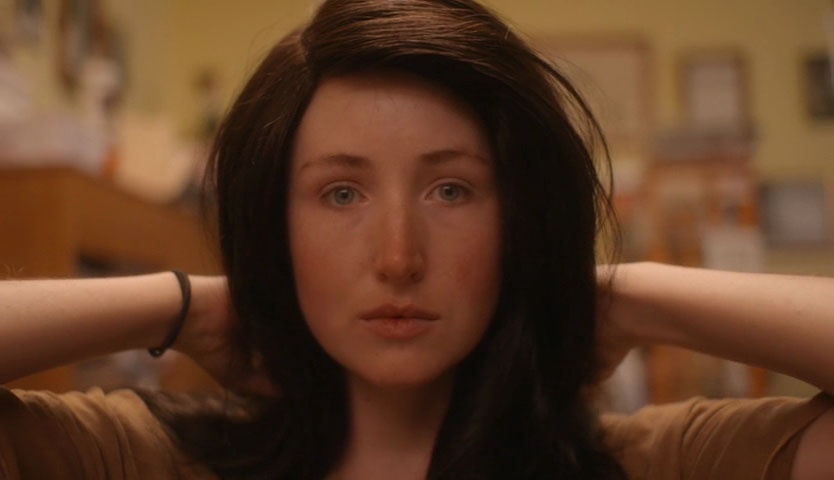
Watched right after Christine. I didn’t love Greene’s Actress (or Christine), but they made for good prep-work for this masterpiece whatsit. A sort-of documentary following Kate Lyn Sheil as she preps to play Christine Chubbuck, presumably in a feature along the lines of Christine, though we see few any details about the feature and nobody’s helping her with character prep.

The first movie I’ve seen to film its own crowd release notice:

Kate’s in Florida where it happened, and locals seem to have no memory of Christine or her fate. She goes through library microfiche, reads books about suicide, does some serious tanning and gets fitted for a wig, goes gun shopping and finally gets a peek at some archive footage of the real Christine. It all leads to a joke of an ending, Kate finally building up the nerve to shoot herself, but the entire process leading up to that was fascinatingly staged (or “staged”).

This came out the same time as Kate Plays Christine and was slammed, then I read some defenses of it, so thought it’d be instructive to watch both. And this one, the straight period-piece retelling of dead newswoman Christine Chubbuck’s final days, was worse than I’d feared, an unenlightening, 1970’s-fetishizing semi-drama leading to a foregone, unpleasant ending. Christine has a depressive history, has personal and family and work troubles, and tragically kills herself on air. Michaels Sicinski and D’Angelo argue that it’s not unethical, not exploitative – maybe so, but it struck a couple wrong notes with me. I kept thinking “sure, but what’s the point,” and then Kate Plays Christine was an entire feature about trying to find the point, and that played beautifully for me. Not a huge fan of Simon Killer either, I’ll be hesitant to watch another Campos joint (but damn, Sicinski says Afterschool is great).

The actors do an unusually good job with unexciting material, at least. Rebecca Hall is magnetic as Christine, despite the character being prickly and awkward. Tracy Letts, who’s wonderful in everything these days, is the boss, Timothy Simons from Veep is a coworker, and Michael “no relation” Hall (TV’s Dexter) a potential love interest.

Evan has a dying mom, is also a bit of an impulsive fuckup, and during his immediate post-mom depression he acts self-destructively to the point of having to flee the country. Off in Italy he meets a couple of drunken brits, takes a job with chill farmer Angelo, and hooks up with gorgeous local Louise (Nadia Hilker), who turns out to be an ancient cat-squid-beast, as shown through some dodgy CG.

Evan then spends the rest of the movie trying to convince Louise not to be reborn as a new identity, which is something that happens every generation or so, forcing her to disappear and make new ID documents and will herself possessions (shades of Highlander), but to remain mortal and live a normal life with a tourist loser. Someone described it as Before Sunrise as a monster movie, which is about right, and I enjoyed it even though it seems like I have nothing nice to say.

Evan is Lou Pucci, who looks like my neighbor Jared, but is actually the doomed nerd of Evil Dead Remake and bazooka kid of Southland Tales. The Moorhead/Benson duo also contributed a segment to V/H/S/3 and have made two other features which seem to be horror movies but aren’t, really. Count me in.

Manana is tired of her family, and one day walks out and gets her own apartment. Everyone tells her this is unacceptable and ridiculous and she’ll come crawling back, but she does not. She still sees her husband and kids and parents, reluctantly, but mostly keeps to herself even when home. Remarkably, the movie allows this to happen, doesn’t condemn or destroy her.

Michael Sicinski on letterboxd:

Nana & Simon’s choice to spatialize Manana’s rebellion allows them to literalize her movement away from the fold, a break which is then compromised by her older brother’s insistence that some dumb lugs in her building “keep an eye on her.” Unbeknownst to Manana, the patriarchy is everywhere. This is made even clearer, in far harsher terms, when some old friends of Manana’s divulge a secret about her past, something that she herself did not know.

That something is that her husband Soso (“ironically but accurately named”) had a long-term affair, something her friends assume Manana already knew, because why else would she have left. In fact, he has a son with this woman, and Manana meets him under the pretense of checking their gas meter. Meanwhile life goes on in the family she has left – one kid has a breakup, the other has a new (pregnant) girlfriend, and Manana’s parents and brother can never stop meddling.

Bilge Ebiri, whose review got me watching this in the first place:

The film unfolds as a series of long takes, as we follow characters in and out of rooms, staying close enough to register individual experiences while always making sure to keep the rest of the world in focus. But the camerawork isn’t that rough, handheld, vérité style we’ve become so used to; it’s fluid without being showy, immediate without being unbalanced.

Codirectors Ekvtimishvili and Gross made a previous feature called In Bloom, which is also about females in Georgia escaping their families. Soso starred in Aleksey German’s Under Electric Clouds, and I have no idea where Manana (Ia Shugliashvili) came from.

Stupid Matt Damon has money problems (you can tell because he stays up late at a cluttered desk frowning at an adding machine) so he decides to get small. His wife Kristen Wiig decides against the idea at the last minute, then he loses his palacial house in the divorce, moves into an apartment below hard-partying Christoph Waltz whose housecleaner is Vietnamese dissident Ngoc Lan (Hong Chau of Treme, Inherent Vice). These three hitch a ride with Udo Kier to the original small colony led by Dr. Rolf Lassgård (A Man Called Ove), which is retreating into a mountain to wait out the impending human-caused global catastrophes. Stupid Matt Damon decides to go with them, then decides not to, then convinces Ngoc Lan he’s in love with her.

Katy says it’s like they asked each actor what they’d like to play (“a sea captain!” “a hard-partying smuggler” “a one-legged humanitarian”) then wrote a script around it. It tries to be a bunch of things at once, not so successfully, and there are awkward and obvious bits, but I appreciate the ambition, and Christoph Waltz looks like he’s having the best time. Second movie we watched theatrically in a row to feature Laura Dern.

Of our original trio, Han Solo has died in part 7, Leia now leads the resistance with second-in-command Laura Dern and Han-like hotshot flyboy Poe (Oscar Isaac), and Luke is secluded on an island refusing to help would-be protege Rey (Daisy Ridley) because he lost control of his last protege Kylo Ren (Adam Driver). John Boyega (Attack the Block) apparently had a larger role jumpstarting the narrative in part 7 – here he’s paired with engineer/love interest Rose (Kelly Tran) trying to help the rickety remains of the resistance escape from Kylo and howling ham sandwich Domhnall Gleeson in their attack fleet. Benicio Del Toro is a smooth traitor to both sides, there are computer-animated characters who don’t quite work, appearances by Yoda, Chewbacca and the robots. I appreciated Rian Johnson’s commitment to filming it all in well-designed visual frames, and this would probably rival the Guardians of the Galaxy movies in rewatchability, but that doesn’t make me happy that Rian is committed to a decade of Star Wars instead of original stories.

I’d like to say I sought out an Israeli movie in New York during Hanukkah, but really I watched this because of the dance scene in David Ehrich’s top 25 video.

Neatly divided into three sections. In the first, an Israeli father (Lior Ashkenazi of Late Marriage and Footnote) and mother (Sarah Adler of Notre Musique and Jellyfish) are visited by military flunkies and told their only son has died during his military duty. This turns out to be a mistake, and the enraged dad insists the military immediately bring his son home to visit. In the second part, their son Jonathan is on assignment with a handful of others at a remote roadblock. We observe their bored routine, stopping and humiliating drivers before letting them through the little gate, then the morning after a horrible accident that kills four innocents, Jon is taken away to visit his family. In the final part some months later we learn the son died in a crash that morning, the parents have been separated, and they’re together for a few minutes hashing some things out.

Shot with such flair, artfully designed without being quirky or showoffy. The tension and despair on display is absolutely wrecking, but the film compensates with an abundance of humor (light and dark). Maoz’s second film after the acclaimed Lebanon, which I guess I need to check out. Played Venice this year with Human Flow, Ex Libris, Three Billboards and champion The Shape of Water.

Cute mouse Dinki runs away from her fake family (her “dad” is a guy wearing mouse ears and her “brother” is a dog) with a boy and her creepy girlfriend who hears murder-voices. Birdboy himself spends most of the movie a useless junkie, having nightmares and reminiscing about life with his late father in a lighthouse, but briefly he turns into a giant enraged bird-beast and kills all the dump rats who threaten his friends.

It doesn’t feel like an adult animation so much as a kids’ animation that has been isolated and deprived of light or hope for decades until all the happy furry creatures have turned to despair. Also featuring a living piggybank and living alarm clock, the opposite of Disney’s Beauty and the Beast trinkets, showing the cruel horrors we inflict on the objects that are just doing their jobs for us. Played with a short…

Decorado (2016, Alberto Vásquez)

From one of Birdboy‘s directors, a handful of truly awful animal-characters interact in short sketches, while one of them (the guy whose best friend is a ghost and is married to a robot-voiced woman whose secret admirer is a horrible monster) starts to realize that he’s in a Truman Show situation with artificial scenery. Some crude gags striving towards profundity, not quite making it.

Another magical drama about a refugee in hiding with a carefully balanced comic tone, this was inevitably going to be compared to Le Havre, my favorite movie of a few years back, and fall slightly short. But it’s nice to have more of refugee Khaled’s story in this one, as opposed to near-mute Idrissa in Le Havre, and the acknowledgement of the racism and xenophobia within the country’s citizens fueling the policies that are making it so difficult for him to gain asylum in Finland.

Syrian Khaled has bounced through ten countries on his way to Finland and is desperate to locate his one surviving relative, his sister Miriam, and bring her to a safer place. His Iraqi friend Mazdak offers communications help to look for the girl while Khaled finds work with Wikström (Leningrad Cowboy Sakari Kuosmanen), who has left his wife for reasons unknown and purchased a dumpy restaurant. Wikström and Khaled are given too little shared screen time for us to watch them bond (alongside a cute dog and three bedraggled employees who came with the building), but Wikström proves to be big-hearted, protecting his newest employee from the elements and the authorities.

Kaurismäki won best director in Berlin (A Fantastic Woman, Félicité, On the Beach at Night Alone). My moviegoing companions were surprised and appalled that Finland would not offer Khaled asylum and try to have him deported, but now that I’ve seen Stranger in Paradise, nothing is surprising. Others were dismayed by all the screen time given to amateur performances of rockabilly songs, but I preferred those to the half hour of backstory showing how Wikström came to run a restaurant. I recognized Kati Outinen (the wife in Le Havre) in one scene, and restaurant doorman Ilkka Koivula (probably also from Le Havre), but that apparently was not Carel Struycken as a bartender.