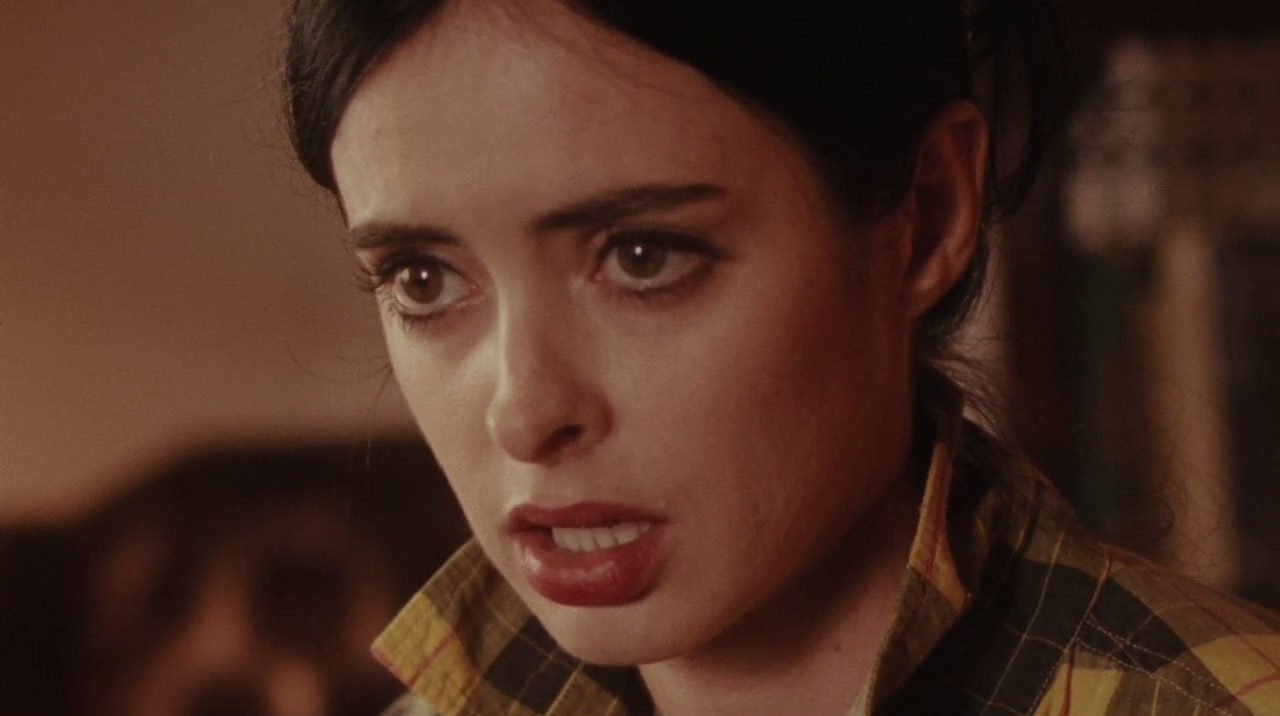
“I hope this will be good for us… but especially for me.”

Watched during Sundance Week! During Sundance 2015, I managed to watch three movies from Sundance 2014. There are lots of movies from last year that I mean to catch up with, and this seems as good a scheme as any.

Seems like a hard movie to enjoy, a non-comedy with a total asshole lead character (played by Jason Schwartzman, a puppy dog with a severe hairstyle). But the movie only occasionally seems to sympathize with him, and it takes sidetracks into the lives of the people he knows: his long-time girlfriend Ashley (Elisabeth Moss, star of Top of the Lake and Mad Men), his novelist mentor Ike (Jonathan Pryce), and that novelist’s daughter Melanie (new Marvel superhero Krysten Ritter). After the finale, which is particularly harsh towards Philip, allaying my fears that the movie expected me to care about a terrible person’s sense of well-being, I decided maybe Perry set out to make a movie centered on the selfish prick who shows up in minor roles in other movies, usually to make the sympathetic lead characters look good in comparison or to motivate some kind of action on their part. Philip and Ike become friends but can’t seem to motivate each other, because they’re both the selfish prick.

“I want you to contextualize my sadness.”

I didn’t much enjoy Perry’s The Color Wheel, and don’t care for his handheld camera work (although it seemed better here, in color), but can’t ignore a critical mass of critical acclaim – don’t want to sleep on a masterpiece. This wasn’t, but it’s got good acting and some hilarious/horrible moments, like Philip’s response to a student asking for a recommendation: “Here’s a piece of paper with some staples in it. Wish I could be of more help.” Casting Jason Schwartzman and making a movie about white middle-class sadsacks and father issues, decorated with 1970’s book jackets and omniscient narration, Perry might want to hang with Noah Baumbach and Wes Anderson.

Josephine de la Baume, lead vampire of Kiss of the Damned, plays Philip’s fellow English teacher, who poisons the department against him. The Color Wheel’s Kate Lyn Sheil played one of Philip’s exes, and Eric Bogosian (Joe McCarthy stand-in of Witch Hunt) narrated. Edited by Robert Greene, who made a splash last year with his own Actress.

“Tonite only”, that’d be Friday the 13th, Sept. 2013.

My favorite prickly response to the movie comes from M. D’Angelo, who finds the narrator’s grammatical errors and misuse of words “entirely typical of [Perry’s] approach to filmmaking in general. Everything here feels like the work of someone inexpertly trying to synthesize challenging elements of books he’s read and movies he’s seen… which is what ambitious young artists do, to be sure, but they’re generally not celebrated this fervently until after they exit the blatant juvenilia phase.”

A.R.P. on not making “calling card films” to get hired in Hollywood:

There is an ineffable “do not hire” quality to Listen Up Philip, apparently, that shows experienced manufacturers of entertainment that whomever made this film is most likely hard to work with.

Much more interesting visually than it looked from trailers and posters, which were all Joaquin looking into the distance while talking to Siri, sometimes smiling. More interesting emotionally too. Phoenix’s beloved operating system grows and learns at an accelerated rate, like if Short Circuit’s Johnny Five had internet access, finally admits to having simultaneous romantic relationships with hundreds of humans, and soon afterward leaves all the lonely humans alone with each other to further explore her own consciousness. It’s kinda beautiful and terrifying in a Terminator Skynet sense.

The somewhat-happy ending leaves Phoenix with Amy Adams, a longtime friend who bonded with her own OS while divorcing her husband. Also featured: Rooney Mara (Zuckerberg’s ex in Social Network) as the wife divorcing Phoenix, Olivia Wilde as a blind date whom Phoenix is too damaged to pursue, Portia Doubleday as a Siri sex surrogate, Chris Pratt as a coworker, and the very human voice of Scarlett Johansson. Won a million awards, including a screenplay oscar.

It feels, accurately, like an adaptation of a long, wordy book, in that it’s a long, wordy movie that crams in characters and investigations and descriptions and dialogues and backstories through its runtime, leaving little breathing room or sense that it’s all adding up to something. And it feels like one of those sprawling PT Anderson ensemble dramas, in that it’s packed to the gills with great actors, some of them never better than here. And it’s faithful to the madcap trailer, in that it contains those lines and comic scenes. And it’s similar to Big Lebowski, in that they’re both quizzically-plotted red-herring comedies featuring addled detectives. But it’s like none of these things, the visuals closer to Anderson’s The Master than I was prepared for, the mood less comic and hopeful. Some of the critic reactions I looked up mention the dark, disillusioned second half of Fear & Loathing in Las Vegas, a good point of reference. It’s being called the first Pynchon adaptation, but only because nobody (myself included) saw the semi-official Gravity’s Rainbow movies Impolex and Prufstand VII. Random movie references, presumably from the book: a company called Vorhees Kruger, a street called Gummo Marx Way.

This is Joaquin Phoenix’s show, but his cop frenemy Josh Brolin keeps trying to kick his ass and steal it. Also great: Jena Malone as an ex-junkie looking for her husband, Katherine Waterston as Doc’s ex-and-future girlfriend with questionable allegiances, and Martin Short as a depraved dentist. Plus: Martin Donovan, Omar, Eric Roberts, Jonah from Veep, Reese Witherspoon, Owen Wilson, Benicio Del Toro, Maya Rudolph, Hong Chau and Joanna Newsom.

D. Ehrlich:

Anderson has imbued [Joanna Newsom] with a spectral dimension – every conversation she has with Doc sheds light on his isolation, but each of her appearances ends with a cut or camera move that suggests that she was never there, that she isn’t an antidote to his loneliness so much as its most lucid projection.

MZ Seitz, who is “about 90 percent certain [Newsom] is not a figment of anyone’s imagination.”:

Phrases like “peak of his powers” seem contrary to the spirit of the thing. Vice impresses by seeming uninterested in impressing us. Anderson shoots moments as plainly as possible, staging whole scenes in unobtrusive long takes or tight closeups, letting faces, voices and subtle lighting touches do work that fifteen years ago he might’ve tried to accomplish with a virtuoso tracking shot that ended with the camera tilting or whirling or diving into a swimming pool.

G. Kenny:

The movie walks a very particular high wire, soaking in a series of madcap-surreal hijinks in an ambling, agreeable fashion to such an extent that even viewers resistant to demanding “what’s the point” might think “what’s the point.”

D. Edelstein:

It’s actually less coherent than Pynchon, no small feat. It’s not shallow, though. Underneath the surface is a vision of the counterculture fading into the past, at the mercy of the police state and the encroachment of capitalism. But I’m not sure the whole thing jells.

Seitz again:

Something in the way Phoenix regards Brolin … suggest an addled yet fathomless empathy. They get each other. In its way, the relationship between the stoner “detective” who pretends to be a master crime fighter and the meathead cop who sometimes moonlights as an extra on Dragnet is the film’s real great love story, an accidental metaphor for the liberal/conservative, dungarees/suits, blue state/red state divide that’s defined U.S. politics since the Civil War.

A. O’Hehir:

Like Anderson’s other films (and like Pynchon’s other books), Inherent Vice is a quest to find what can’t be found: That moment, somewhere in the past, when the entire American project went off the rails, when the optimism and idealism – of 1783, or 1948, or 1967 – became polluted by darker impulses. As Pynchon’s title suggests, the quest is futile because the American flaw, or the flaw in human nature, was baked in from the beginning.

Goofy meta-romantic-comedy with half the cast of Wet Hot American Summer, full of delightful bits and ones that didn’t quite work (extended scene about Chris Meloni crapping his pants). Good cameos and minor roles, the best being a sword-wielding Michael Shannon, but it’s mostly the Rudd and Poehler show and they sell the whole fake-comedy thing perfectly. Oh and New York City, which is practically a character in the film.

Better than expected (because I expected Into The Wild with a happier ending). Reese Witherspoon goes on a life-cleansing solo voyage, encounters friends, admirers and dangers, a benevolent shoe company, potential-rapist hunters. Flashbacks to her mom Laura Dern dying of cancer and Reese’s ensuing descent were very well integrated into the present-day story. I am a fan of this movie’s editing. Vallée made last year’s Dallas Buyers Club, Nick Hornby adapted the memoir, and Reese might’ve won more awards if Julianne Moore hadn’t made an alzheimer’s drama the same year.

Great sequel to The Pervert’s Guide to Cinema. I liked this one better – less psychoanalysis and more social/political discussion. Again we’ve got clips from films and new stories and music performances, with Zizek talking for the entire runtime, having been placed inside the sets from some of the films (“feel-ums”). Would be worth watching this a few times, a la the Adam Curtis movies, in order to grasp it all, but it’s simply less enjoyable than an Adam Curtis movie. Maybe if they got Craig Baldwin to edit the visuals and Mark Cousins to re-record the voiceover… but I digress.

Some Things:

Good idea to open with They Live. Besides the obvious bit with the clear text commands beneath billboards and magazines (“consume”) he discusses why the fight scene has to be so long and difficult.

Zizek speaks from inside They Live, The Sound of Music, a Coke commercial, A Clockwork Orange (I think), Jaws, Triumph of the Will (heh), The Fall of Berlin, one real location (an airplane graveyard), Taxi Driver, Full Metal Jacket, Brief Encounter, Seconds (good one) and Titanic (including a great post-credits stinger where he plays Dead Leo DiCaprio)

“The basic insight of psychoanalysis is to distinguish between enjoyment and simple pleasures. They are not the same. Enjoyment is precisely enjoyment in disturbed pleasure, even enjoyment in pain, and this excessive factor disturbs the apparently simple relationship between duty and pleasures.”

He uses Kinder Eggs (“a quite astonishing commodity”) as a metaphor about layers of enjoyment. I think by his logic that Edgar Wright movies are Kinder Eggs.

He defends Rammstein, showing concert footage that has been likened to nazi imagery. Actually, nazis come up a lot in this movie, and there’s a long section about Beethoven’s 9th, Ode to Joy (also feat. A Clockwork Orange).

Seconds:

How to properly mock communism: in Loves of a Blonde and The Fireman’s Ball, Milos Forman “mocks precisely the ordinary people in their daily conformism, stupidity, egotism, lust, and so on. It may appear that this is something very arrogant, but no, I think that this is the way to undermine the entire structure of the Stalinist universe, to demonstrate not that leaders are not leaders – they’re always ready to say ‘oh but we are just ordinary people like you’ – no, that there is no mythic people which serves as the ultimate legitimization.”

“How come it is easier for us to imagine the end of all life on earth, an asteroid hitting the planet, than a modest change in our economic order? Perhaps the time has come to set our priorities straight and to become realists by way of demanding what appears as impossible in the economic domain.” Seems that Zizek is advocating for revolution.

Amazing imagery of water across the world: rivers & lakes, dams & reservoirs. Occasional scenes of codirector Edward Burtnsky creating/assembling a photo book of the same material, so this is the motion companion to his book. Emphasis is on human intervention upon natural water paths, with a few interviews about the ensuing wreckage upon lives and the environment. The credits claim a 180:1 footage ratio. I calculate that’s 261 hours of raw footage.

Not my favorite kind of thing stylistically (ugly-looking party movie with improv dialogue) but narratively very exciting. While mysterious comet passes overhead and power goes out, partygoers venture to house down the street but always end up at the same house… or an interdimensional alternate-reality version of that house. Sliding Doors is mentioned alongside quantum theory and Schroedinger’s Cat as they figure out what’s happening, heh. Gets really great in the second half, and ends with Emily wandering from house to house until she finds a reality she likes, one where all the party friends are getting along nicely, then she nails that house’s Emily in the face and takes her place. Neat twist when the version your movie is following turns out to be the evil one.

Unexpectedly for an indifferently-shot indie movie where the only actor I recognized was Nicholas Brendon from Buffy (although his character claims instead to have appeared on astral-event series Roswell), the writer/director’s previous movie was Rango, and he worked on the Pirates of the Carribean movies, from which he brought Laurie Maher, who plays Emily’s boyfriend’s ex. The boyfriend Maury Sterling was in astral-event series Extant, and another actress wrote/directed astral-event movie Seeking a Friend for the End of the World. Emily herself is married to the star of Jane The Virgin, which Katy was watching downstairs.

Something wonderful (inflatable medical robot turned flying/fighting machine against its own will) combines with standard superhero-team origin-story and standard double-revenge plot with standard twist ending (you mean the most extremely obvious suspect doesn’t turn out to be the shadowy masked villain?). Adequately racially/sexually-diverse team of genius tech-nerd college kids use their lab experiments to defeat their own professor who has hijacked young Hiro’s micro-bots to destroy the military-capitalist who sent the prof’s daughter into another dimension. Interdimensional rescue of cryo-sleeping daughter unexpectedly recalls Interstellar, and robot’s self-sacrifice to serve man, floating away half-wrecked, recalls Terminator 2. Actually made me kinda sad, but as with Guardians of the Galaxy, we get a rebirth epilogue. As much as the world calls out for sequels to recent hit Disney movies, they keep putting out new stuff like this, to their credit.