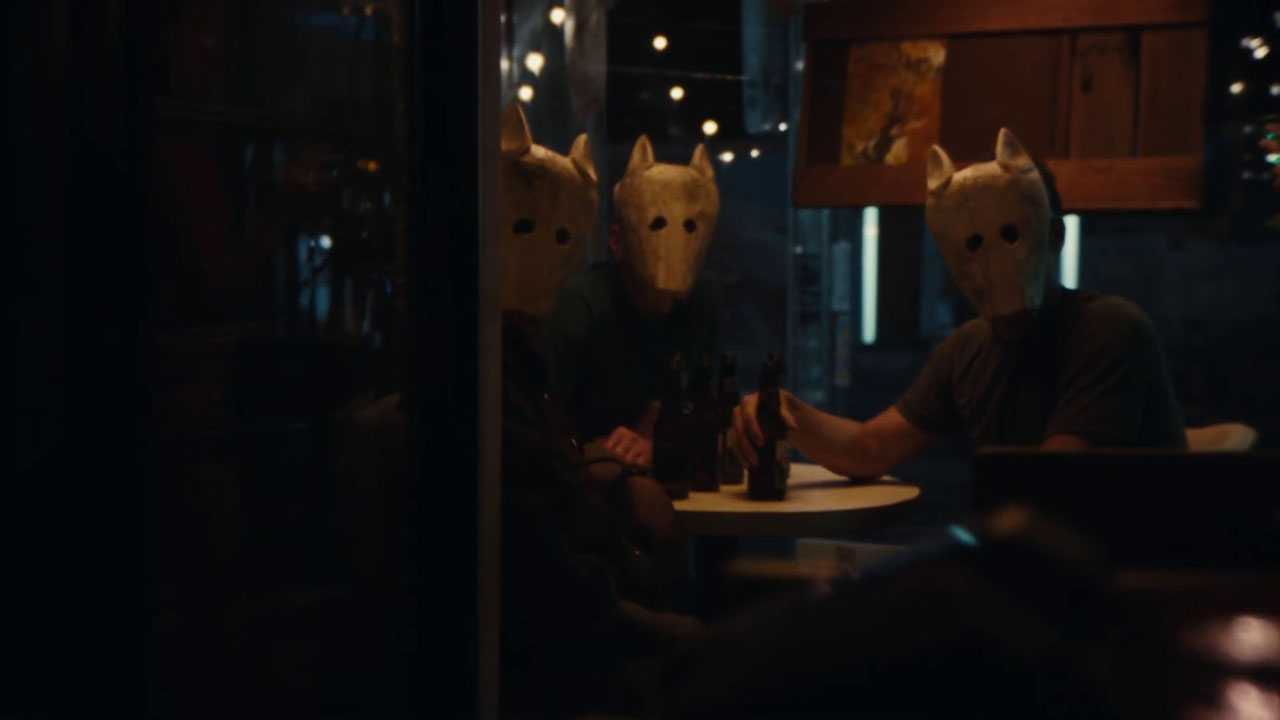
A follow-up 14 years later.

–
Porky in the North Woods (1936)

Porky’s wildlife refuge is an animal paradise, but an illegal french trapper invades, mutilates the forest creatures then whups porky’s ass, so the forest army fights back. The commentary guy knows all the song snippets Carl Stalling is playing and tears up listening to them.

–
Porky’s Poultry Plant (1936)

Such fast cutting as chicken farmer Porky hops into a prop plane to defend the chicks from hawks. Tash’s first WB cartoon. Comm says original Porky voice actor Joe Dougherty brought his actual speech impediment to the role before Mel Blanc took over… structural ripoff of Disney’s Silly Symphonies but more modern and violent… Tashlin is described as a “rumpled unsociable fellow.”

–
Now That Summer is Gone (1938)

Less-fun musical picture, a squirrel who loves gambling loses the family acorn supply to a grifter – his dad in disguise, teaching him a lesson. Writer Fred Neiman’s only credit before leaving the cartoon game (I dutifully wrote that down from the commentary, but who is Fred Neiman?).

Kosher acorns:

–
Puss n’ Booty (1943)

Back to black & white… the cat has eaten a pet bird and hidden the evidence so the family orders a new canary. After a prolonged cat & bird game, the bird eats the cat – good twist – remade with Tweety & Sylvester in 1948. The Jerry Beck commentary mainly wants to tell us exactly which animators worked on which shots.

–
I Got Plenty of Mutton (1944)

WWII meat shortages… Hungry wolf in cabin tries making bone broth, steams a single pea, then goes after the sheep since the sheep dog is off at war. Dressing as a sexy sheep to fool the protective ram backfires, the ram keeps chasing him even after revealed as a wolf, and 15 years before Some Like It Hot.

–
Brother Brat (1944)

Today’s tough women in the warplane-riveting workforce need someone to watch their horrific kids while at work, so Porky is enlisted. Baby Butch torments a cat, wrecks the house, and almost murders Porky with a cleaver – I’m not sure what the wartime lesson is here.

–
The Lady Said No (1946)

This is… not a Looney Tune, it’s a Daffy Ditty… a stop-motion musical about a sexual harasser in Mexico. He takes the girl who only says no to a restaurant, then she says no to him going back to his old life, and no to birth control, and he’s distraught to find himself a father of a hundred babies. Replacement animation with moving camera, impressive work for a silly little movie.

A follow-up to last year’s program, with some non-’73 films added for context.

–
Heavy-Light (1973, Adam Beckett)

Video ghosts pong across the screen then engulf it, again and again with different RGBs and forms, sometimes in sync to the electro-spectral music. Adam seems cool – he was an animation pioneer who worked with the Hubleys and on Star Wars, and died young in a fire. Music by Barry Schrader, president of the electro-acoustical music society, who has recently worked with Wadada Leo Smith.

–
Evolution of the Red Star (1973, Adam Beckett)

After a Chairman Mao intro we get rippling pen and paper red/blue line worms slowly blobbing across the screen, the shining red star and other geometrical pulsars holding fast in their spots. In the second half someone seems to be tweaking the settings on their tube TV until the rich color of the red star is restored and takes center stage again. Music by another electro-acoustical pioneer, Carl Stone, whose last few albums made some major top-tens.

–
Diary (1974, Nedeljko Dragic)

Man is walking, then driving, going through as many transformations as the animator can dream up. Party and city scenes, mouse chasing cat, wild color shifts. English words and letters threaten to transform all people into language, but abstract forms win the day, and the man looks miserable about it. Better music than usual, always changing forms to suit the visuals. Won the grand prize at Zagreb.

–
Production Stills (1970, Morgan Fisher)

Simply a film documenting its own making in real-time. We hear the crew working and discussing and see flashes as someone takes polaroids then pins them to the wall in front of the film camera. Reminds me of Michael Snow’s book.

P. Adams Sitney on Fisher: “Very quickly he became the most academically reductive practitioner of minimalist filmmaking … steadfastly resisted the sublime. Instead, he invented cinematic paradoxes.”

–
Picture and Sound Rushes (1973, Morgan Fisher)

Fisher gives a a film technique lecture about picture and sound sync, reading from notes at a desk while an 11-miute timer counts down. We keep losing either sound or picture or both, as he explains why this will happen, breaking down the film’s structure – we lose sound and can’t hear the full description, but we’re also seeing it in action, so we can piece together the missing information. Self-reflexive structural pranksterism – the film is a lecture on itself and a demonstration of its own techniques.

–
The Wilkinson Household Fire Alarm (1973, Morgan Fisher)

One-minute take of a rotating fire alarm which starts spinning then loses momentum like a wind-up toy.

–
De?licieuse catastrophe (1970, Piotr Kamler)

Very blobby 3D scenarios. Person wearing bootleg liquid-engorged optical-illusion sweater engages with the Q-Bert bouncing sphere and plays his horn for a dust sprite until the electro-score gets stuck in a loop and the whole world overflows. The music is by – you’re not gonna believe it – an electro-acoustical pioneer, Robert Cohen-Solal. Kamler was Polish but his whole film career was in France

–
Cours de secours / Heart of Relief (1973, Piotr Kamler)

Ornate cut-out cyclist balancing act upon a tug-o-war rope. Chess players atop the circus stack escape via light-balloon to correct imbalance caused by clockwork romantic pursuit so they can return to their game. Score by Francois Bayle, a “major figure” in electro-acoustical music.

–
Le Pas (1975, Piotr Kamler)

Papery sheets peel off from the gleaming pink surface of a cube and land neatly in a new spot until the entire cube is transposed. A couple sheets stay airborne caressing each other in a film-edit lock-groove but eventually rejoin the cube. The sound is ethereal shimmers by Bernard Parmegiani, whose diverse body of work is mainly dedicated to electro-acoustical music.

–
Orb (1973, Larry Jordan)

Following up Our Lady of the Sphere, more play with cut-out illustrations. Epilepsy-sun becomes balloon, ancient statues join an RGB disco, everything kinda floats away into space.

–
Once Upon a Time (1974, Larry Jordan)

The same colors from the last movie with more direct music and less direct visuals. Narrated story about hearing a bird. Another voice, now it’s a radio play with a woman asking a bird for help finding the missing prince – she locates him in the bardo and says he must be born again.

–
World (1970, Jordan Belson)

Sphere-lens smoke, the universe in a crystal ball. Sunflower spot patterns, TV static eyes, ink-blot anemone. A really good one. Wiki says Belson and Harry Smith got their start at the same time, but it’s Larry Jordan who reminded me of Smith… also says Belson did effects for The Right Stuff, that movie keeps coming up lately. P. Adams Sitney says this one is constrained “by a banal musical soundtrack,” says the abstract geometry recalls Allures.

–
Meditation (1972, Jordan Belson)

Symmetrical spark shower, crashing waves, a human diver, then back into the ether, sphere-blobs slowly becoming other terrains and galaxies, the audio striking bells ringing long notes.

–
Light (1973, Jordan Belson)

Piano score, very water-surface-looking light patterns, then wind, then rising sun. Blooming patterns as the music turns dark and electronic, harp with abstract forms in outer space, finally lens flare leading to fiery apocalypse. Can’t figure out how he did any of this.

With the frantic pace of the first film and my useless writeup, I worried we wouldn’t know what’s going on in this movie. But it’s just Spider-man, dealing with his usual Spider-man teenage problems while also trying to prove himself to the interdimensional society of Spider-men who say Miles only became a Spider-man through infinite improbability when a spider from Universe 42 warped into his version of New York. Attempts to save the universes from a Jason Schwartzman-voiced Watchmen-looking portal beast, then the movie cuts off before the next battle, Miles and his buddies facing off against an Evil Miles who became Venom The Prowler. Looks somewhat less splendid and amazing than the first movie because we made the mistake of skipping it in theaters and watching at home.

Porco is a daredevil pilot with a broken-down plane, chasing pirates, who at least have a code of honor. The pirates team up with hotshot pilot Curtis, who falls for Porco’s girl Gina. Porco is stuck with young architect Fio until his climactic dogfight, which becomes a boxing match when both planes are incapacitated, then everyone gets back up and flees the fascist government. It’s a fun pig adventure that holds onto a nice sense of mystery at the end.

Nathan is supposed to write the song that saves the world, but never got around to it (this would make a good double-feature with Bill & Ted 3). Murderface becomes possessed by evil. That cocaine clown is back, and the producer guy with bionic eyes. Sweet ending: “We forgive you, Murderface. You bring balance to this band by sucking. You suck so fucking much we can’t live without you.”

Franz Kafka’s A Country Doctor (2007, Koji Yamamura)

Yamamura made Mt. Head, which I saw a bunch of times when it came out and now don’t remember so well anymore. When a choir starts narrating in song it is clear that this isn’t a great Kafka story adaptation, but the design and animation are very cool. Heads keep deforming, voices keep double-tracking, while hairy loops and bubbly blobs float over the image.

–
Jefferson Circus Songs (1973, Suzan Pitt)

There is some kind of human stop-motion here, kids (all the actors are kids) dressing in fancy doll clothes and moving like robots or Svankmajer creatures – insane and dreamlike, not always in a good way. No idea what this meant, it’s completely out of the blue – even the credits don’t make sense. Apparently made in Minneapolis, the kids created their own roles, and even the distributor calls it “a string of puzzling little episodes.”

–
Flo Rounds a Corner (1999, Ken Jacobs)

Extremely Arnoldized clip of a girl in pink rounding a corner, the picture strobing and the frame sometimes splintering into sections that Arnoldize at their own separate pace. Had I known it was going to be silent, I would’ve thrown on “Light’s New Measure” by Black Duck.

–
Jackals & Fireflies (2023, Charlie Kaufman)

Like a music video for a poet. Eva HD’s work also appeared in I’m Thinking of Ending Things, and she is a fan of David Berman and Nico. Kinda works as “overheard in new york: the movie” – I’ll bet the movie plays better if you enjoy the voiceover poem and its delivery.

Young guy dies pathetically in front of the girl he likes, flees the afterlife, rewinds time and returns to his body, manic and indestructible. The character models keep shifting, the movie throws in 3D and crazy perspectives and photography, light and form and dimension and rationality all fluid. I wasn’t purposely looking for something to show up The Congress, but couldn’t have chosen better. The guy, his girl Myon (whose main characterization is “has got large boobs”) and her sister are swallowed by a whale while escaping the situation caused by our dude’s violent resurrection, and meet an old man who built a city inside.

I haven’t loved Yuasa’s recent features, but he’s in the animator pantheon for this and Walk On Girl. I should try either Kemonozume or Devilman Crybaby.

“Lousy choices, that’s your whole story, lousy movies,” someone says to Robin Wright, playing “herself.” This one’s not exactly great, but better than lousy – at least we get interesting topics and some fun animation. Getting around to watching this due to one of those topics – the idea of movie studios scanning actors then using their digital images indefinitely is back in the news.

Harvey Keitel as her agent gets a good monologue during the scan procedure, then Robin takes her money (they never say how much) and goes home with her hard-of-hearing kite-obsessed son Kodi Smit-McPhee. Twenty years later she enters the “animation zone” to attend a contract renegotiation party. The company which has successfully controlled and redefined her image for so long (one of her future sci-fi films is named RRR) stupidly puts Actual Robin in front of a live mic. There’s a revolution, real or imagined, and Robin is stuck in animated form so they freeze her body for future scientists to deal with. This is where Paul Giamatti comes in – he specializes in explaining insane situations to people in movies.

Somehow this is already Junior Stargazer Woodrow’s third Wes Anderson movie.

Good movie, need to see again.

AUG 2024: Saw it again, hence the (cropped) screenshots.

Bilge Ebiri:

We’re told that what we’re watching is really a theater piece written by the legendary American playwright Conrad Earp (Edward Norton). The film actually begins on a black-and-white television stage with the story narrated by a Rod Serling-like Host, played by Bryan Cranston. (So, really, it’s a play within a play within a TV production within a movie.) The Host reminds us that “Asteroid City does not exist. It is an imaginary drama created expressly for the purposes of this broadcast. The characters are fictional, the text hypothetical, the events an apocryphal fabrication.” In other words, the story itself is a phantom, unknowable … Late in the movie, Jones steps away from playing Augie and runs into the actress (Margot Robbie) who was to play the part of his wife but was reportedly cut from the finished piece. As the two recall the scene they would have had together, the Andersonian whimsy slips away to reveal a perfect moment: two people communing with the messiness of life through their memory of a scene that doesn’t exist, from a play that never happened, presented within a theatrical-cinematic fiction pretending to be a TV show.

Sam Adams [after making some connections to method acting]

Anderson’s not aiming for pointed or even coherent critique of the method, so much as to contextualize it as one style among many—perhaps a road to the truth, but not the only one … Fiction often seeks to explain the human condition, to offer answers to questions that elude us in our own lives, but Asteroid City refuses that mandate. Toward the end of the movie, we see the actors in the play attending a lecture by the teacher Saltzburg Keitel (Willem Dafoe), who instructs them to approach their characters from “the outside in”—the practical opposite of the method approach. Dafoe has worked with Anderson before, but he’s particularly apt for this part as a longtime member of the Wooster Group, the experimental theater troupe that rejected method acting in favor of having the actors “simply do things on stage.”

Vadim Rizov:

Asteroid City‘s closest relationship to the immediate present comes from its intricate echoes of Anderson’s own work, especially Rushmore: Augie’s wife is dead when the film opens, just like Max Fischer’s mom, as Schwartzman has aged from playing a single father’s child to the solo parent himself … What’s definitely new, for Anderson and for all of us, is the look of the widescreen narrative that makes up the bulk of film. Shot in Spain, Asteroid City‘s fully constructed American Southwest looks like Looney Tunes meets Red Desert, an unlikely and fairly breathtaking synthesis; I couldn’t even initially tell if I was looking at live-action, cardboard cutouts or some kind of weird and imperceptible layering of the two.

David Ehrlich:

Royal Tenenbaum only needed a narrator, but Augie Steenbeck requires such an elaborate framing device that it ultimately becomes impossible to parse where he ends and the next person begins. And so it goes with many of the characters in a movie that never lets you forget that Scarlett Johansson is an actress playing an actress who’s playing an actress. But if the interstitial scenes in Asteroid City are destabilizing by design (in a why is Augie suddenly making out with a Kentucky fried Edward Norton? sort of way), you don’t need an airtight grasp on the mechanics of how everything fits together in order to be knocked flat by the effect of feeling it all click into place.

Vikram Murthi:

Anderson eventually collapses the film’s dual characters and settings via Schwartzman’s performance. Schwartzman-as-Augie leaves the Asteroid City set during its physical climax to return backstage where, as Jones Hall, he asks Schubert, the director, whether he’s playing the character right. Schubert assures him that he is, despite some “actorly business,” and to just read the story if he doesn’t understand the play. Immediately afterwards, he heads to a fire escape to smoke a cigarette where he speaks with the actress (Margot Robbie) who once played Augie’s late wife, standing on the opposite fire escape of a neighboring theater. Together, they perform their cut scene — a dream sequence between Augie and his wife that occurs on a moon of the alien’s planet — for themselves across a chasm of darkness. It’s difficult to put into words the complicated magic that arises from these two successive scenes. As a child, Schwartzman starred in Rushmore as the precocious teenage playwright/director Max Fischer, arguably the most autobiographical Anderson character; the conversation between him and Brody feels a lot like an older Schwartzman (or a grown-up Max) asking an older Anderson for guidance and being assured that he’s still doing okay, despite all the loss and confusion. (It’s also as if Anderson is using his once-younger surrogate to assure himself of the same thing.) Meanwhile, the scene between Schwartzman and Robbie speaks to Anderson’s late-era project, which testifies that authentic candor, about grief or real-world concerns, can arise from the stagiest settings: two “real” people perform a scene for no one but themselves, and in the process, transcend the confines of fiction and reach profound understanding.