High school girl meets hot college boy, but he gets into a situation trying to prevent an interdimensional worm from killing millions of people, and he is transformed into the three-legged chair that the girl’s mom made for her before dying in an earthquake. The girl accidentally transforms the protective stone keeping the dimensional doors shut into a cat, and now she and the surprisingly nimble chair have to cross Japan chasing the cat, closing doors and fighting worms, while missing their exams back at home. Of course this was in the top-five biggest Japanese theatrical films ever.
Tag: animation
Animated Shorts watched in June
Bead Game (1977, Ishu Patel)
Stop-motion beads create a series of creatures devouring each other until inevitably, as most animated films do, it becomes a cautionary tale about senseless human violence. Really impressive work, fast and complex, synched to a percussion soundtrack, and I don’t know how they got that 3D light effect in the final minute. Up for the oscar that The Sand Castle won.

–
Paradise (1984, Ishu Patel)
A completely different kind of thing, bright 2D animation, frames fading into each other to create a slow dreamy blur-motion on everything. All very bird focused. A black bird flies into a magic castle made of a million points of light and sees a human king and a parade of colorful exotic birds. Back in the real world he brutalizes all the local birds and flowers, stealing colors and patterns and props to make himself look prettier, does a crazy dance for the king who locks him outdoors in the cage of shame. After escaping, I guess he lives in harmony with his fellow wild birds. Lost the oscar to a shorter British thing I haven’t seen.


–
Labirynt (1963, Jan Lenica)
This is exciting since I’ve watched the Lenica & Borowczyk shorts but not any of his solo work. Man in a wingsuit descends into the city and hides from various beasties and sees different animal-based horrors. Surreal low-motion clip-art animation, full of birds and moths and traps. He’s finally captured, scanned and identified, rescued by his hat-bird, then shredded when he attempts to escape in the wingsuit. Verdict: cool. This won a prize at Annecy, where Borow also won for his Concert de M. et Mme. Kabal.


–
The Cameraman’s Revenge (1912, Wladyslaw Starewicz)
One-ups the Lenica by using actual dead bugs (with wire legs) as stop-motion puppets. A cheatin’ movie, a couple of beetles make out with other bugs and get caught. A jealous grasshopper films the husband with a hot dragonfly – including through their hotel keyhole – and projects it when the beetle couple go to the movies, causing a riot that ends with the beetles in jail. Robert Israel soundtrack on the now-rare DVD.

–
The Frogs Who Wanted a King (1922, Wladyslaw Starewicz)
Clay frogs, a hundred times more expressive than the insect cadavers. Fed up with democracy, the frogs pray to the gods to be sent a king. He sends them a stone idol and they get pissy, so he sends a stork which eats all the frogs it can find. An original Aesop fable (he sent a water snake instead of the stork).

–
Little Bird Gazouilly (1953, Wladyslaw Starewicz)
I can’t resist watching another bird short and catching Starewicz forty years later. It’s a beautiful one, adding camera movement to the complex stop-motion. Baby birds are born in the trees over the city, and the bulk of the story follows their first day in the human world, getting into hijinks. A bird gets mad at a mirror, just like my birds did earlier today. Wladyslaw had moved to France after 1917, and this film and many more were co-credited to his daughter Irene.


–
There Will Come Soft Rains (1984, Nazim Tulakhodzhayev)
Opens with an egg, but it’s not another bird movie, it’s a breakfast-making machine. The humans have disintegrated but the household automation carries on. The concept (by Ray Bradbury) and illustration is cool, but the animation is nothing much. Aha, it’s a bird movie after all, as a bird flies in the open window while the automation is celebrating the new year 2027, and the anti-intruder robot arm tears the house apart. It doesn’t end great for the bird either.

Symphonie Diagonale (1924, Viking Eggeling)
Patterns of curved and diagonal lines rhythmically shift and unmake themselves. Good modern soundtrack by Sue Harshe.

–
My Childhood Mystery Tree (2008, Natalia Mirzoyan)
A Russian kid whose main fear is that hawks will steal his teddy bear has an intricate dream of human-held cities of junk collectors atop a giant tree. After a dogged chase, he refuses to give up his bear when asked, leading to the collapse of their entire owl-bug society.

–
Kitty Kornered (1946, Robert Clampett)
Porky has too many cats, tries to put them out for the night but they revolt and take over the house. I like that the red-nosed cat’s whole personality was “the drunk one.” Their leader is a proto-Sylvester. A shadow-puppet dog and a martian invasion get involved.


Bird Movies 5: Los Pajaritos and other shorts
We’ve been watching bird movies. Here’s a final roundup.
–
Alone Among Birds (1971, Janusz Kidawa)
Ornithologist Jerzy Noskiewicz lives on a nature preserve on a West Polish lake, watching and tagging the local and migrating birds. Beautiful and very birdy short, divided into chapters, with big doom music.


–
Ptaki (1963, Kazimierz Karabasz)
Much more bird-appropriate music here, with light guitars and woodwinds. Doc of a homing pigeon competition – the pigeons are trucked away from their starting point then fly back and get ranked on speed. After the birds’ release the movie flies back home itself, showing a birds-eye view via aircraft. All their legbands are removed by the judges, so how does any breeder get their own bird back?

–
Ptak (1968, Ryszard Czekala)
Opens with a beautiful animated bird made of free-floating triangles before following a lumpy crosshatch man with weird fingers who runs the public toilets. The man is in trouble with the government, and either the toilet job is his punishment or he’s paying the fine with toilet money. He frees the bird in the end. I didn’t get it. I saw Czekala’s The Roll-Call a few years ago, and he’s kind of a depressing dude.

–
Birds (1968, Frans Zwartjes)
Trix is bobbing a toy bird on a string, but every five seconds the camera flash-edits to her bare legs instead, and back, and again, until despite the film’s short five-minute runtime, even Trix gets tired and goes to sleep.

–
Los Pajaritos (1974, Antonio Mercero)
Air pollution montage then a bunch of dead birds, oh no. Royally costumed dude trades his getup for one of the last living birds, a woman with finely sculpted hair gets the only other bird in town, and they both lose their birds and give chase to recover, until they meet up at the park with two birds, making plans to flee the city. A silly dystopia, everything over-punctuated – I guessed it was by the Telephone Box guy pretty easily. Her bird chase is fun, using ever-larger chase vehicles, recruiting everyone she sees to help, and apparently having a grand time. Both leads also appeared in Luis GarcÃa Berlanga’s Placido.

–
Birds (2012, Gabriel Abrantes)
Meeting scene in a Haitian forest with halting dialogue. Second movie of my Birds series where someone’s spouse is transformed into an animal – this time a goat. Good closeup of a buzzard, then into town where everyone is jumping and shouting in full bird costumes. Meta-conversation accusing Abrantes of using “shitty theory.” Maybe it’s an arthouse/festfilm parody, I dunno.

–
Bird Karma (2018, William Salazar)
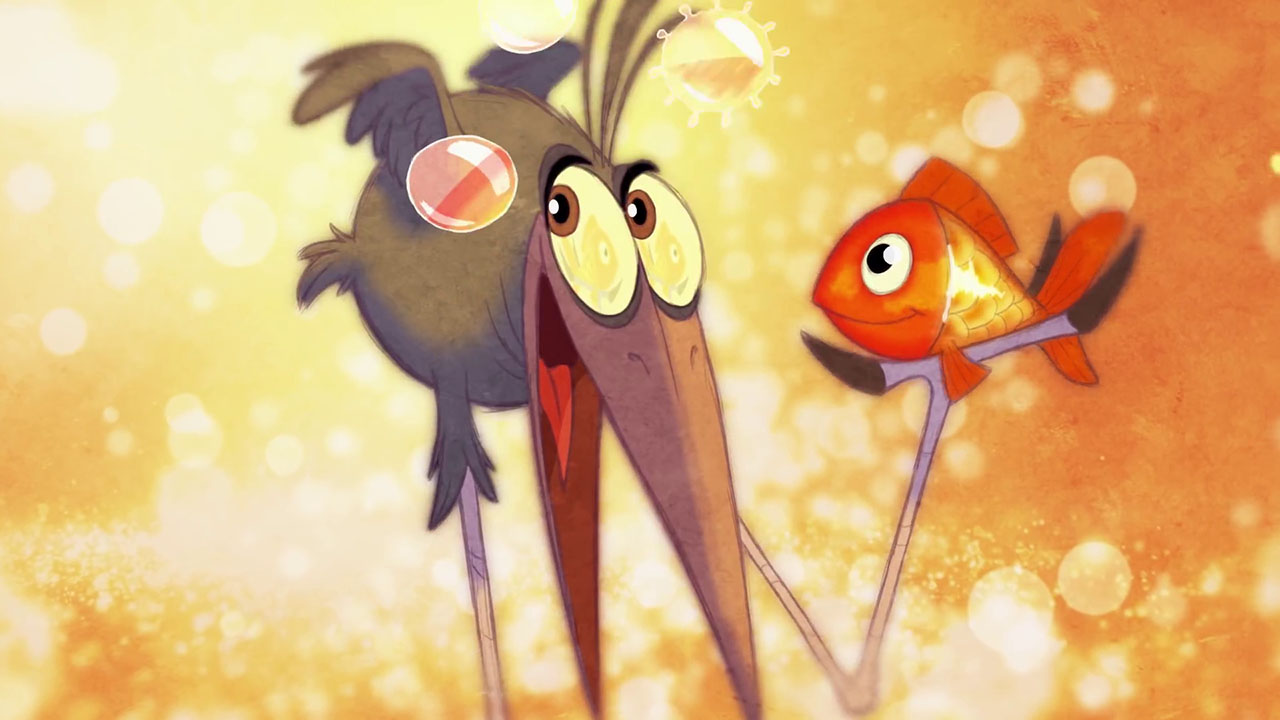
Short, snappy and cartoony, produced by Dreamworks. Water bird has all the fish he can eat, but goes after the magic golden rainbow fish. Salazar worked on this year’s oscar short winner The Boy, the Mole, the Fox and the Horse.
Evangelion 2.0: You Can (Not) Advance (2009, Hideaki Anno)
Carrying on where we left off from 1.11, and the wikis confirm that the stuff I didn’t remember from the series (suicidally British pilot Mari) is new to the movies. Doubling down on the Christianity stuff and the teen nudity. Asuka jumpkicks an angel to death, then when her robot becomes possessed, the bosses remote-pilot Shinji’s eva and beat the hell out of her. Some good action, slowed down by a couple of lame pop songs – and it’s fun that the subtitles only translated song lyrics in the final scene instead of the dialogue that might’ve explained what is happening.


Turning Red (2022, Domee Shi)
Evident from the opening moments hyper-narrated by the lead girl that this is a movie for teenagers, not for me. Stuck around for the different animation style (blobby 3D humans with sharp anime expressions / red panda spiderman) and to see if her mom would turn into panzilla and murder an entire boy band (almost). This is the second time in a few weeks that I’ve thought of Detention – maybe I should put down the new stuff and just rewatch Detention.
SHOCKtober 2022 Shorts and Roundup
The Beholder (1983, Chris Sullivan)
A restaurant scene and a street preacher, in constant states of absurd transformation, first-person camera flying through it all. Sound is field recordings, or a good approximation. Blobby watercolor, with inspired animation, comparable to Bill Plympton. Sullivan made a few shorts then got to work on his 2+ hour feature Consuming Spirits, which was recently on Criterion.

–
The Fall of the House of Usher (1984, John Schnall)
One problem with reading Poe aloud is that “acute illness” sounds like “a cute illness.” Usher House looks like an American suburban house from outside, but still has a butler. Ol’ Rodrick is worried about his sick sister, whom he maybe buried alive. The musician here can’t match the spoken phrase “the wild improvisations of his guitar.” Calm, soft candle-lit drawings with some good closeups. Schnall turned in the occasional short for the next couple decades, worked on Sesame Street, lives in New Jersey. These were both from the “Animation of the Apocalypse” video.

–
Hideous (2022, Yann Gonzalez)
Yann stages a talk-show transformation to four songs by The XX, or technically from their singer’s solo album. So it’s a music video EP. We need more stuff like this.


–
The Telephone Box (1972, Antonio Mercero)
I knew the general premise (man gets trapped in telephone box), but always imagined it as a cheap-looking b/w short, not this eye-popping Prisoner-era color. What seems like a stupid accident escalates when a procession of townsfolk can’t free him from the box, then apparently a phone-box truck arrives to fix the mistake, but nope, they pick up the box with man inside and cart it impersonally to a warehouse full of phone boxes with men trapped in them. Feels like a metaphor for oversized companies that set stupid procedures in place which keep merrily humming along even as they wreck people’s lives, but maybe this Comcast telephone hold music is influencing my thoughts.


–
Also watched an episode of Don’t Hug Me I’m Scared, and need to see the rest.
–
I feel like horror is underrepresented on the year-end lists, and deserves its own award show, so here are the 2022 SHOCKies nominations:
Best Writing:
Best Directing:
Best Acting:
Best Shocks:
The Timekeepers of Eternity (2021, Aristotelis Maragkos)
Perfect example of a whim of an experimental concept getting painstakingly taken all the way, the arthouse festival-film equivalent of those people who create live-action remake videos of Mario Kart games. In Stephen King’s The Langoliers, the villain’s extreme “idle hands” anxiety has him constantly tearing paper, so Maragkos has printed the 3-hour TV version onto copy paper and ripped and torn it into an hour-long edit.


Cool concept, but the problem with your source material being a 1990’s TV movie is that your experimental film feels a lot like a 1990’s TV movie, which is quite bad, especially when the never-idle Bronson Pinchot is onscreen. Billy Crystal’s wife in City Slickers is top billed, for some reason. Dean Stockwell plays a mystery writer who has Got It All Figured Out (RIP Angela Lansbury). Frankie Faison is here to be the Black guy who gets killed first. There’s a blind Shining-child who helps out by feeling the spooky vibes. Not gonna blame King (who cameos) since I remember digging the original story, and despite all the clunky dialogue, the new version is worth the ride.


Apollo 10 1/2: A Space-Age Childhood (2022, Richard Linklater)
Linklater very suddenly diving into his decadent old-man era, sitting on the porch and proclaiming “when I was growing up, things were like this and that, we used to do the following activities, let me list every TV show we ever watched.” I’d think it a low-effort tossed-off nostalgia fest for the streaming circuit, but the work involved in making an animated feature rules out that theory.

Inu-oh (2021, Masaaki Yuasa)
Cursed Mutant kids meet up and share a musical connection. Tomona was blinded by the magic sword that killed his father, and Inu-Oh was born a mutant due to a deal his serial killer father made with a magic mask. Stories of mutants and curses are usually good, and Yuasa’s animation is playful and unusual, especially when visualizing how blind Tomona “sees” the world through sounds. But then after a half hour it abruptly becomes a hard rock musical… returning to sum up the kids’ stories at the end, but too late. And while some directors will shoot the plot scenes normally then make the style come alive during musical numbers, Yuasa does the opposite. The whole hour of rock & roll theatrics is full of repeated shots and movements and angles, third-rate early-MTV stuff.