1982: the year of Blade Runner, White Dog, Poltergeist, The Thing, Gandhi, Britannia Hospital, Fitzcarraldo, Fanny & Alexander, Tron, the Sting version of Brimstone & Treacle… and this, the legendary Worst Kurt Vonnegut Adaptation Ever. From young hotshot Steven Paul, one of the producers of Doomsday, and I know I just said I wouldn’t waste my time watching anything created by anyone involved with Doomsday, but the Vonnegut connection combined with this movie’s reputation for being one of the worst comedies of the 80’s forced me to watch it out of morbid curiosity.

Laurel and Hardy? The book was dedicated to them.
image

Opens with narration by Orson Welles, surely giving even less effort than he did as the voice of the planet in Transformers: The Movie. You can immediately tell that the movie has no comic sense whatsoever. It looks cheap despite the big-name cast, and every “joke” is dead on delivery. The comedy is mostly people falling down, moving fast, talking funny (slapstick, I guess) and it’s badly staged… for instance, the twins are giant-sized, but only when convenient.

I don’t think Vonnegut was as mean-spirited towards the Chinese. And of course, Noriyuki “Pat” Morita is not of Chinese descent, but better him than Mickey Rooney I suppose. He plays the shrunken thumb-sized ambassador, a reference only understood by readers of the book since it’s unexplained during the movie. Other bits from the book are also rethought and bungled, and the twins are from SPACE now (and return to space in the ridiculous ending). All traces of Vonnegut’s trademark sadness and humanity are lost, unless you consider the sadness of the cast and the releasing studio and the audience. Rogue Cinema points out that the movie’s cast (Khan, Feldman, even Welles) and poster and title (and renaming the doctor “Frankenstein”) aimed to make audiences think that this would be a Mel Brooks Close Encounters parody. That particular advertising lie is probably the most well-thought-out part of the whole film.

Lewis!
image

Khan!
image

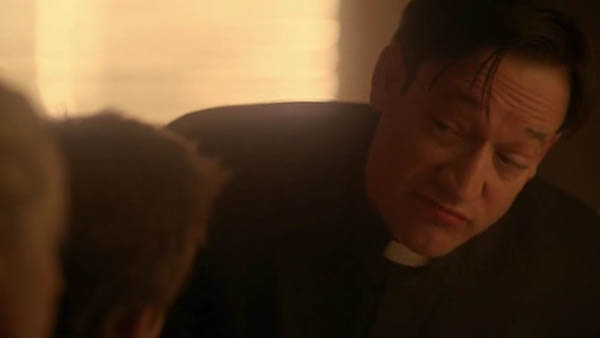
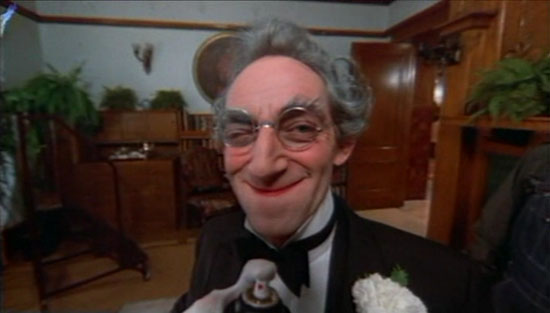
Madeline Khan and Jerry Lewis double-star as both the super-genius twins and their rich, detached parents. Marty Feldman is the butler in the twins’ secluded home. John Abbott plays a guy with a cool beard and Samuel FULLER is the colonel at the Military School For Screwed-Up Boys.

Feldman!
image

Fuller!
image

One of the last films of Jim Backus (Mr. Howell on Gilligan’s Island, voice of Mr. Magoo), John Abbott, Marty Feldman, and even Jerry Lewis (had starring roles in 6-7 more movies, most of them bad) but Jerry recovered in time to make Arizona Dream. Yes, Slapstick was a mega-career-killer, destroying the respectability of everyone involved! It ruined cinematographer Anthony Richmond, who previously shot the beautiful Man Who Fell To Earth and Bad Timing but went on to shoot Dane Cook movies and Dumb & Dumber 2. And – little known fact – it contributed to the death of Orson Welles and was directly responsible for his never completing Big Brass Ring, The Dreamers or Other Side of the Wind. Orson’s female co-narrator’s career was so thoroughly demolished that the internet has no record of who she was. But on the bright side, the movie helped launch the film career of Pat Morita, who would star in The Karate Kid two years later.

Morita! (he’s the one not looking at the camera)
image

Music by Michel Legrand and a song with lyrics by Vonnegut were edited out of the movie after the original release – why?? Assistant-directed by Michel’s son Benjamin Legrand, ending his short career as assistant-director (begun the year before on Rivette’s Merry-Go-Round).

Everybody wants prosthetic foreheads on their real heads? The incest scene doesn’t go very far, because we need a “PG” rating.
image

Released around the same time as Scorsese’s awesome King of Comedy, also with Jerry Lewis, though I think this was shot first and shelved for a while. Gene Siskel calls it “shockingly bad” and Ebert calls it offensive but makes a point of not blaming Vonnegut or Lewis. I heard one detectable Jerry joke: “You know, do as the romans do… when in rome, that is – I had it backwards” (it’s all in the delivery). There’s an occasional passionate line-read by Madeline or Jerry, the occasional animated bit of action, but mostly the movie moves mechanically from one laborious scene to the next, a simple motion illustration of a screenplay written by a guy who knows a guy who talked to a guy who once read the Vonnegut novel (which wasn’t one of KV’s best stories to begin with). I would looove to say that Fuller, Lewis and Feldman were excellent and the movie was slightly worth watching, but they weren’t and it wasn’t. I’m not in any hurry to rewatch Breakfast of Champions to decide whether this one is worse, but I think it probably is.

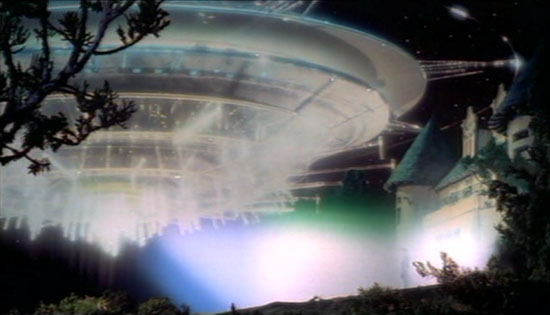
Close Encounters of the Dumb Kind:
image

An utterly boring and mediocre movie made by a Canadian TV director. Based on a novel, and I can tell. Seems like an adaptation, not as something conceived as a film. As a film it has no spark, life, reason to exist. Every scene is meticulously edited, ends exactly when you think it will end. All the actors seem capable (except maybe for the girl who played our hero’s first wife). Our hero looks a touch like Gabriel Byrne. Plot doesn’t matter, doesn’t matter, doesn’t matter. Memory and mementos, moving on with our lives after tragedy. Tragedy comes in the form of nazis. I hate nazis as much as the next guy but that doesn’t mean the movie gets off the hook for being so dull. I just wish I had watched Black Book for the third time instead.

World premiere of this doc, which will double-feature with Profit Motive and the Whispering Wind at Tribeca in a couple weeks, so I watched Profit Motive on video then ran out to see this one in the theater. Unfortunately, Hidden In Plain Sight was also on video, and looked considerably worse projected in the theater than Profit Motive looked on DVD on my laptop. Shot in 16mm and video (you can sometimes see interlacing, especially at the end), then the whole thing thrown into an ugly low-grade digital video mash. If this bothered the director (in attendance), he didn’t mention it, nor did he mention how the music seemed to skip every couple of seconds, so I have to assume these things were intentional. It’s a movie about looking and seeing. Street, somewhat pretentiously (and comparing himself to Godard and Vertov along the way) wants to teach us new ways to look at city scapes. Leaving the theater I was very happy that my city was full of natural light and color, non-interlaced, without any of the dull ambient music (seemingly ripped from last night’s “experimental” shorts) that plagued Hidden.

Street visits Dakar, Santiago, Marseilles and Hanoi, stands on street corners and films stuff. Just whatever. Then there’ll be some black and an intertitle with a quote or an organizational header, then more street corners. Sometimes sync sound, sometimes sound from elsewhere or ambient music or silence. I was content to be bored for the hour, but Street lost some goodwill when he talked some crap about how he enjoyed seeing San Francisco disfigured by the 1989 earthquake… then lost more when he tried to make a point about tourists seeing a wide view of the city, and locals seeing more narrowly, observing finer details. It’s actually a fine point, but he is a tourist, and his street-corner tourist-gaze is far from a local’s view of the city. Shooting stuff that tourists aren’t expected to shoot (walls, locals walking around, more walls) does not make one a local and I resent his attempt to educate the audience and show us “unique perspectives” via banal images. Gianvito’s Profit Motive (or Marker’s Sans Soleil, or Vertov’s Man with the Movie Camera, or Akerman’s From the Other Side) this ain’t.

Program kinda sucked this year. Feels like I spent enough time on it already, so not gonna spend too much more writing about it. I’m sure each film felt “experimental” to its creator, but there was nothing here we hadn’t seen before. Also with few exceptions people feel the need to accompany their “experimental” images with “abstract” blippy swimmy music, ugh. Also also, forget any references to “film” below, since everything but Shake Off was on video (and Shake Off either originated on HD or at least had mostly digital components). Why can’t everyone call ’em “movies” like I do? All quotes are from the film festival booklet, with their queer use of commas intact.

Doxology (Michael Langan)
“An experimental comedy…” Cute. Tennis balls and automobiles and vegetables defy space and time – funny and not overlong. Probably would’ve been my favorite here, but the picture was fucked and distorted, stretched out much wider than it should have been. Thanks, AFF365/Landmark.

Such As It Is (Walter Ungerer)
“The film is divided into four parts and four themes: the underground in the city; above ground in the city; a field in the country; and fog and the ocean. Each theme has its separate identity, yet they are not separate. Through manipulation and abstraction of imagery the four parts are joined, as the land, and the air, and the oceans are joined by the earth.” Besides the over-use of commas at the end there, this description is far better than the film it describes. The interminable subway bit, tiny flicks of reflected light turned into digital noise on an ugly gray glowing background, seemed suddenly less crappy in comparison when I saw a cityscape turned into spinning 3D cubes within cubes. What did they mean by the title? How is it? This was the first of a bunch of ugly video-projected shorts (from digibeta or dvd?). I do a bit of quality-control on our video deliveries at work, and I never would’ve allowed this thing to go out with all the banding issues it had. Go check your After Effects settings, re-render in 16-bit and bring it back to me later.

A Convolution of Imagined Histories (Micah Stansell)
“The film is comprised of four chapters, telling four separate stories that make up a meta-narrative. The works are the result of imagining the visual track to the story of someone else’s memories.” One of those short films where a narrator talks about shit their parents did when they were young or before they were born, like The Moon and the Son but with less animation and more overlapping sounds and video and slow/fast effects… anything to make it seem interesting (which it was, but only barely). Director in attendance seemed a nice enough guy. Talks not about “filmmaking” but “compositing”. Experimental Short Composites would be a more honest name for the program.

Dear Bill Gates (Sarah J. Christman)
“A poetic visual essay exploring the ownership of our visual history and culture.” Thought I was in trouble when the voiceover said “40,000 years ago…” but it was well-done, with deep storage of photos in old mines subliminally connected with “data-mining” and the mining of our memories. The longest of the shorts, and interesting enough to justify its runtime.

Passage (Peter Byrne)
“A reflection on the peripheral… this work visually catches sight of experience, as it moves past.” Notes I took in the theater read: “flickering, fluttering digital colored mess overlapped w/ blurry video of birds w/ sucky jangly music. These all have crappy music. I can hear yawning.” Film festival directors: I am available to write blurbs for your shorts programs!

Office Mobius (Seung Hyung Lee)
“An abstract story…” I didn’t find it abstract at all. Kinda cute buncha office collisions, with one character who got laughter whenever he’s on screen – a star in the making. My notes say “butt-ugly digi credit titles.” Letterboxed within the 1.33:1 projector frame within the 1.85 movie screen.

24 Frames Per Day (Sonali Gulati)
“The film raises important questions around immigration, cultural stereotypes, and the meaning of home from a transnational perspective.” Bunch of field recordings interspersed with a fake-sounding conversation (perhaps based on a real one) between director and “cab driver”. The stop-motion visuals of a hallway manage to be less interesting than the soundtrack. They say it was shot 24fpd over nine months, but La Region Centrale (or even 37/78 Tree Again) this ain’t.

Drop (Bryan Leister)
“The aesthetic journey of a drop of water – animation sound and image are combined to create a zen-like exploration of fluidity and nature.” I might have written: “a bit of nothing to fill out four minutes in the program.” Nice to hear actual music, though.

Rewind (Atul Taishete)
“The film moves in reverse towards the beginning as the opening of the film evolves as the climax.” Clumsily worded, but what they mean is the film’s shot totally in reverse, not just in reverse-ordered segments like Memento. Unlike Memento, there’s no reason within the narrative to justify the reversal, except I suppose that it wouldn’t have been as cool (or “experimental”) in regular motion. It’s about a blind guy in a diamond heist and ahhh, I’m not going into it. This also had music.

Shake Off (Hans Beenhakker)
“A perspiring boy dances magically across borders.” Seriously, a perspiring boy? I would’ve called him a “dancer” as do the credits, but then they would’ve had to think of a synonym for “dances” as an action verb. Can’t tell if it was the same dance footage looped four times, or just a similar performance. The dance and fluid camera movements weren’t enough – they had to put fakey digital backdrops behind the guy and with David Fincher zooms and cuts that appear seamless. A nice dance & technology demo.

The last two (both non-U.S.) are the only ones listed on IMDB. I spend so much time on that site, sometimes I consider making a film JUST so I can be listed on IMDB. These compositors have different ambitions than I do.

Sometimes I consider taking this “blog” off the internet and making it for my eyes only. I just know one of the filmmakers is going to google themselves, find this page and be offended. I’m sorry!

I started off the year talking about how there are so many great movies I’d like to see, it’s stupid to waste time watching bad movies… see also “The Finding Forrester Effect“. And here I am watching two bad ones in a row (this and Doomsday). Sure both viewing decisions were vaguely auteur-based since I’ve liked work by these directors before, but wasn’t Finding Forrester itself directed by a renowned film auteur? Oh well, there is no discovery without risk.

image

Chow plays a poor, uneducated, overworked, widowed single father. On top of that, his son is bullied at school, failing his classes, and can’t play sports because his shoes are falling apart. On top of THAT, Chow falls off a building at his construction job and dies. and his son cries and cries, and so does his nice teacher, and so do the only other people in the movie theater besides myself.

On the other hand, there are poop jokes and dream sequences, and the kid has a cute flubbery alien that his dad found at the dump.

Back on the first hand, the alien is beaten and squished and drowned and exploited and abandoned. Finally it kills (?) itself to resurrect Chow, god only knows why.

Movie alternates between bland and cruel. When it’s not making one of its main characters suffer, it’s not doing anything particularly exciting or interesting either. The good parts (most of them involving two extremely oversized middle-schoolers) are few, and not good enough to make this a movie worth watching.

image

It’s rare that we get a foreign film here in Atlanta less than two months after its opening date in its home country. I guess this didn’t play the festival circuit and was maybe pre-sold for US distribution after the 1-2 punch of Shaolin Soccer and Kung Fu Hustle. Anyway, it closed in a week and we’ll hopefully never hear from it again. Better luck next time in Kung Fu Hustle 2

Maaaan, what part of “from the writer/director of Dog Soldiers and The Descent” made me want to watch this, even for free? At least it was a midnight screening so I didn’t waste too much precious time on it, but the thought that I could’ve spent even half of that time playing Wii instead shall always haunt me.

People whose work I will avoid from now on:
– Marshall, of course
– actor David O’Hara (The Departed, upcoming Wanted)
– producer Steven Paul (Ghost Rider, The Uninvited, Castlevania)
– producer Benedict Carver (Bratz, Tekken, Castlevania)
– cinematographer Sam McCurdy (Hills Have Eyes II, Bob Hoskins pic Outlaw)
– editor Andrew MacRitchie (recent James Bond films, Sahara, Victims, Solomon Kane)
– production company Rogue Pictures (Seed of Chucky, Balls of Fury, Hack/Slash, The Strangers, Castlevania)

In other words, don’t see Castlevania!

Bob Hoskins and Malcolm McDowell paychecked it on this one – guess I don’t blame them. Anyway, this is a rip-off of 28 Weeks Later in which the girl from Resident Evil wanders into a post-apocalyptic Irish Yojimbo war between some non-magical Lord of the Rings castoffs (led by McDowell) and some Mad Max wannabes (led by two stuntmen-turned-actors). This leads to a buncha ineptly-shot action scenes, but don’t think this is an action movie – most of the runtime is dedicated to boring wordy exposition which wasn’t even appreciated by the couple sitting next to me who loved the movie. There’s an A.I. flesh fair, and some token cannibalism, and lots of unexplained futurey stuff and plot holes galore. Marshall also loves to show us pointless gruesome gory details including a cow, a rabbit, and more than a few people exploding or getting eaten or shot or run over. An ugly, stupid, trashy movie.

Time to trudge through the rest of MoH season 2, since season 3 (now called “Fear Itself” and moved to a network) isn’t due till summer (or later, thanks to the writer’s strike). Looks like Gordon, Carpenter and Anderson will be back along with Mary Harron and Ronny Yu, all very promising. But for now, there’s nothing better to half-watch while I pay bills and wrap ebay packages than a TV movie by Tobe Hooper.

It’s hard to say if this movie is worse than “Dance of the Dead”, but I think it might be. Inconsistent, blurry storytelling (patched over, but not enough, by character voiceover, even after that character has died) with that annoying overlapped visual effect used in “Dance”, and a story that leads nowhere and explains nothing, and not in a “increase suspense by withholding information” way. At least the inexplicably-acclaimed “Pelts” was a straightforward story, and at least “Dance” had that beautiful end-of-the-world rain-of-death moment. This has got none of that.

image

Either this one dude or the whole town (or a neighboring town?) has a history of violence. Once every generation, they go berserk and kill each other. Or some of them do. And this is related to a demonic force or possession and/or oil in the ground and drips from the ceiling. Traces of the infectious family violence plot in “The Screwfly Solution” but to no purpose. Sometimes the damned thing is under the ground, external force, and sometimes it’s inside someone

One effective horror bit has a guy killing himself in the head with a hammer. It’s not clear why he turned on himself instead of the people around him. Ted Raimi is cast as a killer priest, but he can’t help much. A mess of a flick. That’s okay, I didn’t expect it to be very good.

Ted Raimi:
image

An extremely lame waste of time. Uninteresting doc about uninteresting man who claims to be a zen chef then undermines both parts of that description. I was willing to bet that the director was one of his middle-aged female students so enamored with his personality that she simply had to make this movie to show the rest of the world how fascinating he is… but she turns out to be a professional filmmaker with more than 25 works to her name, most of them fictional. Oops. As for our chef, I think he wants to look cool on camera, but he overdoes the dorky humble shtick and ends up looking like a mixed-up hippie who has gotten where he is by faking it. Either way, Hal Holbrook and Catherine Keener were much more convincing and entertaining as mixed-up hippies in “Into The Wild”.

A cutesy, saccharine drama with lots of insulting business about fate thrown about, and Robin Williams as Fagin with a soul-patch.

Freddie Highmore (Charlie of the Chocolate Factory) wants to find his real parents, runs off to the big city chased by a well-meaning but barely-in-the-movie Terrence Howard (Glitter, Big Momma’s House) in search of his parents (Keri Russell of Waitress and Jonathan Rhys Meyers, who hadn’t been in any bad movies until this one), who only met once and don’t even know that they are parents. Along the way, Freddie is helped/hindered by Williams (of too many bad movies to list).

Hardly any romance in the movie, so not even Katy was happy… just a rooftop hookup then some happy glances at end of film (complete with a shout-out-to-god skyward glance by Freddie). Robin has violent mood changes, Keri smiles too much, Rhys Meyers has a rock music career (in a plot thread as underdeveloped as Terrence Howard’s character)… wait, in fact the whole movie was underdeveloped. How did it spend two hours telling this story without even telling any part of it properly? Even August’s relationship with black 13-yr-old talented guitarist friend Leon is underdeveloped, as is Keri Russell’s whole star-cellist thing.

Director Kirsten Sheridan is Jim’s daughter and is my age. Writer Nick Castle directed “Major Payne” and “The Last Starfighter”. Composer Mark Mancina usually does Disney cartoons and action flicks. The kids come out of this one pretty okay, and if anything, this is a step up for Robin Williams.