More consistently on-topic than any previous Moore video/film project, and even more of an illustrated essay than Fahrenheit 9/11 was.
Kinda made me cry a little. Katy liked it, too.
More consistently on-topic than any previous Moore video/film project, and even more of an illustrated essay than Fahrenheit 9/11 was.
Kinda made me cry a little. Katy liked it, too.
You hear about “cult films” and films with “a cult following” a lot, but where are these cults? Is there a basement in Des Moines where ten or twelve people get together monthly to watch Richard Elfman’s Forbidden Zone? Maybe a club in Montreal that meets at a different member’s living room every wednesday night to watch a different Mario Bava movie from one guy’s prize collection of DVDs and bootleg cassettes? An Alejandro Jororowsky society in Mexico City that watches a 16mm print of El Topo once a year followed by a ritual sacrifice of farm animals?
If these movie cults literally exist, I just hope there’s one for Werner Herzog.
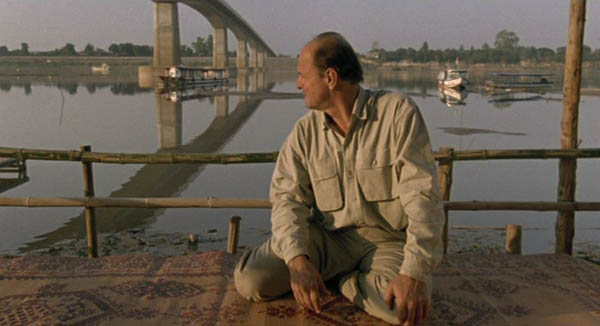
“Little” Dieter Dengler was about seven when WWII ended. He lived through the rebuilding of Germany, when people were boiling and eating wallpaper to get the nutrients that were supposed to be in the glue. Later became a blacksmith’s apprentice and worked at a machine shop. Got toughened the hell up by all these experiences and finally left town for the first time ever to head to America and become a pilot at age 18. Joined the air force, worked shit jobs for a few years, then quit to get a college degree, become a citizen and join the navy where he finally started flying, which is all he ever wanted to do. Got sent right away to Vietnam, and first mission he’s shot down and captured over Laos. It gets hairier from there, with deadly escapes and all the adventures that Herzog’s upcoming Rescue Dawn will be recreating. Died in Feb 2001, and there’s a “postscript” scene of his funeral on the DVD.

Dieter lived an exceptional life, went through very extreme ordeals, and had a single driving obsession (to fly), all making him such an obvious Werner Herzog protagonist that, a decade after shooting this documentary, Herzog is returning to the same story with Rescue Dawn.
Never one to make a “straight” documentary, interviewing Dieter and his war buddies at a neutral location, zooming in slowly on old photos and showing stock footage… no, Herzog does all that, but he also takes Dieter back to Laos. Herzog “helps” Dieter re-enact his own capture and imprisonment with props, locations and some willing Laotian men. What a terrible, wonderful idea. Dieter seems totally up for it, never breaks down into post-trauma sobbing sessions, just reports his history matter-of-factly, with Herzog’s voice occasionally coming in to ask questions or observe in his godlike way.

(Grizzly Man connection) Dieter: “Duane, my friend, he was gone, and from then on my motions, my progress, became mechanical. In fact, I couldn’t care less if I would live or die. But then later on, there was this bear, this beautiful bear that was following me. It was circling me in fact sometimes. It was gone and I missed it. It was just like a dog, it was just like a pet. Of course I knew this bear was there, he was waiting to eat me. When I think about it, this bear meant death to me. And it is really ironic. That’s the only friend I had at the end, was death.”
But… Herzog: “Dieter took an early retirement from the armed forces and became a civilian test pilot. He survived four more crashes and flies to this day. Death did not want him.”

Completely awesome movie, short and gripping and moving. I might not join the Herzog cult (they’d never stop talking about the relationship between man and nature, and they probably all have dangerous and bizarre obsessions) but I’ll sure watch more of his films.
Second-and-a-halfth time I’ve seen this. Next time I’ll have to find the longer (miniseries?) version.

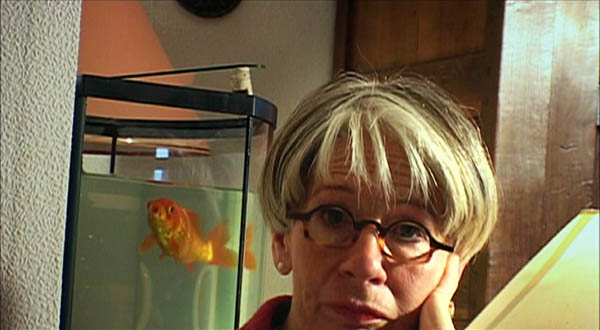
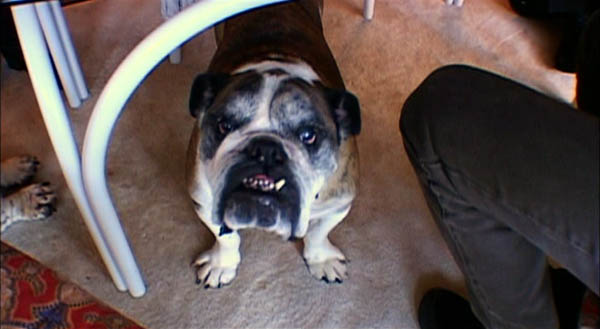
Still my favorite wine documentary. Unnervingly unsteady handheld digital camerawork, wandering obsession with wine people’s pets, sudden shifts from one country to another, and interviews that give subjects plenty time to make their views clear or to make fools of themselves.

Movie starts (but does not end) in Brazil, which is apparently a difficult place to make wine. For the most part, the ol’ stickler traditionalists come out looking good (Mondille family, the guy below), the big-money company owners come out looking not so good (Michel Rolland, Mondavi, Antinori), and some other characters add flavor and remain neutral (critic Robert Parker, new york distributor Neal Rosenthal).

I read a great magazine interview with Jonathan Nossiter – was it in Cinema Scope? Will have to find that again. I love how idiosyncratic the movie is – the way the camera restlessly looks around instead of watching the interview subjects, the inclusion of scenes and dialogue that the subjects probably thought (knew!) would be thrown out, the rich v. poor, worker v. owner and globalization arguments stated or implied in every scene.
Katy liked the movie, I think.
Harsh, harsh film. Three soldiers (Zack, Mike and Steve) get cameras to take on their tour in Iraq, filming daily activity and keeping sort of video journals. Meanwhile, camera crew in U.S. interviews their family, loved ones, and records their safe return home at the end. Tightly edited together to give an excellent, horrifying look at the war.
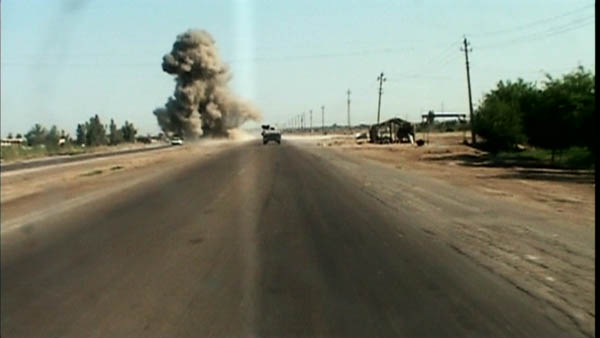
Cameras can be helmet-mounted or gun-mounted, giving a disturbingly video-game-like feel to the fighting (and there IS fighting). We see IEDs go off, civilians get hurt, US soldiers get hurt, dead rebels, grieving families. Brings home the reality of things I’d only vaguely read/heard about that are still going on (this was shot 2004). Very glad I watched, even if I felt terrible throughout.
Zach is from Lebanon, speaks Arabic, is one of the few US soldiers who can communicate with the locals, until he gets tired of having to repeat the company line to them. Mike is a pro-war go-get-em guy who signed up because of 9/11 and ended up disgusted by the experience, back at his difficult job at home. Steve is a lightweight joker reading The Nation, goes through a lot in Iraq, comes home probably with post-traumatic disorders, all a ball of bottled rage. These guys have gone to war and been messed up by it. They’re worse off, both countries are worse off. A real-life horror movie.
An IED going off:

Night-Vision Zack:

“Secularism won’t give us our rights. America is secular but its democracy hasn’t achieved justice.”
All movies start with the ending now. This starts with the ending.
Documentary portrait of an Iraqi father running for political office, unsuccessfully. His (friend’s?) son gets kidnapped for ransom towards the end of the movie, safely returned, seems unconnected to the election. A muddled film giving a muddled look into the muddled political world of a muddled country. Would’ve maybe been valuable if The War Tapes hadn’t blown it away a few minutes later.
Enjoy the forced subtitles:


Maybe it’s because the Tara never properly focused the projector, but we didn’t like this so much. Thought it had its moments, and was an interesting idea for a documentary, done in a unique way, but with the unfocused images and the erratic editing (“kinetic” if you ask the imdb reviewers), I felt like I did at Mondovino… wanted to look away from the screen or close my eyes, and just rent it later.
The director says: “Iraq in Fragments illuminates post-war Iraq in three acts, building a picture of a country pulled in different directions by religion and ethnicity. Filmed in verité style with no scripted narration, the film explores the lives of ordinary Iraqis to illustrate and give background to larger trends in Iraqi society.”
First section follows a Sunni kid in Bagdhad with narration by the kid himself, getting beaten and tossed around and trying to hold down a job. Second section has more of a wandering focus, with a religious Shiite group planning strategies in a smaller city. Third section is in a rural area, with Kurdish farmers and brick-makers, again focused on a boy with his narration.
Katy didn’t like the way parts one and three had a personal focus and part two wasn’t about one person. I did like the variety, would’ve maybe preferred a third approach for the third section instead of bookending with two young kids talking about their dim futures.
Would have to see again, either on video or in focus.
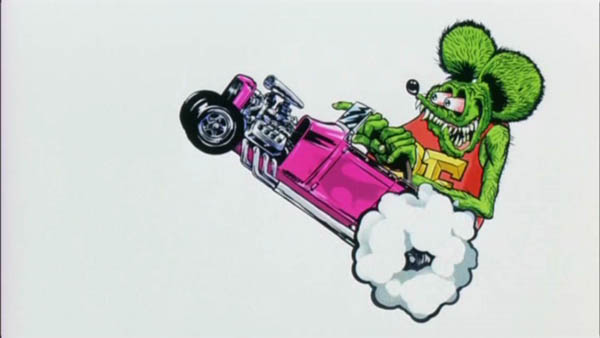
Documentary about Ed “Big Daddy” Roth, pioneer in custom-cars, custom t-shirts, illustration and merchandising. Neat little movie with a fun Sadies score, but no big deal. The “talking cars” bit is just shots of Roth’s actual cars with the headlights pulsing and a celeb voiceover. Very little footage of Roth himself, just narrator and cars giving his story.
Roth’s take on Mickey Mouse in a custom car:

Roth’s most famous creation (after Rat Fink):

Roth:

Still my #1 or #2 favorite documentary of the decade (grizzly man? same river twice? farmer john?). Saw Ross McElwee speak twice today. What I learned:
– His movies are all interconnected, which I’d know if I bothered to watch some of them.
– He considers Time Indefinite to be the sequel to Sherman’s March
– was impressed by DA Pennebaker docs but particularly by Fred Wiseman’s Titticut Follies, which he said made him want to make docs, but not the same way as DA and Fred… example of the crazy naked man staring back at the camera, put a human face behind the camera so it’s not as much a weapon (my words)
– tries to capture these little moments of feeling, of humanity in each picture. Showed us a scene of a mechanic discussing his daughter’s death, Ross says he once tried to find the exact frame where the man’s face flashes, changes, but he couldn’t find it. “The moment must have been between the frames”.
– question whether he’s considering the film, the big picture, while filming each small scene, he says “even while you’re having these conversations about life, death and god, you have to be thinking ‘how am I gonna edit this?'”
– Ross was once fired by Miramax (apparently, The Six O’Clock News deals with this)
– says his future films will have more old footage juxtaposed with the new stuff, will deal more with memory and pictures and how time and preservation change things.

Favorite bits are still the film scholar wheeling Ross around (says he showed the movie to a group of self-important film scholars and they *howled* at that scene), the little revelations and plot twists, the cousin’s house of memorabilia, the beach / fish rescue ending.

Ross films himself walking across a yard, pumpkins in the foreground, garden sculptures behind, with a little dog yapping at his feet. The dog has ruined his shot, the shot of himself contemplating all that he’s learned, so he gets rid of the dog and does the shot again, self-consciously narrating these facts and including both versions in the final film. That’s one of my favorite documentary scenes… the part where the narrative stops, and he reminds us that he’s making this movie, that we’re watching a movie that he made… it’s not Life Exactly As It Happened, it’s not The Pure Unedited Truth, it is Ross’s movie and he shows and tells us everything through his own filter. It’s a creation, a film, like The Godfather or Rushmore, a work of mostly non-fiction, but still a valid creative work. And usually, USUALLY (see: American Movie?) the minds behind this work are more important than the subject matter. Gotta remember that the next time I’m tempted to see dreck like Enron or Gunner Palace. Ross is my hero.

Katy liked it!

Haven’t watched this one in a while. Good stuff. Good music. What am I gonna say? Nelson Mandela can’t dance.