Crank
Just the combo of stupid/fun I was looking for. Asshole (Jason Statham) gets injected with Speed plot device, has to keep his heart rate up while finding out who killed him, very D.O.A. It’s ridiculous, but knows it’s ridiculous, keeps the energy high and ends up a Shoot ‘Em Up-caliber success

Crank: High Voltage
Just the movie to put a damper on the fun spirit of the first movie, Hatchet 2-style. Cartoon credits and an intro TV reporter calling the events implausible and saying “bullshit” on the air set up the self-aware, even-more-ridiculous sequel, but it devolves into sexist, racist trash that borrows too heavily from the first movie. I always forget to not watch sequels to things I like.

I had no idea that Statham’s best bud was Pedro from Napoleon Dynamite. He was a highlight of both movies. I don’t think anyone else stood out (sorry, Amy Smart) besides Statham himself, who was so good that I’m actually considering renting the Transporter series. I’d originally figured that I’d follow these two movies with Gamer by the same writer/directors, despite its bad reviews, but Crank 2 cured me of that. Also, naturally, I admit that both movies would’ve been better if I hadn’t watched them alone and sober.

Netflix Streaming has got a bunch more movies I would never pay to rent, but which I might watch for free if I was sick or something. I’m sick today, so here goes.

Prince of Persia (2010, Mike Newell)
I see ropes and swords and Lord of the Rings fire-sculptures, and holy crap is that Ben Kingsley?? Donnie Darko has a fake british accent, and he just let his girlfriend fall into the pit of hell before unleashing a crazy amount of ‘splosions and triggering a muted montage of flashback snippets. Then Donnie, who long ago became less cool than his big sister Maggie Darko, discovers that the movie was just a dream he saw in the handle of his magic dagger. All I remember from the video game is that your little man had a more human-like gait than was usual for video games, and it was incredibly hard to avoid falling into pits. As I type this, Donnie is telling a beardy fellow to “listen to your heart.” So it’s safe to say the movie isn’t much like the game, except when the girl fell into that pit.

The Men Who Stare At Goats (2009, Grant Heslov)
“Larry’s dead,” are the first words I hear… guess I won’t be seeing Kevin Spacey. Still holding out hope for Stephen Root, though. Oh wait, there’s Spacey now, wtf. Directed by an actor who played “guy in big suit” in Bug. There’s an LSD prank then all the army base’s goats and prisoners are set free. I’m not detecting much comedy in this comedy, so I guess it got dark and turned into a drama halfway through. Jeff Bridges and George Clooney escape in a chopper, Ewan provides poignant, anti-corporate-media voiceover, and it ends on a dud of a joke. Glad I didn’t sit through the rest of this.

The Girl With The Dragon Tattoo (2009, Niels Oplev)
A pierced punk rock girl (a “rebellious computer hacker” according to the Netflix description) talking with her mama seems sad. Later, some blond woman is talking about being raped by her dad, cue spazzy flashback with bland music. Punk girl visits hospitalized boyfriend, drops off secret financial records, he writes an article causing a mogul to commit suicide, and punk girl steals a lot of money and escapes to a tropical paradise. Whole thing seems anticlimactic and unengaging. But I guess if The Da Vinci Code can be a huge success, so can this. Still, at least Da Vinci had a big ending (the codex is shattered! Amelie is Jesus’s daughter!) to justify all the dreary exposition. This one wasn’t even exciting enough for me to check out the last ten minutes of the sequels.

Vampire Girl vs. Frankenstein Girl (2009, Nishimura & Tomomatsu)
Dubbing!! The fakest CGI ever. Oh, this is one of those direct-to-video Japanese teen movies full of awful music where everyone wears school uniforms. It’s not even as good as Tokyo Gore Police (they share a director). “When you gave me that chocolate, I had no idea how you really felt about me” should not be one of the final lines of a movie with this title. Oh, and Vampire Girl decisively wins.

Factotum (2005, Bent Hamer)
Hooray, Lili Taylor! Long takes + poorly furnished rooms = gritty realism. Poor Charlie Bukowski is having money issues and lady issues. Matt Dillon gets life advice from “Old Black Man” (according to the credits) in the unemployment office, finally gets one of his stories published. I don’t find Dillon’s poetic voiceover very compelling. From the dude who made Kitchen Stories.

Ondine (2009, Neil Jordan)
She is telling fisherman Colin Farrell that she’s not a magical water creature, but just a girl who almost drowned while escaping from something or other. Uh oh, some fellows with pistols and strong accents. What is happening? Colin and the girl live, are getting married at the end. Jordan made a bunch of movies that always look somewhat intriguing but not quite essential.

The Day The Earth Stopped (2008, C. Thomas Howell)
If you start watching a movie ten minutes before the closing credits, the hero and villain are always in the middle of some revelatory exposition scene. All movies are the same. Should you really entrust the remake rights of The Day The Earth Stood Still to one of the teen actors from Red Dawn? Earth starts shaking (I’d hardly say it is standing still) and sepia-toned CGI versions of major world monuments (and a ferris wheel) are falling rapidly towards the camera. I was excited that Judd Nelson is in this, but I’d gotten him confused with Judge Reinhold – who is Judd Nelson? There is yelling and guns and terrible camerawork, then something really stupid happens and I guess the aliens don’t destroy Earth. Shame.

2012 (2009, Roland Emmerich)
Here’s a movie that isn’t afraid to let the world end, or to cast Oliver Platt! I don’t see world monuments crumbling, just a big Titanicky iceberg adventure (Roland must’ve had some ice left over from The Day After Tomorrow) with people yelling and swimming through tunnels to close or open portals and machinery. Oh, surviving mankind lives on arks now, and Africa turns out to be the future, or the home of the our civilization or something.

Salt (2010, Phillip Noyce)
Another movie with a third-billed Chiwetel Ejiofor, and more awful camerawork – only this time it’s awful in a big-budget extreme-cutting sense, not the give-an-idiot-a-camera awfulness of The Day The Earth Stopped. Ooh, the president is down. A. Jolie, handcuffed in FBI custody, still manages to kill Liev Schreiber, whoever he is. The backstory exposition comes a couple minutes late in this movie, then noble Chiwetel lets Jolie escape to kill again. From the writer of Equilibrium (and Ultraviolet, yuck) and director of Rabbit Proof Fence (and Sliver).

Red Dragon (2002, Brett Ratner)
Emily Watson is in a super intense burning-house scene, then a big fake explosion knocks down Ed Norton. This movie marked the end of my needing to see everything Norton was in (Keeping the Faith and The Score had already lowered expectations). Ed’s in the William Petersen role (WP’s on a cop show now). After he and Raiff Fiennes shoot each other to death, we see ol’ Hopkins (in the Brian Cox role) writing letters, and oh Ed isn’t dead actually, and it ends with a cheese-headed transition into an early scene from Silence of the Lambs. Doesn’t look bad, really, but as with all Ratner movies it is not to be taken seriously.

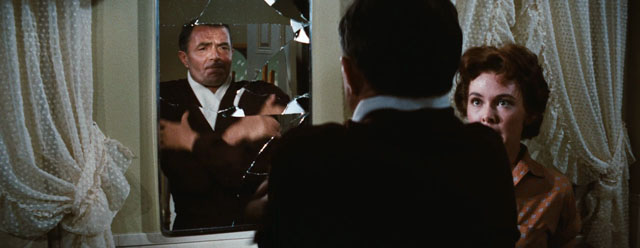
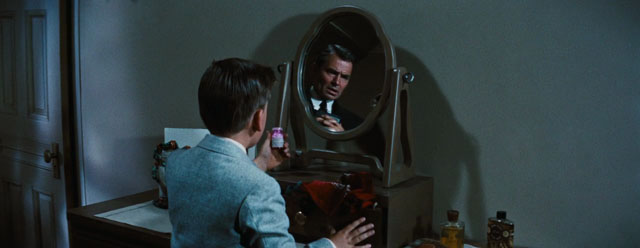
I enjoyed the crazily over-the-top performances of Ray’s Rebel Without a Cause and Johnny Guitar but didn’t get much of a sense for his filmmaking – unless his thing was casting unhinged actors and letting them loose within overly melodramatic stories. I suppose he also made extreme/sly comments on society with Johnny’s crusading zealot McCarthy figure and Rebel’s mixed messages on masculinity and family units. Well, this one brings it all together, with an extreme (but less “method”) performance by James Mason and a brutal attack on society and family and everything else. I don’t know if it’s that tying-together of the Ray threads or the movie itself, but I’m currently loving it more than the other two.

Good mirror:

Bad mirror:

Scary mirror:

Mason is a schoolteacher who starts experiencing massive pain. Doctor says the pain will get worse and he’ll be dead in months unless he takes miracle-drug cortisone (wikipedia: “a steroid hormone … suppresses the immune system, thus reducing inflammation and attendant pain”). So Mason pops some pills and all is well – he and loving wife Lou (!) and son Richie carry on with their movie-perfect 50’s lifestyle. But it’s not as perfect as all that… schoolteacher salaries were low even back then, so Mason holds a secret after-school job as a taxi dispatcher in order to keep up those perfect middle-class appearances. The cortisone is expensive, and worse, Mason is forgetful – misses some doses and doubles some others, until he’s taking twice the proper dosage and starting to go completely manic from the side-effects. He quits his cab job, tries to get fired from the school, berates everyone he comes across and finally, in a state of biblical delusion, conspires to kill his son. Last-minute rescue (in the form of a stairway fistfight with buddy Walter Matthau, which alone is worth the price of admission) returns Mason to the hospital, where the doctor straightens out his dosage and brings him back to his senses. Hoorah for modern medicine!

Pain chart:

Walter Matthau!

I guess this was the American Beauty of its time, allowing a white suburban dad to rebel against his status and say things that nice people should not say, attracting the attention of the neighbors, to the horror of his wife. Only this was so much better. The wife (as already contrasted with the wife in Close Encounters) is understanding and recognizably human, there’s a reason given for Mason’s outbursts (drug effects, vs. Spacey’s midlife crisis) and a more reasonable ending (it’s too easy to end your movie by having a sexually-frustrated neighbor shoot your lead character to death).

Good praying:

Bad praying:

One writer worked on three decades’ worth of James Bond movies and the other scripted Forbidden Planet which also came out in ’56 – sounds more like the kind of team that would’ve come up with Star Wars than this. Suppose I’ve seen James Mason in Lolita but he made more of an impression here, with his unexplained foreign accent in the California suburbs, his mad energy shaped (if not subdued) by his British schoolteacher’s intelligence. Barbara Rush (who had appropriately just appeared in a Douglas Sirk movie, as Jane Wyman’s meddling daughter in Magnificent Obsession) was just as good, and it’s always nice to see Walter Matthau, here in one of his first roles.

Cover shot:

Barbara Rush, one more time:

Watching at my usual slow pace. Ten months to watch thirteen episodes, oh my. At this point I’m probably willing to agree with people who’ve been saying this is the best show ever on television. Still one season to go.

New directors: Anthony Hemingway, who also worked on The Corner, steps up from being a longtime assistant director, David Platt (a Law & Order guy), Jim McKay (R.E.M.’s Tourfilm) and TV’s Seith Mann.

Low body count this season. Careers after death: Fruit, shot in the head in the first episode – Brandon Fobbs, who went on to appear in an Uwe Boll movie. Tyrell Baker (Little Kevin) starred in The Barbershop Chronicles, which is not a sequel to Barbershop. Cyrus Farmer (tough kid Michael’s stepdad), also of Oz, appeared in a Notorious B.I.G. bio-pic. And J.D. Williams (personable drug dealer Bodie Broadus, a regular since season 1), was in a short-lived show called The Kill Point.

The Addiction (1995)

A black and white (but mostly black) arthouse vampire movie. Being a big fan of talky French cinema and a moderate fan of avant-garde, non-narrative films, I always hesitate to use the word “pretentious,” but it kind of seemed pretentious. Maybe I’m just afraid of philosophy, and since the lead character is getting her PhD in philosophy, there was lots of Sartre and Heidegger and the like.

With Edie Falco, who I didn’t recognize with long hair:

It’s full of great ideas, though, and maybe it’s because I was weak and sick while watching, but I found it moving by the end. College student Lili Taylor (in that brief period between Short Cuts and I Shot Andy Warhol when she seemed like a movie star) is bitten in an alley then left alone. She get no underground vampire dance clubs or Lost Boys camraderie – she has to figure it out on her own. Clever metaphors to STD’s and drug use abound (she steals blood from homeless dudes using a syringe, ugh) along with the pondering about the nature of being. She does briefly (oh! too briefly) get a mentor in the form of Christopher Walken, second-billed for his three minutes of screen time.

With the teacher she’s about the seduce and then bite:

Lili graually infects classmates and professors, then holds a graduation party that turns into a bloodfeast. I think she dies from taking sacrament soon after, but she’s in the hospital all torn up so maybe she was dying anyway. Movie was “presented” by hip-hop/comedy producer Russell Simmons for some reason and written by Nicholas St. John, who wrote most of Ferrara’s previous movies but not Bad Lieutenant, his previous killer combo of horror and catholicism.

With some girl she just bit:


Body Snatchers (1993)

Watched this on a whim since it was on netflix streaming, not expecting much from Ferrara’s studio horror remake (the movie he forgot about when criticizing Werner Herzog for remaking Bad Lieutenant), but it was great – excellently creepy and so stylishly shot – one of the few times throwing a big-budget thriller remake at an artistic filmmaker has paid off (sorry, The Departed). Paid off for me anyway – if IMDB is to be believed, it was a royal bomb in theaters. In competition at Cannes though, beaten unfairly by The Piano (and fairly by Farewell My Concubine). Third of four Body Snatchers movies. I knew about the Kevin McCarthy and the Nicole Kidman, but not about the one with Donald Sutherland and Leonard Nimoy.

All Things Horror points out: “Sure, it’s not perfect. There’s a bit of annoying narration that seems completely unnecessary, some unfortunate blue screen, a goofy big explosion-filled ending,” all valid points. I’d like to add that the scene where suspicious doctor Forest Whitaker is driven to suicide by approaching aliens was pretty over the top, and if I didn’t already know Whitaker is a great actor, I would not have guessed it from this scene.

Awesome move setting the story on an army base, a location where everybody is trained to act like a pod person anyhow. R. Lee Ermey is looking good with his little mustache as the local general. Young Marti (Gabrielle Anwar of Flying Virus and iMurders) reluctantly moves onto the base with her boring dad (he’s so boring) Terry Kinney (founding member of Chicago’s Steppenwolf Theater), evil stepmother Meg Tilly (Psycho II) and observant little stepbrother. Marti immediately stars hanging out with a couple bad influences: hot, emotionless chopper pilot Tim (Billy Wirth of The Lost Boys) and general’s daughter Jen (Christine Elise of Child’s Play 2). Once the snatching starts, Tim’s post-traumatic stress disorder proves extremely useful in blending in with the aliens. Particularly creepy was the wide-mouthed pointing scream the baddies used as an alarm once the base had been mostly snatched.

Soon after that starts, Marti’s dad goes in search of help. And suddenly Guy Pearce is on an airplane? Then some Lebanese guys welcome Don Cheadle to Toronto?? Oh man, netflix has started playing the movie Traitor instead, probably to make a funny movie-snatchers joke. It’s hilarious, but I had to go rent a proper DVD of Body Snatchers and watch the last half hour a few nights later.

Writing assistance by both Stuart Gordon and Larry Cohen – along with Ferrara that’s an entire unholy trinity of 80’s cult filmmakers. No wonder I liked it.

After playing the hellraiser in Le Ceremonie, Isabelle Huppert is back to being classy and restrained in this one. She’s the first and third wife of pianist André Polonski – he had a son by his second wife, who died in a car crash. In another part of town, Jeanne (Anna Mouglalis: Coco Chanel in the Jan Kounen film) learns from her mother that she was nearly switched at birth with Polonski’s son Guillaume. Since Jeanne is an aspiring pianist and looks up to Polonski, she takes this as a sign and visits his house, where he offers to give her private lessons.

Huppert and Dutronc:

It’s gradually revealed that icy Huppert, who runs a chocolate company, puts sedatives in the family’s chocolate every night, and drugged Guillaume’s mom the night of her car accident years ago. Jeanne drives off to the store at night with Guillaume in the car, knowing very well that she’s been drugged. Why does she do this, other than to offer us a climactic suspense scene? Huppert ends up like Sandrine Bonnaire in Le Ceremonie and Jean-Pierre Cassel in La Rupture: caught red-handed as the credits roll.

Mouglalis and Pauly, born on the same day:

All sorts of parallels and doubles – each kid is missing a parent, they were (nearly?) switched at birth, Huppert and Polonski were married twice, Jeanne dresses up as Guillaume’s mother – I’m not sure what it all adds up to, but it kept the movie from feeling thin even though very little happens, plot-wise, over 100 minutes. Guillaume is Rodolphe Pauly, who played the soldier who dies and swaps identities with Audrey Tautou’s beloved in A Very Long Engagement, and sharp-featured Jacques Dutronc was Pialat’s Van Gogh, also costarred with Huppert twenty years earlier in Godard’s Sauve qui peut (la vie).

Chabrol:
“Perversity guides its adept (or its victim) to a form of relative solopsism that leads us to provide other examples of relative solopsism; that of the musician, for instance, with infinitely more benign consequences that are nonetheless real. We have tried to illustrate this idea by the slow dissolution of the most definite certainties of our society – here, filial descent, and so the family. The main aim is to get across the idea that all certainties melt away as the story progresses.”

Nicolas Cage’s first good part since Lord of War and Val Kilmer’s first good movie since Kiss Kiss Bang Bang. Cage hurts his back rescuing a prisoner, starts taking lots and lots of drugs and racks up gambling debts. He robs kids outside clubs, gets a violent dude mad at Cage’s hooker girlfriend and loses a key witness. Surely he is a bad lieutenant, but he has a few principles, and Cage’s charismatic intensity keeps us on his side even as he’s waving guns at grammas (lovable Irma P. Hall of the Coens’ Ladykillers). Ultimately he takes down a drug baddie (Exhibit, fifth-billed in the second X-Files movie), saves his girl (Cage’s Ghost Rider costar Eva Mendes) and pays off his bookie (Awwww Brad Dourif is getting old. Life is too short).

Nic, Brad and red beans:
image

The story (from a lead writer on Cop Rock) isn’t great, and the idea (remaking Abel Ferrara’s Bad Lieutenant) is awful, but Herzog pulls it off with flair. The occasional weirdness (extreme closeups of reptiles, including an iguana music video – what is it about drug movies and visions of reptiles? See also Fear & Loathing in Las Vegas), the sense that Cage is having too much fun to take anything seriously, and a lovely tacked-on ending where Cage meets the ex-con he saved and they get philosophical at an aquarium rescue this doomed movie and turn it into something I’d actually recommend. Can’t wait to see Werner’s other 2009 movie (star Michael Shannon, the contagiously crazy dude in Bug, shows up here as a police property guy).

image

Cage pulls up at a building I think I saw in Wild At Heart. Maybe lots of buildings in New Orleans look like that. Jennifer Coolidge (Pootie Tang), Fairuza Balk and other names I know or faces I’ve seen pop up regularly. Surprising that so many actors wanted to be associated with a cheapie indie remake of a cult film, but I guess you can’t discount the Herzog factor.

Salon:

Your ending really defies expectations. I’m not quite sure what to think about it, in fact. We expect one of two possible endings — the bad lieutenant triumphs, or he is punished for his misdeeds. And you really don’t give us either one.

Herzog:

In my opinion, it’s a very beautiful and very mysterious ending. You see, according to the screenplay, it ended with a false happy ending that became a real abyss of darkness. And I thought, no, we should not dismiss the audience like that, out into the street. There should be something vague, something poetic, something mysterious.

Returning directors Ed Bianchi (now working on an alternate-reality King David miniseries), Steve Shill (whose Beyonce movie did pretty well) and Timothy Van Patten (of Master Ninja) are joined by Elodie Keene (two TV movies starring Linda Hamilton), Thomas J. Wright (Millennium, Firefly, a Hulk Hogan movie), Daniel Attias (Stephen King’s Silver Bullet), Rob Bailey (CSI), Ernest R. Dickerson (The V Word, Juice, cinematographer on Do The Right Thing) and series co-creator/producer Robert F. Colesberry (also first a.d. on Warhol’s Bad) who died six months after season two ended.

I briefly mentioned why I’d give a crap about TV episodes’ directors in my season one write-up – I started watching the show after reading an online fight over it. An auteurist extremist (heh) watched one late-season episode and wrote a tirade accusing the episode’s director (not the writer, not the series creator) of being homophobic and called the show “the most awful racist drek I have seen in years.” My favorite part: “The show, like a lot of current American TV, has deliberately bad exposition. This is designed to make you watch all 54 previous hours of the series, so you can figure out what the heck is going on.” This started a hundred-message discussion culminating in the dramatic exit of the list’s founder, and got me interested enough to finally watch the show which everyone but those two guys were passionately defending.

The Dead this season: D’Angelo Barksdale (Larry Gilliard Jr.) moved on to The Machinist and Brad Anderson’s Fear Itself episode and some new Patrick Swayze show. Frank Sobotka (Chris Bauer) was in Flags of Our Fathers, Broken Flowers, starred in Anderson’s Sounds Like, and is in a new vampire show. Stolen-goods warehouser George Glekas (Teddy Cañez) shows up in Law & Order from time to time. People who probably won’t be back (serving long prison terms or witness-protection): Nick Sobotka (Pablo “Liev’s brother” Schreiber) was in J. Demme’s Manchurian Candidate remake and Stuart Gordon’s Fear Itself episode (and should consider being Ben Affleck’s stand-in if he runs out of work). Ziggy Sobotka (James Ransone) was in Inside Man and Generation Kill. Dealer White Mike (Brook Yeaton) is actually The Wire’s props guy who worked with John Waters back in the day. Greek drug man Eton (Lev Gorn) played a dealer in Keane with at least two other Wire actors, and russian muscle guy Serge (Chris Ashworth) was 25th-billed in Terminator: Salvation.

I’d be here all week if I attempted a plot description. Season 2 was slow going at the start, pulling the team back together, but it got rolling towards a great/depressing ending, which should lead naturally right into another season. I wonder if there was no guarantee of a second season after #1, but after #2 a third was a sure thing.

The Freshman (1925, Newmeyer & Taylor)
The sad truth about Harold Lloyd is that I loved him when I first saw him, but every time I rewatch a movie I like it less. So far I’ve seen Safety Last! and The Freshman twice, and each dropped from “great” down to around “pretty good”. I’m afraid to rewatch the ones I thought were pretty good to begin with.

image

Young Harold (he was actually 32) watches imaginary film The College Hero over and over to prepare himself for college, filling his head with stupid ideas about college life. I would’ve loved it if they’d done more movie-vs.-reality comparisons, but it seems the only thing he took away from the film was the hero’s nickname (“Speedy”), catchphrase (“I’m just a regular guy”) and silly jig, which everyone at college mocks until Harold manages to win the big football game, then the jig becomes the coolest thing. It’s a wonder that nobody else at school had seen this movie and figured out Harold wasn’t even an original nut, just a nerdy guy ripping off a bad movie joke. But my biggest surprise was finding that the silly hat Harold wears wasn’t an invention of his silly movie – college kids (according to this silly movie anyway) actually wore those hats!

Below: Harold and “the college cad” in silly hats. The cad, Brooks Benedict, later appeared in Leo McCarey’s not-sequel The Sophomore.
image

In the scene below, Harold’s tailor hides behind a curtain, ready to patch Harold’s unfinished suit should the need arise, but the two get their signals crossed because of a dude at a table ringing a bell. Supposedly the bell ringer is Charles Farrell, star of Street Angel, but he sure doesn’t look like he does in my screengrabs from that movie.

image

The girl who likes Harold, cutie Jobyna Ralston, was in The Kid Brother and Wings, didn’t make it in the sound era.

image

The Mystery of the Leaping Fish (1916, Christy Cabanne & John Emerson)
Written by DW Griffith and Tod Browning, the same year they did Intolerance, and co-produced by Keystone. Douglas Fairbanks was apparently famous enough to play himself in a framing scene – I think he plays himself, and the rest of the film (starring himself) is his rejected pitch to a producer for a film to star himself. That’d already be plenty to wrap one’s head around for a 1916 short, but that’s before we even get to the main story, which involves incompetent and extremely drug-addicted hero Coke Ennyday trying to stop criminals from smuggling contraband via one-man inflatable toy rafts, and stop the criminal mastermind from forcing the lovely Fish Blower to marry him. Coke gets the drugs and the girl, and I didn’t know I could have my mind blown by Douglas Fairbanks. Bessie Love, the Fish Blower, appeared in three major films in the early 1980’s, sixty-five years after this one. I wonder if anyone on those sets asked her about her cult druggie silent short.

The Play House (1921, Buster Keaton & Eddie Cline)
I’d seen almost all of Keaton’s solo silent shorts, but I’d missed this major one, in which he plays all the characters in a trippy dream sequence that lasts the first half of the film. Reliable heavy Joe Roberts finally wakes Buster from his funhouse-mirrored delusion and he goes to work as a stagehand, where he’s spooked by a pair of identical twins with mirrors. A sheer delight of visual invention only grudgingly held together by a plot.

That’s two of Virginia Fox, daughter of William Fox:
image

Buster Keaton’s minstrels:
image

Cops (1922, Buster Keaton & Eddie Cline)
The Freshman was a movie about a boy whose ideas about life have been warped by the movies, Leaping Fish had Douglas Fairbanks the actor playing Douglas Fairbanks the aspiring screenwriter, and The Playhouse featured Buster Keaton playing a hundred of himself in a stage performance viewed by even more of himself. Cops has no self-conscious reflection that I can think of. It’s just a damn fine heist/love/chase flick with great invention in props and situations. However it does fit in with the outrageousness of last two films in its ending: snubbed by his intended love, Buster effectively commits suicide by running back into the police station where he has just locked up hundreds of angry cops.