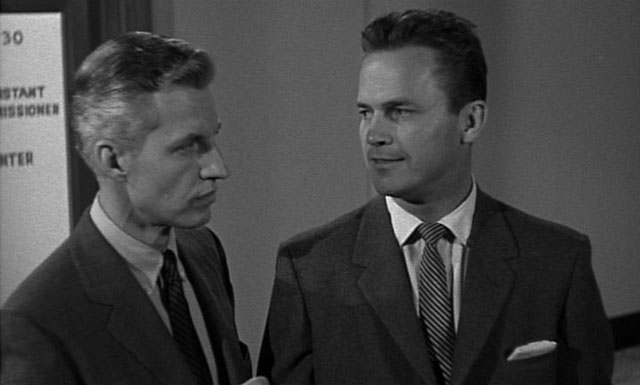
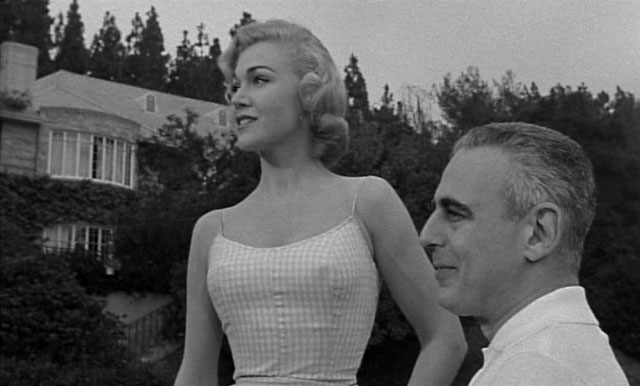
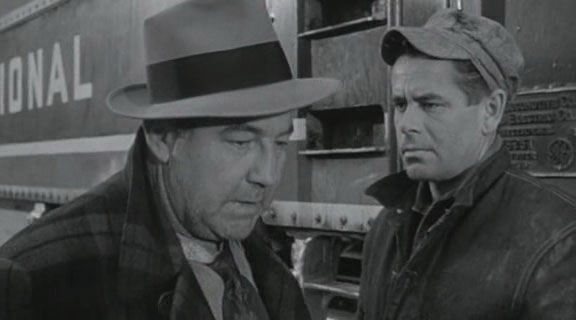
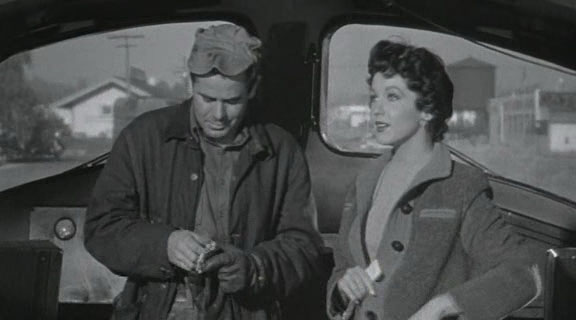
A true low-budget “b movie” classic. Made by an indie studio with no-name stars, a rough, dirty-looking film print with short jumps and gaps, shown as part of Emory’s noir series. First Ulmer movie I’ve seen (unless watching The Amazing Transparent Man on Mystery Science Theater counts).

Tom Neal is kind of a pathetic character, a wannabe concert pianist playing a crappy New York restaurant with his sweetheart Sue singing – but she won’t marry him until one of them makes good, so she sets out for Hollywood. Later, Tom has failed to make his fortune, but decides to hitch-hike to L.A. to see his girl. He’s picked up by a slightly dangerous-seeming guy named Charlie, who lets Tom drive while he naps, apparently dying in his sleep. Or maybe he dies when Tom opens the door to see if he’s alright, and Charlie falls out of the car, knocking his head into a rock. Or maybe he’s not dead at all – either way, Tom panics, takes the man’s clothes, wallet and car, and carries on.

But Tom, the dummy, picks up a hitch-hiker who turns out to be severe control freak Ann Savage. She’s onto him, since Charlie had given her a ride in the same car, so she threatens to turn him in, gets him to rent them an apartment and buy her clothes and booze. In perhaps my favorite 40’s-noir death scene so far, one night he grabs the phone cord (I think it was to keep her from calling the cops) leading under her closed bedroom door and pulls with all his might, not knowing that the cord was looped around her neck. Now Tom is a two-time murderer, doesn’t want to bring his fugitive past into sweetie Sue’s life, so he hits the highway, stopping irritably in a diner (where Sturges regular Esther Howard is the waitress) to pause and recount his tale to us via voice-over.

Which leads to The Last Shot of Detour, the subject of a ten-page article by Morgan Fisher in Cinema Scope, which soon lost me when I realized it was a “close reading” of a one-minute piece of film, but after skimming a few pages I got interested again, in his discussion of strangely self-conscious moments in the movie that could only have been inserted on purpose. When watching the movie, the final shot made me laugh – Tom’s narrator voice tells us that one day on the road he’ll catch his final, fateful ride, and at that very moment the state patrol pulls up and takes him away. I hadn’t thought to consider it as a subjective shot, a flash-forward illustrating his thought, but without any cuts or visual cues that we’ve left the present.

Tom Neal, the non-brute lead of The Brute Man, was best known for beating the hell out of Franchot Tone in 1951 and killing his wife in 1965. Ann Savage memorably reappeared sixty-three years later in the great My Winnipeg. Detour was remade in the 1990’s with Tom Neal Jr.

D. Coursen:

Ulmer is actually taking several American fantasies (“going west,” looking to Hollywood for success and happiness, finding freedom and happiness on the open road) and performing unnatural acts on them, with devastating effects … Each ridiculous plot twist narrows his alternatives, increases his victimization, further emphasizes his lack of free will. In fact, the closest thing to a moment of freedom in the movie (though the character doesn’t perceive it as such) comes in the extraordinary sequence in which, working in the nightclub he professes to despise, he plays a brilliant, disjointed piano improvisation, shown largely through closeups of his crazily moving fingers.

Boring city-planner Alan Curtis (of High Sierra) is framed for the strangling murder of his cheating wife. Unfortunately his alibi is The Phantom Lady (Fay Helm with giant black eyes) who has disappeared. A detective with tons of time on his hands (Thomas Gomez, John Garfield’s doomed loser brother in Force of Evil) interviews a bartender and a cabbie, a dancer and a drummer, and they all recall Mr. Curtis and his little mustache, but not his lady friend with her Hellraiser eyes and flamboyant hat. So Curtis is off to the electric chair.

Ella Raines in stalker mode:

But wait! Curtis’s secretary from Kansas (Ella Raines of Hail the Conquering Hero) isn’t gonna let the movie end so quickly, because she has the hots for her boss and an alarming tenacity. Ella gets in touch with her self-destructive dark side and tails first the bartender (bald, skittish Andrew Tombes) then the drummer (hyperactive Elisha Cook Jr., the highlight of the movie, whose drumming is more sexually suggestive than anything in Written on the Wind) to their deaths.

Elisha Jr. at the kit:

The movie has a less complicated view of human nature than most noirs. Ella is the most dynamic character, going from smitten office drone to steely stalker, (just barely) being able to make out with the creepy drummer in exchange for information, but she snaps back into girlish submissiveness at the end. By comparison, Curtis, scheduled to die in a couple weeks, is in a slightly bad mood. The detective re-opens the case because he decides Curtis’s phantom-lady alibi is too stupid not to be true, and offers a worryingly simplistic analysis of the killer: an insane megolomaniac artist. Wouldn’t you know it, Curtis’s best friend Franchot Tone (who played a boring millionaire in Here Comes The Groom), a crazed self-obsessed sculptor with perfect, glowing white hands is back in town.

Franchot Tone examines his perfect hands:

Ella teams up with Tone, his frequent headaches and strong strangler hands failing to tip her off, and tracks down Phantom Lady through a hat manufacturer. P.L. is an extremely delicate rich woman who lost her fiancee, so they have to speak softly and finally leave with her hat (which presumably will be able to testify on its own). Luckily, nobody has to drag P.L. out of her privileged little mourning room because Tone springs into action, giving away the plot and trying to strangle Ella then leaping to his death when the detective bursts in.

Great little movie by Siodmak (just off Son of Dracula) based on a story by Cornell Woolrich (Rear Window, Papa Benjamin) with some nice shadowy scenes (the prison visits, bartender stalking). I could watch it again tonight. And tomorrow night. And every night. And every night. And every night.

Didn’t seem very noirish, nor very good, for at least the first half. Barbara Stanwyck (between Double Indemnity and The Furies) is at her least appealing as a spoiled invalid shouting into the telephone all day and night, and her husband Burt Lancaster (in his noir period, between The Killers and Criss Cross) barely appears. Eventually it all falls into place. She is even more spoiled than it first seemed, having stolen Burt away from his girlfriend, given him a meaningless job at her father’s chemical corporation, then fallen into a psychosomatic paralysis to keep him at home taking care of her. Burt is no jewel himself, attempting to break free of his father-in-law’s grasp by stealing chemical supplies and selling them to gangsters. The “wrong number” of the title is a call Stanwyck accidentally overhears at the start, two men plotting a murder – hers, on order of her husband, who tries to stop it at the last minute. Too late, and though I love Ms. Stanwyck, this was one movie in which I didn’t mind her getting killed.

Since the plot comes together in fragments from Stanwyck’s perspective, gathering backstory over phone calls as time ticks away, I was hoping for a flashback-within-a-flashback, and got one! Burt’s cutie ex (Ann Richards) is nice enough to try helping out, though her husband (Leif Erickson, the grinning would-be cop-killer in The Tall Target) is investigating Lancaster. I also liked meek scientist Evans (Harold Vermilyea of The Big Clock and Edge of Doom), Burt’s reluctant partner in crime, who manages to escape (but perhaps not for long, since the cops are closing in on Burt). The Franz Waxman score can best be characterized as loud.

Between this and The Snake Pit with Olivia de Havilland the same year, Litvak was on fire making popular pictures about mental women – unfortunately, his two stars’ oscar nominations cancelled each other out so the award went to Jane Wyman.

If I count right (and it’s difficult), this was director Orson’s fourth of twelve released feature films. All the usual Wellesian eccentric production tales surround it, and the usual claims of studio mistreatment (an unapproved music track, an hour of footage removed), and the usual reports of poor reviews and low ticket sales. That stuff aside, we’re left with a great movie, full of idiosyncratic camerawork and acting (why oh why does Welles assign himself an Irish accent) and super dialogue.

Trophy wife Rita Hayworth (who’d just starred in Gilda) takes a fancy to Irish-Welles, sends her rich husband Arthur (becrutched Everett Sloane of The Patsy, The Enforcer) to hire Welles for their yachting expedition. Welles doesn’t mind being around Rita, but Arthur and his partner Grisby (Glenn Anders of Laughter, hamming it up) get under his skin with their power plays and upper-class bitchiness.

Welles tosses a sharks-eating-each-other metaphor at the rich folk, later is spotted smooching Rita at the aquarium as a visual tie-in. What distracted me from thoughts of the Steve The Octopus controversy from Citizen Kane was noticing that sometimes Welles and Hayworth seem to be conversing before real fish tanks, and sometimes before massive projection-screen blow-ups of fish tanks, so unrealistically out of proportion that it must have been intentional.

Back in the fold, Grisby offers a way out – he’ll give Welles enough money to run off with Rita in exchange if Welles helps Grisby fake his death, boasting about a murder for which the police could find no body. But the plan, as all movie plans must, goes wrong. Grisby kills Arthur’s private investigator (Ted de Corsia, killer who gets chased over the Williamsburg bridge in the climax of The Naked City) then turns up dead himself, Orson the obvious suspect. He escapes the cops and finds Rita, but she’s behind it all, stashes him in an abandoned funhouse – for no reason other than to provide outstanding visuals for the final mirror-room showdown. Arthur and Rita shoot each other down, and Welles is left behind.

Now this is why I keep a movie journal – so I have to take the time to consider and remember what I’ve seen, so next year I’m not confusing Manoel on the Isle of Marvels with City of Pirates with Robinson Crusoe. I know I’ve seen Double Indemnity before, but last time shouldn’t even count, since I’d swear it was a Humphrey Bogart movie that involves some fictional law about not being able to prosecute someone twice for the same crime. Whoops, that was Double Jeopardy with Ashley Judd. Anyway, I thoroughly enjoyed seeing it again, as they say, for the first time.

It’s really a perfect noir plot. Fred MacMurray is an upright insurance salesman, very close with his boss Edward G. Robinson (the year before he’d take center stage in Lang-noir Scarlet Street). They’re on the same side – Fred sells policies and Ed sniffs out fraudulent claims. But Fred’s head is turned by Barbara Stanwyck (also his costar in Remember the Night), trapped in a loveless marriage with a rich man. When she suggests taking out life insurance on her husband, Fred is immediately on to her. But instead of reporting her spouse-murdering desires, his own desire for her sucks him into the plot. Why not use his inside knowledge of life insurance mechanics to help her, gaining himself a rich and beautiful wife in the process?

Problems: first, Fred is spotted on the train pretending to be her husband (who was already killed a few minutes earlier, strangled in his car). Fred has a brief uncomfortable chat with Sturges regular Porter Hall, who turns out to have a great memory when he’s later interviewed by Robinson. Second, Fred underestimated Barbara, who is now trying to seduce the boyfriend of her dead husband’s daughter so that he’ll kill the daughter and tie up any loose ends. Confrontation: Fred and Barbara shoot each other, and Fred stumbles back to the office to tell the whole story into Robinson’s dictaphone, providing us with a narrator/framing device.

Nominated for every oscar but lost all to Going My Way, Gaslight and Laura. Shot by Preston Sturges’s cinematographer John Seitz. Based on an acclaimed novel by James Cain (Mildred Pierce, The Postman Always Rings Twice) and adapted by Wilder with the great Raymond Chandler (The Blue Dahlia).

R. Armstrong for Senses:

Subverting Barbara Stanwyck and Fred MacMurray’s audience-friendly personae, Double Indemnity used genre to comment upon a changing America. Revolving around the combative mating ritual of a larcenous insurance salesman and a bored brassy claimant, the exchanges are tough, vernacular and eventually brutal, echoing a war entering its final bloody stages and a burgeoning crisis in American sexual relations. Featuring a manipulative, sexual woman, and shot on LA locations employing chiaroscuro lighting, this archetypal film noir remains a masterpiece of fleet narrative and sociocultural resonance.

Now that I’ve seen this twice (both times on 35mm at Emory) I’m positive it’s one of my favorite movies. Perfect actors, dialogue, camera and lighting, perfectly paced and scored. It’s such an ideal film that while walking out, I almost fell into the trap of wishing for the glory days of Hollywood because they can’t make ’em like that anymore. Close call – I’m feeling better now.

Criminal flunky Joe (Paul Valentine of House of Strangers) tracks down Robert Mitchum (early in his career) working at a small-town gas station, says that big badman Whit (Kirk Douglas, a few years before Ace in the Hole) wants to speak with him. Mitchum drives up to Whit’s house with his cutie girlfriend, tells her his long flashback story along the way. We spend such a long time in flashback that once the action picks up again, I keep forgetting we’re back in the present.

Mitchum was originally hired by the baddies (both with prominent chins) to track down Kirk’s thieving runaway girl Jane Greer (whose IMDB page is more interesting for trivia about how Howard Hughes used to stalk her than for her film roles). He finds her in Mexico, falls for her, and they run off together, live in hiding for a couple years until discovered by his partner (Steve Brodie, a cop in Losey’s M, also in The Steel Helmet, later Frankenstein Island and The Wizard of Speed and Time). She shoots the partner and runs off, Mitchum belatedly discovering that she’d also stolen Kirk’s money for which she’d been claiming innocence.

So now Kirk wants Mitchum to steal some incriminating files for him, but plans to frame Mitchum along the way as revenge for absconding with Kirk’s girl (now back in the fold). Mitch gets the scoop from Rhonda Fleming (of The Spiral Staircase, Spellbound), and steals the files, but can’t avoid the frame-up and flees home followed by the gangsters and the law.

Mitchum gets unexpected help from his deaf-mute employee, who dispatches Joe with a fishing-rod yank off a cliff. The kid was Dickie Moore – the youngest actor in the movie, but the one who would retire first, near the end of his child-star film career. The Femme proves to be extremely fatale, shoots Kirk to death, then drives herself and Mitchum into a guns-blazing police roadblock. The “happy” ending is that Mitchum’s sweet small-town girlfriend Ann (Virginia Huston – in her short film career she played Tarzan’s Jane once, and four characters named Ann) is free of his big-city corrupting influence, and can be properly courted by local cop Jim (Richard Webb, also of The Big Clock), in a world devoid of excitement or interest.

The author of the “unadaptable” novel wrote the screenplay himself, would later co-write The Big Steal and The Hitch-Hiker. Shot by the great Nicholas Musuraca, who practically invented film noir with his lighting – or lack thereof – on Stranger on the Third Floor in 1940. Nominated for nothing, in favor of timeless classics like Smash-Up: The Story of a Woman, Ride the Pink Horse and Green Dolphin Street. Bah! Remade in the 80’s with Jeff Bridges, James Woods, and re-starring Jane Greer as the femme fatale’s mother.

Noir about a sleazy lawyer in the illegal gambling “numbers” racket who tries to get rich, tries to help out unlucky small-time older brother Leo, and fails miserably at both. At least he gets the girl, but at the end he’s turning himself in, disgusted that his buddies murdered his brother. The girl (stage actress Beatrice Pearson, only in one other film) is Doris, who is like a daughter to Leo and therefore as distrustful of Garfield as Leo is, but she comes around after Garfield keeps bailing her out of jail and incessantly harassing her. That’s how love worked in the 40’s.

Doesn’t look like the movie had much of a budget, but director Polonsky and D.P. George Barnes (who shot Rebecca and Spellbound for Hitchcock) made it look marvelous. Polonsky was an up and coming talent, oscar-nominated for his debut the year before, but blacklisted soon after this movie failed to make a huge impact. John Garfield was very good in this, even though I couldn’t have picked him out of a lineup of greasy dark-haired white guys an hour later. He was oscar-nominated the same year for Body and Soul, died a few years later of heart problems. Older brother Thomas Gomez (The Furies, Key Largo) lived long enough to appear in Beneath the Planet of the Apes.

While it was great to see this on the big screen, to laugh with an audience at va-va-voom Nick the mechanic and watch everyone jump from shock when Mike Hammer cracks open the Pulp Fiction suitcase and hell peeks out, it’s kinda still not a great movie. Filmed as a cheap quickie and looks like it, the bulk of the plot is Mike following one lead to another to another – and as Josh pointed out, you could delete any one (or all) of those chain links without harming the overall plot structure. What’s important is Mike starts out getting mixed up with a dame in trouble, she is killed and he’s presumed dead, then he tracks down her story finally leading to a bad man with a case of nuclear material which explodes, destroying a beach house reminiscent of the one in Lost Highway. And while we’re on the subject of films influenced by this one, I recognized scenes and locations excerpted in Los Angeles Plays Itself.

Wes Addy and Ralph Meeker:
image

Ralph Meeker who, two years later, would appear in movies by Fuller (Run of the Arrow) and Kubrick (Paths of Glory), was so badass in this movie, the Feds declared it to be 1955’s number one menace to American youth. Badassery is all relative, of course, and he’d soon be out-badassed since the production code was in decline. Hammer and his main squeeze/work partner Velda (Maxine Cooper, of nothing else) are sleazy divorce investigators/instigators until Mike picks up doomed girl Christina (Cloris Leachman, whose career seems to defy summary) on the highway. She’s recaptured by the baddies and tortured to death, then blown up in Mike’s car with Mike, who survives with revenge on his mind. Right away Mike’s in trouble with his cop buddy Pat (Aldrich regular Wesley Addy) who pulls his gun license, and with two thugs (Jack Lambert, who played a bully with a whip in Stars In My Crown, and the great Jack Elam of Moonfleet the same year as this) who work for the evil doctor (Albert Dekker of Siodmak’s The Killers, unseen besides his shoes till the very end). Mike enlists his mechanic Nick (Nick Dennis of Too Late Blues, A Streetcar Named Desire), who gets a car dropped on him by baddies, Velda, who saves Mike’s ass at the end (unless you watched the original ending in which they appear to die in the beach house explosion) and the dead girl’s roommate Gabrielle (TV actress Gaby Rodgers) who turns out to be a baddie spy.

Nympho Marian Carr (Ring of Fear) and bad dude Paul Stewart (Citizen Kane, In Cold Blood):
image

My favorite thing about the movie is the strangeness of the beginning and end scenes. The nuclear-material-in-a-suitcase factor is most interesting for being so mysteriously underdeveloped, giving the movie a sense of richness that the main investigation plot lacks. With the sound effects and flickering lights at the finale, it acts more like a portal to another world than a physical material. Also great is the shock opening, with a girl running in the night, breathing heavy on the soundtrack before being picked up by Mike, the credits rolling upside-down across the screen.

image

Only other Aldrich movie I’ve seen (besides Limelight, on which he assisted) is Twilight’s Last Gleaming from the other end of his career. Written by A.I. Bezzerides (Thieves’ Highway, Track of the Cat) and shot by Ernest Laszlo (While the City Sleeps, Stalag 17).

image

A happy result of my French Film Hiatus is that I’m getting around to seeing some English-language movies I’ve put off for a long time. This one is particularly long-awaited, part of my decade-spanning quest to see Every Fritz Lang Film. I announced the end of the quest a year and a half ago with The Return of Frank James, but actually I still had this one and Harakiri to go, I just didn’t know where to find them.

This is Lang’s version of the same story Renoir filmed as La Bete humaine, with the writer of Clash By Night and cinematographer of In a Lonely Place, and his two lead actors from the previous year’s The Big Heat. It was a prime year for noir, and this movie acts like noir, but I’m not sure that it counts… after all, the hero gets a happy ending and only the bad people get punished. So it’s more like Shockproof than Clash By Night.

Gloria shouldn’t smoke inside – it’s bad for the birds.
image

Glenn Ford, who I couldn’t pick out of a lineup right now, plays a railman returned from the Korean War. Nervous, pinched-voiced fatale Gloria Grahame (Bogart’s neighbor in In a Lonely Place) is the dame he falls for. Then there’s a dichotomy of gruff middle-aged guys: Broderick Crawford (of The Black Cat and Born Yesterday) is Gloria’s mean, jealous, drunk, murderous husband, and Edgar Buchanan (later of Ride The High Country) is a kind friend and landlord to our man (with a daughter who’s hot for Glenn).

Glenn and Broderick:
image

Gloria’s husband murders her (ex?) lover in a train car and makes her watch, keeping the note she wrote the lover to lure him into the train as protection so she won’t turn him in. Although if he wanted this protection to be more effective, he would’ve had her write the guy’s name on the letter… this note could’ve been addressed to any of her lovers.

The incriminating (?) note:
image

Now tied to a husband she no longer loves (he also beats her – have I mentioned?) Gloria seduces Glenn and gets him to agree to murder the husband so they can run off together. Edward G. Robinson would’ve gone through with it, but Glenn Ford does not, telling off Gloria, who promptly blows up at her husband on another train and gets killed by him. Glenn ends up with his friend Edgar Buchanan’s underage daughter, to everybody’s delight.

Glenn and the good girl:
image

At the emotional height of a movie where sleazy characters are having secret meetings and lots of off-camera sex, and Gloria Grahame’s sharp, pointy breasts are poking right out of her sweater, in the background we can see that she and her husband have separate beds, and so America’s morals are safely upheld. Reminds me of the scene of The 40 Year Old Virgin I caught on cable today where every kind of sex is loudly discussed but the word ‘shit’ is safely bleeped.
image