Emotionally delicate movie focusing first on two young kids who saw their teacher’s classroom suicide, then on Mr. Lazhar from Algeria who lies about his past in order to get a job as substitute teacher. Turns out he was a restaurant manager and his wife the professor (?) was murdered for having unpopular opinions, along with both of their kids in Algeria. So, teacher and class are both grieving, and somewhat help each other along in a less touchy-feely way than one would expect from a plot description.

M. D’Angelo: “I did like that he lies about having smacked one of the kids upside the head, however, and that nothing ever comes of it – just an everyday ass-covering.”

J. Anderson in Cinema Scope:

French-speaking audiences may detect parallels between Lazhar’s story and that of the man who plays him. A popular actor, playwright, and satirist in Algeria, Fellag exiled himself to France after the clampdown on freedom of expression in his homeland manifested itself as a bomb attack on one of his productions. Usually an exuberant performer onstage, the 51-year-old Fellag handles his role here with a quiet precision and a keen sensitivity to his fellow actors that is all the more remarkable when you consider that this could have literally been a one-man show. Indeed, the play on which Falardeau’s film is based — by Québécois playwright Evelyne de la Chenelière — was written for a solo performer.

Iris is brought to a spooky boarding school by coffin (it’s actually not that spooky, except for the fact that it appears in a strange movie called Innocence and people are brought there via coffin), is given a schedule and a colored-ribbon hierarchy, dance lessons, play time and a series of rules to never break, then we wait to see what happens when each rule is broken.

The instructors, including Marion Cotillard, the same year she was so good in A Very Long Engagement, and Hélène de Fougerolles of Va Savoir, are businesslike with a vague sadness – rumor is they’re former students who tried to escape and are punished by remaining here forever. Normal students take dance classes for a few years, then in their final year they perform in front of a paying audience in an underground theater that seems like it’s going to be more sinister than turns out, but the movie sticks to its title until its final images when the graduated students are released into the world, and we see our first glimpse of masculinity for 110 minutes.

“Obedience is the only path to happiness.”

Based on a 1903 story from the author of Pandora’s Box and shot with all natural light by Benoît Debie (Calvaire, Irreversible). Supposed to be less story-driven than a sumptuous sensual experience, so it’s a shame I watched in SD. But I had it on my mind since her new movie is being released and since I was just looking at greatest-film polls (somehow wrongly thinking that this one appeared on the BBC list), so was anxious to watch.

A runaway:

M. D’Angelo:

Another disappointingly blatant allegory — they’re back in fashion, it seems — but in this case it doesn’t matter so much, as Hadzihalilovic’s unnervingly precise direction kept me thoroughly engrossed … the opening sequence of “establishing shots” alone is so exquisitely judged, in terms of composition and juxtaposition and even duration, that it more than compensates for the jejune content.

Sept. 2016:
Watched this again in the beautiful blu-ray restoration, along with Agnes Varda’s documentary. Of course, I take back the comment below that the music is unmemorable – I find no showtunes memorable until I’ve heard them a second time, and now I feel like I’ve known the twins’ theme song forever. Had completely forgotten that there’s a murder in this movie, a family friend who hangs around the café is arrested for chopping up a girl named Lola-Lola (Blue Angel reference?). Re: the English version of The Young Girls, it’s glimpsed in the Varda doc, but apparently nobody thought it worth restoring and adding to this box set, so that’s probably the final word on that.

Transporter Bridge, transport me away:

Oct. 2007:
Not a total musical like Umbrellas was, and no connecting characters between the two, just a brief mention of the town of Cherbourg. This one has the same longing tone as the previous film in parts, but mostly it’s a much sunnier film, a loving, colorful, musical tribute to Hollywood escapist classics.
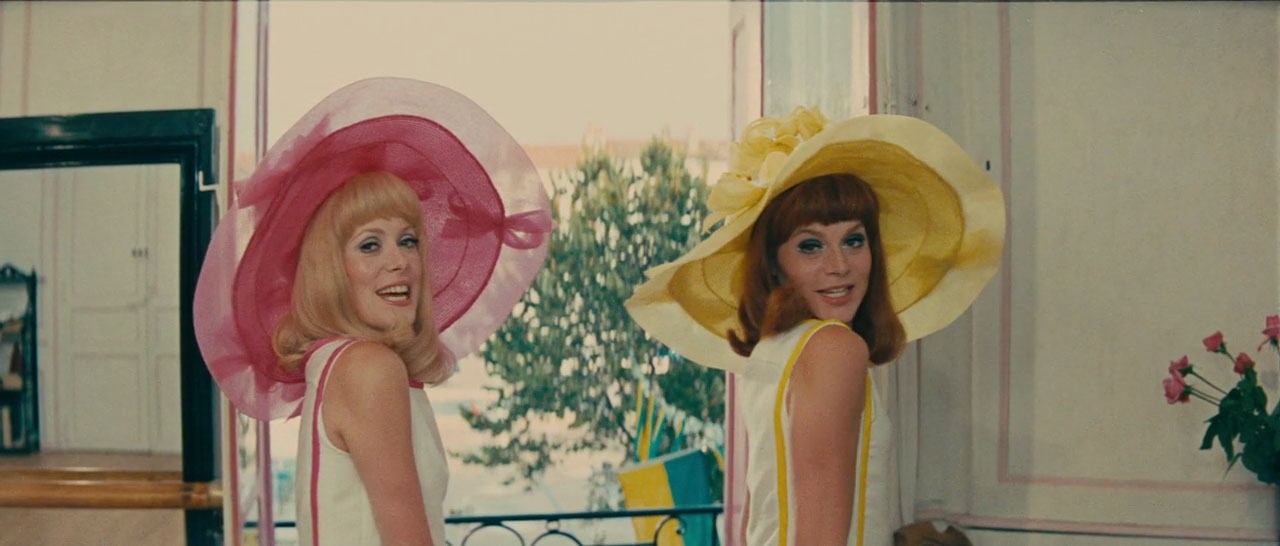
At this point, Demy was far out of touch tonally with his French New Wave contemporaries. Umbrellas characters were at least affected by the ongoing war, but Rochefort, coming after the more politically-engaged Muriel and Paris Belong To Us and The War Is Over, is in its own insular world for the most part. A few years later, after the May ’68 riots and Godard’s and Marker’s hard turns to the left, after even Demy’s wife Agnes Varda had filmed Black Panthers and contributed to the Far from Vietnam project, Demy would continue to go his own way, filming a musical fantasy fairy-tale with Deneuve and Jean Marais in 1970. By that point, I gather that he was not well-liked by his New Wave filmmaker/critic contemporaries. I don’t think he is well-liked still… I’ve been reading that his career was pretty uneven, and only a quarter of his films are talked about regularly. I guess Demy’s films have had to be recontextualized to be appreciated, removed from the radical French 60’s and enjoyed as pure cinema.

Danielle Darrieux (star of Madame De… and the cheating wife in La Ronde, later in 8 Women & Demy’s Une chambre en ville) plays Yvonne, mother of Catherine Deneuve, her tragic real-life sister Françoise Dorléac (of The Soft Skin and Roger Vadim’s La Ronde remake) and young Boubou.

Yvonne regrets having left Boubou’s father Simon Dame (Michel Piccoli) ten years ago. Delphine (Deneuve) keeps missing her dream man, an artist/poet doing his military service, Jacques Perrin (of Donkey Skin, Cinema Paradiso, the Kieslowski-penned 2005 Hell). Solange (Dorléac) dreams of meeting famous American composer Andy Miller (Gene Kelly). And they all (more or less) meet up and fall in love at the end of the movie.

L-R below: Darrieux, salesman George Chakiris (West Side Story), Josette, romantic Perrin, George’s partner Bill, Gramps

Guess I’m not so musical-savvy, don’t know what to say about this one stylistically. I mean, it’s bright and colorful and fun, less sense of loss and longing than Umbrellas, but I kind of miss that. Gene Kelly is a cutie, fits in just fine.

Katy asks why the mother has to work all day at her diner to get by, while her daughters live high in their fancy apartment and pretty dresses from teaching song and dance lessons. Are the realism and the fantasy rubbing against each other uncomfortably, or is the mother paying for Boubou’s school and still helping to support the girls until they get married? If the latter, I’d hope they’d take a shift at the diner once in a while.

This and Umbrellas had a funny combination of set and location shooting, with Demy doing location shots in the actual towns, but repainting the storefronts to his liking. Nice music, nothing memorable for me, having heard it just once. The girls refer to Jules and Jim and composer Michel Legrand. The camera should count as a cast member since it is engaged by the other characters and dances around with them. A self-reflexive movie then, both in its use of the camera and its reference to musical convention. Bright, solid primary colors abound.

Jonathan Rosenbaum: “There are English-dubbed versions of both Umbrellas and Young Girls; I haven’t seen the latter, but the English version of Umbrellas is so unrelievedly awful that I’m happy to have missed the dubbed Young Girls.” Although if the IMDB trivia page is to be believed, Rochefort was fully shot in English as well as French, so it might be worth hunting down an English version if it still exists anywhere.

Varda cameo as the shortest nun:

Caroline Layde for Senses of Cinema:

However undemanding and lollipop Demy’s films may appear, they present some nuance and sophisticated intertext, and they share a certain charm, vivid and unified. His films inhabit worlds in themselves that may peripherally refer to social reality and the real world but remain content as alternate realities of poetry, color, and music … Demy’s consistency of vision itself justifies his inclusion among the “auteurs”, defined by André Bazin and François Truffaut and expanded by Andrew Sarris as distinguishing themselves with their salient visual language from mere metteurs-en-scène. Demy certainly created a signature style of poetry and innocence and clung to it. Yet this quality also has a sophisticated aspect, suggesting the dream worlds of the surrealists and of Demy’s inspiration, Jean Cocteau. It is fitting that the American critic Gary Carey has described Demy as “the Joseph Cornell of French cinema”.


The Young Girls Turn 25 (1993, Agnes Varda)

The town of Rochefort threw a party and screening for the 25th anniversary, invited Demy’s family, Legrand, the set designer, the producer and cast. Bittersweet memories for some, pure joy for others. Film and video of the festivities along with film clips and Varda’s excellent 16mm footage from behind the scenes.

“The memory of happiness is perhaps also happiness.”

Jacques on set:

Sure it’s the cutest-ever story of an orphan mouse who befriends a hermit criminal bear, but it also has major subplots about teeth theft at the behest of a sinister orphanage.

Also there’s a family with a dentist mom who works across the street from her candy seller husband, which is funny and low-key cynical but they don’t seem to deserve the chaos Ernest wreaks upon their businesses.

Beautiful watercolor backgrounds, often fading away at the edges. According to the codirector the writing was influenced by Studio Ghibli (naturally) and Kikujiro (ha!).

I was crazy about it, but something seemed off with the English voices. After just having seen The Little Prince and feeling Jeff Bridges was just perfect as the inventor neighbor, I wasn’t feeling Forest Whitaker as Ernest. The movie is short, so I watched it again in French with original Ernest Lambert Wilson (the American in Not On The Lips), which was perhaps an improvement, perhaps not, but either way a joy to see twice.

2006:
The first time I was too blown away by how wonderful this movie is, so entranced by its beauty and mesmerized by the entirely-sung dialogue to quite believe what I was seeing and hearing. Knew I’d have to see it again soon to make sure the dream was true. Still a nearly perfect movie… even more so now that I understand the singing and the flow and the story, and can just get caught up in it.

2016:
Finally looking perfect on blu-ray – I wasn’t thrilled how some colors on the 1990’s film print restoration jittered like a Nintendo game with too many enemies onscreen. Also I’m watching this for the first time since seeing Lola, so that movie’s lead character Roland Cassard as the jeweler who marries Deneuve and his brief Lola-flashback scene are new sources of wonder.

Meeting Roland at Mr. Dubourg’s place – he’s back there quietly gazing at Geneviève.

Other things noticed: how depressed and sullen Guy is after returning from the Algerian war… the crazy wallpaper in the movie and how it clashes and blends with the brightly colored clothing… and the auto mechanic male lead, from Demy who grew up in an auto garage.

When visibly pregnant Geneviève breaks down and agrees to marry Roland: “If he refuses me as I am, it means he doesn’t have deep feelings for me. If, by some extraordinary chance, he accepts me, I’ll have no reason to doubt him, and I’d be a fool to turn him away.”

And on Guy: “I would have died for him…”

Rosalie Varda played the lovers’ daughter in the final gas station scene – I saw Rosalie again in Uncle Yanco the same day.

Didn’t expect to find a 1954 photo of Chris Marker and Alain Resnais holding a Fernand Léger print in the blu-ray extras:

This is France, but we’re not bothering with subtitles or even accents, because those hadn’t been invented yet in the 1950’s. WWI, fighting against Germany, with rightly celebrated tracking shots through the trenches, from the clueless higher-ups patrolling the men they know nothing about, to the middleman Major Kirk Douglas, a serious star some five years after The Big Sky. Posh general Adolphe Menjou (in one of his final films) has pressured scar-faced general George Macready (evil older husband of Gilda) into commanding an attack to capture a hill in exchange for a promotion. The attack will be a huge failure, killing hundreds of men. Two higher-ups (Gen. George and Lt. Roget) will act supremely dishonorably, the former by sending men to die in a pointless and poorly-planned maneuver and ordering fire upon his own troops, the latter by personally killing a subordinate with a grenade in a cowardly moment. But both will get off without punishment, instead picking three soldier representatives to die by firing squad for the operation’s failure, futilely defended in military court by Kirk.

Three dead men: Paris (Kiss Me Deadly star Ralph Meeker) because he’s the only witness to Lt. Roget’s murder of a soldier, Ferol (Timothy Carey, who doesn’t fit in with the rest of the movie, but it’s wonderful) and Arnaud (Lloyd the Bartender from The Shining), who had a great pre-fight speech about death vs. pain, and gets knocked down by Ferol in their holding cell and has to be executed while unconscious on a stretcher.

I thought of it as a powerful anti-war film (with a different approach to the insanity of war than Dr. Strangelove), but Gary Giddins’s commentary says it’s not exactly anti-war, but “about power, class, manipulation and the absurdity of war as a continuation of those civilian instincts.” He also says the pre-battle politicking between officers isn’t in the source novel.

The Future Mrs. Kubrick:

Menjou at Marienbad:

J. Naremore:

Kubrick is especially good at drawing sharp visual and aural contrasts between the château where the generals plan the war and the trenches where the war is fought. The Schleissheim Palace outside Munich, where much of the action takes place, later became a location for another film that depicts upper-class intrigues amid the architecture of a decadent past – Alain Resnais’ Last Year at Marienbad – and the opening sequence in the palace interior, where Adolphe Menjou suavely manipulates the ramrod stiff but insecure George Macready, was influenced by one of Kubrick’s favorite directors, Max Ophuls, who had died on the day it was staged.

Two friends, spiky-haired Fuchs and moppy Witold, rent a room from Sabine Azéma (maintaining her manic energy from Wild Grass) and Jean-Francois Balmer (That Day, Chabrol’s Madame Bovary). They share the house with young couple Lena (Victória Guerra of Lines of Wellington) and Lucien (Andy Gillet, Celadon himself) and Azéma’s niece/maid Catherette. Then the boarders are invited on a trip to the country with the family. That’s all that happens – but not really, as most of the characters start out wired, talking nonstop and behaving strangely, and animals and people may or may not be dying, showing up hanging from trees. At the end I thought it was all quite astounding to watch, but wasn’t sure what it all meant.

K. Uhlich:

What does it all mean? Wrong question. And it’s probably absurd to even ask. Better, instead, to fully submit to ŽuÅ‚awski’s last symphony of insanity and paranoia, which ends, cheekily enough, with a gag reel (quite the meta final statement).

C. Huber in Cinema Scope has the best explanation of what is actually happening here:

Attempting to forge order from the chaos of the real world, Witold builds a private cosmos founded on arbitrary associations. Increasingly aware of facing a universe of possibilities, in which every connection can be randomly made, and thus is equally profound and silly … Witold is seized by an existential vertigo … In short, it becomes impossible to distinguish the awesome from the absurd, and Zulawski’s cinema of intensity has been zig-zagging with furious power between those two poles for nearly half a century.

Bonkers and gorgeous-looking, as I’d hope and expect from the late Zulawski (only the second of his films I’ve seen, after Possession), shot by young André Szankowski, who was in demand by the old masters (Ruiz’s Mysteries of Lisbon, Oliveira’s Em Século de Energia). Based on a book by Witold Gombrowicz (which does indeed feature a writer lead character named Witold), who has also been adapted by Skolimowski (30 Door Key).

M. Sicinski:

With its first-person musings and associative image-track, Francofonia‘s first half resembles nothing so much as a late Godard video, but the approach and mood is open and accessible even as the subject matter turns highbrow … But most of the remainder of the film is spent dramatizing the wartime cooperation between the Louvre’s Vichy-era chief, Jacques Jaujard (Louis-Do de Lencquesaing), and Nazi cultural attaché Franz Wolff-Metternich (Benjamin Utzerath).

A complicated movie which I thought about for days afterwards, but I waited long enough before writing anything down that now it’s not fresh in my mind and I’m hesitant to write anything at all. A variety of styles, aspect ratios, color palettes, time periods and strange effects (the film’s soundtrack waveform visible alongside the picture was a new one to me). Some Russian Ark-ian museum cruising with your host Napoleon, who showed off paintings of his own exploits and earned a big laugh at our screening when he gazed at the Mona Lisa saying his usual line, “It’s me.” Even the regular historical drama scenes (Louvre chief meeting his Nazi overseer) don’t go in the directions you’d expect of a historical drama and they culminate in a wondrous bit where each character is told by the narrator how his life will end up.

At first I thought Audiard seems influenced by the Godfather movies, from the young enforcer who takes over a crime business in A Prophet to this movie’s immigrant stories (dunno how Rust & Bone would fit in), but after it became clear that Dheepan was heading towards rage and revenge, I thought of it as a more currently-fashionable Harry Brown (others are saying Straw Dogs).

The most interesting twist: Dheepan and his “family” are only pretending to be a family in order to get refugee status and flee Sri Lanka, where Dheepan was a Tamil Tiger. They live together like strangers, only playing the family role for outside observers, but gradually begin to respect and protect each other. Meanwhile, the block of apartments where they live and work is a drug hub which turns violent when lead dealer Vincent Rottiers (young Jean in the Renoir biopic) returns from prison. With these pieces in place, the movie gets to create a crowd-pleasing finale where Dheepan draws on his violent past to protect his makeshift family. M. D’Angelo: “After nearly two hours of depicting the improvised family’s patient adjustments, negotiations, and compromises, Audiard abruptly switches to Hollywood fantasy, and there’s no sign that he’s doing so ironically, metatextually, or with any other subversive purpose in mind.”

Still a pretty good movie. I’m not as upset about this winning the palme d’or (or Loach winning in 2016) as others are. Regardless of the winner, I’m still seeking out as many of the acclaimed competition films as possible (so far: Carol, The Assassin, The Lobster, Sicario).