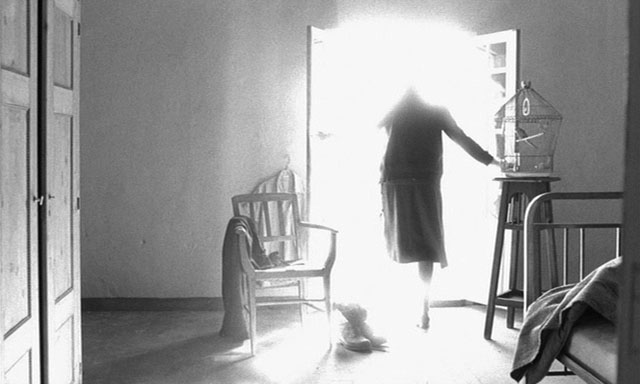
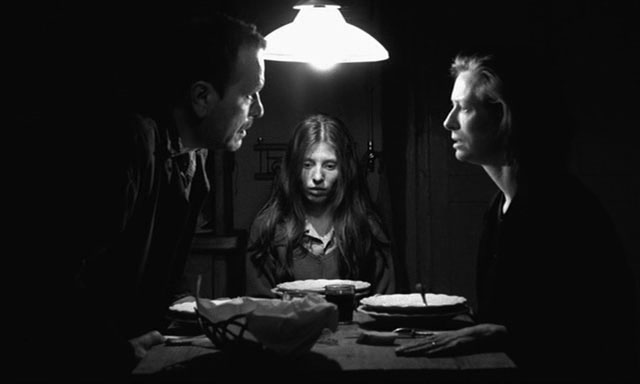
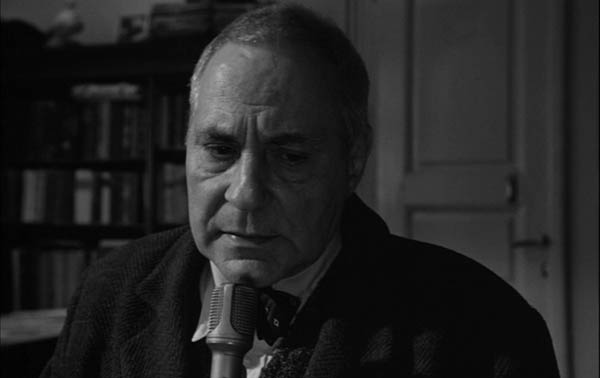
Tarr Noir! Tarr doing suspense/crime drama seems unnecessary since his use of the camera and film editing are suspenseful in itself. The crime doesn’t seem that important (until the very end) and the lead guy is kind of an ass, so the suspense remains in the shots and editing, not much carries over into the story. To get my other complaint out of the way (I quite liked the movie), the sound is off because everything is distractingly dubbed into French and English (voices include Edward Fox of Gandhi and The Duellists and Michael Lonsdale of Stavisky and Out 1). It must be for commercial reasons, but I don’t see it playing anywhere except a few film festivals, so what commercial reasons? Seeing the cast of Satantango hanging out in the bar only makes the dubbing seem weirder. Research indicates that there’s a Hungarian version out there, so I guess Tilda Swinton (French-dubbed in my version) gets screwed in both.

image

Big-time Euro film producer Humbert Balsan (who worked with Youssef Chahine, Merchant/Ivory, Elia Suleiman, Lars von Trier) committed suicide during production, complicating things. Based on a novel by Georges Simenon (Night at the Crossroads, Betty, Magnet of Doom) which has been filmed before in the 40’s. I dig the Mihály Vig music, but it’s no Werckmeister Harmonies, which I listened to obsessively for a month.

image

Offscreen, a man is selling his theater for a suitcase full of money, which gets stolen. The thieves get the suitcase onto the docks, under the watchful eye of stoic Maloin, then one kills the other and runs. Maloin snags the money and hides it. That’s the first half hour in maybe six or seven shots, with no dialogue at all. Crisp b/w images with achingly slow, fluid camera movements, as can be expected.

image

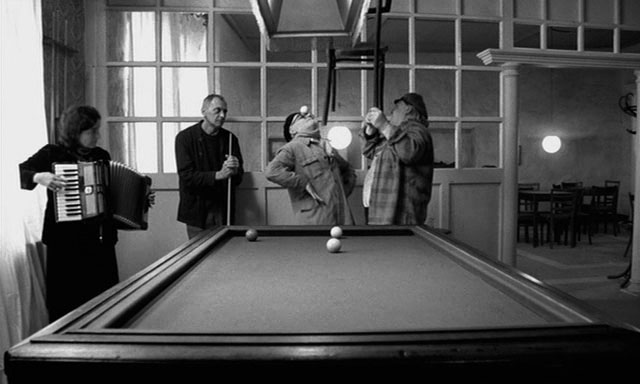
Maloin takes time out from the crime drama to torment his family. He pulls daughter Henrietta (cat-torturing poster girl from Satantango) out of work, buys her furs, then gets screamed at by wife Tilda Swinton. Inspector (from London) questions blond killer Brown. We don’t find out exactly how Maloin kills Brown at the end before returning the money to the Inspector. That’s about it for the plot. Most of the time a very enjoyable flick. Moments of otherworldly Twin Peaks-ish parody during dubbed dialogue scenes are immediately forgiven when we come across some Satantango actors performing random hilarity in the bar, urged on by an accordianist. If Tarr fans can’t have the sustained magic of the last couple movies, at least we can all enjoy some drunken accordian antics together.

image

I’d considered declaring August to be Shorts Month and watching hundreds of those, so I stocked up, but the inspiration had fled by the time the month rolled around. But we can’t let all these shorts go to waste, so I still watched more than usual.

73 Suspect Words and Heaven’s Gate (2000, Peggy Ahwesh)
Fun gimmick videos, one displaying the “suspect words” found by running the Unabomber manifesto through a spell checker, and the other listing off the search keywords of the Heaven’s Gate cult’s website. In the first the text appears quickly and fades out, and in the second the words flicker constantly.
image
image

Apocalypse Pooh (1987, T. Graham)
scenes from Apocalypse Now and Winnie The Pooh inexpertly combined. Actually the lipsync and some of the shot selections were pretty wonderful. I’m pretty sure nobody will ever care about this movie again now that a hundred thousand video mashups are clogging youtube, but it’s a cute piece of cult history. The poor video quality would turn on the guy who made Out of Print.

Thanksgiving Prayer (1991, Gus Van Sant)
William S. Burroughs hatin’ on America, being a general bummer, as is the fashion among leftists around Thanksgiving time. Decent video but I far prefer Ballad of the Skeletons with Allen Ginsberg.
image

Szalontudo (2006, Szirmai Marton)
That joke where guy 1 thinks guy 2 has stolen his food, so he starts eating from the other side, and they glare at each other eating the same food, then guy 2 walks off and guy 1 sees his food still untouched… he was eating guy 2’s food! Ah! This was terrible, with gross squishy chewing sound effects. Won an audience award in north-central Spain where they’ve never heard that joke before.
image

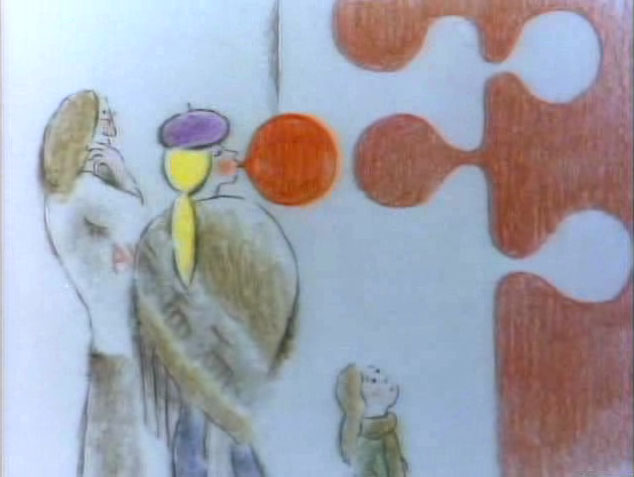
Le Vol d’Icare (1974, Georges Schwitzgebel)
I think it’s primitive animation made on a lite-brite. Or maybe it’s HyperStudio version 0.1. Story of icarus, I suppose. I liked the flocks of birds. What is that, a harpsichord?
image

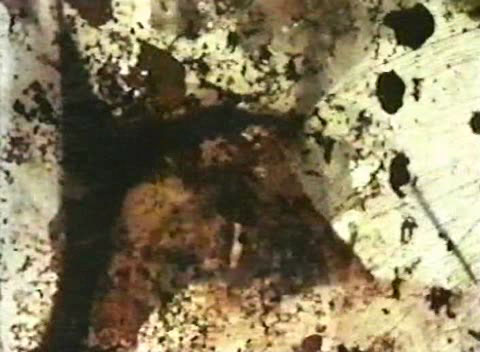
Instructions for a Light and Sound Machine (2005, Peter Tscherkassky)
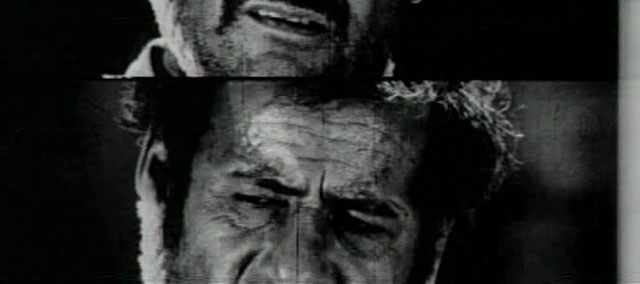
Pumping stutter-motion! Variable-speed lock-groove dude in a Leone western having a death-dream. Ends with words “Start,” “End” and “Finish” overlapping as the guy, appearing to be on fire, runs with mirrored graveyards above and below him.
image

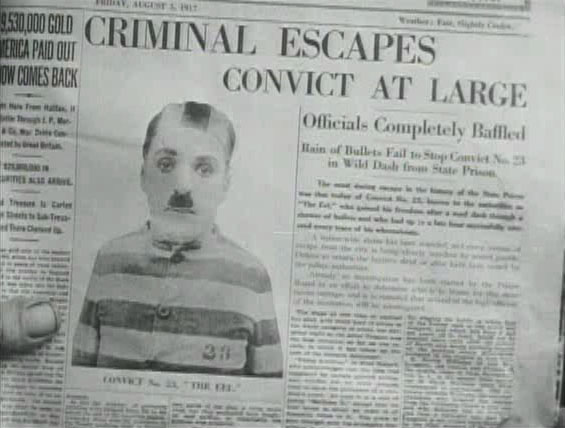
The Adventurer (1917, Charles Chaplin)
Weird to see Charlie as an escaped convict threatening cops with a shotgun. But there’s plenty of ass-kickin and cliff-jumpin so it’s alright. I forgot the encoding quality is garbage on my copy of these… must buy a better one.
image

image

Inflation (1927, Hans Richter)
Rich people, money, poor people, more money, stock traders, more and more and more money, digits rushing at the screen whilst speed-adjusted carnival nightmare music plays until the whole damn thing comes crashing down. Only two minutes long! An achievement.
image

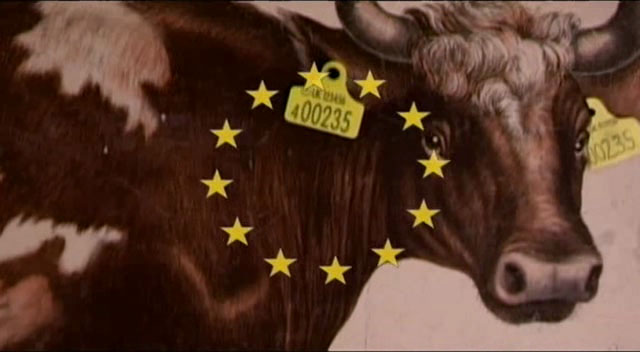
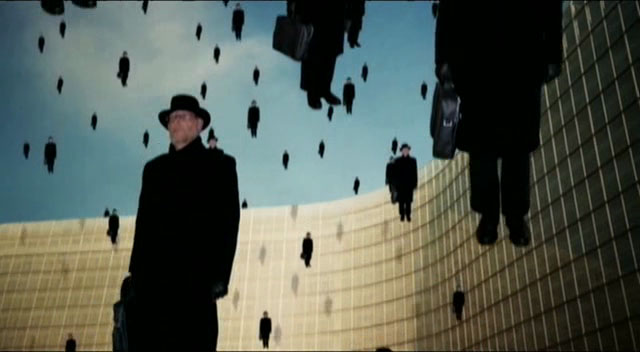
Yellow Tag (2004, Jan Troell)
In the old days we were close to our farm animals but today governments require tracking ear-tags. Fun movie… maybe didn’t need the classroom and religious art scenes, but it makes up for that in the end by going all wacky with shooting galleries and suited men raining down outside some kinda UN building.
image

image

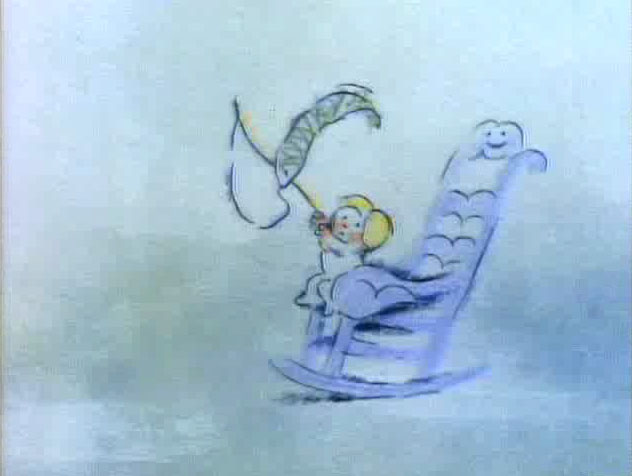
Crac! (1981, Frédéric Back)
Animated story of the creation and long life of a rocking chair, accompanied by drum and fiddle music. It’s much better than it sounds.
image
image

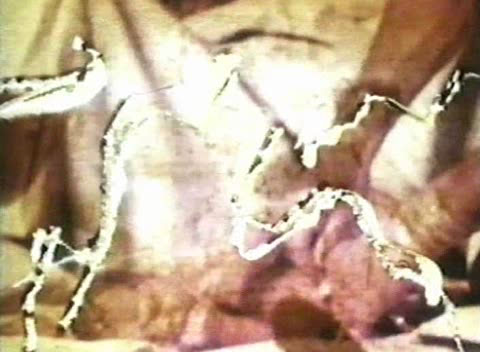
Thigh Line Lyre Triangular (1961, Stan Brakhage)
Arrrrgh, another birthing movie! Why did nobody warn me? Apparently the title is Brak-code for “vagina.” Once I got over the initial shock, this is excellent. Hand-processed frames over live-action film, intense.
image

image

Let’s see, this opened last July and apparently I was too busy watching classic Hollywood comedies, french auteur cinema, documentaries and Wall*E to go see it. Also I wasn’t so wowed by Pan’s Labyrinth and I figured an action-comedy sequel could only be worse than that. Turns out it’s a very good action-comedy sequel. I should’ve guessed. Anyway, looked great in high-def.

image

I guess Hellboy was dating fire woman Selma Blair in the first one – I barely remember the movie even though I’ve seen it twice. Anyway she’s pregnant in this one with twin fire demons, but that’s hardly discussed because we are busy being introduced to, then figuring out how to kill, various wonderful creatures.

image

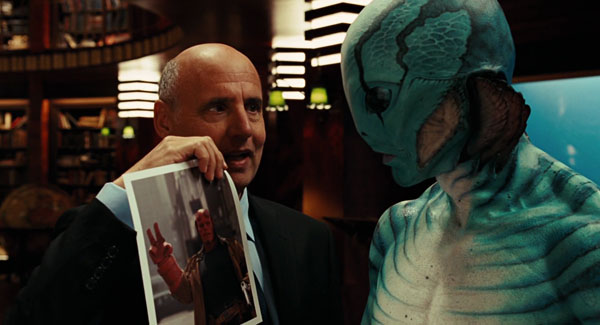
Also Doug “Silver Surfer” Jones is back as Abe the aquatic poetry-reading scientist psychic fellow, Jeffrey Tambor as the comic relief operations manager, and introducing the voice of Family Guy creator Seth MacFarlane as the ectoplasmic being encased in a steamy glass-topped robot suit.

image

This time the crew goes to Ireland (actually filmed in Budapest) to fight some Lord of the Rings holdovers.

image

They win at the end.

image

Did I mention John Hurt appears in the intro?

image

Emory played this for us on 35mm, introduced by poet and politician Gyula Kodolányi who watched it in Hungary during its opening run… and this is the night after I saw a perfect print of The Age of Innocence introduced by Salman Rushdie. If their film screenings are about to stop, as has been rumored, at least they’re going out on top.

Scary movie. First 90ish minutes I’m wondering “where are they going with this”, then it all comes together in the last five. Set in the 1860’s but meant to illustrate and refer to interrogation techniques of the 1960’s (surprised he got away with it). Stark black-and-white, artfully composed in widescreen, with long-ish shots (nothing over a couple minutes), set at a prison out on the plains and a few surrounding buildings.

A hundred or more prisoners are being held together, a few in solitary covered with hoods and the rest in a large courtyard, but the guards don’t know whether they’ve captured the rebel leader and which of the prisoners are his horsemen. Threat of execution turns one prisonder, a pointy-hatted murderer, into a not-so-covert inside agent for the jailers. Guards capture a local woman and torture her to death in view of the prisoners, provoking suicides. Ultimately the jailers succeed through some twisty psych tricks into getting two elder rebel soldiers to identify themselves. A competition is staged, and the winner gets to select a troop of men to leave prison and join him. It’s announced that the rebel leader has been granted amnesty, and the new troops all cheer. The guards, now having identified the rebels, descend upon them with hoods…

Bright Lights:

In the concise (20-minute) but revealing interview included by Second Run with The Round-Up, Jancsó pauses to explain the larger context intended by these films, that is, how they were meant to universalize human cruelty beyond apparent, coded references to the then recent 1956 Soviet action. Speaking carefully and succinctly, Jancsó offers two themes: “the humiliation by the powerful” and “the defenselessness of the people.”

“Storyboards are stupid, stupid things.” – Béla Tarr

37 shots (not counting credits) in 145 minutes, so average 4-minute shots, with all but a handful of scenes contained within a single shot. Camera usually in slow, gliding motion. Stark b/w photography.

Same editor as Tarr’s previous films (Tarr’s wife, now also credited as co-director), same composer and same author of the source novel. Similar in look and feel to Satantango for sure, which means it’s long and slow in a beautiful and captivating way. I never get bored watching these movies, and I don’t even have a theory for why that is… they ought to be boring as all hell, especially Satantango, but I’d gladly watch each one again.

From reading the credits you’d think it’s a grand communal project, not a film by one clear artistic voice. IMDB credits six people for cinematography, unbelievable, including a Kansas native (an acclaimed indie filmmaker), a French steadicam operator who worked on Amelie and The Science of Sleep, and unsurprisingly the guy who is sole credited cinematographer for Satantango and Damnation. Must read source novel sometime, “The Melancholy of Resistance” by Laszlo Krasznahorkai.

Opens in a bar at closing time, Janos Valuska positioning the other bar patrons into a model of the solar system, the camera spinning and rotating around them.

image

Janos walks to uncle Gyuri’s house (how does Tarr manage to make walking scenes the highlights of his films?) to put him to bed. Stops outside to watch a massive truck slowly roll into town, carrying an exhibition with a giant stuffed whale, various curiosities in jars, and “the prince”, a mysterious dwarf.

Next morning, townspeople are all alarmed, talking doom and destruction. Janos delivers some papers, goes back to his composer uncle Gyuri’s house and listens to Gyuri give a strange music-conspiracy speech.
image

Walks through the town square where groups of people are gathered whispering rumors amonst themselves. Thinking himself less naive and superstitious than the rest, Janos pays his 100 forints (about 50 cents) and tours the trailer. Walks home, sees uncle Lajos, must be tired by now cuz I can’t figure when Janos sleeps… but no time for rest, because his aunt Tunde (Gyuri’s estranged wife) comes with threatening news.

If Janos doesn’t get Gyuri to help her efforts gathering a town decency committee (presumably to eject the whale exhibition), she will move back into Gyuri’s house and make his life hell. So Gyuri and Janos get right on that.

image

They get some lunch, carry on, finally part and Janos goes back to the square, where he is accosted by the ever-more-restless townpeople gathered there. I’m starting to wonder if all of these are townspeople, or if some are outsiders drawn by the exhibition (which nobody but Janos is ever seen entering). Janos visits aunt Tunde to report, but she is with a raving police chief and Janos is sent to put the chief’s rowdy kids to bed. Okay, by now Janos has got to be tired, but he walks back to the square (sees uncle Lajos on the way) and sneaks into the trailer, hearing the trailer guy talking with the Prince (seen only in shadow) raving about chaos and destruction. Janos escapes and runs, hearing explosions in the distance behind him, presumably caused by the Prince’s riot-provoking megalomaniacal speech to the crowd.

Janos hides while the townsfolk smash up the trailer (off-camera) and tear up a hospital for some reason, terrorizing the people within including a very sad naked old man. Aftermath of that, everyone files slowly out of the hospital, Janos walks around and discovers uncle Lajos dead, and army men interview Tunde.

image

Back home, Janos sees aunt Harrer looking for her husband Lajos. She tells Janos that the army men are looking for him and he should flee town. He does so, running along the train rails until a helicopter catches him.

image

Gyuri is visiting Janos in a hospital. Is Janos mad? “Nothing counts. Nothing counts at all.” Gyuri leaves, walks through the square, examines the eye of the whale laid out on the destroyed trailer in the middle of town.

Main actor (Janos) is german Lars Rudolph (The Princess and the Warrior). His uncle Gyuri Harrer is Peter Fitz (Au revoir, les enfants) and aunt Tunde is Hanna Schygulla (star of Marriage of Maria Braun and other Fassbinders). Guy who played Petrina (Irimiás’s sidekick) in Satantango shows up as a hotel porter, and Janos’s neighboring aunt and uncle (I’m unclear whether these people are all actual aunts and uncles) played Halics and Mrs. Kráner in Satantango. I recognized Mrs. Schmidt in a scene as well.

Visual themes of space, shadows, enormity, eclipses, light disappearing.

MovieMartyr: “The film’s title gains meaning when János overhears his uncle György, a cooped-up music theorist, talk about tonal scales. He explains that the Werckmeister scale, upon which the musical octave is based, is a false construct, and is not true to natural sound since it cannot convey the full range possible in nature. He elaborates, stating that since all music is based on this faulty foundation, it is all inherently false. With his description of these musical concepts, György seems to tap into the film’s undercurrents. Certainly, the defective musical scale is roughly analogous to the broken political state of the country that the film is set in. His suggestion that all music is unnatural seems to set up a competition between the natural and unnatural (light and dark) that runs throughout the work. That he’s driven his wife Tünde out of his house with his obsession toward his out of tune piano doesn’t bother him in the least.”

Scope: “The climactic storming of the hospital, and the formation of the mob, is given more significance in the film than the novel. And although such an alteration suggests that Tarr intends Werckmeister Harmonies to be read as an allegory of fascist violence, the film does not offer any specific political causes for the violence. Rather, Tarr situates the violence as a function of modernity and industrialization, and, more abstractly, as having a cosmological basis.”

Sight & Sound: “The one truly identifiable centre of malevolence is Tünde, a reactionary opportunist exploiting superstition to gain power in the name of order. It may even be that her musicologist ex-husband Eszter, obsessed with the theories of 17th-century German composer Werckmeister, has himself contributed to disturbing the harmonic order of things by withdrawing from any active involvement; at the very least he is a representative of an enfeebled intelligentsia, vainly fiddling with abstractions while the world burns.” … “In the end the defeated thinker Eszter finally visits the whale, now beached and exposed in the wrecked square and more inscrutable than ever. It’s hard to imagine a more downbeat ending the complete triumph of entropy and reaction yet this conclusion derives a profound grace from the extremity of its pessimism. Explaining the cosmos to his drunks, Valuska pleads, “All I ask is that you step with me into the bottomlessness”, and that is essentially Tarr’s invitation to the viewer. The enigmatic harmonic preoccupations alluded to in the title suggest that this film rich in movement, low on dialogue aspires, as the old phrase has it, to the condition of music. But Tarr’s true achievement is to attain the condition of silence, and of bottomless, awesomely inscrutable nightmare.”

Online articles mention 39 shots, so one of us has mis-counted.

Béla Tarr: “We never use the script. We just write it for the foundations and the producers and we use it when looking for the money. The pre-production is a very simple thing. It takes always a minimum of one year. We spend a year looking all around and we see everything. We have a story but I think the story is only a little part of the whole movie. I have to tell you I absolutely hate the movies that I can watch at the theatres. They are like comics. They always tell the same stories. We don’t like these stories because for us every story is always the same old story from the Old Testament. After the Old Testament we have no new stories.”

Interviewer: “I just think there is a trend in world cinema towards this sort of existential terror and chaos.” Tarr, being awesomely elusive: “No, I just wanted to make a movie about this guy who is walking up and down the village and has seen this whale.”

“If you want to make a colour movie, and you go out onto the street, and you want to create the right atmosphere, you must paint the whole street, because every house is red, blue, green and so on. And you have no colours, you just have some colour chaos. For me it’s a kind of naturalism, the colour movie. With black and white you can keep it more stylistic, you can keep more of a distance between the film and reality which is important.”

same 2001 interview: “Do you know Georges Simenon? After the New York Film Festival one American producer called us. He wants to work with us. And he sent us a script which is full of shit and we said no, no, no. And afterwards he had another idea which we also said no to. And finally we proposed to him this short story by Simenon. The title is L’homme De Londres (The Man from London). And now we are working on this project. The script is ready. And this American producer founded this European company in Denmark and he moved from New York to Copenhagen. And we will start this project now which I hope we can complete.”

“You know the final cut took just half a day!”

May 2024: Watched the new restoration and read the novel… slowly. Fortunately there are only a few characters, with verbose tangles of thoughts, so it’s hard to find a paragraph break to put the book down but easy to pick up later. As always, Lasz-Krasz’s books in English seem like impossible feats of translation. The book has multiple perspectives including dim postman Valuska, while the movie entirely follows Valuska, who seems less dim. A different person dies in the riot (V’s mom in the book, Mr. Harrer here). The movie’s advantages include gorgeous photography and music, a compelling Valuska performance, and his unknown fate at the end. Replaced some screenshots above – more:

I’ll probably remember the feeling of Satantango, the length of it, the way it moves and the way it looks, a lot longer than I’ll remember the plot and characters. So here:

The money from the harvest has come in. Mr. Schmidt is planning to run off with Mr. Kraner and their wives instead of splitting fairly eight ways. Futaki, sleeping with Mrs. Schmidt, finds out and wants in. The doctor watches all this from his room getting drunk on fruit brandy. But the news is that Irimias and Petrina, long thought dead, are approaching town.

At the bar, Mr. and Mrs. Halics frolic with the innkeeper and a talkative Kelemen (“Irimias hugged me and the waitresses jumped like grasshoppers and I was plodding and plodding and plodding”) while the Doctor fails to make the long walk in the cold rain to get more brandy, the town prostitutes have no customers, and a young neglected girl kills her cat then herself.

Irimias shows up at the funeral and rebukes everyone, tells them he will help them start a new life with meaning and honor if they give up all their cash. They abandon the town and head for a crumbling manor, but Irimias shows up soon and says the time is not yet right, that they must scatter and live quietly until attitudes shift enough that they can begin this new life. Irimias fiddles around trying to get lots of gunpowder, finally submits some kind of report to the police captain informing on the former townsfolk, whom he clearly detests. The doctor, alone at home after a hospital visit, boards up his windows.

Simply amazing to sit in a dark theater for eight hours, surrounded by this movie. Time expands and contracts, bends and warps, loops back upon itself. The black-and-white cinematography, the scattered diehard audience, the closeness to the screen, the jitters and scratches and cuts in the film, the swing between almost inaudible dialogue and ear-splitting bell-ringing, the middle-of-the-night drive home from Nashville… the most perfectly realized cinema experience I’ve had for years. A true cinephile/cult film. Seeing it at home on video over the course of a few nights was to study the movie, to follows the story and see what the movie might look and sound like… it was a preview. Seeing it in Nashville is to be part of something, to feel like there’s a point to cinema besides my own living-room amusement. The movie gives hope, if not to the dismal and defeated small-town Hungarian people, then at least to me.