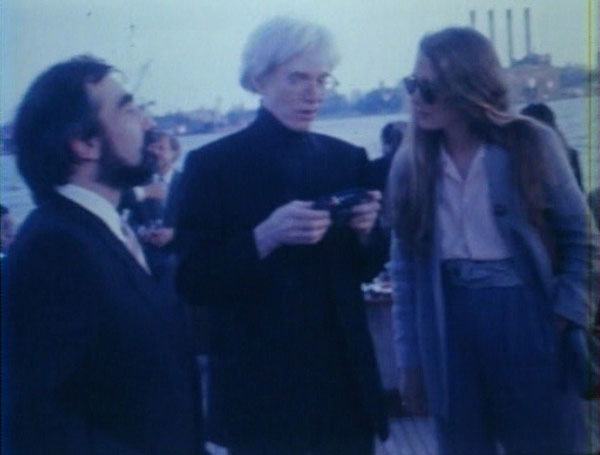
After an opening monologue about not understanding life or people, and not really wanting to understand them, hours and hours of home movies! Mekas in voiceover assures us they are edited in “random” order, but chapter 8 starts with a shot of a campbells soup can, then we glimpse Warhol on a ferry a minute later, so it’s not as random as he’d like us to think. Not randomly selected, either… each is a scene from the previous 30-or-so years chosen for its “glimpses of beauty.” So even though it seems weird to release home movies, with details a hundred times more meaningful to Mekas and his family than to a distant viewer like myself, it’s edited for wide appeal so really very nice.

image

I don’t mean to represent the entire five-hour film with a screenshot of Andy Warhol, it’s just that I was watching on the TV then I moved into the kitchen for ten minutes and brought the movie with me (miracles of technology) and happened to grab this frame.

There’s also sped-up film, rapid editing and some superimpositions – not just untouched boring ol’ film footage. His voiceover isn’t concise, but he has plenty of time. “I’m not so sure what I’m doing, really.”

I like that he keeps calling us his friends.
Or maybe he thought only his friends would ever watch this.

Alternate title: Children and Cats (Sped Up)

The sound quality could use a boost. I recognized Allen Ginsberg, and titles introduce Hollis Frampton, P. Adams Sitney, Nam June Paik, Ken Jacobs and Richard Serra.

I’m guessing it was New Yorkers (more specifically, regulars at the Anthology Film Archives) who voted this a decade-best film. Seems like it’d have added significance for a New Yorker.

Recommended listening: “Springtime in New York” by Jonathan Richman

“That moment everything came back to me, in fragments.”
Some repeated title cards (like “This is a political film”) and the chapter headers give it a sense of structure.

Random dude on IMDB:
“This is the work of a man at peace with his own happiness. We should all be so lucky.”

Mekas explains himself:

My film diaries 1970-1979: my marriage, children are born, you see them growing up. Footage of daily life, fragments of happiness and beauty, trips to France, Italy, Spain, Austria. Seasons of the year as they pass through New York. Friends, home life, nature, unending search for moments of beauty and celebration of life friendships, feelings, brief moments of happiness. Nothing extraordinary, nothing special, things that we all experience as we go through our lives.

NY Times:

At almost five hours, the movie is brief only when compared with Mr. Mekas’s 78 years of life. The film is a first — the home movie as epic. With its intentionally rough-hewn cuts, it is a journal, with hand-typed titles interspersed throughout that skitter past like lightning flashes and are meant to evoke moments. It’s a fleeting storm of a film, with pockets of rhythms that suggest the ebb and flow of a naturally unfolding event — though for some, its length may call for coffee and blankets.

I’m glad I got to see this in a theater, since I don’t know if I could’ve sit still for it on video. Also fun to observe the number of walkouts, probably from the half of the audience who hadn’t read the description beforehand and gasped loudly when Andy mentioned its 3.5-hour length in his introduction (AKA the half that wasn’t receiving class credit for attendance). But surprisingly I didn’t like it very much, never got the sense that all the elements (formalist experiment + weight of duration + story or lack thereof + static, careful camera compositions + subtle lead performance) congealed into a singular, great experience.

So, as I already knew, the film portrays Jeanne going about her routine for three days: making coffee, awakening her son and sending him to school, shopping, sleeping with some guy, making dinner, eating with her son, going to bed. Towards the second half her routine isn’t going as smoothly. Potatoes are overcooked. She walks into the wrong room. She can’t comfort the infant she watches while her neighbor shops. Then on the third day she stabs her guy to death with scissors. I’m still thinking about language since watching Pontypool. IMDB and Criterion descriptions say she “turns the occasional trick,” but most viewer descriptions outright call her “a prostitute.”

Delphine Seyrig was already a star (see: Last Year at Marienbad) and would remain one. Jan Decorte (her son) would only be in one more film (also by Akerman). The first two (non-murdered) men are both directors, the middle being Jacques Doniol-Valcroze. He played Etienne, whose letters get stolen and ransomed, in Out 1.

I. Magulies:

The perfect parity between Jeanne’s predictable schedule and Akerman’s minimalist precision deflects our attention from the fleeting signs of Jeanne’s afternoon prostitution. They nevertheless loom at the edge of our mind, gradually building unease. Jeanne Dielman constitutes a radical experiment with being undramatic, and paradoxically with the absolute necessity of drama.

Helping explain the movie’s feminist reputation:

Aunt Fernande, Jeanne’s sister, living in Canada, only appears in the form of a letter, read in litanylike monotone by Jeanne to her son; the neighbor, heard by the door (and played by Akerman herself), describes how, shopping for her husband’s dinner, and still undecided, she ended up getting the same expensive cut of meat as the person in front of her on line. Never casual, each of the film’s uniquely strange and long-winded monologues expresses some form of gendered pressure: they refer to Jeanne’s marriage, the son’s Oedipal thoughts, each breathing a sexual anxiety, each a drawn-out, wordy attempt to mitigate the “other scene” we never see, the elided afternoon trysts.

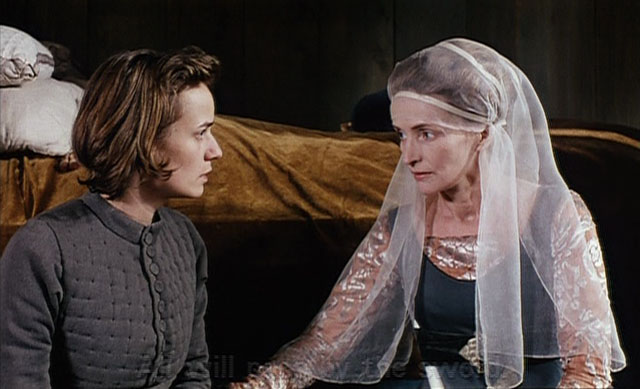
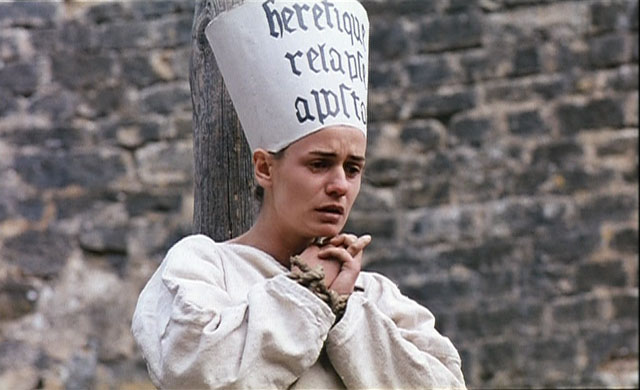
I. The Battles begins with Jeanne having had her angel visitations already, trying to convince local government to take her to the king, and halfway through the film gets to the battles she led against the English. II. The Prisons is half battles (which is good; we didn’t get enough battles in part 1) and half British prisons (with hardly any of the trial/execution scenes that Dreyer would focus on). All set 1429-1431, except for an odd intro in 1455, with Jeanne’s aged mother, a nun, telling of her daughter’s unjust execution.

image

It’s a Rivette film, all right. Long shots with medium natural lighting, deliberate camera movement, same typeface as always on the titles, brief blackouts between scenes, same list of collatorators in the credits. Quite a follow-up to La Belle noiseuse… I’ll bet nobody saw this coming. It works very well to Rivette’s strengths, though, and stays focused on Jeanne and her quest without gimmicks and without getting caught up in the scale of the story and the hundreds of side characters.

image

Sandrine Bonnaire, a decade after Vagabond and a year before The Ceremony. I didn’t recognize anyone else besides a cameo by Edith Scob. IMDB says Jean de Metz, the guy who leads her to the king’s court, was in Hurlevent, King Charles (André Marcon) is appearing in Rivette’s new film, and Quentin from Out 1 played Pierre Baillot (who was that?).

with Edith Scob:
image

Joan is charismatic and persuasive, but acts realistic. Her supernatural visions aren’t shown – we know Rivette isn’t above showing supernatural visions, but here he has Jeanne speak of them regularly without portraying them as a reality to the audience.

Unfortunately, this four-hour film has another two hours which I can’t see at the moment. Looks like Artificial Eye has released it on DVD. You know, my birthday is coming up…

image

J. Rosenbaum:

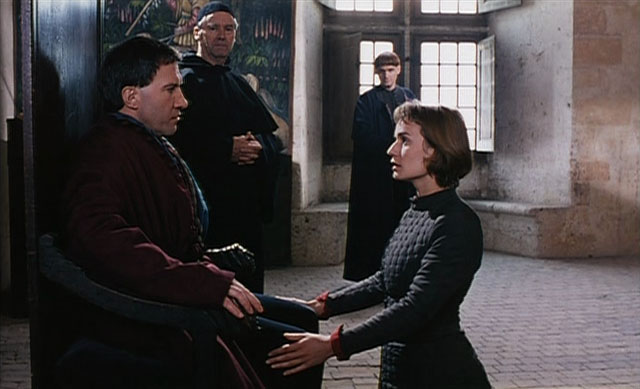
…this is a materialist version of a story that offers no miracles, though it does offer a pertinent attentiveness to gender issues (such as the nervousness and sexual braggadocio of the soldiers who sleep beside Joan) and a Joan who’s girlish as well as devout, capable of giggling as well as experiencing pain; when she wins over the dauphin the scene is pointedly kept offscreen, and when she’s interrogated by priests about her faith she could almost be a graduate student defending a dissertation.

with the king/dauphin:
image

C. Fujiwara:

As Rivette and Bonnaire present her, Joan suggests a novice movie director protected by a seasoned crew that humors her as much as obeys her. (Army life in this film is more sitting around than fighting; in this respect it’s like a film shoot.) She doesn’t do miracles; she just uses common sense and takes the initiative.

An absolute monster of a movie. No longer called The Argentine and Guerrilla, it’s been simplified to Che part 1 and Che part 2 then run together into a “roadshow” with a 15-min intermission, a printed program, and no trailers, credits or titles.

Part one has flashbacks (or flashforwards, depending on your point of view) to Guevara speaking at the U.N., epic movie music, and titles telling us when and where (within Cuba) the action is taking place. Emphasis on Che’s medical skills and on all facets of the revolutionary struggle: weapons training, psychology and ideology, strategy and inter-group politics. Far as we can tell, it’s Fidel Castro who is leading the men, and Che is going where he’s told – though he gets the final glory of capturing the capital himself (against orders, which were to wait a couple days for the main group to arrive).

Part two: no flashbacks, no narrator, less obvious music, and titles simply number the days since Che’s arrival in Bolivia. Starts out a crafty spy tale, with Che in a master disguise to get into the country with everybody looking for him, then meeting the countrymen who yearn for revolution and think the time is right. Alas, the time is not right… the highly organized military government tracks the men, bombs their camps with help from the U.S., and most damning of all, turns the local citizens against the revolutionaries.

Part one is too much of a hero-portrait with too much of a classic film-history-reenactment trajectory, but part two is too dark, too gritty and hopeless with not enough signposts for the audience. The combination could’ve made for two so-so movies, but it doesn’t – not at all – instead, the weaknesses of each disappear in the presence of the other, forming one extremely strong work, probably Soderbergh’s best.

From the writer of Eragon and Jurassic Park III… I’m serious! Besides Cannes-winner Del Toro and hundreds of unfamiliar faces, we had Catalina Moreno (of Fast Food Nation, Maria Full of Grace), Gaston Pauls (star of Nine Queens), Lou Diamond Phillips (who I didn’t recognize; only place I’ve seen him in 20 years is Bats), Jsu Garcia (Traffic, Nightmare on Elm Street) and a cameo by Matt Damon.

“Send this by pneumatic tube, quickly!”

This is now the earliest feature film I’ve ever seen (and the next two runners-up are also by Feuillade). Really this is five movies, each a multi-part serial, so maybe it’s the five earliest feature films I’ve seen…


PART ONE: IN THE SHADOW OF THE GUILLOTINE

The criminal master of disguise Fantomas is introduced robbing a rich woman of her jewels in a clumsy-ass fashion… he gets caught in her house then just walks up, looks at her threateningly, and walks away with them. They couldn’t think of a better scenario for the opening of their movie? I guess it shows that he’s an imposing character, and his appearing-ink business cards are cool (see bottom of page). Then it’s on to introduce Inspector Juve with his funny mustache and his reporter buddy Fandor. A man has been found murdered, so Juve questions his widow (Lady Beltham), who it turns out is having an affair with Fantomas. When inspector and reporter discover this, they easily capture the criminal, who is imprisoned to await the guillotine. But through a convoluted scheme, the widow springs Fantomas – she flatters an actor celebrated for portraying Fantomas on the stage to agree to meet her, and pays off the incredibly dense prison guards to spring Fantomas to come meet her at the same place (with the understanding that he’d be returned to prison within an hour) and they do the ol’ switcheroo – but Juve notices before the actor can be mistakenly executed (in the novel he was too late).

The regular Feuillade style is apparent here – people with comical mustaches who look conspiratorially into the camera, lots of crime, outdoor scenes with actors in cool black capes, convoluted scenarios and a plot that seems to be making itself up as it goes, helping the cliffhanger feeling.

Some nice outdoor shots in this movie. Feuillade is fond of long walls. I like them too.
image

The actor has all these admiring women, yet he sneaks off eagerly when he gets the letter from Lady Beltham? I guess her letter made her seem more “loose” than the ladies in his dressing room.
image

Juve, triumphantly stymied. Fandor (on left) looks on.
image


PART TWO: JUVE VERSUS FANTÔMAS

Opening credits are cool, showing the main actors crossfade into their characters-in-costume (in Juve’s case it’s changing into a hat, a fake mustache and a less-nice suit). At the start, Lady Beltham is presumed dead – but actually she’s organizing a gang of bandits who rob passengers on a train car then cause a train accident to cover up their crimes. Or was that another woman? Either way, our reporter is on the train and escapes with another passenger. He and Juve are lured into a gun trap, but they escape and tail the woman, getting her to lead them to Fantomas, who escapes by putting on his suit with false arms then simply running away, leaving Juve and Fandor each holding an arm. Brilliant! Okay, then Fantomas has a list of people he’s having mysteriously squeezed to death, so Juve wears spiked bands over his body when he goes to sleep and has Fandor hide in the room – wakes up being choked by a boa constrictor, ouch. Later, they’ve figured out where Fantomas hides out, so they storm the house and kill the boa (for real, on camera, uncool) but the criminal mastermind was hiding in a tank of water in the basement, escapes, and blows up the house!! Will the cops survive?? Great episode, action-packed.

great train robbery:
image

wrestling a boa – notice the spiked suit:
image

awwwwwesome closing shot – note sprocket holes:
image


PART THREE: THE MURDEROUS CORPSE

Oh man, this is not gonna be a strong plot summary. I was tired, and I thought it’d be 50 minutes but it was 90. Wasn’t doing anything else while watching but somehow I still got confused. So Juve is missing presumed dead from the house explosion and Fandor is investigating stuff on his own. Fantomas I think is dressed as an old woman who trades stolen goods, or maybe that was an actual old woman, and Juve is made up as a retarded homeless guy who helps her out. A dude is framed for a murder, then killed in prison, then abducted from the prison… WHY this happens I never figure out, but Fantomas makes gloves out of the man’s hands (seriously) and commits a bunch more murders leaving the dead dude’s fingerprints behind. The cops are, of course, mystified, but Fandor comes across a list of the murder victims in the order they’re killed. He finally hooks up with Juve again, Lady Beltham reappears for a minute, probably some other stuff happens but our heroes end up tracking Fantomas to a house and cornering him in the one place where there was a secret trap door. Whoosh, through the trap door and our heroes are empty-handed (actually they got the skin-gloves). NOT as radical an ending as the previous part, and maybe a bit long and convoluted.

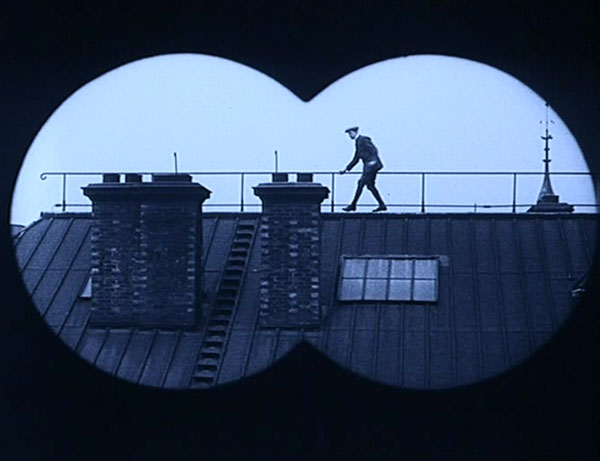
Fandor on the rooftops of paris:
image

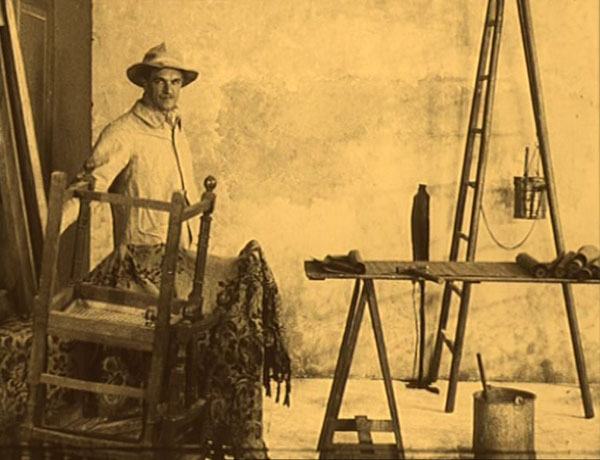
Juve (in disguise) approaches Fandor (studying list of victims):
image

They’ve got him cornered! Note trap door and icky gloves:
image


PART FOUR: FANTÔMAS VERSUS FANTÔMAS

Juve is arrested straight away on suspicion of being Fantomas (what, because he couldn’t catch the guy?). The movie is telling us that the written situations are more important than the characters, since our hero Juve sits out most of the movie, making Fandor the hero by default. Fantomas reappears as Tom Bob (seriously, that’s his name!), American Detective. Lady Beltham has remarried and become the Grand Duchess Alexandra. She organizes a costume ball to collect reward money for the capture of Fantomas, and Fandor, not thinking things through, goes to the ball dressed as Fantomas. So do a police captain and Fantomas himself. A Fantomas-fight ensues, the master criminal escapes and the captain is killed.

After Juve is finally released, he’s captured about ten seconds later by Fantomas’s men, who believe that Juve is really Fantomas and want their share of the loot that they’ve helped steal (Fantomas ripping off his own men is a running theme). Fandor is on top of the plot and helps bag the men, capture the loot, rescue Juve and even capture Fantomas, but F. slips the men by walking them into two holes in the ground, the silliest escape in the whole series. I’m starting to doubt that this is a planned five-part series which is building up to something… think it’s just a regular movie franchise that makes it up as it goes along (nope, turns out they are closely based on a series of novels).

Left: “Tom Bob” Right-center: blood leaking from hole in the wall, 70+ years before Evil Dead 2
image

Fantomas vs. Fantomas at the costume ball:
image

Juve, kidnapped, hears Fandor hiding in the barrel. People are always hiding in barrels and baskets in these movies.
image

Juve fingers the crooked guard, an inside man who works for Fantomas:
image


PART FIVE: THE FALSE MAGISTRATE

I was hoping for an awesome ending but it seems the series peaked with part two. The plot gets more ludicrous, with Juve voluntarily taking Fantomas’s place in a Belgian prison under the logic that F. was gonna break out anyway, and Juve’s men can just catch him at the border to France. Of course Juve’s men suck at catching Fantomas, so F. runs around impersonating a judge while Juve rots in jail for the first hour of the movie. Fandor buzzes around of course, but doesn’t do all that much… this one is mostly about the criminal, with his disguises and lucky breaks, ripping off the wealthy and his own gang members.

These gang members scammed a rich guy and his jeweler, no big deal. F. takes it a step further, killing the thief with the jewels in a horrible way (he is rung to death inside a giant bell), killing the rich woman’s husband then blackmailing her for more money. Fandor finally figures out what’s up, Juve is released and they corner Fantomas… but a few hours earlier, as the judge, he’d told the warden to release the master criminal Fantomas secretly at midnight because it would actually be Juve in disguise. Juve, unwittingly this time, helps Fantomas escape again!

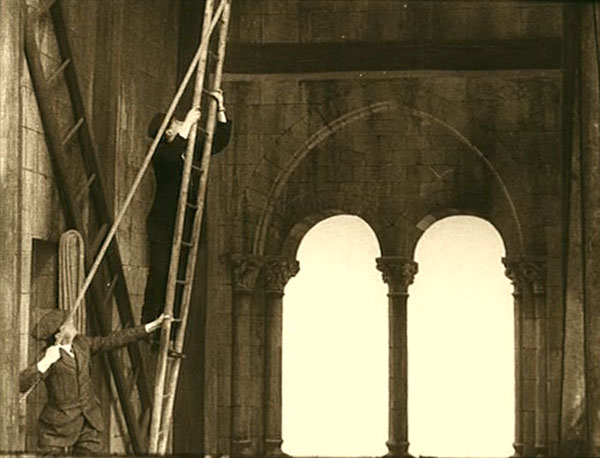
Fantomas helps dude up into the bell where jewels are hidden. Dude throws empty jewel case down and Fantomas takes away the ladder. The next day at a funeral when the bell is rung, blood and jewels rain down on the crowd. Wiiicked.
image

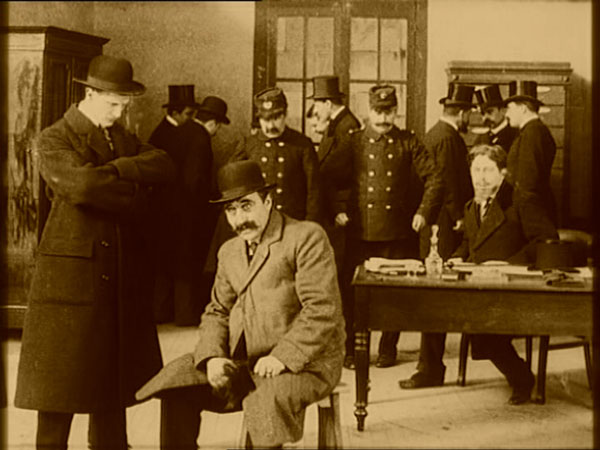
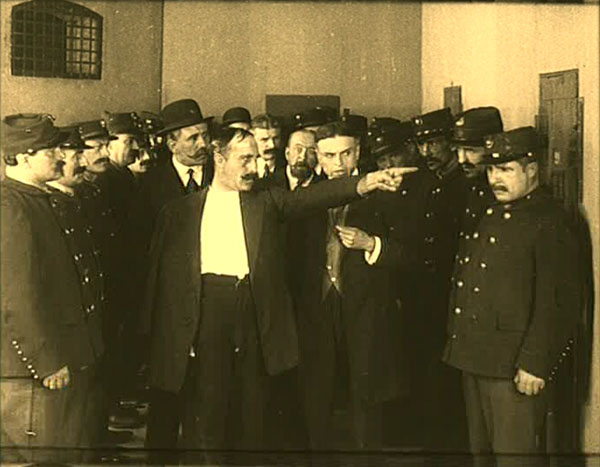
Note how the Belgian prison looks awfully like the French prison (above):
image

Fantomas, as the judge, feeling the pressure:
image

So is this one of the first great features of cinema? Does it meet expectation? Is it still a good movie today almost a century later? Is it as cool as that classic poster which now graces the DVD box cover? Well, no to that last one, but yes to the others. I still enjoy Judex better, but Feuillade’s crime serials are amazing fun, winking at the audience (sometimes literally) at times, getting cruel and serious at others, but always a good time to watch. And you can probably find someone who claims that they changed cinema forever… let’s see… yep, J. Travers says it introduces “not just the idea of a film series, but also [establishes] the crime thriller. The essential ingredients of film noir and the suspense thriller can be seen in this film which, remarkably, (when you consider when the film was made) still appears surprisingly modern.”

He qualifies the five movies: 1. most dreamlike and innovative, 2. best action, 3. most sophisticated, 4. most convoluted, 5. the weakest, comparatively mundane Each movie was divided into chapters with title cards – I didn’t realize each of these was a different serial episode! That means to see the complete Fantomas at the time of release, you would’ve had to go to the theater twenty-one times!

People are always mentioning how much the Surrealists loved these movies… I just read a whole website about it. Watched the bonus feature, wherein K. Newman immediately pronounces it “Phantom-ass.” Now I have to rethink the whole series, imagining Juve, wide-eyed, telling cops “this is the work of phantom-ass!” No wonder they eventually locked him up. Newman says the authors originally wanted to call it “Phant-o-moose” and now I think he’s just messing with us, under the “nobody watches DVD extras so we can say whatever we want” theory. Ahh, he says Diabolik was Fantomas-influenced – I can see that.

Edmund Breon (Juve) was in Les Vampires, took the 1920’s off, then appeared in fifty-some mostly British movies for the next two decades, waiting to die until after he’s been in Howard Hawks’ The Thing From Another World, a good move. René Navarre (Fantomas) was in movies through the 40’s, including a sound version of Judex. Georges Melchior (Fandor) barely made it into sound films. Renée Carl (Lady Beltham was in 180+ silent films – her only sound role was in Pépé le Moko (but last-billed).


“Did you folks in the audience just SEE that?”
image


This just in: a great article by David Bordwell on the series.

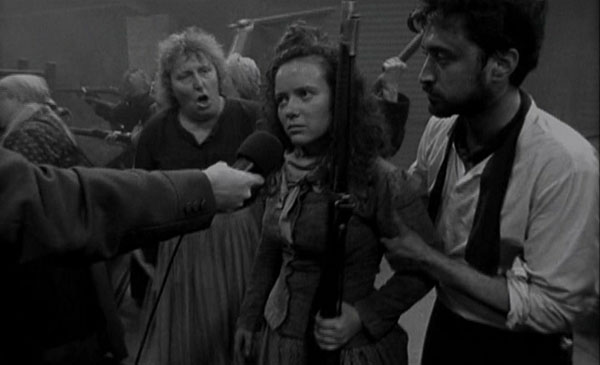
Story begins March 17, 1871 and ends two months later. Watkins introduces the movie via his two commune reporters (one of whom is played by Peter’s son Gérard, who has also acted in They Came Back and Diving Bell and the Butterfly), showing the set (a factory on the former site of Georges Melies’ studio!) at the end of the shoot. The set is minimal – walls and rooms were constructed, and props seem accurate and well-placed, but you never doubt that you’re on a set – you can see the walls, the lights, sort of Dogvillian. And the camera – of course the actors talk directly to the camera, since this is a Peter Watkins film. The cameraman (Odd Geir Saether from Edvard Munch) is always mobile, always shooting full cartridges at a time to be (slightly) edited later on.

image

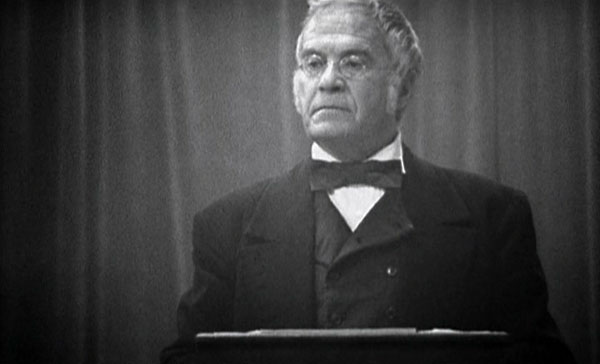
There are intertitles which comment on the action, fill in missing context, flash-back-and-forward, connect the revolutionary ideas of the commune with the present realities of France. People break out of character mid-scene to talk about the film and about their own present situations, to comment on the relevance of the film and of the commune – but they’re not talking to us, exactly, telling us what to do or think, it’s more that they’re working out their own thoughts and we can make what we will of it. That’s not to say the film is unbiased – it’s extremely pro-commune. The mass media is represented by a more traditionally shot right-wing telecast which gives twisted accounts of the events we see in the commune.

An official statement:
image

Most of the actors didn’t have screen credits before this one, but some have gone on to appear in other movies (The Barbarian Invasions, Eric Rohmer’s Lady and the Duke, Science of Sleep, Miracle at St. Anna, etc). They workshopped the story and their own roles, and came up with their own dialogue, full participants of the film. Some of this I learned from the very good hour-long doc on the disc The Universal Clock, which dares to ask questions (like whether Watkins is responsible for his own marginalization) as it discusses his career and the making of La Commune. This would actually be a fine standalone film to play before some of PW’s better movies for the uninitiated – it stands high above the usual DVD-extra fare.

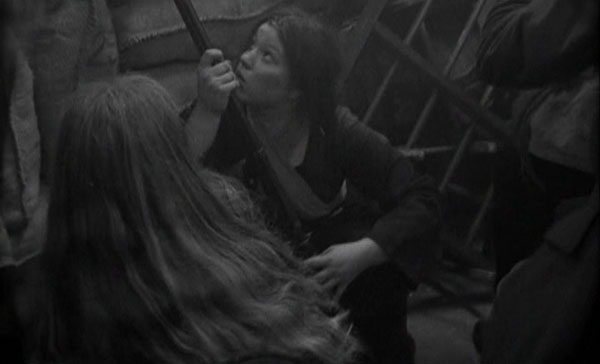
Lots of death and guns in the movie, all offscreen. Nobody is ever shown killed, no actor ever plays dead:
image

There’s a lot to say about the Commune and I’m not gonna say it all here. I’m worn out on the topic from watching all seven hours on these DVDs, and I’m pretty sure I’ll remember the important stuff (plus PW’s excellent website has a good summary).

The hated bourgeoisie:
image

Was the film good, though? Well, it’s far from my favorite Watkins feature (I’d maybe put it above The Gladiators). While it’s not dry and academic, it’s not exactly immersive – and while I wouldn’t say there were unnecessary scenes or that it should’ve been shorter, it’s exhausting at its present length, a mountain of a movie. The guy’s got a point that films and videos should not have to fit the “universal clock” of a television schedule, but this one didn’t fit the clock of my work week, and even with Katy out of town and my evenings supposedly all to myself, it still took me three nights to watch. So it’s an extremely admirable production, in every sense, about an important topic, but unlike other monumentally long films (hello, Satantango) I’m in no hurry to see it again.

image

I.
Movie opens exactly how I would’ve opened a Tom Petty movie, with a concert performance of “You Wreck Me”. And this is a four-hour movie, a four-HOUR movie, so I thought we’d have some breathing room and could afford the four minutes to hear the whole song uncut, set the stage for your epic Tom Petty documentary by letting us hear a whole Tom Petty song, just so we know what exactly we’re celebrating here. But P.Bog goes the obvious talking-heads documentary route instead, cutting into the song so people like Eddie Vedder, Stevie Nicks, Dave Grohl and Johnny Depp can tell us that they love Tom Petty and his music so much. Damn, almost had something there. I guess P.Bog doesn’t want people tuning in and thinking it’s gonna be a straight-up concert, but still, I hope in the next four hours he finds time to play one song, just one song all the way through without voiceover. Can you celebrate a musician without actually playing any of his songs?

We may not get to hear a song uninterrupted, but we can enjoy watching Johnny Depp talk without any bothersome on-screen text saying “Johnny Depp”. But I didn’t recognize half the people who spoke, so if he doesn’t eventually start with the text, I’ll just never know.

But look at me complain. It’s an enjoyable show so far, talking ’bout Petty’s early obsession with rock music and his meeting Mike Campbell and Benmont Tench and early days in Mudcrutch. All songs I’ve heard before from the box set with nice home-movie footage to go with it.

II.
Tom drives to L.A. to find a record deal, gets a few of those, Mudcrutch breaks up because the studio wants Tom more than the rest of the band, and the Heartbreakers are quickly formed to replace it. Their record producer wrongly assumes that they mean the name Heartbreakers ironically. Tom is shot in arty black-and-white.

III.
First two Heartbreakers albums are out. There was all of one sentence about the second album being more difficult than the first before they cut to people raving about it. Some good live footage, some talk about drug use. And finally, one entire TV performance of a song with no cuts or voiceovers. Hoorah! A “required monthly test” on my tape cut out one talky segment. The band was initially popular in Britain before they caught on in the U.S.. Someone’s trying to convince us that Tom Petty was part of the Talking Heads/Sex Pistols rebel new-wave/punk movement, since the Heartbreakers’ roots-rock was out of fashion on the radio, replaced by bloated dinosaur rock and disco. I guess it’s a workable theory but I want to hear David Byrne’s opinion first.

IV.
Third album was a big deal. Jimmy Iovine shows up and tells us that third albums are always big deals. Petty found out he was being dicked around by his record company and he sued them… big unprecendented event, led to settlement giving Tom more control and royalties from his music and the eventual release of “Damn The Torpedoes,” feat Refugee, Even The Losers and Don’t Do Me Like That. Movie plays nearly the whole album over the story.

V.
Some pressure for the fourth album, “Hard Promises”, another great one, feat. Insider and A Woman In Love. Very nice segment on The Waiting that starts with Petty singing it acoustic, cuts into music video / studio version, then after an interview piece closes out the song with Eddie Vedder on vocals during a live performance. We lost a bass player (no hard feelings), gained a new one (Howie Epstein), won another fight with the record company (over album pricing), dealt with Stevie Nicks, and played the great Stop Dragging My Heart Around. First time diving into Tom’s angry youth, his abusive father (plenty of hard feelings) and sweet mother who died during the recording of this album after long illness. Iovine presents his theory: missing mother + abusive father = rock star. Towards the end of 1982 I drove back to work blasting Insider with the windows open. Man, it’s only 1982… how long can P.Bog keep this up? Did he ever watch the whole thing at once?

VI.
Next album “Long After Dark” (the one with “You Got Lucky”) isn’t as good as it might’ve been. Producer Jimmy Iovine is blamed for his involvement. Next album “Southern Accents” (feat. Eurythmics-penned “Don’t Come Around Here No More”) isn’t as good as it might’ve been. Producer Jimmy Iovine is blamed for his lack of involvement. We get a full pretty-recent concert performance of the song “Southern Accents”, and a brief description of the drug-fueled two year period around the Accents album leading to Tom’s smashing his left hand into a wall. P.Bog uses an innovative cutting style during this segment, and intimate camera work reminiscent of his film “Texasville”. Haaaa I’m just kidding, it’s the same ol’ interview stuff. I turned it off after a black screen announcing the end of part one. I hope part two is on my videotape!

VII.
The album: “Let Me Up (I’ve Had Enough)” feat. Bob-Dylan-co-penned “Jammin’ Me”. Here in part two, Petty’s rock cred and history firmly established, we take an immediate P.Bog-style veer towards talking about all Tom’s Famous Friends. Tom and his group back up Dylan (who hadn’t played with a band since The Band), hang out with ex-Beatles and Jeff Lynne and Otis Redding and finally form the Traveling Wilburys, marking the point when Tom went from rebel-rocker to a guy whose records my mom would buy. I haven’t seen The Last Waltz but mentions of The Band got me wondering if this is P.Bog’s answer to that movie, a big rock statement blending his two main talents of reminiscing about the old days and namechecking famous friends. Oh but I shouldn’t be mean to P.Bog, don’t really know much about him.

VIII.
Wilburys record comes out and is a huge hit, then Roy Orbison dies so that doesn’t go any further. Tom alienates the band by making a solo-ish record in “Full Moon Fever,” but it’s the biggest hit of his career and the Heartbreakers play the songs live and they don’t seem so bitter anymore.

IX.
Tom continues to alienate the band, this time with the help of Jeff Lynne, “Into The Great Wide Open” producer who likes to record the band members one at a time instead of all together like they are used to doing. New drummer joins during “Wildflower” sessions and is asked to stay permanently when old drummer finally quits. They hang out with Roger McGuinn, Johnny Depp, Dave Grohl, Faye Dunaway. “Greatest Hits” sells ten million copies after Tom is finished grumbling about it. The band gets a little happier. I’m starting to be thankful that the movie is so long. It’s been nine lunch hours so far I’ve gotten to hang out and listen to Tom Petty stories, and I always feel like playing some Petty albums when I get back to work.

X.
I didn’t think I’d end up criticizing a four-hour doc for its omissions, but when it acts like it’s telling the whole story, those omissions seem serious enough to mention. Firstly, they didn’t mention the Petty/Heartbreakers soundtrack to She’s The One. I can see not wanting to spend a lot of time on it, but they could at least mention it in passing… it’s a great album. More importantly, Tom’s cameo as the mayor of Bridge City in the post-apocalyptic epic The Postman went unmentioned. “I heard of you, man… YOU’RE famous.” On the bright side, the band is back together. On the less bright side, nobody seems totally happy with “Echo”, least of all Tom, who was going through a divorce at the time of recording. Back up with a new wife and a hall of fame induction for “The Last DJ”, currently the Heartbreakers’ most recent album and a very good one. And then back down again as bassist Howie Epstein dies from drugs and is replaced in the band by original bassist Ron Blair. Oh, and the band backed up Johnny Cash on “American Recordings”, something else to be proud of.

XI.
Oh augh, the summary chapter. Would that the VCR chewed up my tape sometime between last time and this one. Tom is proud of “Highway Companion” but has nothing new to say about it. There’s some more concert and video footage, but mostly this is where we throw all the clips of people saying nice things about each other to leave us feeling good about ourselves and Tom and rock ‘n roll. Might work better if you’ve been spacing on the movie for four hours and gone through a couple six packs, but as a standalone episode it’s tedious. So I’ll keep my last words to a minimum: good flick, good tunes.

Commandment I: I Am the Lord Thy God
image

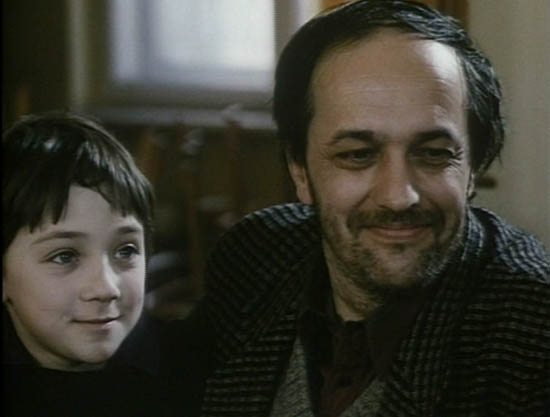
Boy lives alone with his father. They love (erm, “worship”?) their all-knowing computer, which calculates that the ice outside is thick enough to skate on. Kid’s aunt thinks the kid should have a more spiritual education, but dad disagrees because science and computers are where it’s at. Needless to say, the ice was not thick enough to skate on.

Sad, cold, dreary, dark episode, opens with a sad man sitting in front of a fire by the lake. DVD extras say that we’ll see him again. Starts/ends with the aunt watching TV news broadcast showing the kid running through school hallway with other kids a few days before the ice incident. Maybe this was a fine episode to begin the series theatrically, when you’re sitting wondering what’s coming next, but on DVD, I was bummed by this one (and by the circumstances of trying to watch it) so it took over a month before I made it to part 2.

The sad man acted in Kieslowski’s No End. The kid is my age, appeared in Schindler’s List.

image

———————————-

Commandment II: Thou Shalt Not Take the Name of Thy Lord God in Vain

image

Sad woman’s husband is deathly sick, is neighbor to sad doctor whose family died in bombing years ago. Doctor does his best, but it’s not looking good for husband. Thing is, wife needs to know if he will live or die, because she’s pregnant from another man and wants to know whether to keep the baby.

The episode might’ve seemed grim and dreary if it hadn’t followed the dead-child segment. Both were pretty affecting, but this one sucked me right in. Kind of a soapy sounding plot, but Kieslowski obviously not a soapy director, so it works. Doctor warms up to the wife, finally tells her the husband will almost certainly die, she phones boyfriend and breaks up with him (more or less) but keeps the baby and stays with the husband, who improves against all odds. Lot of close-ups, more dead animals and warm clothes, no sign of the sad man by the lake who introduced the series.

The doctor (above) played lawyers in both White and No End. The woman (below) starred in Wajda’s Man of Iron and in something called Life as a Fatal Sexually Transmitted Disease.

image

———————————-
Commandment III: Honor the Sabbath Day
image

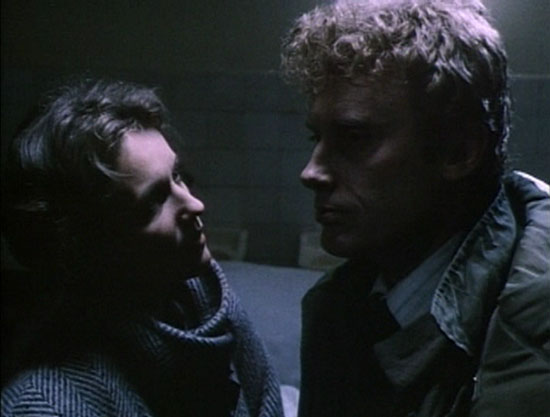
Cab driver’s ex shows up on Christmas eve and leads him on a wild goose chase, supposedly looking for her missing husband. In fact, her man left three years ago, and she is so lonely over the holidays that she tricks her ex into spending time with her. He catches on to some of the lies, maybe all of them, but he comes along anyway and returns to his own wife at daybreak.

A weird one, all deception with little truth about the background of these two and their former relationship… unless their past was mostly deception. I liked it, but not one of my favorites.

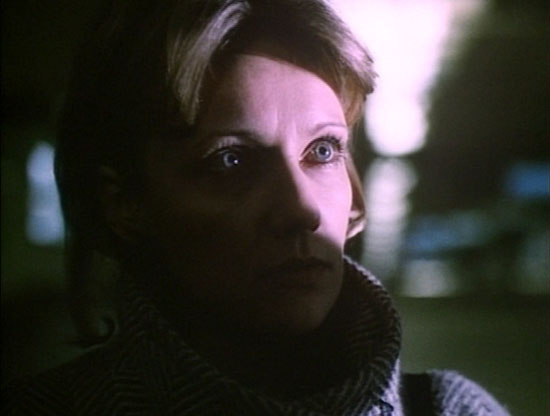
The woman is from No End. The cab driver appeared in The Unbearable Lightness of Being, currently a soap opera star.
image

———————————-
Commandment IV: Honor Thy Father and Mother
image

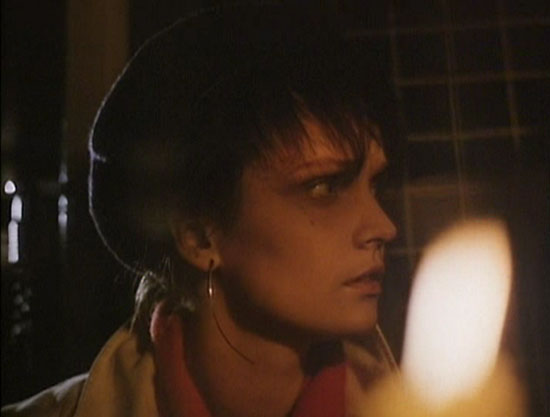
When Anka’s dad Michal goes out of town, she opens a letter marked “to be opened after my death.” Dad comes home and she shows him the sealed letter inside, in her dead mother’s handwriting, telling Anka that Michal is not her real father. Anka says that she’s always felt this to be true, and suggests they could be lovers instead of father and daughter. He doesn’t go for it… but Anka is toying with him, having written the letter herself and never opened the real letter (although the real letter very likely says the same thing).

Oh good, a real crazy one. Was Anka serious about any of it or was she only trying to expose her father? I liked it, though I started pondering alternate titles for the Decalogue and came up with Sad People Telling Secrets & Lies In The Dark. Sums up the last three pretty well. Our mysterious young man makes an appearance, carrying a white canoe.

The “father” was third-billed in Kieslowski’s White.

image

———————————-
Commandment V: Thou Shalt Not Kill

image

An antisocial youth, an antisocial taxi-driver and an idealistic young defense lawyer collide Crash-style. Youth is tired of dropping rocks off overpasses, damaging property and pushing men into urinals, decides to kill a taxi driver. Gets sent through the justice system, where our lawyer passionately but unsuccessfully defends him, finally hangs for his crime.

Good story, one of the more obvious and political ones. I mean, thou shalt not kill, you know? The sad young man shows up right before the murder, giving our antisocial youth a pleading look. I’d kinda prefer if this guy was obliviously walking through all ten tales, rather than acting like a helpless Wim Wenders angel all the time.

The cinematographer Slawomir Idziak (who had worked with Kieslowski before on The Scar) went hog wild on this one, filming the whole first half in sepia tones with encroaching shadows around the edges. It worked out well for him – he was hired back for the gorgeous Double Life of Veronique and Blue, and later did Gattaca, Black Hawk Down and the latest Harry Potter.

The beginning of the young lawyer and criminal’s acting careers, but veteran actor Jan Tesarz (the murdered taxi driver) went on to appear with Bruce Willis and Colin Farrell in Hart’s War. I recognized the woman with the dying husband from episode 2 as a would-be customer from whom the taxi driver speeds away.

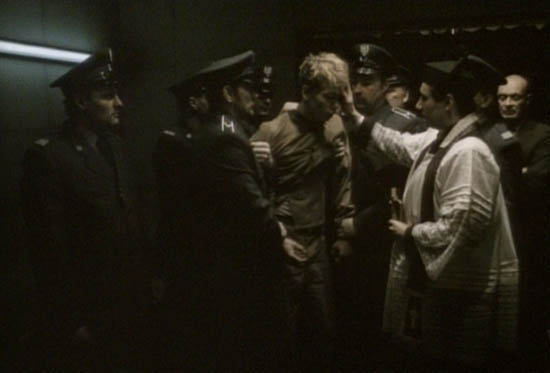
They arrested the wrong guy for the murder! Check out the white chalk “M” on the shoulder of the guard at Jacek’s right arm:
image

———————————-
Commandment VI: Thou Shalt Not Commit Adultery

image

A more conventionally shot episode, a voyeur movie that watches us watch it. Tomek, who lives with his “godmother” (his absent best friend’s mom) spies on Magda through a telescope every night, and stalks her in various other ways. She either warms up to the idea or decides to fuck with him, I haven’t figured which, and gets him over to her place one night for just a few minutes… after which he runs home and tries to kill himself. She is crazy with worry, finally he resurfaces and I guess he has gotten over her.

Extended version, A Short Film About Love, apparently has a different ending. This episode and the previous one (which also has an extended theatrical version) were both letterboxed.

Magda starred in No End, Tomek was Kieslowski’s assistant director on half the Decalogue episodes, and the godmother died in April ’88 – this was her last role.

image

———————————-
Commandment VII: Thou Shalt Not Steal

image

Lot of close-ups in this one. Young mother Majka and daughter Ania live with Majka’s mother Ewa (Anna Polony) and father (Wladyslaw Kowalski, star of that ugly live-cartoon movie Avalon). Elder Ewa treats little Ania as if she was daughter, not granddaughter, and Ania doesn’t even know Majka is her real mother. Majka solves this by kidnapping her own six-yr-old daughter during an outing and running away to the house of her former lover & high school teacher, now a teddy bear maker, giving it a sort of fairy-tale edge from the kid’s perspective. In the end Ewa gets the kid back but Majka flees on a train, and we’re left wondering where the kid really belongs, and whether Majka somewhat succeeded by convincing the kid that she is the real mother.

I liked. Same kind of morally questionable situation as parts two and five, but without the sour death tone hanging over it. If I ever get around to showing Katy a Decalogue episode, this would be a good starting point. Most of it takes place away from the apartment complex, and I didn’t see our Observer or anyone from another episode.

image

———————————-
Commandment VIII: Thou Shalt Not Bear False Witness
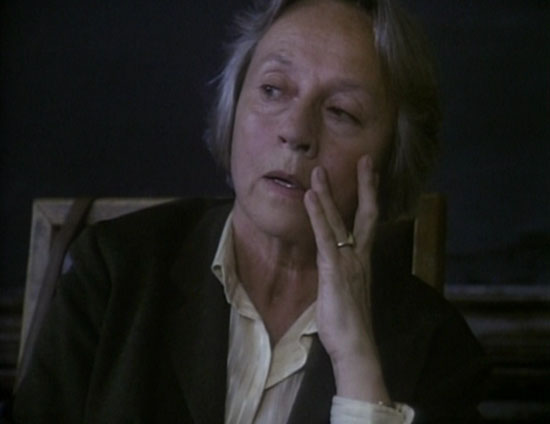
image

“Why do some rescue others, while others can only be rescued?”

Opens with a memory/flashback. Not showy camerawork, some handheld, a few intense close-ups. Zbigniew Preisner’s musical style is easy to recognize. Listened to hours of his soundtracks between the last episode and this one. A very good episode.

Old woman Zofia (Maria Koscialkowska, above, appeared in famous unfinished Polish film Passenger 25 years earlier) keeps herself in shape while everything around her is falling apart – pictures won’t hang straight, lights won’t stay on and car sounds like it’s always on the verge of dying. Zofia teaches a college course on ethics, featuring an extended reference to episode two (“I can tell you that the child lives”), where she is visited by middle-aged interloper Elizabeth (Teresa Marczewska, below). E. claims that as a young Jewish girl during WWII, she came to Z.’s house for protection and was turned away. Later she studied Z. from afar, wrote books about her, but wants to know why. Turns out there was some bad info about the people with E. being nazi collaborators and Z. couldn’t risk it. The women seem to trust each other now, but there’s a shady, uneasy tone to the episode, somewhat lightened when Z. comes across a friendly contortionist during a jog. At the end, Z. takes E. to a man who did help her during the war, now a tailor (Tadeusz Lomnicki, narrated Passenger and appeared in Blind Chance and Man of Marble) but he won’t talk about the old days.
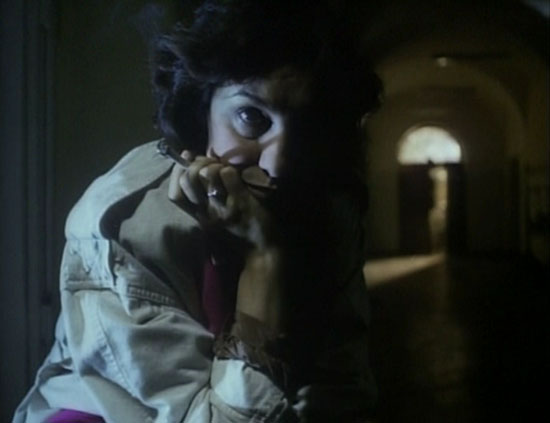
image

———————————-
Commandment IX: Thou Shalt Not Covet Thy Neighbor’s Wife
image

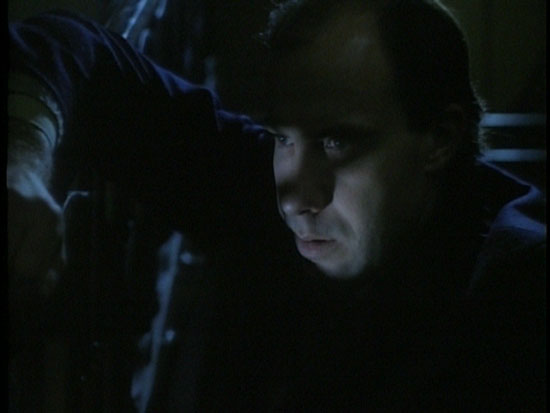
And now it’s the actual music from Blue, with heavy references to Double Life of Veronique in the story. A girl tells the surgeon “I’m not allowed to sing because my heart wouldn’t stand it” then recommends him some Von Den Budenmayer and adds “I know I’m someone else.” Cinematographer uses lots of light in almost every scene, a Decalogue rarity. Some lovely shots. Same cinematographer as part 3, later shot Red, then some random Hollywood stuff before his early death in 2001.

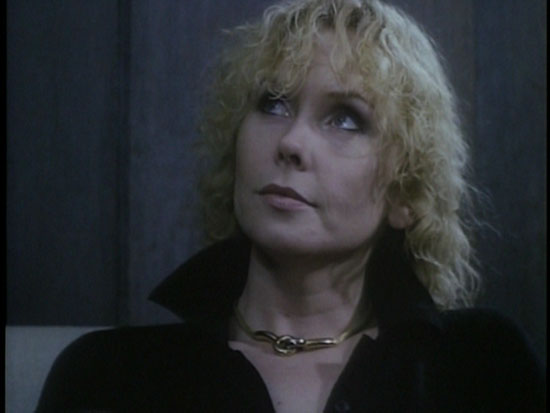
After former philanderer Roman learns he is impotent, he allows his wife to have affairs, but then becomes jealous and regretful. Roman hides, spies, believes that she loves the younger man more, when in fact she’s trying to get rid of him to stay with her husband. When she goes on a ski trip and Roman finds out the younger man is following her, he attempts suicide by bicycle, but survives for a tearful hospital reunion (and btw, he’s not impotent after all). Played a lot better than it sounds from my description.
image

———————————-
Commandment X: Thou Shalt Not Covet Thy Neighbor’s Goods

image

Involves death, robbery and deception, and does not end well for our heroes, but it seems lighthearted in comparison to the others, full of dark humor. One of the least believable of the series, which adds to the humor… these guys don’t quite seem real, so their loss isn’t as sad as it might be. Had the degree of obsession they show at the end (studying new stamps they bought for a few cents at the post office) been shown before the Scott Thompson guy opted for surgery to trade his kidney for a rare stamp, it might’ve turned more into a horrifying drama than a comedy.

Lead singer of a punk act Artur (Zbigniew Zamachowski, star of White) and family man Jerzy (Jerzy Stuhr, also of White and star of Camera Buff, who looks like Scott Thompson) are brothers who unknowingly inherit the largest, most valuable stamp collection in the country from their father. First they consider selling, but they’ve inherited their dad’s collector bug as well, so they move to protect and then to expand the collection (Jerzy trades a kidney for a one-of-a-kind stamp to complete a series). But all the stamps (except that one) are stolen while Jerzy is in the hospital.

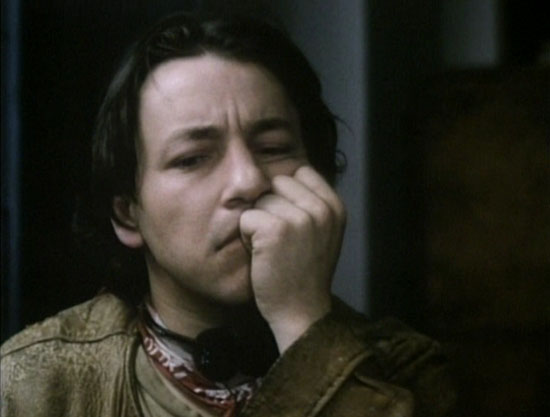
Episode opens with Jerzy singing about breaking all the commandments. A kid who scams the brothers on behalf of other collectors was Tomek, the peeping tom from part six. Minimal music, uses drum rolls for punctuation, adding to the comic effect.
image

———————————-

I didn’t watch these all at once. Started this entry August 2007, posted June 2008, whew.

Kieslowski: “When you work with the ten best cinematographers in the country, a kind of contest develops. … We managed to avoid the rut you fall into when you make films that take longer than two or three months to shoot. Things were different all the time. … I gave great freedom to my coworkers and friends the cameramen.”

Here’s to the cameramen! Some more screenshots:

image

image

image

image

image

image

image

“Popular unity against the criminal bourgeoisie!”
image

Other street protest chants:
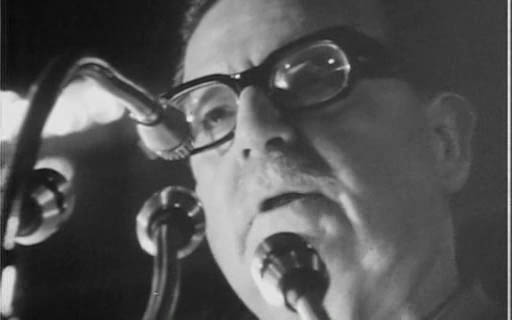
“Bourgeois shit, the street belongs to the left!”
“We need an iron hand!” (?!)

I alternately see this referred to as an epic 1979 movie, a long two-parter with a third-part postscript, or three separate movies. I guess they were presented theatrically in different ways in different countries. The 2/1 split seems right to me, as I’ll explain.

Part one drops me into the middle of an election in March 1973, which I didn’t understand until towards the end of the movie. I wondered why nobody was saying Salvador Allende’s name – turns out it was a senate election, and either the pro-Allende party lost, or they just did not gain enough seats in congress to prevent the opposition from holding a majority. So for the rest of Allende’s short reign as president, the country’s senate is mostly against him, undermining his authority. Movie is on the street, taking opinions from everyone, kind of slow at the start since I don’t know what’s happening, but excitement is in the air, and things straighten out soon enough. Cameraman is terrific, patient but curious, always looking for the best thing to shoot even if it means wandering off the person talking. I can’t believe the sound guy can keep up with him, but he does.

Salvador Allende:
image

A politician:
image

image

image

Part two picks up right where the first one ends, with an attempted military coup on June 29 1973, and part two ends Sept. 11 1973 with the successful coup that killed Allende and instated General Pinochet as ruler. In between those dates, Guzmán covers everything that happens in the whole country, it seems, with access to the marches, the debates, worker meetings, everything but the secretive military that turns against its country (with help and provocation, it turns out, from the U.S. government). This is by far my favorite of the three parts, and could easily work as a standalone movie… I see the Film Forum in NYC thought so as well. The events themselves, a democratic country swerving communist then falling military-dictatorship, is the best movie material you could hope for and Guzmán and his crew make the best of it, watching from ground zero as history is made, producing one of the best docs I’ve ever seen.

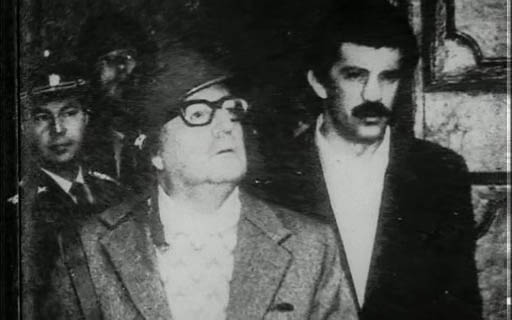
Military man who shot and killed Argentine cameraman Leonard Hendrickson at the end of part one:
image

Salvador Allende, file photo:
image

Bombing of the presidential palace:
image

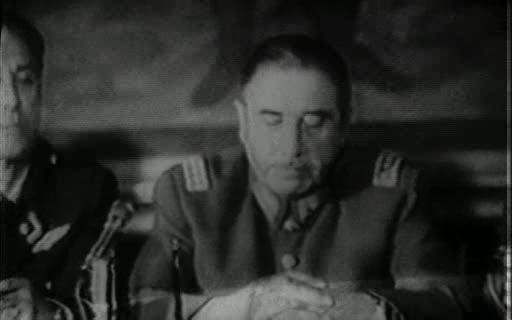
Pinochet addressing the nation on TV:
image

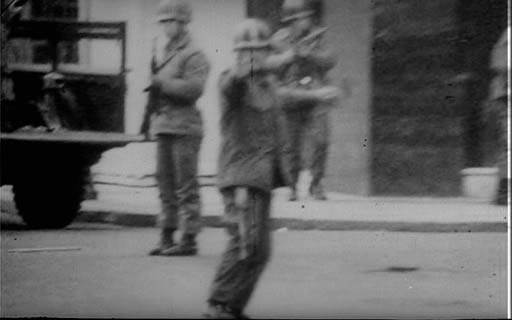
Military rule:
image

Pinochet: “After three years of support for the Marxist cancer we have been given a disaster that is economic, moral and social, that could not continue to be tolerated by the sacred interests of the mother country.” (or something like that – I think it’s all amateur-translated)

Guzmán: “From the 11th of September, all resources of the Chilean army are mobilized to repress the popular movement with the compacency of the North American government. The first armed resistance offered by some industrial cords, agricultural populations and student centers are squashed quickly in unequal fight. Thousands of people are killed and the main sport fields become concentration camps. The longest democracy in the history of Latin America ceases to exist.”

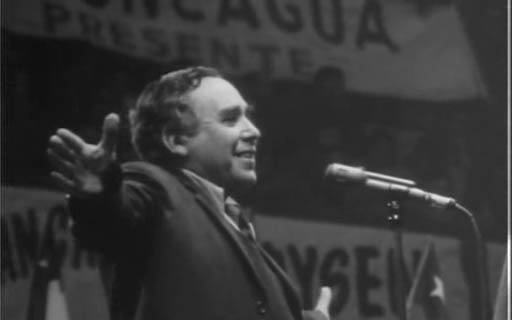
I don’t exactly wish I’d skipped part 3, but it would’ve made a nice recap six months later instead of watching it right after 1 and 2. Filmmaking in Chile wasn’t easy during Pinochet’s rule, since Pinochet was killing and imprisoning everyone who disagreed with him, including the cameraman of Battle of Chile (to whom the completed work was dedicated), so Guzmán backs up and shows further details of the workers’ movements during Allende’s presidency, not again mentioning Pinochet or the violence. The many worker meetings and the creation of multi-factory blocs and the attempted attack on Allende’s credibility by the “Christian Democrats” (his primary opposition) via a U.S.-funded transportation strike had all been covered in the previous films, but now we see them in greater depth… “depth” meaning lots of guys with sideburns talking into microphones at meetings. Since I’m not personally interested in creating a communist worker’s paradise in my own neighborhood, part three wasn’t of much use to me, but I’ll bet it’s exactly what Chris Marker was hoping for when he helped fund Guzmán’s efforts to document what was happening in the country. Marker’s own angry reaction to the coup is documented in his short Embassy, which I’ll have to watch again now that it’s on a new, clean DVD.

The transportation strike:
image

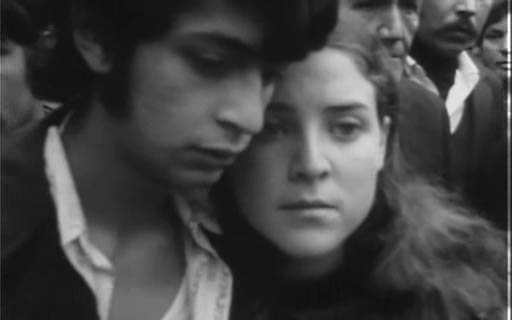
The people:
image

The sideburns:
image

The revolution:
image