A vacationing Marianne and Nicolas visit the estate of long-idle painter Frenhofer and his wife Liz, where an unguarded look by Marianne gets Fren’s artistic urges raging once more. Nicolas tells Fren that Marianne will pose for a painting without asking M.’s permission first, but she comes anyway, with an angrily determined look on her face, to spite Nic. First few scenes when she goes naked in the studio are just astounding. Frenhofer goes about his work, setting up a drawing table, sketching some lines (Rivette, in his usual fashion, shows us the entire artistic process, omitting nothing for the sake of runtime), while M. has this incredible internal struggle visible on her face. It probably helps a lot that the film was shot in order, so the character and the actress become increasingly comfortable with her nudity as the audience does too.

image

Fren’s relationship with his wife Liz proves to be complicated. She was once his model, and the very painting he’s attempting to achieve with Marianne was once begun and abandoned with Liz. In her conversations with Fren and Marianne and Porbus the art dealer (with whom she once had an affair) and in her movements and her uneasy looks we get a wonderfully conflicted character. She’s never showy or artificial – the only one here who fits that description is Marianne’s boyfriend Nicolas, who grows increasingly absent. He comes back towards the end when his sister arrives to artificially force a closure to Nic and Marianne’s long limbo-vacation. Marianne, either dedicated to the painting or still stubbornly trying to prove her mettle, refuses. When she sees herself in the finished painting, sees what she’d been trying to hide while apparently so exposed, Frenhofer watches her expression, and what he sees convinces him to hide the painting forever behind a brick wall and stay up all night creating a substitute, a less powerful work which pleases Porbus and sickens Nicolas. I wonder if Frenhofer’s falling in love with Liz prevented him from ever finishing the painting a decade earlier, for fear of scaring her, or if his falling in love prevented him from being able to see that part of her which would enable him to finish it. Either way, a very satisfactory ending, the masterwork completed but Frenhofer, a greater man than Nicolas, hides it for the well-being of the two women.

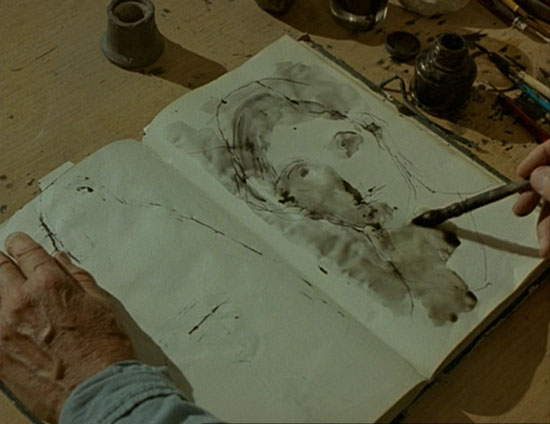
Simply filmed, mostly in long takes in authentic locations. I mean, the shots aren’t Tarr-long, or even Rivette-long, just longer than most films – though there are authentically long insert-shots of sketches and drawings created from scratch before our eyes. I watched with headphones and found the sound of Fren’s pen scratching across his notepad to be almost unbearable. Rivette’s usual favorite sound effect of footsteps on a wooden floor can be muted when convenient, as when Liz comes into her husband’s studio and watches unnoticed.

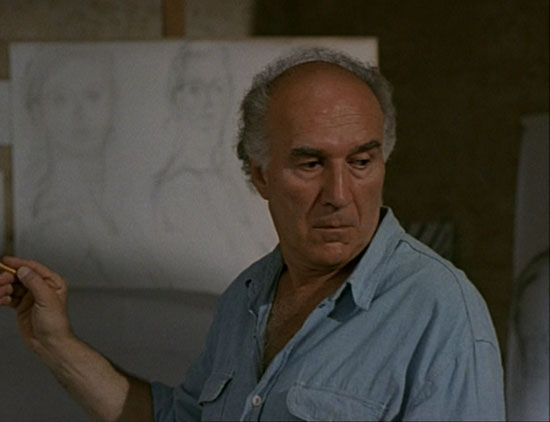
Frenhofer = Michel Piccoli – Simon Cinema himself, of lots of films by Ruiz, Oliveira, Godard, Bunuel, Hitchcock, Varda, Demy, Resnais, Malle, Clouzot, and Mario Bava.
image

I just saw Emmanuelle Béart as Marie, and she’s been in two different movies called L’Enfer.
image

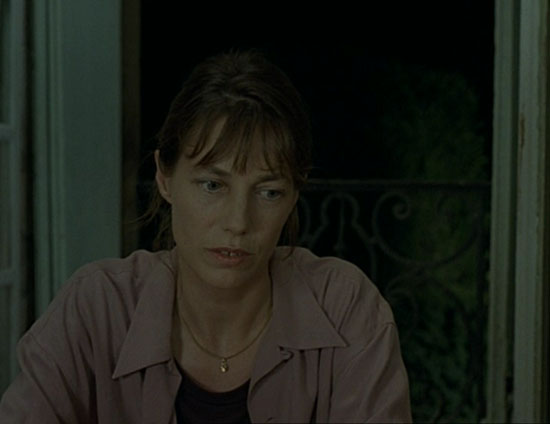
Jane Birkin was in Love on the Ground, Same Old Song, Kung-Fu Master, Keep Up Your Right and Blow-up.
image

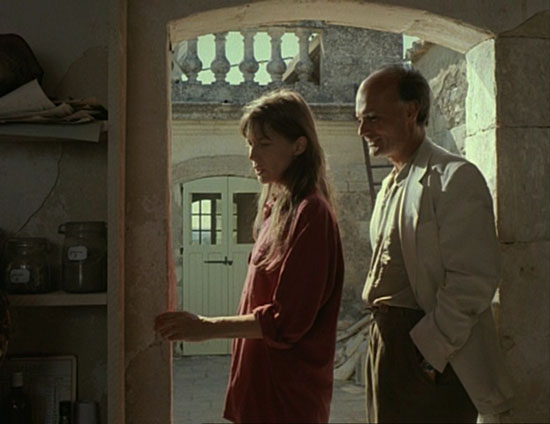
Art dealer Porbus (right), Gilles Arbona was in similarly-titled La Belle Captive.
image

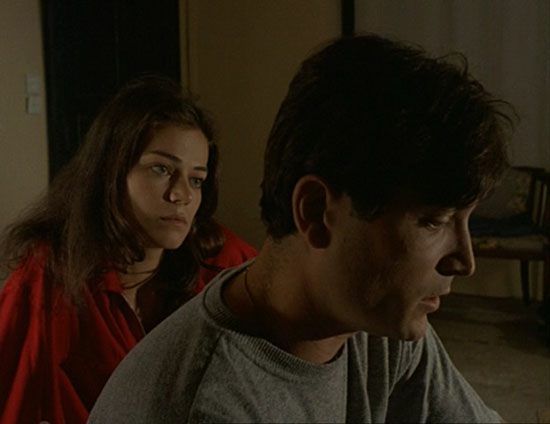
Nic’s sister Julienne, Marianne Denicourt (left with David Bursztein as Nic), later starred in Haut bas fragile and played Victor Hugo’s wife (?) in a French TV biopic of Balzac.
image

“And the hand of painter Bernard Dufour.”
image

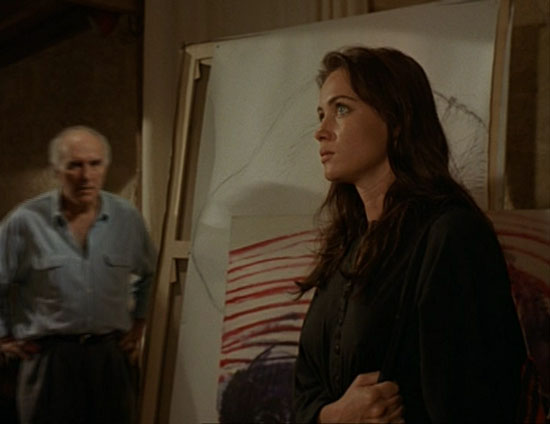
Towards the end, when Frenhofer is through sketching and has started to paint, we see the first slash of red across a canvas. There’s more red during the next painting session, and when we glimpse the bottom of the “true” completed painting from under a sheet it’s mostly red). The false ringer painting is almost all light blue.
image

J. Heilman:

The film begins unassumingly in a hotel courtyard where we see a young man stealthily sketching some seemingly oblivious English-speaking tourists. As Rivette’s camera continues to pan, however, we find that our casual artist is actually the subject of another’s art. A woman on the hotel’s balcony furtively snaps a photo of him, but is noticed by sketcher, who becomes visibly irate. As soon as he confronts her, though, it becomes immediately apparent to us that most of this incident was a ruse. The two artists are lovers, and their coyness was entirely put on. Spurned by the excitement of their charade, they retire to the bedroom. The stunt even continues a bit farther than planned when one of the tourists watching this amorous French drama unfold says to another in mock culture shock, “Well, what do you expect?” This seemingly frivolous episode resonates throughout the rest of the film, since it manages to say much about the relationship between an artist and subject, the secretive, similar natures of art and love, and the need to sometimes create an environment where ever-fleeting inspiration might strike. It’s these themes that come to the fore during rest of the long journey that La Belle Noiseuse takes.

image

K. Uhlich in Slant, less reverential than most, says it “vacillates between genuine insight and didactic mystique-of-the-artist bullshit.”

Won the grand jury prize at Cannes, but didn’t have quite enough of that barton fink feeling to take the golden palm. Did not take the nation’s award shops by storm – lost the Cesar to some Gérard Depardieu flick, and wasn’t nominated for an Oscar or much else. But it did put Rivette’s name back into public circulation.

I watched two-hour edit Divertimento a couple months later.
“The hand of painter Bernard Dufour” barely appears in it!

Music by Igor Stravinsky, and the name Divertimento was stolen from the short version of one of his works. An in-joke for Stravinsky fans. That fits in with the Balzac references and the fact that the entire project was based on a joke, a flip fake answer Rivette would give when asked about his next project.

Jacques Rivette:
image

This will be one to watch again when I know more French, or just when I’ve lived longer.


Chapter 1(a), “Toutes les histoires” (“All the (Hi)stories”)

Dedicated to Mary Meerson (Langlois’s companion who helped run the Cinematheque) and Monica Tegelaar (producer of Raoul Ruiz’s On Top of the Whale).

image

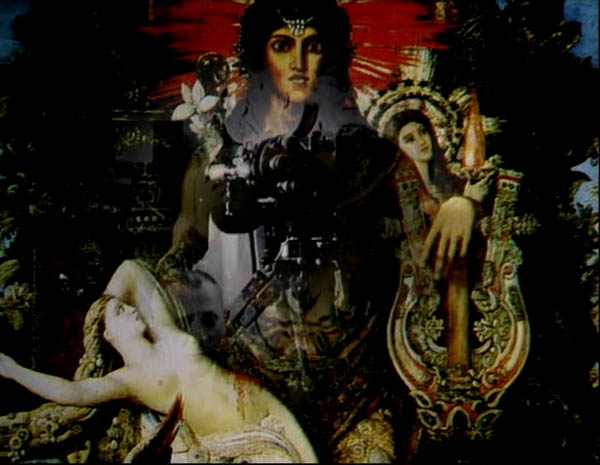
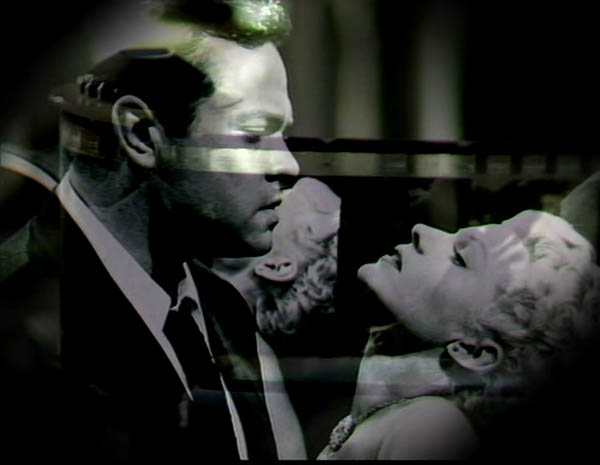
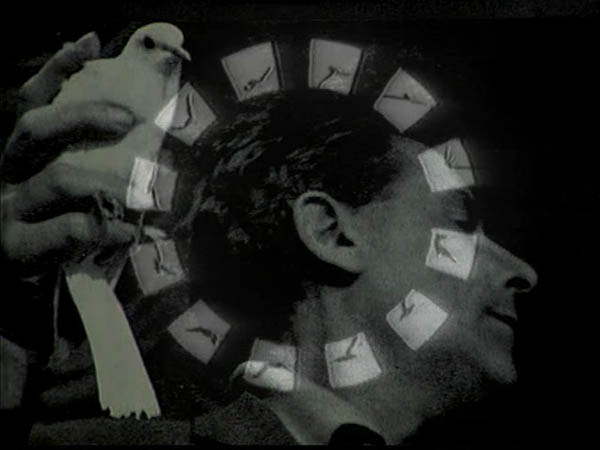
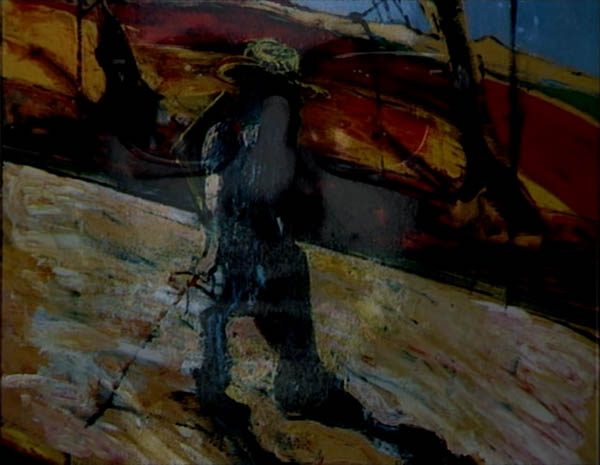
IMDB says parts one and two came out in the late 80’s, and the rest followed in the late 90’s. This one seemed more like a 50-minute trailer than an episode. Montage of archive footage, still and moving, edited and faded and superimposed and blended together. The footage includes scenes from films of course (rules of the game, great dictator, day of wrath, germany year zero) but lots of stills (producers, directors, Thalberg, Hughes) and paintings. Lots of focus on World War II, and ending with that Germany Year Zero segment, the whole thing came off as vaguely depressing. Maybe that’s why it took ten years to get the rest of the episodes made?

Three images overlapped: (1) Rita Hayworth dancing, (2) a drawing of Howard Hughes in his final days, (3) the witch-burning scene in Day of Wrath.


Chapter 1(b), “Une Histoire seule” (“A Single (Hi)story”)

Dedicated to John Cassavetes and Glauber Rocha (Brazilian director of Black God, White Devil).

image

Surprising number of references to Godard’s own films. Tons and tons of stuff I am not getting because I don’t know much French (I pick up half the film titles and some of the short sayings printed onscreen) or art history, and haven’t seen most of the films. Should’ve known better than to think part two would be more straightforward or make more sense. Even if I don’t know what it’s saying, I still get interesting juxtapositions of images and nice shots from great films seen and unseen, which is enough to keep me watching. Sounded like I heard some Leonard Cohen and Neil Diamond.


Chapter 2(a), “Seule le cinema” (“Only Cinema”)

Dedicated to Armand J. Cauliez (a writer, published a book on Jacques Tati) and Santiago Alvarez (Cuban filmmaker).

image

Fast-forward a decade. Same ol’ thing here, but two big changes:

(1) Not just montage of pre-existing footage edited with Godard in his study anymore. An actual actor, Julie Delpy, reading poetry. Also an interview with Godard by another guy (couldn’t be Serge Daney – he died in ’92), 90% untranslated.

(2) Me getting a little tired and pondering making my own historie(s) of cinema instead


Chapter 2(b), “Fatale beauté” (“Deadly Beauty”)

Dedicated to Michele Firk (film writer turned militant radical, killed herself in Guatemala to escape arrest) and Nicole Ladmiral (actress in Bresson’s Diary of a Country Priest).

image

Sabine Azema (above) recits some poetry, much of it untranslated. Godard types at his typewriter some more. I listened in the headphones and a background noise (JLG’s pet bird?) frightened me. Something about photography being invented in black and white as the colors of mourning to note the death of reality. And something about women, and murder, and Band of Outsiders and Rancho Notorious and Gone With The Wind. Good to see that Godard appreciates Tom Waits.


Chapter 3(a), “La Monnaie de l’absolu” (“The Coin of the Absolute”)

Dedicated to Gianni Amico (Italian filmmaker, assistant director on Bertolucci’s Before the Revolution and Godard’s Le Vent d’est & James Agee (film writer, champion of Chaplin’s Monseiur Verdoux, writer of Night of the Hunter and The African Queen)

image

or part 3A, the war and futility episode. WWII talk leads into an appreciation of Italian Neorealism and the most clearly presented introduction to a certain aspect of cinema and history thus far in the series. Says that Italian cinema in the 40’s and 50’s changed film like Manet (the godfather of modern art) changed painting. Closes with a nice montage of Italian film (minus too much onscreen block text and crazed fade transitions) set to a Richard Cocciante song. This episode has a clear point and meaning and narrative arc and supporting arguments… I don’t understand. Maybe the others have too, and I’ve been missing it. Juliette Binoche appears with Alain Cuny (of Les Amants and La Dolce Vita), who died in 1994, four years before this episode aired. Julie Delpy looked mighty young in her segment too – maybe all this footage was shot in the 80’s and not finished editing until ten years later.


Chapter 3(b), “Une Vague Nouvelle” (“A New Wave”)

Dedicated to Frederic C. Froeschel (head of a cine-club in Paris, 1950) and Naum Kleiman (Russian film critic, director of the Moscow Film Museum).

image

“Becker, Rossellini, Melville, Franju, Jacques Demy, Truffaut. You knew them.”
“Yes, they were my friends.”

A personal episode, sometimes celebratory but more usually melancholy. Godard himself is the guest speaker this time, but he’s actually into it, not just distractedly reciting behind his typewriter. These things never quite seem to begin, the opening titles still playing when the episode is half over. Some 400 Blows, some Henri Langlois, more goings-on about the death of cinema. What, is video the new art form?


Chapter 4(a), “Le Côntrole de l’univers” (“The Control of the Universe”)

Dedicated to Michel Delahaye (actor in Out 1, Alphaville, plenty more) and Jean Domarchi (1950’s, 60’s Cahiers critic, had a bit part in Breathless).

image

Another really good one. Probably not coincidentally, all the voiceover on this one is translated, so I was able to understand it. Lots of voiceover – it’s getting to be more of an essay lately and less of a purely visual slideshow. Still plenty of that dull video text, white-on-black block lettering. The thing always drags a little when JLG decides to move those words around the screen for thirty seconds before returning to the film clips. When there were clips, it seems half of them were by Hitchcock, “our century’s greatest creator of forms.”


Chapter 4(b), “Les Signes parmi nous” (“The Signs Among Us”)

Dedicated to Anne-Marie Miéville (one of Godard’s collaborators since 1976) and to Godard himself.

image

I hope nobody stumbles across this entry hoping to learn about the film, because I really doubt I understood most of it. More more more war images in this section (have I mentioned that the film is obsessed with WWII?) and more ponderings on love, death, art, history, man, the state, and Charlie Chaplin. And it seems to me that Godard is terribly depressed. Anyway, here’s a good bit of the voiceover from the last eight minutes:

I need a day to tell the history of a second…
I need an eternity to tell the history of a day.

We can do everything except the history of what we are doing. It is my privilege to film and live in France as an artist. Nothing like a country that every day walks further down the path of its own inexorable decline.

I am the fugitive enemy of our times. The totalitarianism of the present as applied mechanically every day more oppressive on a planetary scale. This faceless tyranny that effaces all faces for the systematic organization of the unified time of the moment. This global, abstract tyranny which I try to oppose from my fleeting point of view. Because I try, because I try in my compositions to show an ear that listens to time. And try to make it heard and to surge into the future.

The only thing that survives from one epoch is the art from it created. No activity can become an art until its proper epoch has ended. Then, this art will disappear. Thus, the art of the 19th century – cinema – made the 20th century exist, which barely existed.

Cinema feared nothing of others or of itself. It wasn’t sheltered from time. It was the shelter of time. Yes, image is happiness. But beside it dwells nothingness. The power of the image is expressed only by invoking nothingness. It is perhaps worth adding: The image, able to negate nothingness, is also the gaze of nothingness on us. The image is light. Nothingness, immensely heavy. The image gleams. Nothingness is that thickness where all is veiled. The most fleeting moments possess an illustrious past. If a man passed through paradise in his dreams and received a flower as proof of passage, and on waking, found this flower in his hand… What is there to say? I was that man.

Thought I’d watch the Cannes 1988 press conference, but after the first three minutes (“video artist” Godard passionately attacking television) it all turns French.

From a belatedly-discovered interview between JLG and J. Rosenbaum:

JR: Yes, but it also isn’t legally acknowledged that films and videos can be criticism.
JLG: It’s the only thing video can be — and should be.

With that strong distinction between film and video, it occurs to me that JLG considers Histoire(s) as being about cinema but not being a work of cinema itself. I watch Breathless on my TV and say I’ve seen one Godard movie, then I watch Histoire(s) on my TV and say I’ve seen two Godard movies. JLG should like to smack me for such a thought.

The charactors (actors) and their relationships seem more important than plot/storyline, so I’ve made a page for the characters first, then a story summary page, separated into day one and day two, totalling my most complex journal entry to date!

I spent all this time on plot and character description, not necessarily because the story elements are so important, but because I may not get to see this again and I want to be able to remember it.

Thankfully, I have a downloaded copy of the movie from Raitre Italian TV, so I can get lots of screen shots.

But what of the movie, overall? Worth the trip to New York to see it, for sure. A total experience of a film, from the dedicated audience to the live subtitles to the 16mm presentation to the museum theater that hosted it to the sheer length and intermissions to the Jean-Michel Frodon (Cahiers du Cinema editor) introduction to the content, with its very long wide shots and very gradually developing story… many scenes that only form a complete big-picure scenario if you’re paying close attention for most of its runtime.

Dennis Lim of the NY Times called it “the cinephile’s holy grail” and says:

In the annals of monumental cinema there are few objects more sacred than Mr. Rivette’s 12 1/2-hour OUT 1. Shot in the spring of 1970, this fabled colossus owes its stature not just to its immodest duration but also to its rarity. Commissioned and then rejected by French television, the film had its premiere on Sept. 9 and 10, 1971, at the Maison de la Culture in Le Havre before receding into obscurity . . . has become a true phantom film whose reputation rests on its unattainability . . . Mr. Rivette worked without a script, relying instead on a diagram that mapped the junctures at which members of his large ensemble cast would intersect. The actors came up with their dialogue; the only thing Mr. Rivette actually wrote were the enigmatic notes Mr. Léaud’s character receives . . . With OUT 1 he found the perfect match of form and content, an outsize canvas for a narrative too vast to apprehend. In a 1973 interview Mr. Rivette described the film’s creep from quasi-documentary to drama in ominous terms: the fiction ‘swallows everything up and finally auto-destructs’.

I love it – not just a legendary museum curiosity that people pretend to like to impress other cinephiles, but actually an amazing film worthy of its reputation. Of course, mostly its reputation is that of an unattainable film (we were told this was the eighth-ever public screening), not of a great masterwork… but I guess it’s worthy of both of those.

The experimental theater exercises get very long, even too long, but not tedious. If a scene lasts “too long” in a regular movie, maybe you could’ve trimmed two minutes to make it feel right. But the theater scenes aren’t necessary at all, from a story point of view, so there’s no telling how long they need to be. When it hits me that I’ve been watching the same theater scene for twenty minutes, it’s not annoyance but awe that hits me. It’s hard to say what exactly is necessary in this movie… once you start cutting or shortening scenes, tying up loose ends and clarifying character connections and histories, you’re talking about a different movie (and not SPECTRE, but a different movie entirely). Best leave it the unwieldy beast it is, and appreciate it as that.

Dennis Lim’s article is a good one… here’s more:

“Out 1” now seems a relic of a bohemian heyday, a time when you could spend your days rehearsing ancient Greek plays or making 12-hour films. But even in 1970 that hazy idyll was already fading. The film takes its shape, as Mr. Rosenbaum has noted, from “the successive building and shattering of utopian dreams.” An epic meditation on the relationship between the individual and the collective, “Out 1” devotes its second half to fracture and dissolution. But it’s not a depressing film, perhaps because its implicit pessimism is refuted by its very existence. Experiential in the extreme, “Out 1” cannot help transforming the solitary act of moviegoing into a communal one.

And Lim says that Rivette’s 2007 movie Don’t Touch The Axe will be revisiting Balzac’s “History of the Thirteen”. “Does this represent a closing of the circle? An expansion of the master plan? If there’s one thing we know from Mr. Rivette’s films, it’s that the big picture will remain just outside our grasp.”

Ah ha: Rivette’s interview from Film Comment… he says shots of Paris’s landmarks “were inserted…frankly as empty spaces. As a kind of visual silence. . .” I had been wondering.

Reverse Shot says: “In Rivette there’s a sense, not just of watching or duration, both of which are passive ideas, but of actively being put through a process”.

Crawford in Reverse Shot:

Out 1 was made in the aftermath of the social uprising of May ’68, when a series of strikes by Parisian student unions devolved into a full-bore confrontation with the military. What once began as a hope to radically reinvent the mores of a stagnant and conservative society ended meekly, with the unions urging a peaceable return to work and De Gaulle’s party consolidating its power to a greater degree than ever. Out 1 taps into this post-May ’68 malaise, betraying an abiding mistrust in grand social movements, services organizations. Paris is turned into a disconnected amalgam of individual groups hermetically sealed off from one another. . .

Is it too simplistic to describe Colin as a spectator’s surrogate and leave it at that? What do we make of choice to pose as a deaf-mute and his return to that state at the end of the film? How, for that matter, do we take of the weird behavior of the male (Colin) and female (Frédérique) interlopers? Their logic and mode of behavior is vastly different from anyone else in the film; it’s like they’ve parachuted in from Céline and Julie Go Boating.

I’ll probably remember the feeling of Satantango, the length of it, the way it moves and the way it looks, a lot longer than I’ll remember the plot and characters. So here:

The money from the harvest has come in. Mr. Schmidt is planning to run off with Mr. Kraner and their wives instead of splitting fairly eight ways. Futaki, sleeping with Mrs. Schmidt, finds out and wants in. The doctor watches all this from his room getting drunk on fruit brandy. But the news is that Irimias and Petrina, long thought dead, are approaching town.

At the bar, Mr. and Mrs. Halics frolic with the innkeeper and a talkative Kelemen (“Irimias hugged me and the waitresses jumped like grasshoppers and I was plodding and plodding and plodding”) while the Doctor fails to make the long walk in the cold rain to get more brandy, the town prostitutes have no customers, and a young neglected girl kills her cat then herself.

Irimias shows up at the funeral and rebukes everyone, tells them he will help them start a new life with meaning and honor if they give up all their cash. They abandon the town and head for a crumbling manor, but Irimias shows up soon and says the time is not yet right, that they must scatter and live quietly until attitudes shift enough that they can begin this new life. Irimias fiddles around trying to get lots of gunpowder, finally submits some kind of report to the police captain informing on the former townsfolk, whom he clearly detests. The doctor, alone at home after a hospital visit, boards up his windows.

Simply amazing to sit in a dark theater for eight hours, surrounded by this movie. Time expands and contracts, bends and warps, loops back upon itself. The black-and-white cinematography, the scattered diehard audience, the closeness to the screen, the jitters and scratches and cuts in the film, the swing between almost inaudible dialogue and ear-splitting bell-ringing, the middle-of-the-night drive home from Nashville… the most perfectly realized cinema experience I’ve had for years. A true cinephile/cult film. Seeing it at home on video over the course of a few nights was to study the movie, to follows the story and see what the movie might look and sound like… it was a preview. Seeing it in Nashville is to be part of something, to feel like there’s a point to cinema besides my own living-room amusement. The movie gives hope, if not to the dismal and defeated small-town Hungarian people, then at least to me.

Gone with the Wind! Currently sits at #170 in the IMDB Top 250. Strangelove is #19.

Agreed it’s a damn good movie, with lots and lots and lots of nice scenery and nice costumes and quotable lines and expensive-looking business all over. I found the first half (Scarlett O’Hara’s family plantation is slow to adjust to the losing Civil War) much more interesting and easier to sit through than the second (her relationship to Rhett Butler, reclaiming her Tara estate and worrying about her crush Ashley and his pregnant wife Melanie).

Lotta talk about Atlanta and Georgia. Mammy was fun, always talking to herself. I liked the fiddle-dee-dees.

IMDB trivia quotes a memo written by producer David Selznick about the firing of George Cukor as director of Gone With The Wind: “I think the biggest black mark against our management to date is the Cukor situation and we can no longer be sentimental about it… We are a business concern and not patrons of the arts.”

Watched the four-hour TCM reconstructed version over a few days. Liked it pretty well. Excellent intro to McTeague’s character: finds an injured bird while mining and picks it up… another miner knocks it out of his hand, so McTeague hurls the guy down a hill. Oh, and the slang between McTeague and Marcus is fun. The elderly neighbors and junk dealers provide nice counterpoints to McTeague’s relationship with his wife, and the movie keeps coming back to the heavy-handed theme of greed. I’d wondered if it had just been a four-hour movie in 1924 that Stroheim had edited himself whether anyone would talk about it half as much today. Is it THAT important a film, or is the fact that most of the footage was destroyed by the studio the thing that makes it important? Anyway, cool movie, glad I saw it. Not quite as nice as Sunrise (but what is?) and the story’s a bit of a bummer. Appropriate ending, anyway (and nicely tinted desert scenes).