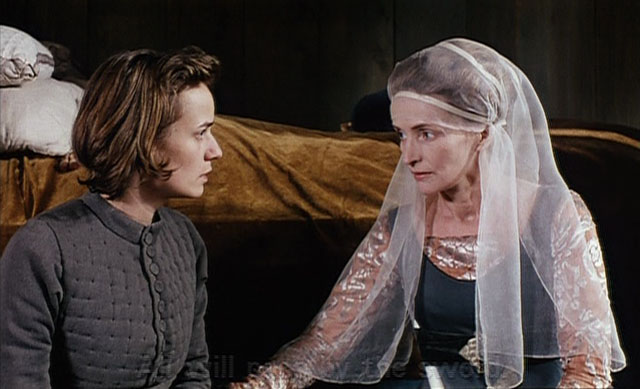
Servant Dave Franco (like a less intense James) escapes from Lord Nick Offerman after getting caught with his Lady, and runs into drunken priest John C. Reilly, who offers Dave a job at his dysfunctional convent, where Dave pretends to be mute and becomes an object of desire by the nuns – slightly flipping the power structure of the Pasolini version in The Decameron.

Lead nuns: Aubrey Plaza is a vicious witch (with co-witch buddy Jemima Kirke), Alison Brie (Diane on BoJack Horseman) has rich (or formerly rich) parents and was just waiting out her time until she could be married off. Kate Micucci (Garfunkel and Oates) is a kissup narc (and secretly Jewish). And drunken priest John C. Reilly is sleeping with head nun Molly Shannon. Eventually, all of this gets out of control and Bishop Fred Armisen has to come sort it out.

The Italian landscapes and castles are cool, but overall little fancy filmmaking here. I was kept constantly amused by the anachronistic, foul-mouthed dialogue and blasphemous behavior in the period setting. Jeff Baena cowrote I Heart Huckabees then disappeared for a decade, recently came back with Life After Beth and Joshy, which share a bunch of cast members with this one.

Not to be confused with The Clan or The Tribe or The Wolfpack. Movies need better titles.

My first Pablo Larraín movie, and it’s unusual. Not sure what I was expecting, maybe more Matteo Garrone-style. Has a hazy digital look with odd white balance and sometimes grotesque wide lenses, and tells an odd story about a house of recovery/isolation for problem priests.

Father Matías arrives with an exquisite beard, but has been followed there by Sandokan, whom he used to molest as a boy. Sandokan yells in front of the house until Father Matías walks outside and kills himself.

Newcomer Father Matías:

So Father Garcia is sent from the church to investigate, and probably to shut down the house and scatter its residents. The residents seem less concerned with him than with Sandokan, who is still hanging around town, so they stage a crime to pin on him, murdering their own and their neighbors’ racing dogs. Sandokan gets beaten up by an angry mob, and Father Garcia agrees to leave the house alone if they’ll take care of poor Sandokan.

Investigator Father Garcia:

I didn’t get this ending, really, but liked the actors’ beards and the general muddled atmosphere of the thing. Obviously don’t know what to make of Larraín at this point – need to watch more of his work. I thought he was one of our beloved international festival auteurs (his current Jackie is getting raves) until discovering so many negative reviews of this one. Checking online, I see that Sicinski has turned in a four-paragraph review of the other The Club (“a Master Lock for your steering wheel”) which is confusing the Letterboxd commenters.

Nick Pinkerton:

There are doubtless those who will prefer the smoldering indignity of Spotlight, ever so slightly tinctured for flavor with self-recrimination, to the moral murkiness of The Club … Shot by Larraín’s regular cinematographer Sergio Armstrong, The Club is overlaid with a milky haze … it gives the impression of an all-permeating damp fog, a dramatis personae who are half-ghost, and a setting that is somewhere between the Chilean seaside and Purgatory.

Sandokan:

Looking up cast, Jaime Vadell must’ve played the oldest priest (nobody, including he, can remember his crimes) because he appeared in Ruiz’s Three Sad Tigers back in the 1960’s. Dog-killing ex-nun Sister Monica was Larraín regular Antonia Zegers, and dog trainer Vidal starred in and cowrote Tony Manero.

Quintín:

Larraín prefers to deal in his films with the low and middle classes, whom he strongly despises. If there’s a common thread running through his cinematographic output, it’s that the problem of contemporary Chilean society is not, as usually assumed, that it suffered a dictatorship for almost 20 years, during which time thousands of citizens were murdered, tortured, and disappeared, all kinds of censorship and repression was exerted, and people couldn’t leave their homes at night because of the curfew. No, for Larraín the true problem is that Chileans deserve their fate because they secretly liked to be humiliated and destroyed by the barbarians, as they thought that they were not strong enough to rebel against them.

I guess I’m starting to get Pasolini’s style, thanks not to this confusing movie but to the blu-ray extras, which say he combines his knowledge of art and iconography with deliberately naive framing and ignorance of film history and style, influenced by Gramsci (“the revolutionary potential of the arts”) and the neorealists (who insisted on a “high level of political and cultural engagement on the part of directors and writers”). In retrospect I can see how these ideas work, but in my experience of watching the movie, it seemed like a silly bunch of populist, amoral comedic sex stories, lightly enjoyable.

First, someone is murdered in a cave, but it’s dark and I’m not sure what’s happening or if it’s important.

Then Andreuccio (Ninetto Davoli) is scammed by a princess who claims to be his long-lost sister before ejecting him into a toilet and stealing his money. He finds fortune with grave robbers later that night, stealing a gemstone ring from a bishop’s crypt.

Masetto pretends to be stupid and mute in order to gain favor with the nuns and eventually have sex with all of them.

A husband returns home to his cheating wife Peronella where she has stashed her lover in a huge vase, pretending that he’s interesting in buying it. This is when I realized that none of these episodes are related in any way.

Legendary liar/forger Ciappelletto (Franco Citti, title star of Accattone – aha, learned that he’s the murderer in the prologue) is dying, gives a final fake confession to a very impressed priest.

A multi-part episode framed by the story of a painter (Pasolini himself) working on a mural… also featuring young lovers Caterina and Ricardo caught nude on a balcony and forced to marry… Lorenzo is killed by his lover’s brothers and she finds his grave and keeps his head… and a sex fiend returns from the dead to tell his buddy that the afterlife has “nothing against screwing around”

Back to the painter: “Why complete a work, when it’s so beautiful just to dream it?”

Won a prize in Berlin (despite featuring some of the laziest dubbing work I’ve ever seen) where Vittorio De Sica took the Golden Bear. “It also quite infamously started a trend of pornographic films based on Boccaccio’s Decameron, something Pasolini actually found very upsetting,” per Patrick Rumble’s vital video essay.

Little Orphan Anna grew up in the church, is about to become a nun when the higher-ups say they’ve located her only living family, and send her off to meet her aunt. Aunt Wanda, a judge in town, says Anna’s real name is Ida, she is a Jew whose parents were murdered during WWII. The two set out to visit the parents’ grave, which is complicated since they haven’t got one, but fortunately run across their murderers who’ve taken the family home as their own. They take a couple bags of bones (Ida’s parents, Wanda’s son) to the family plot in a now-abandoned cemetery. Wanda tries to convince Ida to give up the nunnery, hooks her up with a cute saxophonist called Lis. Not much dialogue in the movie so we have to draw our own conclusions why Ida sleeps with the boy then sneaks away to return to the convent – but not much imagination is needed to figure why Wanda commits suicide.

4:3 b/w movie, beautifully shot though I sat close enough for the screen to look pixelly in wide shots. Plenty of head room, and a tendency to cram Ida into a lower corner of the screen, reminding me of Josh Brolin in Milk but probably for a different purpose.

The only actor I’m seeing in anything else is Joanna Kulig of Elles, gorgeous young singer of the saxophonist’s band. Pawlikowski made My Summer of Love and won awards for Last Resort with Paddy Considine.

Something I didn’t get that J. Kuehner explains: Wanda reveals “her own past as a prosecutor of ‘enemies of the people’ (historically, former anti-Nazi resistance fighters who were convicted in show trials under the Stalinist regime)”.

Like Rivette, Bresson started his feature career with a nun movie. This is an interesting one in light of his later movies about crime and punishment. On prison trips, young nun Anne-Marie (Renee Faure, lovestruck globemaker’s daughter in L’assassinat du Père Noël) becomes obsessed with Therese (Jany Holt, the prostitute in Renoir’s Lower Depths), trying to get her to join the convent – which she does after her release, but not before shooting a man to death as revenge for her imprisonment.

So, Anne-Marie gets ever more intense towards the woman she thinks she has saved, and Therese is extremely moody, never fitting in at the convent since she’s really using it to hide from her latest crime.

Senses:

For her disruption of convent life Anne-Marie is expelled, but secretly returns nightly to pray at the tomb of her order’s founder. When she becomes deathly ill, she is discovered and readmitted to the fold; and, upon her death, Thérèse undergoes a change of heart, delivering herself to the police and to her just punishment. .. This route to Anne-Marie’s saintly fulfilment and Thérèse’s transformation passes through continually ambiguous terrain, in which will, destiny, and chance become indistinguishable, and in which saintliness and criminality not only work side by side but mingle.

Head nun Sylvie was in Le Corbeau the same year, and one of the others – I get them confused – was Marie-Hélène Dasté, Jean Dasté’s wife and a stage actress for playwright/novelist Giraudoux, who adapted the story for this film.

Public Affairs (1934)

Princess defies king, flies to nearby Crogandy to marry their clown chancellor, who gets a few funny bits in this visually indistinct, silly-ass comedy. A pretty good extended contagious-yawn joke leads to a plane crash, then everyone in town falls asleep (probably not a Paris qui dort reference). We follow the chancellor from a statue unveilling to a firehouse demonstration to the launch of a ship, with Marcel Dalio (the marquis in Rules of the Game and Frenchy in To Have and Have Not) playing most of the movie’s roles besides the romantic leads.

Revisiting this after watching so many Rivette movies. The sound design, amplifying ordinary noise from clothes, floors and chairs, usually uncovered by music, is the main familiar element. It may be his most tightly structured film, without any improv, though I’d have to watch it back-to-back with Don’t Touch the Axe to be sure.

“In marrying your sisters, we’ve ruined ourselves.” Anna Karina, towards the end of her Godard relationship, is sent to become a nun by her parents against her will in the mid-1700’s. To her, the experience is just like prison, but she manages to sneak out some letters and secures herself a lawyer (soundtrack plays ocean waves when she’s finally allowed to see him), incurring the wrath of head nun Francine Berge (gorgeous baddie of Franju’s Judex), until her punishment is finally noted by Berge’s superiors and Anna is moved to a new convent.

Karina and Berge have a nun-off:

The new one is a pleasure palace, run by clingy lesbian Liselotte Pulver (of A Time to Love and a Time to Die), whom the father confessor tells Anna to avoid like the devil. Anna doesn’t like this place any more than the last one, finally teams up with an amorous monk (Francisco Rabal, whose face was ripped off in Dagon) to escape. Best scene is with him, as she realizes his intentions and the music goes mental.

Karina and Pulver bond:

Anna flees him and he’s captured – oh, and her mom is dead, her friend who talked her into becoming a nun in the first place (Micheline Presle, Depardieu’s relative in I Want To Go Home) is dead, and now her lawyer is dead. Then she flees the village where she’s hiding out, gets picked off the street by a fancy lady, and finally flees her party right out an upper-story window. This made more sense once the internet told me the “fancy lady” was a prostitute, oops. C. Clouzot: “Rivette completes Diderot’s unfinished novel with her suicide.”

brief moment of happiness, post-escape:

the end is near:

Banned in France for over a year, with much public debate leading up to its eventual release. It’s funny now that this movie was considered so outrageous, falling five years after Mother Joan of the Angels and five before The Devils. Quite a good movie, even if not extremely Rivettian. Cinematographer Alain Levent worked on the first films by Chabrol, Rohmer and Truffaut, shot Cleo from 5 to 7, The Nun and later, Sam Fuller’s Day of Reckoning and Madonna and the Dragon. Adapted again (sort of) by Joe D’Amato in the 80’s and there’s a new version out with Isabelle Huppert.

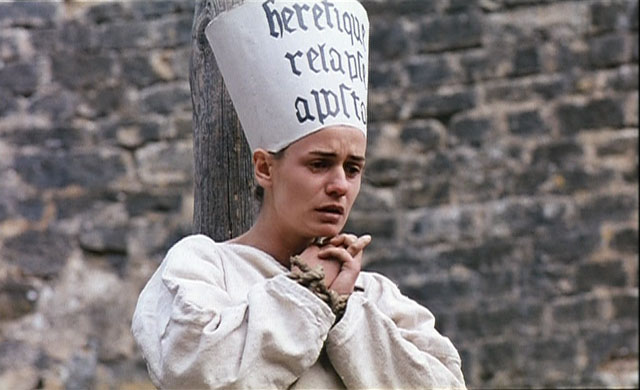
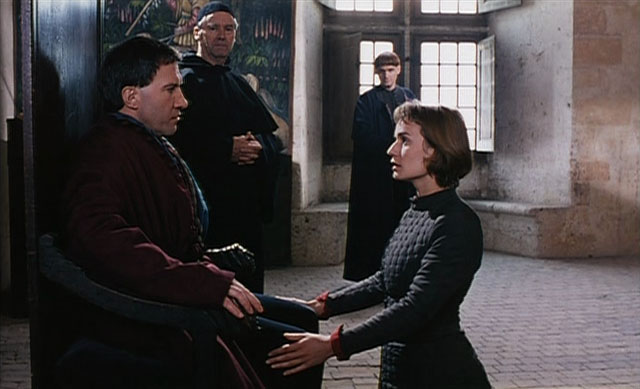
I. The Battles begins with Jeanne having had her angel visitations already, trying to convince local government to take her to the king, and halfway through the film gets to the battles she led against the English. II. The Prisons is half battles (which is good; we didn’t get enough battles in part 1) and half British prisons (with hardly any of the trial/execution scenes that Dreyer would focus on). All set 1429-1431, except for an odd intro in 1455, with Jeanne’s aged mother, a nun, telling of her daughter’s unjust execution.

image

It’s a Rivette film, all right. Long shots with medium natural lighting, deliberate camera movement, same typeface as always on the titles, brief blackouts between scenes, same list of collatorators in the credits. Quite a follow-up to La Belle noiseuse… I’ll bet nobody saw this coming. It works very well to Rivette’s strengths, though, and stays focused on Jeanne and her quest without gimmicks and without getting caught up in the scale of the story and the hundreds of side characters.

image

Sandrine Bonnaire, a decade after Vagabond and a year before The Ceremony. I didn’t recognize anyone else besides a cameo by Edith Scob. IMDB says Jean de Metz, the guy who leads her to the king’s court, was in Hurlevent, King Charles (André Marcon) is appearing in Rivette’s new film, and Quentin from Out 1 played Pierre Baillot (who was that?).

with Edith Scob:
image

Joan is charismatic and persuasive, but acts realistic. Her supernatural visions aren’t shown – we know Rivette isn’t above showing supernatural visions, but here he has Jeanne speak of them regularly without portraying them as a reality to the audience.

Unfortunately, this four-hour film has another two hours which I can’t see at the moment. Looks like Artificial Eye has released it on DVD. You know, my birthday is coming up…

image

J. Rosenbaum:

…this is a materialist version of a story that offers no miracles, though it does offer a pertinent attentiveness to gender issues (such as the nervousness and sexual braggadocio of the soldiers who sleep beside Joan) and a Joan who’s girlish as well as devout, capable of giggling as well as experiencing pain; when she wins over the dauphin the scene is pointedly kept offscreen, and when she’s interrogated by priests about her faith she could almost be a graduate student defending a dissertation.

with the king/dauphin:
image

C. Fujiwara:

As Rivette and Bonnaire present her, Joan suggests a novice movie director protected by a seasoned crew that humors her as much as obeys her. (Army life in this film is more sitting around than fighting; in this respect it’s like a film shoot.) She doesn’t do miracles; she just uses common sense and takes the initiative.

People are talking about Ken Russell these days because of a DVD release of his early biographical documentaries, so when I was frustrated at the video store (no Stuart Gordon! no Wizard of Gore!) I rented this on a whim. Oh boy am I glad I did. Don’t know what the modern critical consensus is (it’s on the They Shoot Pictures list and in D. Ehrenstein’s top ten, so probably pretty good) but to me, this is a masterpiece. Got to see it again, preferably in higher quality than this blurred DVD copy could provide.
UPDATE 2016: Watched this on 35mm, front row at the Alamo – a divine experience.

Vanessa Redgrave has spinal problems:
image

It’s about the same 1600’s nun-mania incident in France that Mother Joan of the Angels covered very capably and artistically a decade earlier, but this one opens up the story, bringing in King Louis XIII and Cardinal Richelieu (who together strengthened the monarchy and centralized power in France), enlarging the town and creating amused mobs and public executions, and focusing mainly on a priest outside the convent, Urbain Grandier (played by Oliver Reed, his favorite role), who seems corrupt at first but becomes the most noble character in the movie towards the end.

Grandier with one of his pre-marriage young conquests:
image

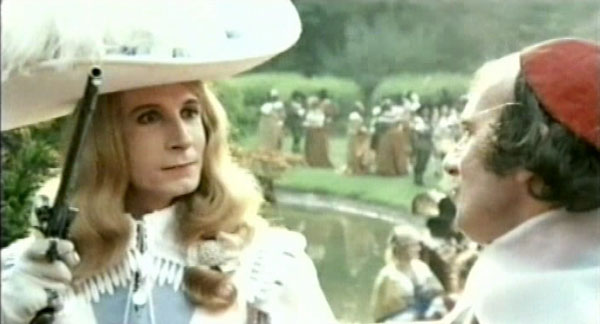
The nuns (led by a hysterical Vanessa Redgrave of Blow-Up and Camelot) are shown to be repressed young bundles of hormones, stuck in the convent by circumstance and not by choice, who finally explode at the sight of Grandier glimpsed through their barred windows. The nuns request a father confessor but instead of Grandier they get stern, sexually ambiguous Mignon (Murray Melvin, who had a good year in ’75 with Lisztomania and Barry Lyndon) who calls in professional witch-hunter Father Barre (Michael Gothard of Lifeforce, The Three Musketeers) to perform an embarrassing public exorcism. Meanwhile, Grandier has knocked up one girl and made a big deal of defending the city from the whims of central government, meets Madeleine (Gemma Jones, lately playing everyone’s mum in big-budget films) and dedicates himself to her in a private wedding ceremony. Richelieu and the fey King (hilariously shown in his garden shooting protestants dressed as birds) use the nun-mania to their political advantage, taking down Grandier, having him tortured and killed by the enthusuastic Father Barre. Grandier out of the way, the city’s protective walls are destroyed. Final awesome shot is of U.G.’s devastated wife walking out of town, surrounded by ruins of the wall and the bodies of protestants tied to wagon wheels atop unreasonably high poles.

image

Derek Jarman, right at the start of his career, did the glorious sets and production design, and David Watkin (lots of Richard Lester movies, Out of Africa) was cinematographer. Two music people, one did period music and one did the discordant jazz that played over darker scenes. Russell wrote the screenplay based on a play and an Aldous Huxley novel. Pretty closely based on fact, if the Wikipedia article on Urbain Grandier is accurate (wow, it even has a graphic of U.G.’s “confession” co-signed by Satan himself).

As far as religious mania goes, I’ve lately seen Spanish Inquisition movies (Pit and the Pendulum, Goya’s Ghosts) a Boston Witch-hunt referencing movie (Ghosthouse) and other movies about religious conflict (Guelwaar, The Milky Way), and this tops ’em all. Of course, as a non-religious person I’m biased towards the extreme corrupt-church-hatin’, and as a guy I’m biased towards all the female nudity, but aside from all that, this is a scorching, beautiful, excellent movie.

a gem from Wikipedia:
“British film critic Alexander Walker described the film as ‘monstrously indecent’ in a television confrontation with Russell, leading the director to hit him with a rolled up copy of the Evening Standard, the newspaper for which Walker worked.”

King and Cardinal during the bird-shooting scene:
image

Oliver Reed:

You would think from the critics’ hostility that Ken Russell had tried to pull off some obscene hoax. On the contrary, the film is, I think, an utterly serious attempt to understand the nature of religious and political persecution. It is not in any way exaggerated. If anything, the horrors perpetrated in Loudun in the 17th century were worse than Russell has chosen to show . . . the character of the priest was a marvelous one to act. Ken Russell’s brother-in-law is an historian and he helped me research Grandier’s life, with particular reference to his thesis in celibacy. The people of Loudun loved him. He walked among the plague victims and comforted them. I started to play him as a priest and realized that he was a politician.

[on criticism of The Devils] It was very disturbing to make. I still haven’t got over it… Where do you draw the line? This is the way it happened – those nuns were used for political ends, toted round France as a side show for a year. Do you ignore the actual historical accuracy and the fact that the Church, the politicians and the aristocracy were corrupt? I get so angry with the opinion makers who class it with the sex films. If we ignore history because it was unpleasant we’re going to end up with nothing but nature films.

Mignon, belatedly convinced of Grandier’s innocence, with the zealous Barre:
image

D. Ehrlich: “Jarman’s neo-futurist design still gives the madness a divine scale. Any movie that ends with someone furiously masturbating as an expression of their own eternal misery is fine by me.”

Who ever would’ve thought that I’d like a movie about nuns as much as this. Fucking incredibly amazing movie, one of the best I’ve ever seen, and I don’t think that’s just because I’m kinda drunk. Need to see this again and again. Would kill to see it in the theater. Maybe next year, 60th anniversary and all. Oughtta watch it again simply because I wasn’t paying as close attention as I should’ve… but still, seems like an extremely worthwhile movie.

Nuns opening school/hospital in the mountains with “primitive” people and a gruff, attractive male neighbor. One, maybe more of them, loses her mind. Plot and character don’t really need to be discussed, not that I paid strict enough attention to them to be able to discuss anyway, but even though they’re pretty great themselves, it’s the visuals that make the thing a fucking masterpiece. Wanted to cry at the end.

I like how some of the most beautiful shots (in terms of scenery, staging) are also some of the most fakey (obvious sets + backgrounds). Little praying, if any – surprising for a nun movie. Better than Nazarin probably… gotta see Viridiana next.

Also: a cockatoo and an african grey – in the same shot!