Handheld b/w, a low-budget shoot but always terrific-looking in sharp focus. Not Lester’s first feature – why do you never hear about It’s Trad, Dad or Mouse on the Moon? DP Gilbert Taylor shot Dr. Strangelove the same year, Repulsion the following.

It has more of a story than most concert movies but much less of a story than most non-concert movies. The premise is that the guys catch a train to the city, have to rehearse and then film a TV appearance, but they keep wanting to run off and play and insult people.

As Paul’s clean grandfather, Wilfrid Brambell, known for playing comic character Albert Steptoe. As the two guys responsible for getting the boys through their day, Norman Rossington (Saturday Night and Sunday Morning) and TV writer/actor John Junkin. Uptight sweater-wearing TV director Victor Spinetti would return in Help! the following year.

I’ve generally avoided band documentaries, firstly because there are too damned many, but secondly because they all start to feel similar (Meeting People Is Easy, part 93). This Bobby Bare Jr. doc was playing as Bobby Bare Jr.’s opening act, and the director was in the room, so that felt special. The movie gives plenty of time to his songs, lets some play all the way through which is nice, but after a while it seemed weird, watching this standard-def version of BBJr projected on a sheet, sitting on a folding chair hearing the songs on tape, an hour before seeing the real BBJr play the same songs sounding 100 times better. Also, damn, BBJr’s family life is a mess, and I didn’t realize before the show/movie that his new album would be a breakup record, so the movie opens with BBJr heading out on tour as his new baby is born, then ends with him returning from a second tour and seeing his baby again, but relationship troubles are afoot, and finally we’ve got the song “My Baby Took My Baby Away”, and there’s Bobby up singing it in our face, making us think about his baby, whom he can’t see on this Atlanta tour date or even back home anymore. Kind of an uncharacteristically melancholy night for a Bobby Bare Jr. show. “Rock & Roll Halloween” was fun, though.

“Do you know Mexico?”
“… Sure.”
“Go there.”

Ridiculous comedy about soviet musicians who head to America to find their fortune. The movie’s deadpan consistency won me over. By the time the “deceased” band member they’ve been carrying frozen atop their car thaws out and joins them mid-song (a development I saw coming an hour earlier but still enjoyed watching), I was happy that there are sequels to look forward to.

Bunch of guys who look like TV’s Frank and wear pointy clown shoes to match their haircuts go on a road trip through America (from NYC to Mexico), playing small clubs along the way. They’re all pretty indistinguishable except for their tyrannical manager, the long-lost cousin they pick up somewhere in Texas, and the idiot Igor who followed them from home attempting to help. A.K. lets the songs play out, making it a sort of concert film.

Kaurismaki was in synch with Jarmusch, shooting in all the same locations as his earlier Down By Law the same year Jim was filming the similarly rockabilly-referencing Mystery Train. He appears as a car dealer in this one. The Idiot is Kari Väänänen (Polonius in Hamlet Goes Business) – he and band manager Matti Pellonpää have been in a bunch of Kaurismaki’s movies.

Igor at a Memphis barber shop:

Thru the Wire (1987)

Criterion/Hulu also had some of A.K.’s short films. This is a noirish clip – Nicky Tesco (cousin/vocalist from the feature) escapes from prison, seeks his woman while being chased by cops.

Rocky VI (1986)

Giant Russian Igor completely destroys wispy American Rocky (and some officials) in the ring. The music track is dark, with layered vocal samples – and yodeling, at one point.

A semi-documentary that eventually focuses on scraps of stories: Paolo, who jumps into the river every year during carnival, and a couple of young lovers (actually cousins). Other pieces of the movie include the filming of the movie itself, camera turned upon its own crew, Gomes tryin to explain why he’s not making the film he was supposed to make, and a series of concerts, letting awful pop songs half play out before abruptly cutting away.

I’m so in favor of the semi-doc, fiction/doc blend, experimental narrative, etc, but couldn’t get into this one, not nearly as much as Tabu. It’s kinda beloved though, and won a prize in Vienna.

M. Peranson:

Organically constructed and impressively humble, Our Beloved Month of August shows the fantastic, mythic elements present in everyday life, and the mundane realities present in filmmaking, presenting the two as links in a neverending chain of dominoes.

Gomes:

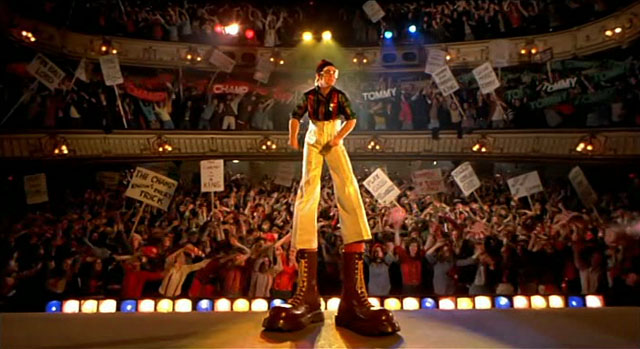
“Tommy is the only rock opera ever made” – Ken Russell

Sad Ann-Margret’s husband is killed in the war. Some time later she goes on vacation and meets Bernie (Oliver Reed) at a resort. He moves in, but one night the husband returns, disfigured from a plane crash, and Bernie kills him in front of little Tommy, who’s told that he didn’t see anything, didn’t hear anything, won’t say anything. And so he doesn’t ever again.

Tommy grows up to be curly-haired space-cadet Roger Daltrey. He’s not healed by attending Eric Clapton’s church of Marilyn worship, nor when Bernie gives him a night with extreme drug fiend Tina Turner (filling in for David Bowie), nor when he’s left with psychically abusive babysitter Paul Nicholas or sexually abusive Uncle Ernie (Keith Moon), nor from a visit to Dr. Jack Nicholson (filling in for Christopher Lee).

But one day Tommy finds something he’s good at. After defeating Elton John (who agreed to be in the movie provided he got to keep these boots) at a pinball championship, he becomes famous and attracts hundreds of groupies.

At home, mom celebrates their new wealth by throwing a bottle of champagne through the television and writhing in the bubbles, baked beans and chocolate that pour forth from the damaged set.

Tommy breaks through his mom’s mirror and starts speaking again, becomes a messiah to kids everywhere, his symbol a cross with a pinball on top. Mom is his biggest supporter, and stepdad Bernie is the financial wizard, plotting to set up Tommy camps everywhere and sell merchandise everywhere else. But their prefab religion backfires and the kids revolt, killing Tommy’s parents. But he lives to bathe in waterfalls and climb mountains with a big cheery grin.

It’s a ridiculous story, a twisted excuse for lots of music and celebrity cameos. Russell was never a huge fan of rock music (I’m not a big Who fan myself, really only enjoy “I’m a Sensation” from this soundtrack), had written a follow-up to The Devils called The Angels about false religion, which he couldn’t get off the ground. When offered to direct a movie with sympathetic ideas to his own, which Russell could help mold (he got Pete Townshend to write additional scenes and change plot details) with a pre-sold celebrity cast – a batshit-crazy musical story that needed visual accompaniment – how could Ken say no? It might not be Ken’s purest personal vision, but I double-featured it with Song of Summer as memorial screenings when I heard he’d died.

Unsurprisingly produced by Robert Stigwood, who produced Jesus Christ Superstar (and later Grease). Oliver Reed (of The Devils, of course) was doing Richard Lester’s Musketeers movies around the same time. Daltrey would be back with Russell on Lisztomania, which I need to see. And Ann-Margret needs to be much more popular – she was fantastic in this.

Wire! The Feelies! A long three-part series/feature about a so-called terrorist who operated by a strict moral code can’t help but get compared to Soderbergh’s Che, but the strong use of quality 1970’s and 80’s music throws a Marie Antoinette comparison into the mix.

Watched in nice widescreen over netflix streaming on the TV. Despite its epic length, the movie felt small and far away. Lots of political and historical touchstones that I didn’t recognize, because I have no education or sense of history. Carlos’s motives weren’t clearly explained (something about the Palestinian Struggle), nor were his origins (“It’s no longer Ilich. It’s Carlos”). But his battles, his public terrorist acts, his relationships, hideouts and escapes are all laid out in glorious detail. I’m generally a fan of Assayas films, but didn’t connect with this one at all. I’m thinking netflix is to blame.

Edgar Ramirez can’t be blamed anyway, was magnetic, as they say, as Carlos.

The movie was so long, and petered out in such an energy-depleting way, that I can’t bring myself to write a whole lot or even to read a bunch of articles. So I took to D. Hudson’s great notebook summary and cut out three points I would’ve made if I’d given it more thought (or took better notes).

G. Andrew:

Certainly, the film doesn’t feel anything like television. It’s shot in Scope, boasts the fleet way with narrative, camera movement and cutting that are characteristic of Assayas at his best and has a sense of scale, depth and seriousness of purpose that is essentially cinematic.

M. Dargis:

He lacks substance. He doesn’t have much to say, and his rhetoric gets cruder as the years pass (as does his treatment of women). He’s a man of action, not ideas. Mr Assayas, by contrast, is a director of ideas. … Carlos isn’t Che slogging through the jungle for the cause: Carlos is a mercenary, a thug.

T. McCarthy:

One element that vividly pops out from the film’s vibrant fabric are the numerous scenes in which government officials from Arab and Eastern bloc countries directly order, sponsor or otherwise facilitate terrorism and mayhem in other nations…. I can’t recall ever seeing scenes quite like these in any movie, and they are bracing.

Falkenau, The Impossible (1988, Emil Weiss)

Weiss seems to love Sam Fuller, but he’s not on Fuller’s wavelength, unable to have much of a conversation with the man. So this doc (which is an hour long, but I crammed it in the shorts section anyway) admirably fulfills its purpose by screening all of Fuller’s WWII concentration camp cleanup footage while Sam narrates, taking him to the site of the camp in present-day and asking for his thoughts. That would’ve been more than enough, but Weiss leaves us with a one-sided (Sam likes to talk) silly-ass conversation about fictional representation of war, which would’ve been better left out. I’m most of the way through Sam’s autobiography, one of the greatest books I’ll ever read, where Fuller says this doc screened at Cannes and was praised for its straightforwardness.


Cry For Bobo (2001, David Cairns)

Poor and desperate, a man resorts to thievery to get by. He’s caught and imprisoned, then shot to death after escaping, as his wife and kid leave town, trying to start a new life without him. It’d be a miserable little story if the main characters weren’t clowns. Hilarious, reference-heavy, and better than I’d expected – and I had expected greatness. Already watched twice and trying to get Katy to see it (she hates clowns).


The Possibility of Hope (2007, Alfonso Cuarón)

Zizek:
“We no longer live in a world. ‘World’ means when you have a meaningful experience of what reality is which is rooted in your community, in its language, and it is clear that the true most radical impact of global capitalism is that we lack this basic literally ‘world view,’ a meaningful experience of totality. Because of this, today the main mode of politics is fear.”

Naomi Klein:
“More and more we see the progression of this economic model through disasters. So we’re now in a cycle where the economic model itself is so destructive to the planet that the number of disasters is increasing, both financial disasters and natural disasters.”

James Lovelock:
“If you live in the middle of Europe or here in America, things are going to get very bad indeed.”

Of course the “hope” part comes at the very end, as it does with all recent doom-gloom climate-change global-meltdown documentaries, and the hope in this one, despite the film’s title, isn’t all that hopeful. Start preparing now for how badly the future will suck – and it will suck. An Inconvenient Truth supposedly has a credit-time list of ways you can help the planet, Home encourages us to build windmills and go vegan, Wake Up Freak Out says we must act politically, and there’s always the hope during Collapse that the subject is just wrong, or that he’s a crackpot. Not so much here. If I’ve avoided talking about the filmmaking, well it’s basically a radio show with distracting visuals, much of it b-roll from Children of Men.


Night Mayor (2009, Guy Maddin)

Pronounce it similarly to “nightmare.” An inventor, a Bosnian immigrant, harnesses the “music” of the Aurora Borealis and converts it into dreamlike images which are sent across phone lines to his fellow Canadians using his Telemelodium. Even more/cooler junkpile inventions than in the electric chair short, some nudity (not as much as in Glorious or The Little White Cloud That Cried) and some delicious nonsequiturs. Clean narration by the accented inventor and two of his kids, along with excellent string music. At the end, the government shuts down his project, so he turns his attention from the skies to the seas, considers visualising whale songs.


One Minute Racist (2007, Caveh Zahedi)

Sweet three-minute cartoon story about the slippery slope of racism narrated by CZ, who codirected with a couple animators. Story of a student who doesn’t like asians because they’re too uptight and a paranoid library security guard who threatens to confirm the stereotype.


Talking Heads (1980, Krzysztof Kieslowski)
“What is your year of birth?”
“Who are you?”
“What do you most wish for?”
These three questions are asked to a one-year-old, then a two-year-old, and so on. The final answer: “I’m one hundred years old. What do I want? To live longer. Much longer.”

Most people seem to have thought about the questions for a while – possibly while the camera and lighting crew buzzed about their head, since the film looks like a lesson in how to effectively shoot subjects, professional but no-frills, by cinematographers Jacek Petrycki (No End, Camera Buff) and Piotr Kwiatkowski (second camera on the Three Colors). As a result, the answers come out seeming like a beauty pageant. Everyone wants more honesty and fairness, for everybody to just get along. The answers from kids under ten and adults over seventy are the best.


Born Free (2010, Romain Gavras)

I don’t count music videos as “shorts” or things would get too complicated, but then, I don’t really count this as a music video. M.I.A.’s music isn’t far enough up front, and the video (by Costa-Gavras’s son) is twice as long as the song. It’s a little piece wherein red-headed kids are rounded up by violent cops, beaten, shot and made to run through a minefield. Probably trying to make a point about tolerance and freedom, but for messages of tolerance I preferred the climactic speech in Cry For Bobo, also featuring overzealous cops: “First they came for the mimes, then the jugglers, then the bearded ladies. Next time, it were you.”


Hotel Torgo (2004, buncha dudes)

Buncha dudes head for El Paso and interview the last guy who remembers working on Manos: The Hands of Fate. There’s no real point to this, but the guy is very good-natured about it. Learned that Torgo was high all the time, which shouldn’t come as a surprise but somehow still does.

Three love stories with the same actors in different eras. Can’t think of an apt comparison to another film (haven’t seen Resnais’ Smoking/No Smoking) but it’s sort of the opposite of Hal Hartley’s Flirt). I’d avoided this despite the acclaim because I thought it’d be long and boring (flashback to two Hou movies I didn’t enjoy/understand, Flowers of Shanghai and Goodbye South, Goodbye) but lately I’ve decided that those two required more attention than I gave them, so I watched this one twice (err, six times).


1966: A Time for Love

image

A perfect mini-movie, and it ends so simply and beautifully. He meets her by accident at a pool hall, looking for a different girl. Writes her letters while on his military duty, returns one day and finds her gone. This time, instead of just writing to the next girl, he tracks her down, spends his last few hours of leave with her. Repeated settings, actions and songs (“smoke gets in your eyes” and “rain and tears”) along with the period setting and romantic atmosphere unavoidable evoke Wong Kar-Wai.

image

Girish draws connections:

The original Chinese title of the film is Best Of Times. Hou, like a popular musician, is drawing from his “discography” of films for these three stories. The first reminds me in look and mood of A Time To Live And A Time To Die or Dust In The Wind; the second is set in a brothel like Flowers Of Shanghai; and the third clearly recalls the modern neon-smeared interior spaces of Millennium Mambo. So, Hou has created a sort of compilation album, only he has “remade” the ideas and memories behind his previous films into new stories.

image


1911: A Time for Freedom

image

Silent with piano music and intertitles for dialogue most of the time, traditional twangy vocal music a couple of times (performed, it turns out, by our woman). She is a geisha and apparently in love with her man, though he seems to pay her little mind, focusing on poetry, national politics and the fate of another geisha. He pays for the other girl to be freed when she becomes pregnant, leaving his own girl stuck and alone when he leaves town for Shanghai. Such slow, fluid, measured movements I am sometimes not sure if Hou’s movies are in slow-motion.

image

Stylus:

Of course, the principal subject of both “A Time for Freedom” and Flowers of Shanghai is liberation—from a life of service for the long-suffering geishas, and from foreign rule for Hou’s homeland. Examining the dichotomous relationship between a wealthy activist (Chang) protesting the Japanese occupation of Taiwan and a geisha (Shu) longing desperately for a life outside the brothel, this is Hou’s most explicitly political work since his trilogy on 20th Century Taiwanese history (City of Sadness, The Puppet Master, Good Men, Good Women) and, arguably, his most resonant feminist statement to date.

image


2005: A Time for Youth

image

A confusing one – multiple girls with multiple problems, little explicit story but more detail information than ever. He’s a motorcycle-driving photographer and she’s a throat-tattooed, epileptic lounge singer with a scary website. Seemed to me the usual commentary on modern disconnection through overload of technology, not adding much besides superior cinematography, but the second time through I enjoyed it more (and figured out more, like the fact that He and She both have other girlfriends). Her girl says she’s committing suicide from neglect (touchy) towards the end. Still doesn’t have the emotional impact of the first two – I might’ve switched the order of the segments.

image

Senses of Cinema:

Hou represents this state of freedom by a narrative near-chaos transmitted with a calm and almost casual-looking inscrutability that makes the story impossible to comprehend to any satisfactory degree in just one viewing. It is ironic, though, that while an initial impression might well have been that many of the scenes are presented in a chronologically rather random order, careful examination seems to establish that the story is actually told in a scrupulously linear way.

image


Qi Shu (The Eye 2, Transporter and Sex & Zen 2) has got nothing on the career of costar Chen Chang (Red Cliff, Breath, Crouching Tiger, Happy Together and A Brighter Summer Day), but they’re both wonderful here. Story and characterizations are pretty minimal, movie gets by on weight of emotion, similar to Friday Night and In the Mood for Love – and it shares ITMFL’s co-cinematographer Pin Bing Lee, a Hou regular who also shot Air Doll and Norwegian Wood. Would look even more lovely, I’ll bet, if the DVD wasn’t all interlaced and non-anamorphic.

Won all the Taiwanese film awards. Played at Cannes with A History of Violence and Cache, Battle In Heaven and Broken Flowers, all unfairly beaten by that Dardenne movie.