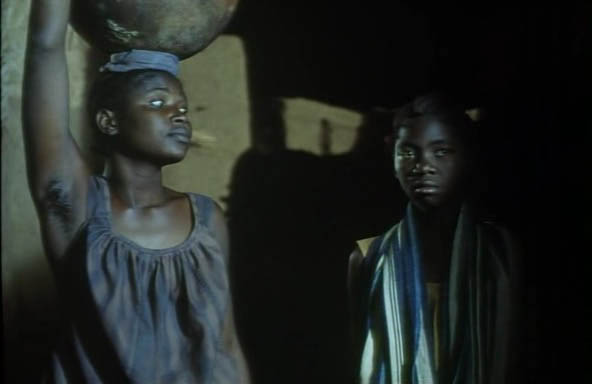
On a Bergman kick lately, so I meant to watch this and Hour of the Wolf for SHOCKtober, but only made it to one. The beginning of Bergman’s extensive work with cinematographer Sven Nykist, brilliant looking but with less of the extreme blacks of Smiles of a Summer Night and The Magician. Supposedly this was stylistically influenced by Akira Kurosawa, after which Sven and Ingmar created their own style.

Pure and flowery Karin with dark, suspicious Ingeri:

Karin (Birgitta Pettersson, a housemaid in The Magician) is the beautiful daughter of Tore (Max Von Sydow, The Magician himself) and Mareta (Birgitta Valberg of Port of Call), sent to church to deliver candles one Sunday wearing her nicest dress. Pregnant dark-haired servant girl Ingeri (Gunnel Lindblom of Winter Light) comes along. The parents are devout Christians (especially mom, who whips herself in atonement) but the girls aren’t – Ingeri prays to Odin and Karin seems to only care about being spoiled by her parents and looking pretty for boys. Along the way Karin flirts with a boy whom Ingeri knows, and the two flee from an icky bridge keeper.

Commentary says the raven represents Odin

The raven appears right after the old man at the bridge, an Odin supporter:

While Karin is alone she comes across a grotesque gang of acrobat goat-herdsmen brothers, and shares her lunch with them, but the two older ones chase then rape and kill her, while the youngest watches, afraid.

The herdsmen:

Karin, first realizing she’s in danger:

The brothers continue on their travels, ask refuge at Tore and Mareta’s house, and in private offer to sell Mareta a beautiful dress – the one Karin was wearing when she left that morning. So the parents already know Karin is in trouble, possibly dead, when Ingeri comes along and confirms it to Tore. “Kill me first. My guilt is greater than theirs. I willed it to happen. Ever since I became with child I’ve hated her. The very day I prayed for it, he did it. It was him and me, not the herdsmen.”

Sad parents:

Tore puts himself through a purification ritual, wrestles a tree to the ground, then waits for the brothers to awaken and kills them all (knife, fire, and throwing the young boy into the wall). Ingeri walks them to their daughter’s resting place. Mareta: “I loved her too much, Tore, more than God himself. When I saw how she favored you, I began to hate you. It is me God meant to punish by this. I bear the guilt.” When Karin’s head is moved, a spring bubbles up from the ground beneath it. Tore senses God is speaking to him, knows he went too far killing the boy, and swears to devote the rest of his life to building a church on that spot.

Von Sydow, out for blood:

Earlier when Ingeri is preparing sandwiches for Karin’s lunch, she puts a live toad between slices of bread, which falls out just before the murder. The DVD commentary: “in ancient scandinavian folklore, toads were thought to be the devil in disguise.”

The movie won an oscar (against Clouzot’s La Verite), but the American and French critics who’d been Bergman’s biggest champions trashed it. Bergman later said it should be regarded as an aberration in his work, and never made another film in an historical setting.

Tree wrestling:

A decade later Wes Craven took the same story and made reprehensible trash out of it with Last House on the Left.

The least Coeny of the Coens’ string of remakes and adaptations. It’s got their perfectly-timed dialogue, comic tone with brief bursts of violence, cinematography by the gifted Roger Deakins, and Dude Lebowski in a major role, but it doesn’t have their mark all over it. This isn’t a complaint – it’s an excellent Western, exciting and well-acted. Plus Matt Damon. He is kinda weird in it. The little girl who had to carry the whole movie, Hailee Steinfeld, got nominated for an oscar for her troubles. Her character is dedicated – shooting unrepentant daddy-killer Josh Brolin once when she first meets him, then again (to his death) at the end. Part of the film was set in my former family home of Ft. Smith, Arkansas. The place hasn’t changed.

March 2024: Watched on blu-ray, noting the excellent music by Carter Burwell. The 25-years-later coda is 1903, the girl now grown, one-armed from the snakebite she got after killing Brolin. Since this came out, the girl has been in Begin Again, then Spider-Men and Marvels and Transformers things.

Opens with grainy shaky videocam footage of cussy drug addicts in an alley who then shoot a girl while on a hectic motorbike ride – meaningful cut to black with the words, in tiny print, “a film by daniel barber,” signaling that this will be an Important Film About Urban Problems (see also: the overbearing music throughout). That’s how Michael Caine treated it in interviews also. Normally Caine wouldn’t be into this sort of grimy personal revenge story of course, but this is an Important Work on a Meaningful Topic, not just some action catharsis. And some viewers even treated it that way – it won a couple of best-film awards – but me, I wanted some action catharsis and found that the movie delivered that well.

Also: Emily Mortimer plays a cop:

MC’s violent spree kicks off (after he has Lost Everything He Had, of course) with a parody scene of extreme urban decay. Caine visits an illegal dealer who sells him a gun while shooting up heroin into his leg while firing a pistol and smoking crack out the barrel while growing pot in his basement while sexually exploiting a young girl while threatening his partner and swearing up a storm and playing loud electro music. Predictably, that scene doesn’t end well, with Caine killing the dudes, taking the guns and burning the whole fucking place, which explodes behind him as he drives the girl to safety. There’s a long action-movie history of vigilante violence by One Man With Nothing Left To Lose Who Couldn’t Take It Anymore, and I don’t see why Sir Michael and crew have to deny that proud tradition and fake like they’re making some documentary expose about the streets, especially when their baddies are so cartoonishly evil. They could do with a few viewings of The Wire. Or hell, maybe street life is really this shitty in England – if so, I’ll take Baltimore any day.

Sho Aikawa starred in Kiyoshi Kurosawa’s Eyes of the Spider and Serpent’s Path, which felt like revenge-drama genre-killers, then he starred in Miike’s Dead or Alive series, which felt like an action genre-killer, now here he is starring in a by-the-books actioney revenge-drama for Miike. How quickly we forget. Or how quickly undistinguished screenwriter Toshimichi Ohkawa forgets, anyway. I get the feeling that Miike’s heart was in Big Bang Love this year, and Scars of the Sun was a standard studio flick a la One Missed Call.

image

Not that it’s bad – just standard, well-made but with no particular flair or invention. Sho Aikawa’s hardworking architect hero is perhaps too blank of a character, though his acting is thoroughly excellent. Sho stumbles across some kids beating a homeless man senseless, moves to intervene and gets attacked himself, so he beats hell out of the youngsters then is surprised when the cops let them all go and tell him he’s in trouble for pummeling underage kids. The screenwriter wants us to know that youth crime is a problem in the city and that the laws aren’t equipped to deal with it. This is best expressed by having an unrepentant 15-year-old, shamed from having been beaten by Sho, kidnap and murder his young daughter. Better still would be if the ensuing media circus finds out about the earlier incident and portrays Sho as a bully who drove the kid to crime. And best of all, since we don’t want to accidentally end up with long scenes exploring the relationship of parents dealing with loss a la In The Bedroom, have the wife (Miho Ninagawa of Dream Cruise) kill herself straight away (we see her on a rooftop, then we see Sho walking past a car. Camera stops moving and I know the body will hit that car two seconds before it does).

image

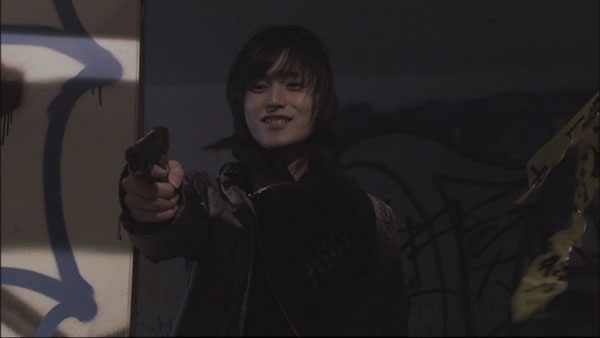
Three years later the murderous kid (Kamiki) is out of prison. Sho tracks down Kamiki’s parole officer Mayumi (above left), his slimeball lawyer, and his ex partner-in-crime, trying to find Kamiki and meet him face-to-face. The movie hammers its theme of criminal youth being coddled by the justice system as Kamiki is left free to create a new gun-toting youth-crime syndicate while Sho is treated as a dangerous criminal and watched closely. Finally Sho goes on the run, takes out the kids with guns, is jumped by Kamiki, shoots the parole officer by accident, then kills the hell out of Kamiki. Sho is either dying or going to jail, but the movie doesn’t tell us which, as he calls his sister’s cop boyfriend and tells him to take care of her, then roll credits.

I thought Kamiki was a girl for a while:
image

The one cool stylish part: since Sho seems incapable of expressing emotion facially (not in general, just in this movie), Miike connotes his inner trauma cinematically, fading to black and white as he watches his wife die, and suddenly snapping back to color three years later after he’s returned to his old neighborhood to find Kamiki, a dripping faucet bringing back the memory of his wife’s bloody death.

image

N.P. Thompson: “the most numbingly inert movie musical ever made”.

Watched it twice in a week, the second time with good sound.

Barber is imprisoned and wife-snatched by judge, returns years later (with young sailor) for revenge, kills blackmailing rival barber, finds then loses interest in own daughter, starts meat pie business with neighbor, mistreats and tries to kill young assistant, kills judge, neighbor, and (accidentally) own wife, is killed by assistant while young sailor rides off with barber’s daughter.

Loving the songs, especially “not while I’m around,” “pretty women,” “I’ll steal you joanna,” and “these are my friends”. The actors all do wonderfully, and the ol’ Burton goth murk is back with a vengeance. Katy disliked the horror aspects and wished that any character besides the two kids in love was a likeable protagonist, someone she could root for, and not a horrible corrupt monster. I thought the two kids were plenty enough brightness in the black, black. I wouldn’t call it numbingly inert, but for a musical it doesn’t exactly pop off the screen. Maybe Thompson will dig the 3-D re-release.

Director of so-what teen-horror “Wrong Turn” (and upcoming cary elwes starrer “The Alphabet Killer”) brings a surprisingly great episode to the so-far dismal second season of Masters of Horror. Inventive, not over-long, good performances and great makeup effects.

image

Dentist MARTIN DONOVAN, who I am so happy to see again, is a very bad husband who lights his wife on fire after a car accident (revealed through flashbacks) then tries to pull her life support so he can carry on with his girlfriend/receptionist Robin Sydney (of gary busey horror “the gingerdead man”, heh).

image

Some problems come up. The wife’s mother starts a(n underdeveloped) media war against Martin to keep the wife alive. Martin enlists lawyer Corbin Bernsen (not the washed-up catcher from major league [that was tom berenger] but the grumpy old veteran player) to get the wife unplugged. But a bigger problem is that whenever the wife flatlines, her ghost comes after Martin (and sometimes Corbin) and tries to kill him. So Martin has to turn a 180 and try everything to keep his wife alive, even if it means skinning his girlfriend when a donor doesn’t come through in time. Fabulous ending, he misses the clock, she dies, and he resignedly walks into his house where the ghost is waiting.

MoH motifs: naked breasts, skinlessness (those two unfortunately collide), recognizable actors doing silly things, that one dark highway that I see in every episode.

image

From the non-auteur behind the classic horror hits “Fright Night” and “Child’s Play” and the less classic S. King adaptations “Thinner” and “The Langoliers” (also writer of Psycho 2). This is from the writer of “The Fury”, which makes me a little less excited to see that one.

image

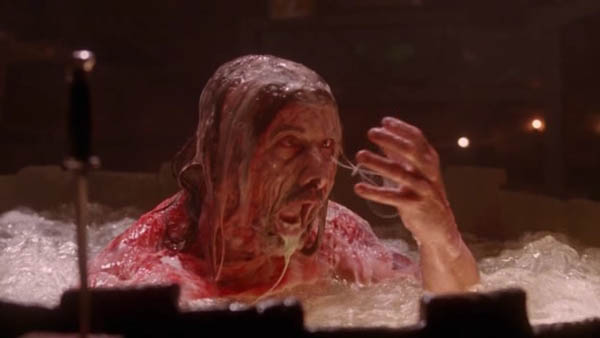
Holland must not have been allowed to adapt King’s “It”. Here we’ve got a story about grown men being hunted down by a killer klown, with flashbacks of these guys as young kids doing bad things together. Sounds like “It” to me. But this one adds exciting story elements that “It” never had, such as that the young kids once conspired to kill a retarded ice cream man, and that the ice cream man comes back as an evil klown and if the now-grown-men’s KIDS fall under the klown’s spell and eat a special ice cream bar, the men will turn into ice cream and melt and die.

image

Ridiculous story, reasonably well acted/directed, not a bad thing to half-watch while I’m doing something else, like writing these entries.

“The Law”

image

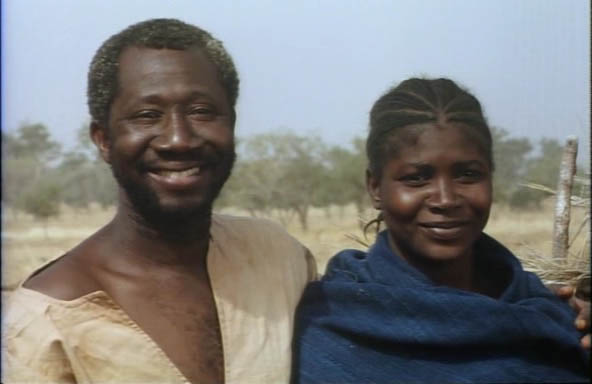
Ouedraogo, from Burkina Faso, was a student of Gaston Kabore, director of last week’s Wend Kuuni, and also worked with Ousmane Sembene.

Saga (actor also in Moolaade, Yaaba, Night of Truth) has been away for a couple years, and returns to find that the woman he was promised as a wife is now married to his father. She and Saga are in love and resume their affair, with disastrous results. Saga’s brother is sent to kill him, but allows him to escape, and the illicit lovers go off to Saga’s aunt’s house… but he comes back for his mom’s funeral, exposing himself to the townspeople. The father banishes the brother, who then shoots Saga, oh and the girl’s dad hangs himself for having a part in all this.

image

Fine story (a darker Ten Canoes?), fine acting, plays at a good pace, not at all as bleak and awful as it sounds from my plot description. Won the Cannes Grand Jury Prize (a step up from the prize Yeelen won three years before), second place to Lynch’s Wild At Heart and beating out Godard, Zhang Yimou and Ken Loach.

image

Little music. A vocalist sings “Tilai… Tilai” a couple times and that’s it. Long shots, but not distractingly long.

“Claire Denis, the director of the autobiographical film Chocolat, set in colonial West Africa, notes that in Tilai every sentence starts with the name of the person who is addressed, in contrast to what she calls the vacuousness of communication among white colonials.”

image

A lonely mute girl gets raped, robbed, and raped again, all in one night. She stops the second guy though (kills him with an iron, chops him up), grabs his gun and goes on a vengeance spree through the city, killing just any man she can.

image

All this killing takes its toll on her daily life, and her seamstress friends at work start to notice the change. She sort of goes from righteous victim to homicidal maniac, but then she never quite loses our affection either. A lot more carefully measured and watchable than the grating Driller Killer.

image

One “victim” actually takes the gun and shoots himself out on a park bench. She doesn’t kill the dog (screen shot below). Eventually puts on the nun suit and goes all Carrie at a halloween party before she’s taken out.

image

Scott Ashlin says:
“What we get instead is… a film that depicts men in the harshest and most unforgiving light, presenting them as legitimately deserving a substantial proportion of Thana’s wrath. Simply put, Ms. .45 has no patience with mitigating circumstances. In this movie, people, both men and women, are defined entirely by what they do rather than by who they are. It doesn’t matter, or so Ms. .45 contends, whether an exploiter had a rough childhood or a bad day at work or a steady stream of shitty luck with the girls he dated in his formative years. Violence buys violence, end of story.”

image

September 2011: Great to see this again on 35mm at Cinefest.