1982: the year of Blade Runner, White Dog, Poltergeist, The Thing, Gandhi, Britannia Hospital, Fitzcarraldo, Fanny & Alexander, Tron, the Sting version of Brimstone & Treacle… and this, the legendary Worst Kurt Vonnegut Adaptation Ever. From young hotshot Steven Paul, one of the producers of Doomsday, and I know I just said I wouldn’t waste my time watching anything created by anyone involved with Doomsday, but the Vonnegut connection combined with this movie’s reputation for being one of the worst comedies of the 80’s forced me to watch it out of morbid curiosity.

Laurel and Hardy? The book was dedicated to them.
image

Opens with narration by Orson Welles, surely giving even less effort than he did as the voice of the planet in Transformers: The Movie. You can immediately tell that the movie has no comic sense whatsoever. It looks cheap despite the big-name cast, and every “joke” is dead on delivery. The comedy is mostly people falling down, moving fast, talking funny (slapstick, I guess) and it’s badly staged… for instance, the twins are giant-sized, but only when convenient.

I don’t think Vonnegut was as mean-spirited towards the Chinese. And of course, Noriyuki “Pat” Morita is not of Chinese descent, but better him than Mickey Rooney I suppose. He plays the shrunken thumb-sized ambassador, a reference only understood by readers of the book since it’s unexplained during the movie. Other bits from the book are also rethought and bungled, and the twins are from SPACE now (and return to space in the ridiculous ending). All traces of Vonnegut’s trademark sadness and humanity are lost, unless you consider the sadness of the cast and the releasing studio and the audience. Rogue Cinema points out that the movie’s cast (Khan, Feldman, even Welles) and poster and title (and renaming the doctor “Frankenstein”) aimed to make audiences think that this would be a Mel Brooks Close Encounters parody. That particular advertising lie is probably the most well-thought-out part of the whole film.

Lewis!
image

Khan!
image

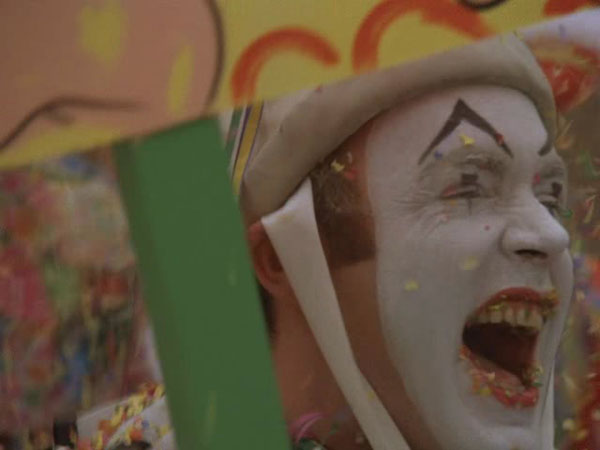
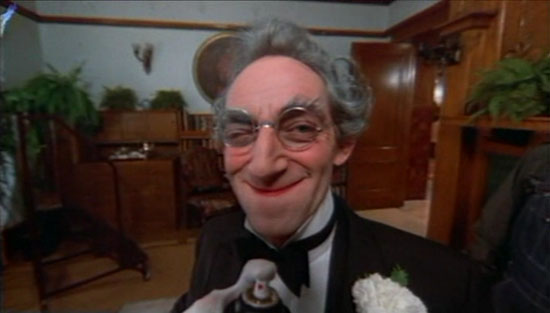
Madeline Khan and Jerry Lewis double-star as both the super-genius twins and their rich, detached parents. Marty Feldman is the butler in the twins’ secluded home. John Abbott plays a guy with a cool beard and Samuel FULLER is the colonel at the Military School For Screwed-Up Boys.

Feldman!
image

Fuller!
image

One of the last films of Jim Backus (Mr. Howell on Gilligan’s Island, voice of Mr. Magoo), John Abbott, Marty Feldman, and even Jerry Lewis (had starring roles in 6-7 more movies, most of them bad) but Jerry recovered in time to make Arizona Dream. Yes, Slapstick was a mega-career-killer, destroying the respectability of everyone involved! It ruined cinematographer Anthony Richmond, who previously shot the beautiful Man Who Fell To Earth and Bad Timing but went on to shoot Dane Cook movies and Dumb & Dumber 2. And – little known fact – it contributed to the death of Orson Welles and was directly responsible for his never completing Big Brass Ring, The Dreamers or Other Side of the Wind. Orson’s female co-narrator’s career was so thoroughly demolished that the internet has no record of who she was. But on the bright side, the movie helped launch the film career of Pat Morita, who would star in The Karate Kid two years later.

Morita! (he’s the one not looking at the camera)
image

Music by Michel Legrand and a song with lyrics by Vonnegut were edited out of the movie after the original release – why?? Assistant-directed by Michel’s son Benjamin Legrand, ending his short career as assistant-director (begun the year before on Rivette’s Merry-Go-Round).

Everybody wants prosthetic foreheads on their real heads? The incest scene doesn’t go very far, because we need a “PG” rating.
image

Released around the same time as Scorsese’s awesome King of Comedy, also with Jerry Lewis, though I think this was shot first and shelved for a while. Gene Siskel calls it “shockingly bad” and Ebert calls it offensive but makes a point of not blaming Vonnegut or Lewis. I heard one detectable Jerry joke: “You know, do as the romans do… when in rome, that is – I had it backwards” (it’s all in the delivery). There’s an occasional passionate line-read by Madeline or Jerry, the occasional animated bit of action, but mostly the movie moves mechanically from one laborious scene to the next, a simple motion illustration of a screenplay written by a guy who knows a guy who talked to a guy who once read the Vonnegut novel (which wasn’t one of KV’s best stories to begin with). I would looove to say that Fuller, Lewis and Feldman were excellent and the movie was slightly worth watching, but they weren’t and it wasn’t. I’m not in any hurry to rewatch Breakfast of Champions to decide whether this one is worse, but I think it probably is.

Close Encounters of the Dumb Kind:
image

Two or three years ago I completed a holy quest to track down and watch every movie by the extremely great Samuel Fuller. This directly led to the creation of this journal, because it turns out that I don’t remember movies very well when I just watch them one after another and never think about them again or discuss them with anybody so now it’s as if I’ve seen no (or just a few) movies by Samuel Fuller instead of all. Fortunately they’re all worth revisiting (except maybe for Underworld USA or Shark! or Madonna And The Dragon) so they’ll all show up here eventually, and maybe I’ll remember them better this time.

So here’s Park Row… selected by John Sayles, aired by Turner Classic, and digitally botched by Comcast (god, they’re worse than ever). Such a sappy and idealistic little flick for the first 30 or 40 minutes, about a fiery newspaper man (Gene Evans) who dreams of starting his own paper and whose dreams come true when a booze-buddy (vet actor Herbert Heyes) turns out to be a rich investor. His little-paper-that-could is run on honest journalism, ingenuity, and dedicated employees including Italian typesetter Mr. Angelo, linotype inventor Mergenthaler (sculptor Bela Kovacs), reckless bridge-jumping reporter Steve Brodie (George O’Hanlon, voice of George Jetson) and young type-sorter and paper-hawker Rusty.

The movie doesn’t show or narrate the events… it reports them. Sam was a newspaper man, a writer, photographer, and a war vet… and all of those come out in this movie, as the second half turns into a war between Evans and his rival paper’s editor Charity Hackett, and not just of wits… wagons run off the road, news stands destroyed, fist fights, even bombs thrown through windows, highlit by an awesome tracking shot that Sam reportedly created by strapping the camera to a man’s back and having him run after Evans, weaving through the movie’s single street set. The movie’s still corny, and at the end Charity admits defeat and offers to fold her paper, in love with the uncompromising Evans. But the grittiness and the sentimentality ramp up simultaneously and complement each other in a way Sam wouldn’t manage again until “The Naked Kiss”.

Excellent movie. It sneaks up on you.

Thirty.

“Stop being melodramatic” – Harry Wesson to Jenny Marsh… in a Douglas Sirk movie!

Did I even have to be told that Samuel Fuller wrote this, when the lead character is named Griff?

Jenny Marsh (Patricia Knight, Cornell Wilde’s wife of 14 years, career fell apart after their divorce soon after this movie came out) is a bad girl just out of jail. She went there covering for her boyfriend Harry Wesson (John Baragrey, appealingly slimy, pretty much a TV actor except for this movie). Gets out and meets parole officer Griff Marat (Cornell Wilde, kinda big star in the 40’s). Trouble ensues.

To keep an eye on the girl, Griff naively hires her to live/work at his house and care for his blind mother. She still visits Wesson on the side and schemes to fake falling in love with Griff to corrupt him and ease her situation. But of course they really fall in love, and she shoots Wesson in a struggle. She’s back in trouble, and Griff will be in trouble if he’s found out for marrying a parolee, so they escape to an oil town to start a new life (leaving behind blind mom and super-irritating younger brother). “But the strain of poverty and fear of apprehension begin to corrode” and they turn themselves in. In a suspiciously happy twist ending, a recovering Harry Wesson lets them both off the hook and they live happily etc.

Tight little 80-minute noir drama. I don’t know much about Sirk, but the Fuller element is there in traces. Fuller’s own debut, I Shot Jesse James, came out the same year.

IMDB reviewer points out: “The title, by the way, seems basically meaningless but to have been chosen for its purely abstract, noirish resonance.”

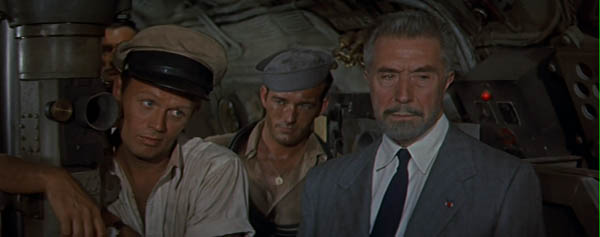
Second time seen, but first time with proper cinemascope ratio. Imagine this cropped:

image

Interesting to use cinemascope on a picture that mostly takes place on a cramped submarine, actually. Even more interesting that this was one of the first cinemascope films.

Richard Widmark, after both Night and the City and Pickup on South Street, is an experienced former submarine commander who is called back in for a secret mission: to escort a nuclear scientist (who disappeared from the public eye weeks earlier) and his scientist daughter (we don’t find that out until the end) to an island offshore of some bad country (China?) who’s developing a nuclear bomb, which they’ll drop from a plane disguised as a U.S. plane to get us into war with some other bad country (Russia?).

image

Sam Fuller directs in the hard, solid style he’s known for. Movie gets slowed down a couple times by preachy moments and the scientist repeats his line about “each man having their own reasons for living and their own price for dying” about two times too many, but for the most part it’s an engaging 100 minutes with some really good parts. They capture a Chinese fighter and lock him down below, then fake that their own Chinese officer is another captive… beat him up and throw him down with the first guy to get information out with a hidden mic. The evil Chinese catches on and beats the good guy to death with a pipe before the others can stop him. A harsh price to pay for information, but worth it because it leads them to discover the nuclear plot just in time. It’s a badass scene that really sticks out in my memory from the first time I watched this.

image

The good Chinese guy was in Steel Helmet. Widmark is alive and retired, but his co-star Bella Darvi committed suicide at 43. The cinematographer did House of Bamboo and Pickup On South Street and lots of famous late 40’s noir.

image

Showed to Jimmy. Hope he liked it. Tight 80-minute twisty little noir about pickpocket who accidentally steals secrets about to be traded to the russians. Cops were monitoring the switchoff to pounce on the head commie, so now cops, commies and the girl stuck in the middle are all after the pickpocket, who remains supercool in the face of danger. Richard Widmark and Jean Peters star, and Thelma Ritter plays Moe, the tie salesman / informant. Everyone in this is perfect. The girl gets shot, but she lives, and Widmark gets her in the end.

image missing

image missing

image missing