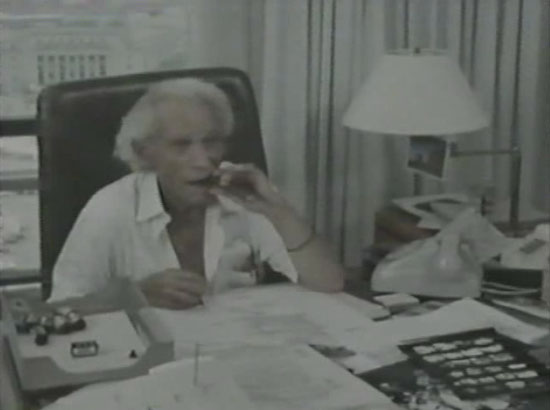
Falkenau, The Impossible (1988, Emil Weiss)

Weiss seems to love Sam Fuller, but he’s not on Fuller’s wavelength, unable to have much of a conversation with the man. So this doc (which is an hour long, but I crammed it in the shorts section anyway) admirably fulfills its purpose by screening all of Fuller’s WWII concentration camp cleanup footage while Sam narrates, taking him to the site of the camp in present-day and asking for his thoughts. That would’ve been more than enough, but Weiss leaves us with a one-sided (Sam likes to talk) silly-ass conversation about fictional representation of war, which would’ve been better left out. I’m most of the way through Sam’s autobiography, one of the greatest books I’ll ever read, where Fuller says this doc screened at Cannes and was praised for its straightforwardness.


Cry For Bobo (2001, David Cairns)

Poor and desperate, a man resorts to thievery to get by. He’s caught and imprisoned, then shot to death after escaping, as his wife and kid leave town, trying to start a new life without him. It’d be a miserable little story if the main characters weren’t clowns. Hilarious, reference-heavy, and better than I’d expected – and I had expected greatness. Already watched twice and trying to get Katy to see it (she hates clowns).


The Possibility of Hope (2007, Alfonso Cuarón)

Zizek:
“We no longer live in a world. ‘World’ means when you have a meaningful experience of what reality is which is rooted in your community, in its language, and it is clear that the true most radical impact of global capitalism is that we lack this basic literally ‘world view,’ a meaningful experience of totality. Because of this, today the main mode of politics is fear.”

Naomi Klein:
“More and more we see the progression of this economic model through disasters. So we’re now in a cycle where the economic model itself is so destructive to the planet that the number of disasters is increasing, both financial disasters and natural disasters.”
James Lovelock:
“If you live in the middle of Europe or here in America, things are going to get very bad indeed.”

Of course the “hope” part comes at the very end, as it does with all recent doom-gloom climate-change global-meltdown documentaries, and the hope in this one, despite the film’s title, isn’t all that hopeful. Start preparing now for how badly the future will suck – and it will suck. An Inconvenient Truth supposedly has a credit-time list of ways you can help the planet, Home encourages us to build windmills and go vegan, Wake Up Freak Out says we must act politically, and there’s always the hope during Collapse that the subject is just wrong, or that he’s a crackpot. Not so much here. If I’ve avoided talking about the filmmaking, well it’s basically a radio show with distracting visuals, much of it b-roll from Children of Men.


Night Mayor (2009, Guy Maddin)

Pronounce it similarly to “nightmare.” An inventor, a Bosnian immigrant, harnesses the “music” of the Aurora Borealis and converts it into dreamlike images which are sent across phone lines to his fellow Canadians using his Telemelodium. Even more/cooler junkpile inventions than in the electric chair short, some nudity (not as much as in Glorious or The Little White Cloud That Cried) and some delicious nonsequiturs. Clean narration by the accented inventor and two of his kids, along with excellent string music. At the end, the government shuts down his project, so he turns his attention from the skies to the seas, considers visualising whale songs.


One Minute Racist (2007, Caveh Zahedi)

Sweet three-minute cartoon story about the slippery slope of racism narrated by CZ, who codirected with a couple animators. Story of a student who doesn’t like asians because they’re too uptight and a paranoid library security guard who threatens to confirm the stereotype.


Talking Heads (1980, Krzysztof Kieslowski)
“What is your year of birth?”
“Who are you?”
“What do you most wish for?”
These three questions are asked to a one-year-old, then a two-year-old, and so on. The final answer: “I’m one hundred years old. What do I want? To live longer. Much longer.”

Most people seem to have thought about the questions for a while – possibly while the camera and lighting crew buzzed about their head, since the film looks like a lesson in how to effectively shoot subjects, professional but no-frills, by cinematographers Jacek Petrycki (No End, Camera Buff) and Piotr Kwiatkowski (second camera on the Three Colors). As a result, the answers come out seeming like a beauty pageant. Everyone wants more honesty and fairness, for everybody to just get along. The answers from kids under ten and adults over seventy are the best.


Born Free (2010, Romain Gavras)

I don’t count music videos as “shorts” or things would get too complicated, but then, I don’t really count this as a music video. M.I.A.’s music isn’t far enough up front, and the video (by Costa-Gavras’s son) is twice as long as the song. It’s a little piece wherein red-headed kids are rounded up by violent cops, beaten, shot and made to run through a minefield. Probably trying to make a point about tolerance and freedom, but for messages of tolerance I preferred the climactic speech in Cry For Bobo, also featuring overzealous cops: “First they came for the mimes, then the jugglers, then the bearded ladies. Next time, it were you.”


Hotel Torgo (2004, buncha dudes)

Buncha dudes head for El Paso and interview the last guy who remembers working on Manos: The Hands of Fate. There’s no real point to this, but the guy is very good-natured about it. Learned that Torgo was high all the time, which shouldn’t come as a surprise but somehow still does.

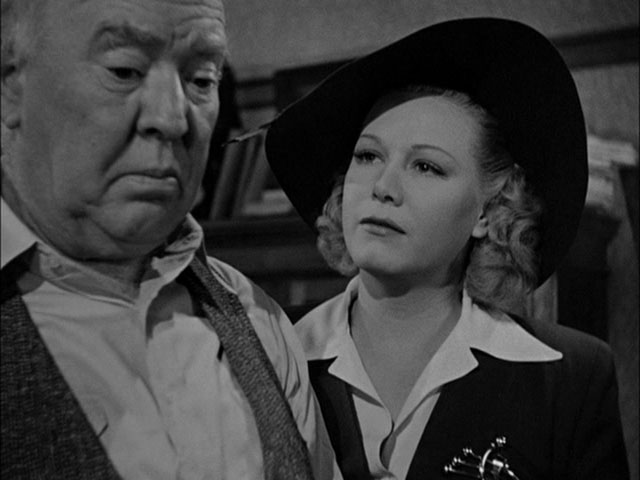
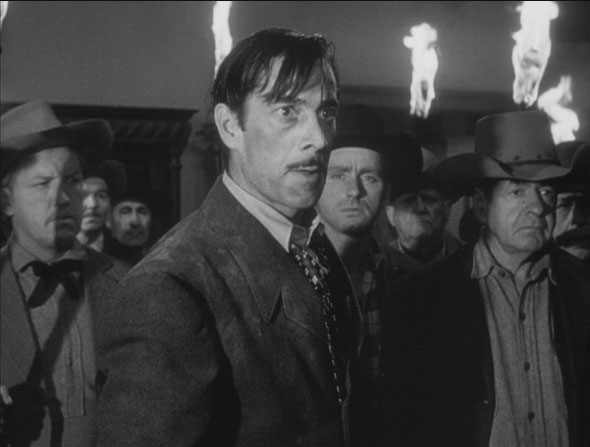
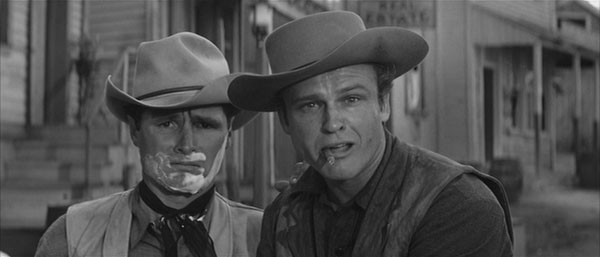
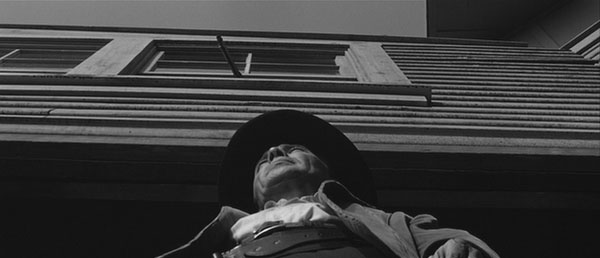
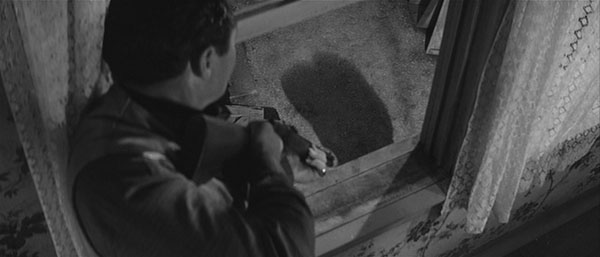
Howard Hawks planned to film Fuller’s “The Dark Page” with Edward G. Robinson and Humphrey Bogart while Fuller was still in the war, but by the time the story finally staggered onto the screen featuring a lower-prestige cast and director, Fuller himself had directed four pictures and was working on his own newspaper drama, Park Row. Maybe that explains why he was so disappointed in Scandal Sheet while he had no complaints about It Happened In Hollywood or Power of the Press. Or maybe he saw the early ones as collaborative screenplays, while this was his novel, written alone, being adapted without his input by three screenwriters – James Poe (Attack, The Big Knife), Eugene Ling (Behind Locked Doors) and Ted Sherdeman (Them!). The reason I wonder is because I think Scandal Sheet blows away the earlier movies and rivals Fuller’s own first two films. I’m sure the script wasn’t what Sam envisioned, but Phil Karlson (later 99 River Street, The Phenix City Story) sure knew how to shoot it. It’s noirish and well-paced with good acting throughout (the hero failed to impress, but isn’t it always that way) and looks like it’s been given care and attention. I doubt Sam was any more pleased when the film was remade in the 80’s with Burt Lancaster and a plot that sounds not-at-all similar to this one).

L-R: some extra, Donna Reed, John Derek, B. Crawford, H. O’Neill
image

You can’t tell from the beginning, with crime reporter McCleary (John Derek of Knock On Any Door) and his photographer (Harry Morgan, who played a character named Sam Fuller the same year in High Noon) deceiving a grieving victim into telling them her story before the cops arrive, if the reporter is a slimeball bastard or just a resourceful newsman. Eventually he starts to look like the editor in Power of the Press (but with dreamy slick 1950’s hair), a good guy at heart but a slimeball by association with his muckraking boss, ed-in-chief Broderick Crawford (depressed train operator in Human Desire). That’s not really the point of the story, and the question is dropped when it becomes clear that McCleary is our hero (you can tell because Donna Reed likes him).

image

Dudes are going about their business raising circulation at the paper by treating the public like dolts (as in Power of the Press, this seems to work) when the editor runs into his ex-wife (Rosemary DeCamp, above, of 13 Ghosts) at the paper’s Lonely Hearts Ball. She’s rightfully pissed at him for ditching her twenty years ago without a divorce, changing his name and moving to the big city, so she offers to blackmail him until violent hubby pushes her into a bedpost, killing her. Now he’s trapped (Broderick Crawford always seems to be short-tempered and trapped), trying to cover up his crime while allowing his star reporter to try cracking the case. Loose end Henry O’Neill (The Sun Shines Bright) is eliminated, turning the accidental killer into a cold-blooded murderer, and the paper follows the case until its own editor’s face is plastered on the front page as circulation finally surpasses the level that would’ve made him a partner.

image

As a possible shout-out to Sam Fuller, the actor who played the judge who fingers Broderick in the gun-totin’ final showdown was actually named Griff.

image

Griff! He played a judge in Angel Face the same year.

Big city newspaper owner Carter is publically attacked by small town newspaper owner Ulysses Bradford for twisting the truth, exploiting the sacred power of the press for commercial gain.

“A free press is the sole right of the people. The editor is but the trustee of that right, not the dictator. Beware of those who hide behind the front pages of America who use for their own advantage the power of the press. They are as dangerous as enemy planes, bombs, guns, tanks.”

Carter, shamed, agrees with Bradford’s editorial, vows to improve his paper at a press conference, but is shot before he can get through the speech. Things get farfetched here, but it’s obviously the work of chief editor Howard Rankin (below), a transparent villain introduced delivering a light line about sending someone to a concentration camp.

image

Hard to find an interesting screen shot. Doesn’t have half the visual interest of It Happened In Hollywood or Park Row.

Now it’s up to Edwina (“Eddie” to her friends), Carter’s longtime secretary, to convince smalltime Bradford to come to the big city, take the reins of the paper (it was left him in Carter’s dying will), get managing editor Griff from under Rankin’s thumb, catch trigger man Trent at another murder and force a confession from Rankin. Can they succeed in these noble deeds? Yes!

image

Oh and I didn’t mention Rankin incites a riot to destroy a warehouse hoarding rationed goods, which turns out to be a secret army supply, and he frames a young commie ex-newsman for Carter’s murder. All this in 60 minutes. Big ol’ propaganda piece for a free press, with more and more spoken comparisons between Rankin and nazi bigwigs as the crimes are revealed. But the worst insult of all: “Why, Howard Rankin isn’t even a real newspaperman.”

Fuller wrote the story, not the screenplay, but we still get idealistic speeches about the press, mentions of Horace Greeley and a character named Griff. Sounds like our Sam. Doesn’t look like him unfortunately… feels like a quickie. No wonder, since director Lew Landers made 28 movies from 1942-44.

Minor Watson (Woman of the Year, Lang’s Western Union) played the murdered newsman, Larry Parks (played Al Jolson in a biopic and its sequel) the commie, Victor Jory (the Rupert Everett part in the 1935 A Midsummer Night’s Dream, also played The Shadow in the 1940 serial) the evil henchman, Atlanta native Lee Tracy (Doctor X and Borzage’s Liliom) the eventual-good-guy editor Griff and Otto Kruger (High Noon, Dracula’s Daughter) the maniacal Rankin. Our female lead Gloria Dickson died in a house fire two years later. Guy Kibbee (Ulysses) seems to have had a nice career despite his unfortunate name, from 30’s musicals to Capra to John Ford. The previous few years he’d been starring in a comedy series as Scattergood Baines.

In the featurette, Tim Robbins says a buncha general things about Fuller’s movies, mentions the year 1959, so I figure he thought he’d be on the Crimson Kimono disc, not having his interview slapped between clips of Power of the Press. Tim is a suitable interview, since I’ve had that song about “the press, the press, the freedom of the press” from his Cradle Will Rock in my head since I watched this.

image

From Sam Fuller’s autobiography:

[Writer/producer Myles Connolly] and I started throwing around ideas for his picture. It was supposed to be about a character based on Tom Mix, the cowboy star of silent films who’d made scores of Westerns. Then came the talkies, and Mix didn’t make the transition successfully. Myles and I came up with a story about a silent cowboy star who doesn’t want to play a gangster role in a talkie because he wants to be loyal to his fans. He doesn’t want to disappoint the kids who are crazy about his Westerns. We called it Once a Hero, but after the movie went into production, they gave it the more commercial title of It Happened in Hollywood.

Harry Lachman, who’d been a successful painter in Paris, directed the picture. Lachman is forgotten today, but he made over thirty movies before he stopped directing in the early forties. Fay Wray played the female lead. This was after King Kong distinguished her from all the pretty blondes of the day as the one who could scream the best. the Tom Mix character, Tim Bart, was played by Richard Dix. It Happened in Hollywood was my first real credit on a picture.

Fay Wray, the one who could scream the best:
image

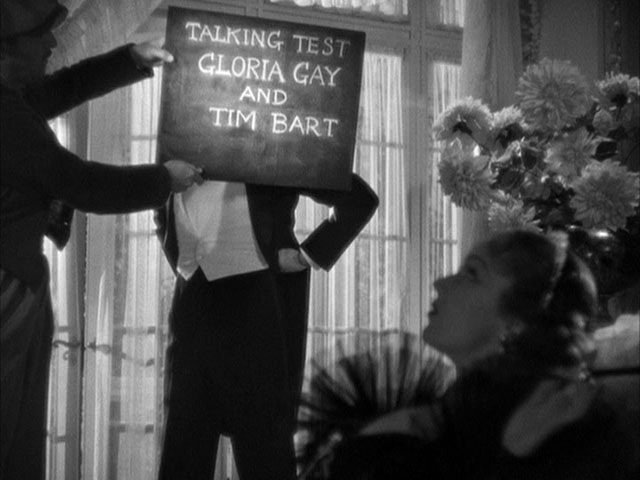
The name wasn’t changed soon enough – the Once a Hero title card made it onto the film. Celeb cowboy actor Bart is introduced screening his latest movie to sick kids, a real white-hat good-guy honest friendly lunkhead. He and his leading lady Gloria are called back to Hollywood for sound tests – she makes it but Bart, dressed in a silly period suit and made to speak out-of-character flowery dialogue, gets cut. Gloria later gets him a bit part as a gangster but he walks when the script is changed to make him a cop killer.

“The day of Westerns is over. We have to make the pictures indoors from now on.” Recalls The Naked City, which we watched the same week, finally making the pictures outdoors again.

Bart in gangster getup with his director:
image

Out of work and unpopular when a young fan comes to visit, Bart throws a party and invites all the stars’ doubles and stand-ins to delight the kid – the highlight of the picture. Some stand-ins do the voices better than others – Chaplin’s and Harold Lloyd’s have no problem since they don’t speak.

This is not W.C. Fields:
image

The improbabilities pile up… a realtor, after Bart to repossess his mansion while the party is being held, is kidnapped. Bart and Gloria tearfully confess to each other that they’re broke. The boy falls ill and the doctor says he can’t be moved. Tim hits his low point, about to reenact the bank robbery for real, ends up foiling a more serious bank robbery and shooting the criminals. Now a hero in the papers, he’s hired back by the studio, Westerns make a comeback and Tim opens a ranch for sick kids. That’s a better ending than Tom Mix got, touring with a circus after leaving the movies, marrying for the fifth time then dying when his car plunged into a ravine.

Did anybody realize that Blake Edwards made a movie in which Tom Mix (Bruce Willis) teams up with Wyatt Earp to solve a murder at the Academy Awards? It came out three months before Die Hard.

A boy in trouble:
image

Decent movie. I liked Richard Dix (who’d really been a silent film star, and not exclusively in Westerns) but Fay Wray made more of an impression. It all confused Katy, who knows Sam Fuller is some kind of badass and didn’t follow his connection with this movie. I didn’t either, honestly – assuming Power of the Press and Scandal Sheet will show off more of his style (I already know that Shockproof does).

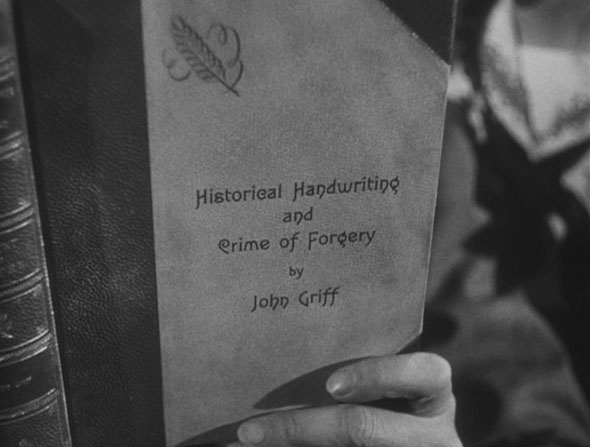
Based on the true story of James Reavis – however his wikipedia article sounds like the true story would make for a far less interesting movie than Fuller’s script. It’s got the pen-and-ink technicality (his forgery is discovered because he uses the wrong kind of ink), the marrying a trumped-up land heir, and the prison time, but it lacks the monastery, the gypsy camp and Reavis-Price’s completely solitary audacity of it all (the real Reavis had financial backers, co-conspirators and hired thugs). Also the guy who exposed the fraud was named Royal Johnson, not John Griff.

image

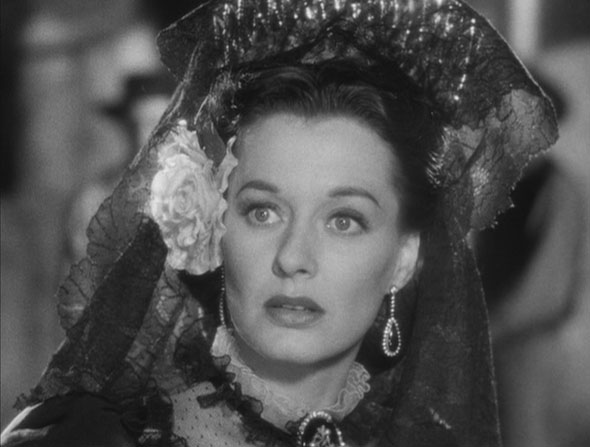
Vincent Price hadn’t found horror fame yet, but he acts up a storm in this – convincing as a showman, a lover, a silent conspirator and an enraged victim of mob violence (see below). His plan involves the U.S. government honoring Spanish land grants – he trumps up his young ward (later his wife, ew) as the sole living heiress of a previously unclaimed grant for the whole territory of Arizona, planting her fictional parents’ gravestones, engraving a proclamation into a giant stone, posing as a monk for three years to inscribe the false grant into the ancient records and getting some gypsies to help him break in where the copy of the records is kept.

image

For all that work he is very nearly killed by the angry villagers, but the government saves him in order to imprison him. His wife (Ellen Drew of Christmas In July, who again fails to make much of an impression) apparently forgives him for giving her a false identity and roping her into his land-grab scheme, picks him up from prison at the end.

image

Fictional-historical adventure-romance-dramas aren’t exactly what Sam Fuller is known for, but he pulls it off. I guess he was one of the few writer/directors out there at this time, and The Steel Helmet wasn’t far behind. The only bit that doesn’t work for me is the silly framing device of old men smoking cigars and reminiscing about the Baron’s crazy scheme. At least Sam worked cigars into the story somehow.

image

That’s Reed Hadley as Griff, the government’s expert fraud analyst who manages to debunk Price and help him escape the angry crowd. Within a couple years of this, Hadley played both Jesse James (for Fuller) and Jesse’s brother Frank, and appeared in two MST3K-bait films.

image

“What’s happened to us is like war… easy to start… hard to stop.”

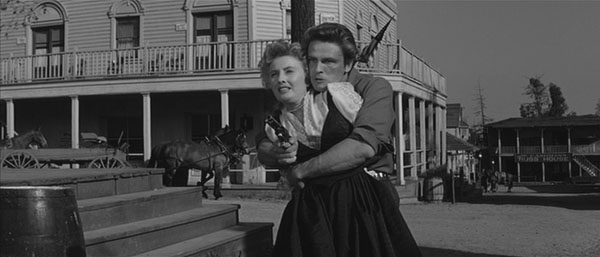
A wordless intro before the opening titles, so no dialogue until 4:30… and it’s only an 80 minute movie, so that’s significant. Once the action starts, of course, it barely lets up, led by a hero named Griff who talks like a hero should talk (sorta like the host of a news magazine show). The star is Barbara Stanwyck but she’s not in the movie half as much as Griff, which only serves to make her more of a presence when she is around.

Anyway, Griff is one of those western heroes who’s amazing with a gun, unbeatable, but hates to use it, haunted from having killed a guy some years ago. He’s an oxymoronically peaceful bounty hunter with his two brothers in tow – nice-guy Wes who falls in love with a local gunsmith girl and eager Chico who wants to be a gunfighter. Griff swaggers into town as Stanwyck’s unhinged little brother Brockie is shooting up the streets, and busts the violent asshole brother’s nose in one of the baddest-ass western showdowns ever filmed. This and Griff’s humiliating public arrest of one of her “forty guns”, a man wanted for robbery, causes a balance-of-power problem with Stanwyck, who formerly owned this town uncontested. But of course… the two of them fall in love.

Charlie Savage (played by John Wayne’s stunt man) and Brockie (John Ericson of Bad Day at Black Rock):
image

John the marshall is a slow-talkin’ goodly old man with bad eyesight whom Brockie shoots (not to death) just for the hell of it, but the cowardly nasal-voiced sheriff Logan and the local judge are friends of Stanwyck’s, so when Brockie is arrested he’s quickly let out. They have a harder time protecting Swain, the wanted man, since he’s got a federal warrant on him, so Charlie Savage kills him in his cell before Swain can say too much. Griff is on the case right away, knowing it’s Charlie because he’s the best shot in town (although why does it take the best shot in town to blast a guy through a prison window?). Charlie sets a trap for Griff, but young Chico interferes and kills Charlie.

image

“Now what did I do wrong?”
“Now you’ve killed a man.”

image

I’m out of sequence here but it doesn’t matter. Griff and Barbara have a symbolic love scene during a tornado and bond over their wild little brothers. Griff bathes in a barrel (but does not get shot up a la House of Bamboo). The movie breaks into a song about Barbara (“She’s a high-ridin’ woman with a whip”). And whenever a man and a woman are alone, the innuendo cranks way up, higher than I thought it could go in the 50’s (well, I suppose Will Success Spoil Rock Hunter was the same year). There’s talk of the death of the wild west, of a peaceful, civilized future.

image

But the kids still wanna play shoot-’em-up. Wes is predictably but still terribly, killed on his wedding day by Brockie, and that’s not the kind of thing Griff can let go. He shames the sheriff, who fails to kill Griff and so loses Barbara. The famed ending, in the writer/director’s own words:

Brock knows Griff loves his sister and surely won’t shoot a woman. He’s wrong. Griff plugs Jessica in the leg and, as she slides to the ground, empties his pistol into the bastard brother.

Griff doesn’t kill Brock out of vengeance. He’s eliminating a cancer that’s terrorizing the community. But he’s disgusted with himself. By resorting to guns, Griff sees the last ten years vanish in a flash, as he becomes the killer he’s renounced.

My original script had Griff killing both Jessica and her brother, stepping over their corpses in a daze, throwing his gun down – this time for good – and walking up the dusty street without a pause. Nothing and no one exists for Griff anymore. The End. That version ran into trouble at the studio…

image

Instead Chico ends up marshall and Barbara runs after Griff as he’s leaving town and they ride away. A few months after China Gate (and somehow Run of the Arrow came in between them), the filmmaking is smooth as hell – scenes playing out in single long takes with powerful fast cutting during the action scenes.

Barbara, in her final year as a headlining movie star:
image

Fuller again:

My story hinged on America’s pervasive fascination with guns. Hell if I know why people think guns are sexy. I cooked up a helluva lot of sexual metaphors playing with the idea.

image

Our gruff hero Griff (far left) is professional tough guy actor Barry Sullivan (The Bad and the Beautiful). Gene Barry (on right, star of China Gate, played a fake Mexican in Red Garters) is brother Wes. Robert Dix (writer/star of Five Bloody Graves) is Chico, and in the light coat is Sheriff Dean Jagger (the beloved major in White Christmas, also in Lang’s Western Union):
image

Fuller:

With Forty Guns, I’d really hit my stride. I considered it one of my best efforts so far. Sure, there were some compromises – like the ending, but it came pretty close to my original vision. At the time, very few people were given the opportunity to write, produce, and direct their own movies.

image

“Every girl is beautiful… until they kill somebody.”

Wowie wow wow, the acting (or the dubbing) by our two leads is terrrrible. But I’ve seen this once before so I knew that and could focus on other things this time. Nice title music by Ennio Morricone, decent camerawork and good shot choices. Ultimately a stupid movie though, not half as good (or half as ludicrous) as Dead Pigeon on Beethoven Street. Worth watching only for Fuller completists like myself, or possibly for Claude Chabrol’s loony performance.

Bobby’s silhouette getting nabbed backstage:
image

Bobby Di Cicco, who I don’t remember being completely horrible in The Big Red One, is a loser wannabe musician who sneaks into the orchestra every night and watches from backstage. He meets Véronique Jannot at the unemployment office and they decide to take revenge on the agents there who humiliate the two while failing to find them work. First up is a mustache-grooming woman they call Mussolini, then a pervert they call Tartuffe played with campy hilarity by Claude Chabrol.

C.C. wearing funny gloves:
image

But when Tartuffe falls out the window (in an incident of neighborly peeping gone wrong) our two hero losers are on the run, assisted by Bobby’s music-shop-owning ex-con buddy and a girl they met while breaking into her dad’s house. These two accomplices (whom our heroes seem to barely know, but are willing to assault cops to help them get away) are nearly as awful actors as our heroes, but they have better voices… his is low and TV-cop-show-like, hers is small and airy.

Oh yeah, here’s Bobby:
image

And what’s her name, Veronica:
image

Presumably (or hopefully) the accomplices are arrested for being horrible liars. Our couple goes on the run. In a snowy small town rest stop en route to Spain, a loose-cannon ex-cop is introduced only moments before pulling out his gun and blasting away, killing Veronica. Bobby is wounded, somehow makes it back to Paris only to sneak into the orchestra, con his way onstage and die mid-performance… nice.

Movie isn’t a total waste of time – there are a few nuts scenes… some pretend-incest that seems to repulse/turn on landlady Christa Lang… Sam Fuller as “Zoltan” a jewelry fence and death-scene enthusiast with an eyepatch concealing a magnifying contact lens… the outer-space sound effects over Ennio Morricone’s score on the final scene.

Christa:
image

Sam:
image

Cameo as a brothel madam by Micheline Presle of some Demy movies, The Nun, I Want To Go Home and American Guerrilla in the Philippines:
image

NY Times called it “a rather mediocre crime story about a Bonnie-and-Clyde couple.” The video box calls it a tribute to the French New Wave. I’m not sure how, exactly… unless the final shootout in the snow is in memory of Shoot The Piano Player.

One of three TV-movies Fuller made in ’90, a year after his final theatrical film Street of No Return (and I still don’t know where to find the other two).

Earnest photographer Jennifer Beals (Flashdance, Chabrol’s Dr. M) is in the Philippines in the mid ’80’s (soon before the downfall of Ferdinand Marcos) looking for shots of strife and poverty to bring global attention to the local slums. She meets up with her ex, opportunistic photographer Luc Merenda (a vet of 1970’s Italian cop movies who cameoed in Hostel II).

Highlight of the movie is this local kid they meet. He learned hardboiled American gangster-speak from the movies and follows our couple around calling her “doll” and him “frenchy” while keeping them out of trouble. Trouble comes when Frenchy snaps a pic of a military man shooting an old woman in the head for not giving up a rebel camp location. From then on, it’s a chase for that roll of film, with more screen time for Frenchy than Beals, even though she’s the “star”.

Christa Lang plays Mama, who runs a sorta casino-brothel. N. Vera says: “It’s got a good Filipino cast–Behn Cervantes is an old friend of Lino Brocka and a theatrical legend… Pilar Pilapil is (or was) one of the most sensual actresses in Philippine cinema.” Pilar plays a girl forced to “work” at Mama’s until boyfriend Behn can afford to buy her out. They seem sympathetic to our heroes’ cause until the end, when Behn is discovered to be a pro-Marcos spy and is machine-gunned in the middle of a rally by the kid – an event captured by both photographers, getting ’em well-paid cover shots for a happy ending.

Fuller no longer had the budget or prestige for a studio shoot, but B. Krohn calls Madonna and some other late works “great films, despite the loss of control from location shooting.” Functional cinematography except for a fun shootout at a movie house, the action on the screen echoing the firefight in the theater.

Music sounds like the percussion of the backing track to that “Oh Yeah” song from Ferris Bueller with some hideous keyboards over it. Fuller wrote the title song (movie’s alt title is Tinikling, named after a game played by street kids in the movie, like jumprope with bamboo poles). Nice lyrics actually, but there’s no adequate performance of it in the film – first the kid belts it out in a moving car, then this guy Samuel Euston puts too much heart and soul and lameness into it.

Oh I forgot to mention this guy Pavel, who’s sorta all over the place trying to cut deals, played by Patrick Bauchau (star of Rohmer’s La Collectionneuse 20 years earlier, also in The Rapture).
image

The doll:
image

Frenchy:
image

Mama:
image

Sam Fuller, nearly 80, wouldn’t direct again after ’90, but would stick around as an actor for a few more years in films by Gitai, Wenders and Kaurismäki.
image

Since Fantoma is not ever going to release this on DVD (with Christa Lang commentary) like they promised to do, the dirty rats, I found a copy elsewhere and finally watched it. And it’s good! Criterion started our national reappraisal of the great Sam Fuller mid-career with The Naked Kiss and Shock Corridor, then moved on to the early films with that Eclipse set, now this week they’re hitting his late period with White Dog, so I’m participating with this pre-Big Red One episode from his forgotten days in the ghetto of television.

This is an episode of a German cop show from 1970 which is still running. I can’t imagine why an American director was allowed to write and direct a German TV episode in English… we’d certainly never invite Werner Herzog to shoot an all-German episode of Law & Order. The producer must’ve been a Naked Kiss fan. Anyway, it’s over 90 minutes long and there’s no indication of regular characters or a running plot or a teaser for next week’s episode, so I’m not sure what format this cop show takes… this played like a standalone film in TV picture-ratio.

I enjoyed the movie quite a lot. It’s technically excellent at times, but when time or budget didn’t allow for excellence they played it loose and fun. Acting isn’t so strong – Christa (Sam’s wife) overdoes it at times, and lead man Sandy (Glenn Corbett of The Crimson Kimono) is generically TV-crappy. I wouldn’t call the incidental music by “The” Can amazing, but has its moments. Fuller (or whoever) gets points for hiring the ultra-hip Can in the first place. The double-agent spy story is pretty cool, but the way it’s pulled off visually is beyond cool. Check it:

How our hero is introduced – he’s the dude in the middle, and that’s his murdered partner on the table:
image

How Christa is introduced, walking past a giant poster of Frank… this movie is very clued-in musically:
image

Some Citizen Kane hole-in-the-floor cinematography:
image

Fuller is having fun with this movie. They watch Rio Bravo, there are characters named Novak and Bogdanovich, and Fuller cameos offscreen as The Senator with a framed picture of Nixon on the wall and a novel by one Samuel Fuller prominently placed on the desk.
image

And then there’s this guy, with the fantastic name of Charlie Umlaut. I’m not sure what his deal is – I think he might’ve killed our cop’s partner, then at the end he shows up in a parade in clownface, screaming his own name until he’s caught and killed. Whatever it meant, it certainly livened up the picture.
image

Very nice cinematography of German cities (Bonn, Cologne) by Jerzy Lipman, who shot early Wajda films and Knife in the Water.
image

Oh right, the plot. Christa works for fey evil rich guy Mensur. She drugs famous people, poses with them in lewd positions, then blackmails them with the photos. Sandy, our cop, shows up far-fetchedly claiming to be in the same business and happening to pick Christa to perform the same job she does for Mensur. Eventually she’s in on his plot and supposedly helping him, but it all gets twisted up, and in the end he’s challenged to a hilariously unconvincing fencing duel in Mensur’s office, which Mensur inexplicably loses.

Mensur, top, is Anton Diffring (of Tusk and Fahrenheit 451).
image

Christa:
image

Christa:
image

Christa!
image