Just before midnight of the new year, a salvation army sister named Edith, “stricken with galloping consumption,” sends for David Holm. Meanwhile across town, Holm (played by the director) gets in a fight with his fellow drunks and is killed. Many flashbacks ensue, including one inside another – the second movie I watched this month where that happens.

Firstly, the last person of the year to die must serve Death driving the phantom carriage for the next year – and time moves slowly after death so one night driving the carriage can seem like a year. So said Holm’s drinking buddy George just over a year ago (the movie points out that George knows such things because he went to college), and now George drives the carriage, passing the reins to Holm.

L-R: David Holm, David Holm, George:

Also a year ago, Edith opened her salvation army branch. Holm was her first guest, and she prayed he’d have a good year, asked him to return next new year’s eve. She stayed up all night patching his disease-ridden coat, catching the tuberculosis that would kill her. He stands up the next morning and tears out all the patches in front of her. So it’s the story of the most selfless angelic woman and the worst, drunkest, cruelest motherfucker (Holm also chases his wife with an axe Shining-style – commentary says probably inspired by a domestic violence scene in Broken Blossoms). Edith’s life (and death) and the phantom carriage both exist primarily to reform Holm, get him to drop the bottle and come back to his family – sort of a grimier It’s a Wonderful Life, a prohibition morality tale.

The whooshy ambient music seemed nice at first, but was perhaps too ambient. From the commentary: “Few, if any, previous films had been enveloped in the darkness of the night the way this film is” – and – “Sjostrom tends to avoid compositions that look too balanced, often shooting into the corners of rooms rather than straight at a back wall.” I appreciated this, as well as the great editing and unusual storytelling, making the movie seem decades more modern than the 1910’s tableau style. Also good acting and fun superimposition effects, overall a hundred times better than the contemporary Murnau film I watched this week. Also came out the same year as Lang’s similarly effect-heavy death-poem Destiny, the year before Haxan, and thirty-six before The Seventh Seal. Remade by Julien Duvivier after twenty years, and again back in Sweden after another twenty.

Holm’s wife vs. Sister Edith:

P. Mayersberg:

The film is surprisingly disconnected from Swedish Lutheranism. It is closer to Bergman’s demonic Hour of the Wolf than to the religious crisis of Winter Light. David’s sudden conversion at the end is not altogether convincing. He is given a last chance by coming back from the dead to save his wife from poisoning herself and their children out of hopeless desperation. But it isn’t God the Father who intervenes. It is his dead predecessor, coachman Georges, who is touched by David’s loving wife and the devoted Edit, who have fought so hard and long to save the man.

Opening-day SHOCKtober screening this season is one I’ve been meaning to watch for years for being Shadowplay’s favorite film. Not my favorite, but I appreciated the enjoyably absurd premise, Chaney’s performance (which involves getting slapped), the brilliant optical transitions (a spinning ball -> globe -> circus ring), and of course, murder by lion.

Lon with his wife and benefactor, just before tragedy struck:

Lon Chaney (same year he did Phantom of the Opera and The Unholy Three) is a brilliant scientist married to sweet Ruth King (in possibly her only surviving film) and sponsored by a wealthy baron (Marc McDermott). Life is good, until McDermott steals Chaney’s ideas and his wife. Chaney is humiliated in front of his peers at a big presentation, slapped by the baron, slapped by his wife, and told to fuck off. Treated like a clown, he joins the circus, becomes an actual clown and creates a hugely successful routine wherein he reenacts his humiliation, getting slapped again and again as he tries to be taken seriously, the other clowns and the crowd roaring laughter at him.

A few years later, attractive young Norma Shearer (The Divorcee) joins the circus, drawing the attention of attractive young John Gilbert (The Merry Widow, The Big Parade) as well as Lon (now, hilariously, only known as “HE”). But slimy old Baron McDermott visits the circus and sees his chance to dump Lon’s wife for a younger girl. He makes a deal with her father to marry Norma, causing HE to take his belated revenge via lion.

Attractive young couple, somewhat overdoing it:

Cairns:

The biggest contortion of credibility is when Chaney confesses his love to Norma Shearer and she thinks he’s joking which, given his performance and the lines we get via intertitle, is impossible to accept as believable in any literal way. Nobody could be that dumb. A modern actor might say the scene is unplayable. But it works, because we get what it’s about (this film is deep but it ain’t exactly subtle, so Chaney even TELLS us what it’s about: “I say serious things and people laugh!”).

The first film MGM released, and the first American picture by Sjöström, lured to Hollywood after the international success of The Phantom Carriage. IMDB suggests a pile of related films – a 1917 Russian version, later Chinese and Argentinian versions, and three 1925 shorts with parody titles.

Transformation:

“Can we knock off the capitalists and officers in the street if we find any?”

Features the most depressing opening 10 minutes of any movie ever. “There was a mother who had three sons. There was a war. The mother had three sons no more.” Actors stop, freeze in mannequin poses. A man beats his horse, as a woman beats her children. Laughing gas is released on the battlefield. A man with small round glasses has fits of hilarity. In silhouette, a soldier won’t shoot, drops his gun frozen, gets killed by his commanding officer. A Russian troop train is ambushed by Ukrainians, and after revealing its defenses is permitted to roll along, out of control since the driver has left, crashing, some men having leapt to safety, others not – a dying man’s arm cross-cut with an accordion thrown from the wreck. A woman reads a letter straight into the camera. Horses respond verbally (via intertitles) to shouted commands.

Real dissonant music, and editing to fit the scenes – lingering at the start, then all quick and exciting leading up to the train crash.

Ukrainian workers return to The Arsenal after fighting for years, first in WWI then to free their country from Russia, then as far as I can figure out the storyline, there’s internal conflict to decide whether they will join the Soviet Union. Quoth Wikipedia “The civil war that eventually brought the Soviet government to power devastated Ukraine. It left over 1.5 million people dead and hundreds of thousands homeless.”

But wait, Wikipedia can explain the movie’s plot as well.

The film concerns an episode in the Russian Civil War in 1918 in which the Kiev Arsenal January Uprising of workers aided the besieging Bolshevik army against the Ukrainian national Parliament Central Rada who held legal power in Ukraine at the time. Regarded by film scholar Vance Kepley, Jr. as “one of the few Soviet political films which seems even to cast doubt on the morality of violent retribution”, Dovzhenko’s eye for wartime absurdities (for example, an attack on an empty trench) anticipates later pacifist sentiments in films by Jean Renoir and Stanley Kubrick.

Whatever specific historical events it may be illustrating, and wherever exactly it may be taking place, I loved every scene. It’s got all the brilliant camerawork and crazy heightened atmosphere of the great Dura Lex, and more. Closes with a firing squad discovering a Ukrainian worker who cannot be killed, baring his chest to reveal no hidden armor or wounds.

Remarkably well-restored, exciting little hour-long comedy, with a distinctive look and memorable performances – much, much better than anything I expected with such a boring name. I don’t know what I thought, maybe a Little Mermaid type thing, but the girl comes from a family who made their wealth in oysters, and agrees to marry down-and-out royalty to get herself a title, hence “oyster princess.”

The hyper-rich Oyster King, Mr. Quaker (Victor Janson, whom I liked so much in this role, I’ll try to forget that he appeared in “the key film in Nazi popular culture” in 1942) is disturbed from smoking a cigar the size of his head by a report that his daughter (Ossi Oswalda, “the German Mary Pickford”) has torn up her room upon hearing that the Shoe-Cream King’s daughter has married a prince, so Quaker hires the local matchmaker to procure a prince.

Handsome Prince Nucki (Harry Liedtke, title star of The Grand Duke’s Finances) lives in a ramshackle apartment with his roommate/assistant, bald jokester Josef (Julius Falkenstein of Dr. Mabuse The Gambler, The Haunted Castle). The matchmaker pays a call, and the prince sends Josef to check out the girl. But she’s in a hurry, marries Josef immediately, and holds a wedding banquet (Quaker: “Excuse me for introducing you to my son-in-law”). A split-screen “foxtrot epidemic” ensues (above) and Josef gets giddily drunk, while Nucki goes out drinking with his friends. This ends with my favorite shot in the movie, the group staggering down the road, depositing a man on each bench along the path.

Nucki stumbles blindly into “the multi-millionaires’ daughters’ association against dipsomania” (alcoholism) where he’s beaten up by Ossi, who falls for him and takes him home. It’s a setup for heartbreak, since Ossi is in love with a man who isn’t her husband, but then Josef says he got married in the prince’s name so the other two rush off to bed together.

Something like Lubitsch’s 30th movie (they were prolific back then), released a decade earlier than anything else I’ve seen by him.

Often I just don’t know what is happening. A title card says “the commisars”, now people are marching with guns, groups are handing scraps of paper to a man who’s collecting them on his bayonet, then a title says “To the telephone office!” What did all those things mean?

It was all very important at the time, a film portrayal of recent political upset and revolution, but with my lack of background in Russian history, most of the movie seems a blur of dates and places and crowds, the significance of most scenes lost, and very few of the alarmingly great compositions of other Eisenstein films. There’s some of the dramatic editing of course – when the crowd is fired upon it seems like single-frame edits, unreal. I don’t think Trotsky comes off well in the end. At least I managed to get used to the unnecessary sound effects all over the DVD.

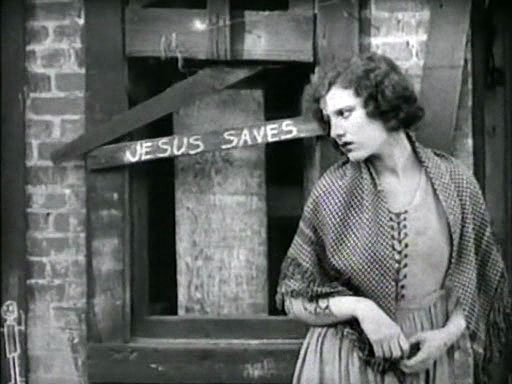
Sternberg puts poetry in his images, but he puts plenty in the intertitles too. Eight minutes in, I’d read about thirty flowery title cards – it’s like if Antonioni movies had subtitles telling you what everything meant, instead of relying on the images.

It’s not as plotless as the Criterion box’s commentaries and docs led me to believe – tells a story, just does it in an unhurried, lingering way. A cowardly young man, a bitter young woman and a helpless child live on the docks, spend their days full of ennui watching a dredge dig the same hole day in and day out, chased around by the dredge workers. One day they up and decide to leave for the city together, after seeing a cat. Take it away, intertitles: “The black cat, like an evil spirit, warned the three nobodies to leave the dredge before the thundering mud could bury their souls.”

My favorite title upon their arrival: “Man’s worst enemy is man. A city is full of enemies.” Some guy who wears lipstick lets them stay at his place for free, knowing that the boy is too stupid to find a job and planning to whore out the girl when the three get too hungry and hopeless. At least I think that’s his plan – things like that used to go unspoken in movies.

But all the makeshift family seems to do is sit on the couch and stare at the walls. Since they expend no energy, they don’t get hungry very fast, so the impatient lipstick man decides to “take her out for a ride in the country and let romance do a little work.” His idea of the country is a depressing little field next to the highway, where he tries to win her trust by beating up the little kid. The young man (“the boy” in the titles) finally asserts himself. “The man was only the victim. The boy was not beating him. He was conquering the harbor, the city, the mud – all the forces that had held him down, and most of all his own cowardly self.”

Horned Lipstick Man:

The titles beam about this moral victory! “Behold! They have fought and won a mighty battle – over themselves! It isn’t conditions, nor is it environment – our faith controls our lives!” The trio walks literally into the sunset, probably falling down and starving to death once out of camera range.

M. Gebert wrote an excellent article about early Sternberg:

Contrary to the usual Hollywood picture of the plucky poor, all must have felt like a slap from something utterly new in 1925. It certainly spawned a fair number of followers— when Lillian Gish gets a face full of wind, when James Murray’s dreams are buried in the crowd, when a Man thinks of drowning his wife for A Woman From the City, you can see how The Salvation Hunters helped shape Hollywood’s idea of what an artistic drama was

In between [Salvation Hunters and Underworld] is the famous unseen and lost film, The Sea Gull. We will presumably never know whether Chaplin suppressed it because he was jealous of how good it was, or because it was unreleasable crap. But I have my suspicions; many independent filmmakers have used their second, better-financed film to essentially remake their first film, much more self-indulgently and with a belief in their own genius inflated well beyond reality.

I thought this was quite good for ’25, it just didn’t make me leap out of my seat like Underworld did. I guess now I’ve seen all the silent Sternberg movies that are known to survive. Some of his other lost films include Exquisite Sinner (pre-Underworld, taken out of Sternberg’s hands by the studio after shooting) The Drag Net (after The Last Command) and The Case of Lena Smith (after Docks of New York). On to the talking pictures.

The year after The Gold Rush and Battleship Potemkin, Eisenstein’s teacher Kuleshov turned in his own gold rush masterpiece. It’s far less funny than the Chaplin feature, and far more economical than the Eisenstein – for the bulk it’s just three actors, a cabin and a storm. You don’t see a lot of Russian films set in Canada. I don’t, anyway, but then I don’t see a lot of Russian films – been meaning to correct that. The titles pronounce this as the “third work of the Kuleshov Collective,” the first two of which still mostly survive.

I don’t get the organizational structure here, but “chairman” Hans (Sergei Komarov of The End of St. Petersburg) with two “shareholders” (blonde-bearded Dutchy and black-bearded Harky) are out in the Yukon mining for gold – unsuccessfully, for the most part, along with Hans’s English wife Edith (Aleksandra Khokhlova of earlier Kuleshov Collective film Mr. West) and mustachioed Irishman (proven by fact that he spends his free time playing flutes and dancing jigs) Michael Dennin (Vladimir Fogel, the hero of Chess Fever).

Based on “The Unexpected” by Jack London. London’s stories made for extremely popular film adaptations from 1908 to 1930 – and he lived to 1916, so may have seen some of them. I suppose people back then enjoyed watching lone, underprepared hikers crash through the ice then slowly freeze to death. This group, however, is well stocked for the weather, and just as they were giving up on their present location, Dennin finds a cache of gold. Unfortunately, he makes up for this by developing a dark jealous rage and deciding to kill everybody. He blows away both the shareholders before Hans takes him down.

Edith is upset:

Now the surviving couple have to bury their partners (in a raging storm) then keep guard over Dennin for a whole season until the Law arrives, because Edith insists they not take revenge into their own hands. But Dennin is insane and destructive (he sets the bed on fire during a flood), and Edith seems to fall further into a religious fervor as they all suffer from cabin fever. This is the bulk of the movie’s runtime, the three of them stewing wordlessly in the cabin. It plays very much like a horror film. Kuleshov shows off his pioneering editing techniques, but also some great camerawork, like this post-Nosferatu hand shadow reaching for the gold.

Eventually the couple appoint themselves officials of the Law, give Dennin a British-style trial, sentence him to be hanged, then carry out the execution on a nice spring day. Dennin appears dramatically in their doorway that night amidst a raging storm – a ghost, a shared delusion or something else?

The trial, watched over by a painting of the Queen:

Nice day for a hanging:

I liked the rumbly electronic score by Franz Reisecker, though it provides some weird moments – while Dennin is playing his Irish flute music, the music we hear is despairingly atonal.

Came out the same year as Street Angel and The Passion of Joan of Arc, just as Hollywood was gearing up to make sound films exclusively. A period piece, but this movie was made so long ago that I can’t tell how much earlier it was set. Sternberg’s modern-day Underworld seems just as much of a period piece now. I watched with the Donald Sosin score featuring sung vocals in a few spots – interesting idea, and not so bad, but give me the Alloy Orchestra any day.

Ol’ George Bancroft gets to throw his bulk around some more, but he doesn’t roar laughter as much as he did in Underworld. He plays a furnace stoker on a ship, given one night of shore leave by boss Mitchell Lewis (of the original Ben-Hur). This is clearly not a good job, since it’s the same task Emil Jannings was forced to do by the revolutionaries in The Last Command, but George isn’t letting it get him down. Right after he gets cleaned up, he sees a girl (Betty Compson of The Great Gabbo and Tod Browning’s lost The Big City) attempt suicide by jumping in the water, and George jumps in to save her. He spends the rest of the evening with her, trying to cheer her up, and finally on a lark, offering to marry her.

It’s not strictly a legal wedding, since George doesn’t file the necessary papers in the morning – instead he sneaks off and prepares to return to the ship. But Mitchell has been creeping around George’s girl, having been rebuffed by his own wife (Olga Baklanova, baddie in Freaks) who resents being abandoned while he’s shipbound all year – at the saloon wedding between George and Betty, Olga offers her own wedding ring to the couple, saying “I hope it does you more good than it did me.” Mitch is now determined to get a girl before he’s due back on the ship. A struggle ensues – Betty shoots and kills him, but Olga rushes over to take the blame. Poor Betty is in trouble again, this time over her clothes, which George stole to keep her warm after the dock-jumping incident. But he’s decided to jump ship, own up to his crime and make good on his mock marriage vows.

Mitchell and Olga:

It’s an overwhelmingly beautiful movie, and almost as romantic as City Lights. I loved the last two Sternbergs I watched also, hard to say which I liked best. L. Sante: “The picture, if merely described, sounds merely sentimental. Everything that is really valuable about it hinges on von Sternberg’s treatment: its deliberate pacing, its unostentatious but exquisite framing, its delicacy cloaked in apparent gruffness, its devil-may-care romanticism.”

Watched half of the DVD extra (made for TV in ’68) in which a Swedish guy shows us clips from Sternberg’s silents and gathers brief thoughts from the director. After the silents, he runs out of clips and starts showing posters instead.

L. Sante again:

It exemplifies virtually every quality of von Sternberg’s films. It is theatrical, with complex but enclosed sets; it makes maximum use of lighting and atmospherics; it is nominally a melodrama but adds unexpected depth to a flimsy outline. It is justly famous for its use of slow dissolves, which serve, as Andrew Sarris noticed, “to indicate the meaninglessness of time intervals between moral decisions.” It is exquisite in its use of montage – but for all that, as Sarris also noted, this is primarily a moving-camera showcase – and its cinematography. The first is demonstrated by the delicate sequence of images showing that Lou has shot Andy, without any sign being more overt than two puffs of smoke, while the blurred subjective-camera shot of the needle Mae is trying to thread through her tears is the highlight of the second. It conveys extraordinary panache in the midst of squalor, and gives all that brio to its characters rather than depicting them from a worldly remove. It is possible to watch the whole picture without being exceptionally aware that it is silent. It is dated in nearly every particular, and yet it is somehow eternal.

JvS: “All my films were made inside of a studio. I don’t like the outside.”

Mulligan (Fred Kohler of a couple other Sternberg features) is a mean-ass gangster who tries to make a poor drunk pick a tenner out of a spitoon. Funny, since earlier this week Katy and I watched Rio Bravo, in which the same thing happens. Like in Rio Bravo, the poor drunk turns out to be one of our heroes – the smart and loyal Rolls Royce (Clive Brook, an early Sherlock Holmes, also in The Four Feathers). Unlike Rio Bravo, the guy who saves him isn’t the sheriff but another gangster making a show of power: the giddy, reckless Bull Weed (George Bancroft, the marshall in Stagecoach) in front of his lady, pouty Feathers McCoy (Evelyn Brent, a cult member in The Seventh Victim, also in a couple of “anti-Mormon propaganda films”).

Bull and his Feathers:

pre-reform Rolls Royce:

Rolls joins Bull’s gang (which seems to consist of himself and some comedian (played by Larry Semon, formerly a hugely successful comic but on his way to an early grave when he appeared in this). Rolls is a big help, giving his boss valuable tactical advice, but he’s transparently falling in love with Feathers. The boss goes to prison, sentenced to death for shooting down Mulligan in his own flower shop. He escapes with vengeance on his mind, but ultimately decides to surrender himself and let Feathers and Rolls have each other.

It’d be a good, entertaining gangster movie from the story and acting alone. Ben Hecht, who wrote more great movies than I can list, won an oscar for this, although he hated the final product for deviating from his script. But the visual style is so splendid it puts the story to shame, and accompanied by the Alloy Orchestra on the Criterion DVD, it’s a piece of cinema heaven.

Sternberg wrote, with apparently typical contempt for his audience, ““I had provided the work with many an incident to placate the public, not ignoring the moss-covered themes of love and sacrifice.” But as G. O’Brien points out, “His high opinion of his own capabilities and his majestic sense of his poetic vocation might indeed seem like intolerable arrogance were they not so undeniably justified.”

Mulligan inside his flower shop:

…while outside…

Guy Maddin’s article on Sternberg and the films is, of course, wonderful to read, and it sounds from the quote like Sternberg’s own writings might be essential:

Once, wandering the shower rooms among the actors washing the day’s grime off themselves, von Sternberg heard a background player release “a formidable laugh, an inhuman laugh, enormous and savage, monstrous, a child’s laugh and a murderer’s laugh.” This gigglepuss was George Bancroft, and … von Sternberg rushed right into the shower stall and cast the naked, roaring gigantopithicus he found there as Bull Weed, the gangster-king of his new picture, Underworld.