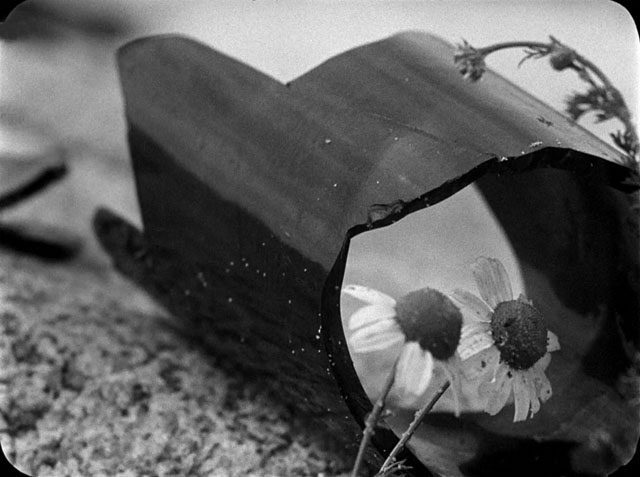
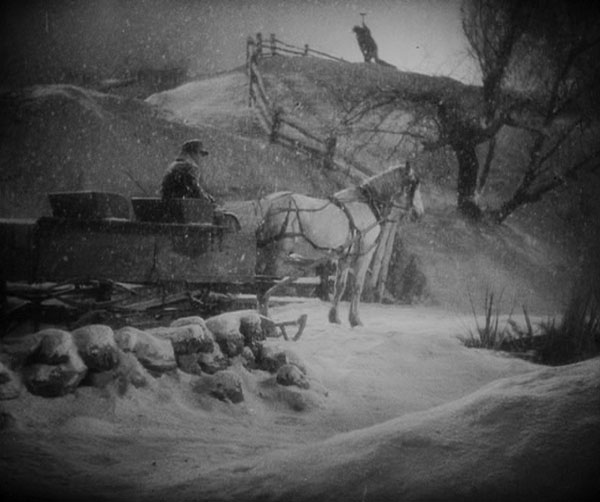
When I realized there is a movie called Finis Terrae from 1929 and another called Finisterrae from eighty years later, I set out to watch them both. Sometimes it’s as simple as that. The latin phrase means “ends of the earth.” There’s a place in Spain (where the 2010 film is set) called Finisterra, and a university in Chile called Finis Terrae (how wonderful), but this Epstein film was set on Ouessant, a small island off the coast of France (today home to an airline called Finistair), and on the even smaller island of Bannec. As the opening titles tell us, “on an island where winter storms wipe out all forms of life, four men come in two teams to spend the summer collecting seaweed in total isolation…”

A gorgeous film, made on location with nearly as many credited cinematographers (one of whom would later work on Vampyr and Hotel du Nord) as actors. Very simple story, a bit too poetically-paced at times, but it worked – I found it very affecting by the end. Apparently not much is known about the film on the web. I’ve seen it listed as a documentary – it’s clearly not, though Epstein seems to have cast local workers instead of film actors.

Strange that the team leaders look to be about sixteen, and their barely-named assistants are large middle-aged men with mustaches – why not the other way around? Ambroise, one of the two young men cuts himself on a broken bottle of liquor belonging to the other, Jean-Marie, causing both a grudge between the men and an infected sore on Ambroise’s finger that gets worse over the next few days, preventing him from working and finally threatening his life … “during a becalmed period making it impossible to cross the waters without the requisite wind in the sails. Cue a rescue mission launched from the mother island, Ouessant, to get them back to at least a semblance of civilisation.” (A. Fish)

D. Cairns:

When the sick boy starts to hallucinate, the movie almost oversteps its stylistic bounds by trying to evoke a state the audience is already in: Epstein snap-cuts a jangling montage of looming ECUs and what look like off-cuts and deleted scenes into an abstract nightmare that threatens to turn the whole experience into abstraction and dissonance, with no way out save the declaration of a cinematic Year Zero from which we can start afresh. Seriously, the movie feels like it was made tomorrow, or at any rate made in 1929 by time-travelers.

A. Fish again:

It would be Epstein’s parting glory; oh, other films would follow in its wake, but they weren’t worthy of him and he’d disappear, a fossil, a megalith one might say, of a silent era, not yet put out to pasture but with the fires not so much raging as flickering in the hearth. He wasn’t alone, one could add Gance, l’Herbier and de Gastyne to that list of exiles, yet his is a name that should stand tall in French film history, but instead often merits at best a paragraph in conventional histories.

Another entry for…

Initiated by Shadowplay

It’s rare for late-career shorts to even exist. Filmmakers tend to “graduate” from shorts to features, never looking back, unless called to work on some anthology film (like that one called “8” which Altman was scheduled to make after A Prairie Home Companion). Animators may be the exception, so half of the late shorts I rounded up were handmade.


Self Portrait (1988, Osamu Tezuka)
The few animations I’ve seen of Tezuka’s are among the most inventive I’ve seen from anybody. I’m not sure if the ten-second runtime of this short, made when he was 60, was imposed by the producer of this Animated Self-Portraits series or if that’s simply how much time Tezuka needed to make his point. Left/right/center portions of faces spin like a slot machine, and after four or five mismatches, the proper self-portrait alignment is reached – jackpot!


Is That All There Is? (1993, Lindsay Anderson)
Another self-portrait – the artist at age 70. Lindsay wakes up, takes a bunch of pills, puts on the news, watches some TV, has a bath, gazes at posters of his own films on the bathroom walls, goes shopping then back home, entertains writer Bernard Kops who talks about getting paid for his work, chats with some more visitors, moans about transportation with the cleaning lady, gets in a fight with his disgruntled nephew, complains about Michael Caine’s hair, discusses John Ford with a BBC producer, photocopies a newspaper review of Michael Powell’s Life in Movies that Lindsay wrote, goes through his scrapbook of past film writing, watches Ron Howard on Oprah (“I always wanted to make a movie … most importantly, I didn’t want it to be boring”), reviews his history of theater productions and film projects (he claims to have written If… 2), goes to the acupuncturist and the doctor, checks out sets and music for a new theater production, talks with his brother about gravitas, then holds a memorial service for two actresses who had appeared in his TV movie The Old Crowd fourteen years earlier. A full day. I don’t know much about Anderson – seen his bizarre Malcolm McDowell trilogy, but I only enjoyed two of them and probably understood none. This was downright enjoyable, especially considering my lack of enthusiasm for the day-in-the-life documentary format. Though I’m not saying this was a documentary – Anderson gets a writing credit, and the scene construction is subtly more intricate than could be expected from a single camera recording in real time.


Narcissus (1983, Norman McLaren)
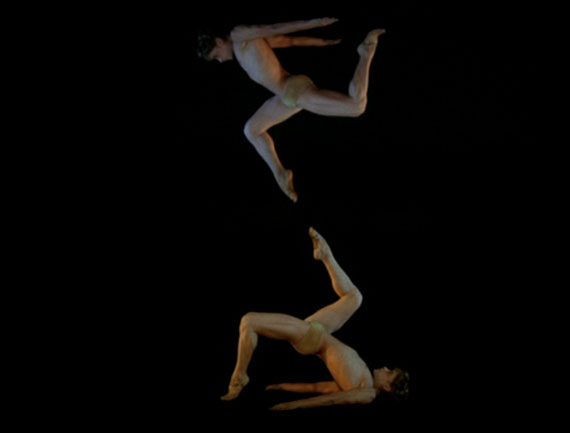
McLaren’s final released film, made when he was seventy. A ballet version of the Narcissus tale, in which our hero dances against a black background with a girl, then with a guy, finally shunning them both in favor of his own reflection. Beautifully shot and danced. I didn’t notice much in the way of McLaren’s signature styles in the ballet until Narc began dancing with his own disappearing self accompanied by nintendo computer blips on the soundtrack. Probably won more awards than any other McLaren film, in part because by the 80’s there were more award shows and festivals than ever before.

Narcissus meets himself:

Dances with himself:


I consider “late” Buster Keaton to be the 70-ish movies he appeared in since the 1920’s, shortly after the arrival of sound when his career went to hell. So these are very late Keaton, made in the last couple years of his life when he was around seventy years old (see also: the Twilight Zone episode he did a few years earlier).

The Railrodder (1965, Gerald Potterton)
A wordless journey through desolate Canada, which must have been trying to attract humans to its empty factories, forests, harbors, fields and cities, all seen as Buster whizzes by on a motorized rail car. Not as good as a classic Keaton short, but not as bad as most state-sponsored promo pieces either, just a light amusement with some minor Keaton antics and major Canadian scenery, with possible references to The General and The Cameraman. I like when he turns the car into a duck blind, but the gag’s payoff is lame – it’s not the most well-planned or well-timed little picture. Director Gerald Potterton moved into animation, making the legendary Heavy Metal.

Buster Keaton Rides Again (1965, John Spotton)
A “making of The Railrodder” that runs almost triple the length of the feature. In fact it’s over-long, in love with its subject, providing nice quick summaries of Keaton’s past films and life story, then rambling on with the present-day footage. A coughing, gruff-voiced Keaton smokes whenever not on camera for Railrodder (he died of lung cancer the following year). He’s a stubborn bastard regarding the gags and filmmaking – it’s clear from this doc that the IMDB’s listing Buster as uncredited cowriter/director on Railrodder is accurate. My favorite gag was in the documentary, not the feature, Keaton pretending to pull a train that comes in while he’s standing near the tracks. It closes with Keaton singing “Casey Jones” in his trailer, more emotional of a picture than the fluffy promo piece it accompanies.

Film (1965, Alan Schneider)
Close-up of an eye. Protagonist, always shot from behind, staggers to his apartment, horrifying all who look upon him. Alternate blurry shots from his POV. In the apartment, he covers a mirror and removes or destroys everything that has eyes. Feels for his own pulse. Finally, Buster’s face is revealed, wearing an eyepatch and his signature hat. Close-up of an eye. I don’t understand Samuel Beckett. Could someone explain him to me?


Stop-motion pioneer Charley Bowers made these couple films over a decade after all his other work, and according to his IMDB bio, “no one is quite sure what he did” during that in-between decade. They’re his final films, completed the year before he became sick at age 64, unable to work until his death a few years later.

A Sleepless Night (1940, Charley Bowers)
No sound at all (who watched silent shorts in 1940?) so the DVD producer unconscionably included an audio track of projector noise. I listened to LCD Soundsystem instead, greatly improving the movie, which was otherwise slack-paced and plotless. We’ve got a stop-motion mouse family who defeats the dog of the house, drinks a bottle of milk, then eats soap and floats away on the resulting bubbles.

Wild Oysters (1941, Charley Bowers)
More technically accomplished (featuring much more camera movement) and snappier than the last one, and with the same models for the mouse family, makes me think A Sleepless Night was a test run for what he’d planned as a series of mouse adventures. Although, spoken dialogue and a song with lyrics that comment on the action aren’t the major improvement. The mouse torments a different dog and also a cat, drilling holes in the floor and pulling their tails through. Weirder is when he runs across some oysters, which link together as a chain and chase him about. Why oysters? Even Tom and Jerry never ran so low on ideas that they introduced a string of oysters. Anyway, weird movie but enjoyable.


The Karateguard (2005, Joseph Barbera & Spike Brandt)
The final Tom & Jerry short released to theaters, and the only one made by Barbera, aged 94 at the time, after the passing of partner William Hanna in 2001. It was a passing of the torch to Brandt, who is still making T&J cartoons. I was never a wildly enthusiastic T&J fan, so I can’t share the outrage of the IMDB reviewer who calls it “unbearably mediocre.” Jerry isn’t great at his karate lessons, so his translucent sensei encourages him to quit, instead gives him a magical gong that summons a stone-faced samurai dog, who proceeds to pummel Tom for six minutes. A good time is had by all.

The Wandering Image (1920)

Released seven years before Lang was a star with Metropolis, and I know those years represented some major developments in filmmaking, but I notice this wasn’t very Metropolis-like. It’s not letting the image tell the story, but seems like a string of wordy intertitles with brief motion images between them. I guess this is partly because half the film has been lost and some of these were explanation title cards added during the restoration, but I didn’t pay attention which were the originals and which were summaries.

The plot is convoluted, justifying all those title cards. Wil Brand is trying to claim the inheritance of his deceased cousin George, is about the sue the cousin’s wife Irmgard, though he has never met either of them (a weird way to introduce the characters, methinks) when he unexpectedly meets the wife on a train and offers to help her, as she’s desperately trying to escape John, her late husband’s brother, who is stalking her by telegram. It’s immediately impressive that this 1920 movie seems to be shot on moving trains and boats and in the woods and the mountains, not at a film studio.

Irmgard says farewell to helpful Wil Brand:

John maliciously tells strangers that Irmgard is his mentally unstable wife so they’ll help him locate her, so Wil sends her into the wilderness. She looks totally miserable, passes a hermit shepherd who decides not to help her, then goes off into the mountains where John catches up and steals some dynamite, getting serious with the death threats now. The hermit comes to her rescue and buried in rubble together, he admits he’s her husband George who faked his own death.

Death tolls a bell for the avalanche victims:

Flashback! She married George after becoming his secretary as he wrote books about free love. He could never marry lest he be seen as a hypocrite by his fascinated readers, since he’s about the only man in 1920 willing to live by his late-1960’s ideals. So John helped them marry in secret, but now that George is “dead”, John threatens to expose the whole sham and prove she’s legally married to him in order to claim the inheritance.

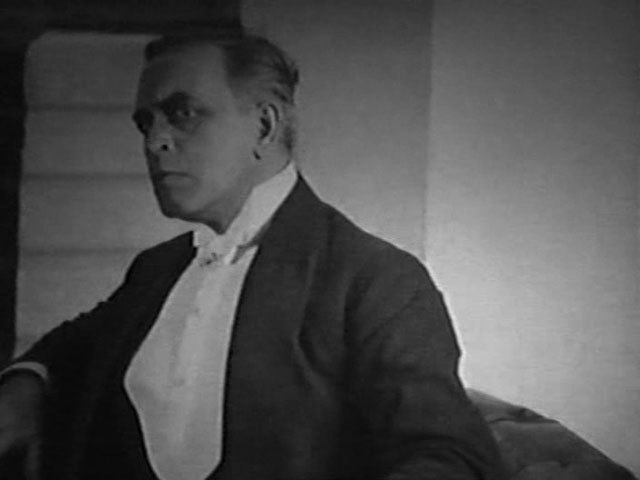
Hans Marr as John:

Hans Marr as George:

Anyway, back in the avalanche, John is atop a mountain cavorting like a madman, tossing rocks at the heads of would-be rescuers, when Wil Brand helps the couple escape. Later, a massive extended contrivance involving the virgin Mary convinces George to return to civilization, but he only stays long enough to retrieve his wife, and take her to live by his side in the mountains, leaving Wil with his promised inheritance – a happy ending, I suppose, given how the Germans used to worship mountains.

Seems like Wil Brand would barely need to have been part of the story, but then Irmgard would’ve had to be stronger and more self-sufficient in the early scenes (she still does pretty well). He was Rudolf Klein-Rogge, Thea von Harbou’s wife at the time, who also had a part in Four Around a Woman and would become Lang’s Dr. Mabuse. George and John are both played by Hans Marr, which probably seemed like some awesome cinematographic trick in 1920. Irmgard was Mia May, Joe May’s wife, who starred in his film of Lang and von Harbou’s Indian Tomb/Tiger of Eschnapur the following year.


Four Around a Woman (1921)
I watched this the next day. Watched it for real, paid it my full attention, not just screwing around on the computer while it was playing. But then how come I couldn’t make any sense of it, or keep track of any characters? Perhaps I’d had too much wine.

Harry Yquem:

Harry Yquem (Ludwig Hartau of Lubitsch’s Anna Boleyn) has the most beautiful wife you could imagine, someone tells us, but then we see the wife and I could imagine better. She is Florence (Carola Toelle), who later tells a friend that “a beautiful woman need not necessarily be true to her husband.” There’s an exchange of fake jewels, rendezvous at an underground tavern, somebody’s long lost brother, a murder and a police investigation. Anton Edthofer (also of Murnau’s Phantom) either plays twins (like in The Wandering Image) or plays one guy who pretends to have a brother, I never figured which. Charles Meunier (Robert Forster-Larrinaga of Dr. Mabuse, The Gambler) is after Florence for a while, and she’s friends with someone else named Werner, and I think it turns out she was a spy and has actually remained true to Harry. Based on a play by Rolf Vanloo, who was also adapted by Joe May for Asphalt.

Florence and one of the twins, I believe:

Opens with a tracking shot around a gambling table – hello, Dr. Mabuse. If the movie wasn’t such a lo-res gray blur, and ironically if there were more intertitles, I might know what is happening. There was zero music on my copy so I played “The World of Shigeru Umebayashi,” which I loved but probably didn’t help my attention level since it wasn’t meant for this kind of film. The only parts I got really excited about were when I saw a 1920 Boston Terrier, some film leader and a test pattern between the first two acts, a man with a monocle, a couple of neat shadowy camera shots, and when this happened:

The Feuillade movies I’ve watched just keep getting better – from Les Vampires to Judex to Fantomas – and I’d heard this might be a total masterpiece, but I was disappointed. Mildly, I mean – it’s a fun movie and all, but it doesn’t hold up as a long-form piece as well as the others. Strange to think his films are a hundred years old. Supposedly he was assisted on this by a young Julien Duvivier.

Can you tell these two men in suits apart?

As usual, I dig the opening credits, motion portraits of each major character. Jacques (serious explorer, close light brown hair, wearing a robe for some reason) returns from Indochina (Vietnam) with Tih Minh, “a young Anamite who had saved his life,” with whom he is chastely in love. Jacques is played by René Cresté – Judex himself. In fact half the cast had recently been in Judex and would appear in Barrabas the year after this. Jacques’ comic-relief servant Placide (a goofball with center-parted hair) is glad to be home and see his fiancee, the maid Rosette (dark-haired and suspicious-looking, but she turns out to be a sweetie). Jacques’ sister Jeanne sets out to “educate” Tih while Jacques and Placide (poor guy) go off to India. Two years later they return and prepare for a double wedding.

1910’s special effects:
Meanwhile, Paris is plagued by a string of robberies and kidnappings perpetrated by evil Dr. Gilson (I can’t describe him, since he’s always got some kind of fake facial hair), Kistna (introduced with a turban and beard) and Marquise Dolores (sultry with big hair). Others mention Kistna as the “Hindu servant” of Dolores, but in private he’s shown bossing her around. The big buzz is that Jacques is bringing home a book from India, The Nalodaya, with a hand-written section by someone called Ourvasi. “In addition to revealing the existence of fabulous treasures, this testament could be of considerable importance in the event of a European war.” The baddies get Tih Minh alone when she’s taking a boat ride, kidnap and brainwash her to collect the book for them. But: “Motivated by what he believes is a laudable zeal, Placide erases Ourvasi’s testament,” so they get a worthless book.

Dolores in disguise:

And it goes on and on and on like this. The criminals don’t commit any more major crimes to terrorize Paris, they only try to get this book (well, now it’s the photograph Jacques took of the inscription before Placide erased it) for the next five hours, trying again and again and again with minor variations. Kistna comes over, all neighborly, and asks to borrow the book and see the photos. Tih Minh is kidnapped at least two more times (oh, and it takes dapper, puffy-cheeked Dr. Davesne weeks to restore her memory after the brainwashing incident). Each group breaks into the other group’s house at least once. Twice the baddies get a spy into the heroes’ house and twice they try to poison our guys. People hide in trunks. Fake beards and mustaches of every sort are used then discarded. It’s a cool flick but I’m not seeing how it’s on the level of Fantomas or Judex.

Dolores (?) and Kistna:

My copy of the movie had no sound at all, so I used soundtracks from elsewhere:
– Mike Patton’s Mondo Cane (I am obsessed with this disc lately)
– The Paranoid Park soundtrack
– Zbigniew Preisner’s Double Life of Veronique soundtrack
– Mihaly Vig’s Bela Tarr soundtracks (love those Werckmeister Harmonies songs)
– Volume 3 of the Toru Takemitsu set:
(“music from the films of Nagisa Oshima and Susumu Hani”) – this was ideal.
– Hajime Kaburagi’s soundtrack for Tokyo Drifter didn’t work out, so on to Philip Glass and Kronos Quartet’s Dracula, which didn’t work either.
– Peer Raben’s Fassbinder soundtracks (volume 1 – only the non-vocal numbers)
– Then back to Mike Patton and Mihaly Vig

Not a lot of writing on this movie online besides this nice article by A. Cutler of Slant, so I’ve perhaps quoted too much of it:

The movie doesn’t have a plot so much as a list of incidents. I don’t feel like I’ve given much away, since the one-damn-thing-after-another structure keeps the viewer watching more for what happens moment to moment than for where the story’s going overall. As a consequence of its cliffhangers, and despite its length, Tih Minh zips. … Feuillade is able to depict such wild happenings onscreen because his foundations are so solid. I mean this not just from a storytelling perspective, but from a visual one. The director consistently relies on static medium-to-establishing shots, proscenium-like in their orientation, the camera viewing the characters from a slightly elevated angle, and the lighting’s generally unobtrusive. In other words, Feuillade gives us a relatively normal, stable-looking frame so that the odd happenings within it can seem all the more disruptive.

Feuillade is filming a rousing adventure story, but he’s also questioning the future of the world. It’s a world explicitly without central authority figures, in which the characters fight to assert their own moral order—as one of d’Athys’s companions conveniently says late in the film to justify hunting the thieves, “why inform the police? We are mixed up in the most remarkable adventure in the world, let’s go all the way with it ourselves.” … The film balances its societal poles so that Nature ultimately has to intervene. Toward the end of the film, as the felons flee into the mountains, Feuillade moves his camera several hundred feet back and we see them as specks in the landscape. Unlike Les Vampires, in which the black-clad Irma Vep appears and disappears at her liking, the antagonists here never seem more than human; once the boulders crash, they seem especially so. D’Athys, a bland hero, triumphs over his adversaries not through skill so much as through luck and fate. Rather than a screenplay deficiency, this seems the movie’s point.

Les Vampires came out the same year as The Birth of a Nation, but as Jonathan Rosenbaum writes, Griffith and Feuillade “seem to belong to different centuries. While Griffith’s work reeks of Victorian morality and nostalgia for the mid-19th century, Feuillade looks ahead to the global paranoia, conspiratorial intrigues, and SF technological fantasies of the current century, right up to today.” The most appropriate comparison for Tih Minh isn’t to another silent film, but to a recent hit like The Dark Knight. Both films are about shape-shifting, disguise-donning villains and the heroes who take the law into their own hands to stop them. Both films structure themselves as a series of setpieces alternating between each party’s capture and escape. Both films are allegories about the wars their countries were then fighting (Tih Minh‘s gang is a gaggle of foreigners; several Dark Knight characters call the Joker a terrorist). Yet Tih Minh trumps The Dark Knight stylistically, tonally, and thematically. … The Dark Knight insists that wire-tapping, torture, and government cover-ups are necessary in the name of freedom, accepting these precepts fatalistically; Tih Minh, by contrast, shows us a world worth saving. … One film exhausts, the other liberates; the comic book film thinks it’s addressing reality, but the human film knows it speaks the language of dreams.

Jacques in asylum:

Notes I took:

“She is like Lord Stone. She will not betray us.”

Kistna comes right over and borrows the book, so why the brainwashing?

“But Tih Minh, the beloved, had drunk the potion of forgetfulness and did not even know how to speak anymore.”

I think they are saying that Gilson and the Marquise are psychic

The comedian got pushed over a cliff into water while the marquise tried to rob the house, caught by Jacques and passed out.

25 kidnapped girls in the basement!!

They encounter a petrified dog, aww Kistna is experimenting on cute puppies.

Kidnappees spend their days having pajama fights

Servant caught in wolf trap, Jacques leaves him.

Plac as hero is upright, not goofy as I expected.

Haha, he lures Tih out of the house to the beach using a cat.

Just as Tih is returned home, obsessed with a cat, Rosette is delivering the photos to fake-beard Gilson. Plac and Ros beat the hell out of him. Time for him to face the fact that he is a very ineffectual villain.

Music for In the Realm of Passion fits so well, I’d forgotten it wasn’t part of the movie.

“Agents of Germany” want to steal the secret. Wow, WWI wasn’t over yet.

Baddies hid microphones in the garden. That’s hell of high technology they’ve got there.

Now Gilson and Dolores are trying to steal the document – all they ever do is try to steal the document and it’s getting a bit boring.

Marx killed a servant after breaking in, then shoots her dad. Marx is Gilson!

This is the kind of car chase that was possible in 1918: the bad guys are driving away at top speed, Jacques is able to catch up by running.

Rosette is an excellent shot

Oh it’s all in goofy fun that we drive away the false nuns who threatened our lives by spraying them with a garden hose as they scurry away. They’ll be back in 15 minutes threatening your lives again.

Jacques seems to be telling Tih that pretty girls should be home arranging flowers, not out avenging the death of their father.

Now it’s an evil cook working in the house with a messenger dog, both of whom “no one suspects.”

Why don’t they stop letting people into the house. No nuns, no new servants, not anybody. Stupid rich people with houses like hotels, servants galore and people always coming and going.

Holy crap, one of the bad spies just killed Dolores with a rock.

The heroes’ plan fails, because of course it does. Our heroes are so foolish that when the baddies are disarmed they use Rosette and Placide as human shields, and this works. They’re DISarmed. You can just run around Rosette and punch the bad guys in the face. But no, they all escape.

I prefer inspector Juve and his reporter sideick Fandor from the Fantomas series. Not only are they in higher-definition than the identical suit-wearing blobs of this movie, they’re much smarter.

Oh good Dolores isn’t dead.

They escape to the rooftops! Finally. It’s just not Feuillade without a chase on the rooftops.

The three baddies turn on each other.
One’s head is smashed with a rock.
Gilson is still alive.
Gilson throws kistna off a cable car.
Gilson is blown up by dynamite!
Kistna is found dead.
Dolores kills herself.
Wedding!

A pretty simple story. Charles Farrell goes to the city to sell the family wheat before the harvest, falls in love and marries Mary Duncan on his way home. Father on the farm is pissed about the low wheat price his son got, and is a huge grouch about Chuck’s lowly waitress wife. Storm is rolling in, destroying crops in other states, so Father works the reapers all night, but slimy Mac sees the family discord and aims to run off with Mary. She leaves, Chuck follows, Dad shoots at them, then everyone forgives everyone else and continues to harvest.

Thing is, it’s just one of the most beautiful films, definitely up with Sunrise and Lucky Star.

The city girl’s hair reminds me of the question-mark on the head of a guy in Sweetie, only in this case, hopefully unintentional, her forehead reads “666”

Chuck Farrell is his usual winning, unmemorable-looking self. I wasn’t sure about Mary Duncan in The River – she seemed a little one-note – but she’s wonderful here and extremely different from her River character. Seems like she could’ve gone further than Farrell’s usual sweet-faced co-star Janet Gaynor in the acting business, but Duncan retired in ’33, five years before Gaynor.

Murnau’s second-to-last film before Tabu. Murnau wanted to title it Our Daily Bread, and had scenes and scenery in mind which the studio denied him. The movie came out in a now-lost sound version and in a version similar to this – not sure exactly how similar, or how much is known about its history, but the booklet with the Masters of Cinema DVD would probably explain some things. Production-designed by Edgar Ulmer, and based on a stage play with a funny title which everyone online mentions as if it’s still important.


Murnau dwarfs the family, hunched at bottom of the frame when father first enters. The little girl, Anne Shirley, had been in pictures since she was four, would be oscar-nominated for Stella Dallas seven years after this.

The workers, L-R:
– Guinn “Big Boy” Williams of Lucky Star, here a pretty good guy with a pretty small part
– creepy-looking Jack Pennick of every John Ford film, whose only role here is to look creepy
– baddie Richard Alexander, who kept busy playing tough-guy extras for the next 30 years

Father: David Torrence is best known, well, for having a more famous brother. Ernest Torrence had some major silent roles (Steamboat Bill Sr., Captain Hook), played Moriarty in an early sound Sherlock Holmes the year before he died. David was in some Michael Curtiz films, anyway.

A Danks:

City Girl’s bond to Sunrise is one of its most fascinating elements. In its opening movements it is as if the film evokes a key plot element of Sunrise (an innocent country boy, Lem (Charles Farrell), is approached by a “vamp” on a train ride to the city) only to then diverge from and invert it (he immediately rejects her). As in Sunrise, the city is presented as a dynamic entity defined by and constructed around movement and a curious modernity; but it also projects a subtle desperation and palpably melancholy quality new to Murnau’s cinema. It is also the home of Kate (May Duncan), the “city girl” of the title who longs for a romantically idealised country life and who subsequently emerges as one of the strongest and most clear-eyed female characters in American silent cinema (presenting a clear reversal of the moral universe – and characters – of Sunrise). It is through Kate that we experience the continuity of the city and country in City Girl, the archetypes of perception and oppression, and the parallel social structures and prejudices that fuel both worlds.

Everybody mentions Days of Heaven as a comparison, and Danks throws in The Wind.

I’ve enjoyed all the Frank Borzage movies I’ve seen so far, so this week I watched all three that he released in 1929. Not only in the same year, but according to IMDB they all came out within a two-month period – can that be right? I’ve only seen seven feature-length movies from 1929, so now 43% of them are by Borzage.


Lucky Star

image

Hunky, brave Tim (Charles Farrell, of course) meets a cute girl (Janet Gaynor, of course), then goes off to war in France and gets his legs blown off delivering food to the troops in a crappy horse carriage whilst his old boss at the telephone company takes the proper army truck to meet girls. There is no such thing as subtlety!

Chuck and Big Boy fight atop a telephone pole:
image

Janet watches, impressed:
image

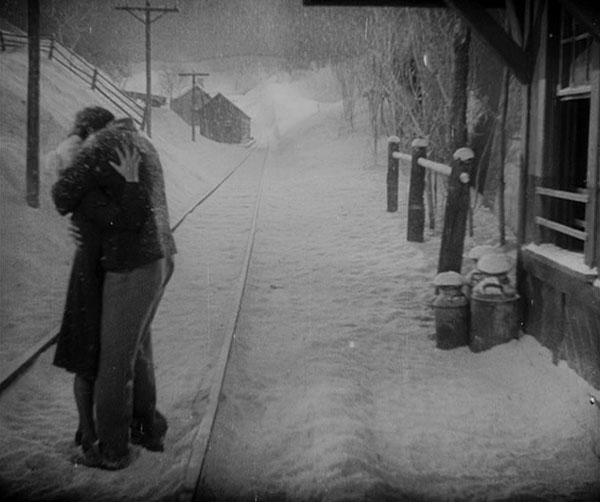
Back home, Tim’s boss (Guinn “Big Boy” Williams of a couple Lang and Renoir movies) is passing himself off as a brave sergeant in town and wheelchair-bound Tim is making friends with the dirty, savage young girl (TOO young, as Tim eventually finds out, backing away slowly). But the girl’s parents promise her to Big Boy. Can Tim rise from his wheelchair for the first time since the war and crutch-walk into town (in the snow) in time to stop the marriage and claim the girl as his own, publicly revealing Big Boy to be a war coward along the way? Yes!

Big Boy and Janet’s mom Hedwiga Reicher:
image

Paul Fix (After the Thin Man, El Dorado, Red River), who sadly never worked with Tom Mix, is a buddy of Tim’s, his only human contact besides the girl. That’s probably him driving by, as Tim leans on a crutch at top of the frame.

image

Shot as a part-talkie with dialogue and effects, but that version has been lost, leaving behind a silent masterpiece. As silly as the plot can be, I got caught up in the (melo)drama of it all and the glorious visuals. Also loved how the film is sped up to make Tim look more wheelchair-proficient than he actually was.

image


They Had To See Paris

Good ol’ down-home mechanic Will Rogers (I liked him better as Judge Priest) strikes it rich as an investor in the town oil field. His wife acts just like Effie in Ruggles of Red Gap, packing up the family (unattached older son Rod, and daughter Opal who’s in love with a hometown boy) and heading to Paris to get them all fine clothes and high culture.

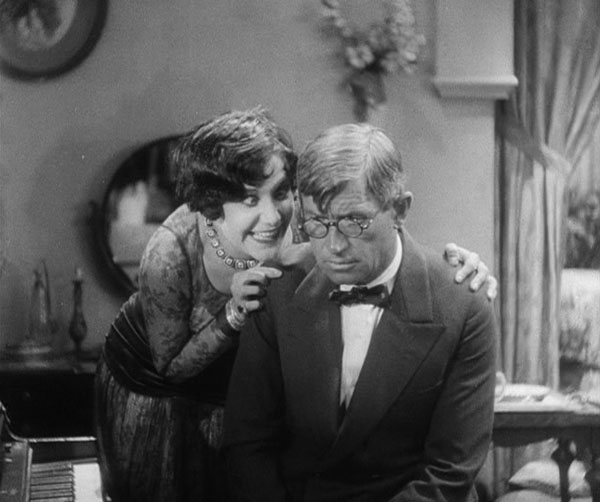
Rod with Christiane Yves, probably:
image

What would a Borzage movie be without beautiful cinematography, fluid camera movements and heartfelt performances? Well, it would be this one. Sound pictures were in their clunky infancy, and even a prestige director like Frank couldn’t make much of a talkie in 1929. No music, but could’ve used some – full of stagey, awkward, staticky silences in the dialogue. It’s also his first comedy that I’ve seen, and I wouldn’t say it exactly had the Lubitsch Touch. But it’s not late-Keaton bad, just disappointing.

image

Poor Will is saddled with increasingly unlikable wife Irene Rich (Lady Windermere’s Fan, The Champ, Fort Apache), aristo-dating daughter Marguerite Churchill (Dracula’s Daughter) and wannabe-bohemian son Owen Davis Jr. (All Quiet on the Western Front). Will raises some hell, wearing a suit of armor to a party and having a non-genteel, drunken conversation with guest of honor Grand Duke Mikhail (above), but eventually his family has him depressed so he fakes an affair with tedious slut Fifi (below) to horrify his family into returning home.

image

Unfortunately this wasn’t a career-killer for the grating Fifi D’Orsay. She appeared in They Just Had To Get Married, then in Joanna’s favorite film What a Way to Go. TJHTGM isn’t a sequel to this (though it sounds like one) but apparently They Had To See Paris was enough of a hit to engender follow-ups, first the semi-sequel So This Is London then the full-on sequel Down to Earth, both of which starred Will Rogers and Irene Rich (and Grand Duke Mikhail even returns in Down to Earth). This is some corny flick, and with Borzage (and let’s also blame the writer Owen Davis Sr., young Ross’s dad) unable to hide his cheesy melodrama behind the artifice of title cards and artful silent cinematography, it just sits out stinking.

Family reunion:
image


The River

Another gorgeous Borzage silent about simple-minded youth in love, ho-hum. This one is a different viewing experience because it’s incomplete, reconstructed with stills and titles a la the TCM version of Greed. Something else that’s different: Charles Farrell plays opposite Mary Duncan, not Janet Gaynor. Duncan (also of City Girl, 4 Devils) lived till the 90’s but only acted through ’33, and was obviously better-suited to this part than Gaynor, since the character is not at all the innocent sweet girl.

image

Farrell, polite and capable but so dumb, builds a riverboat to see the country but stalls at a dam for the winter. There are six more trains into the city where he plans to spend the season, but busying himself with skinny-dipping and wood-chopping, he can’t seem to manage timetables and misses them all. Now it’s just Farrell and somewhat cruel sexpot Duncan. Finally she stabs him and he proposes to her, in that order, but she laughs off the proposal until he almost dies in the cold.

image

Take it, D. Callahan:

The fragment ends with an extraordinary sequence that stands with Borzage’s best work. Allen John has chopped wood all night in the snow, trying to prove that he’s man enough for Rosalee, and he falls deathly ill. Snow is rubbed all over his bare chest in an effort to break his fever, but his heart stops beating. Desperate, realizing how much she loves him, Rosalee climbs into bed with Allen John and tries to warm him alive with her body. Borzage films their faces in close-up with a religious intensity reminiscent of Dreyer, lingering on Farrell’s beatific eyes as his soul slowly seeps back into them. The communion of bodies here is both a rebirth and a renewal, of Allen John’s life and Rosalee’s hopes.

image

Just then, Mary Duncan’s old boyfriend, the murderer Marsdon (Alfred Sabato, who directed the first talkie in Italian) escapes from prison to reclaim her from the weakened Farrell, but fortunately hulking deaf-mute Sam (Ivan Linow, of the Unholy Three remake, who has played characters named Rako, Red, twins Loko and Boko, Tossilitis, Slumguillion and Heinie) appears just in time. The closing titles are outrageous:

image

image

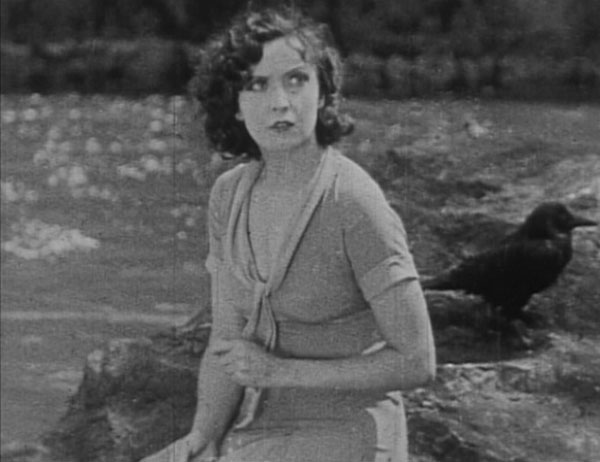
IMDB mentions lost characters The Miller and Widow Thompson, but the fifth lead of the surviving footage has got to be Marsdon’s pet crow, left behind to watch the girl while he’s imprisoned. I’m always glad to see a bird as a major character.

Mary Duncan with crow:
image

Scenes from movies in the silent era, cut together to flow nicely. Music that alternates between pleasantly ambient/minimal, and sharply attention-grabbing, including cuts by Fennesz and David Grubbs. Lots of graphic, sometimes deviant, sex. Pointless quotes from ancient poetry on intertitles connect and divide the piece into sections.

image

Seemed, to me, more valuable as a collection of scenes to peruse, to marvel at these unknown early films (didn’t recognize a single shot, but then I’m no silent film scholar) than as an original piece of editing/filmmaking. It didn’t wear out its welcome, but neither was I impressed by the connections made between scenes. Maybe with access to the original footage one could better appreciate Deutsch’s contribution, besides as curator of some damned interesting old movies. Still excited to see his earlier Film Ist pieces composed of footage from scientific films.

image

More wonderful screenshots:
image

image

image

image

image

I told Katy it was more a string of comic episodes than a consistent story, but I badly misremembered. Very consistent indeed… almost too consistent, with some mopey bits and plot necessities dragging down the comic momentum. But Chaplin’s goal was presumably not to make just the funniest film, but something both funny and true.

From A. Vanneman’s terrific Chaplin articles in Bright Lights:

Charlie has three big men to contend with in The Gold Rush, Tom Murray as “Black Larsen,” Mack Swain as “Big Jim,” and Malcolm Waite as “Jack Cameron.” Wolf Larsen scarcely has a personality. He is merely a symbol of the savagery of nature. He murders two Mounties and leaves Big Jim for dead, before Nature herself, reclaiming her own, sends him plunging to his death in an avalanche.

Big Jim is Chaplin’s partner/rival searching for gold. They don’t do much searching, really, just hide out in murderer Larsen’s cabin attempting to keep peace and stay alive through the cold and hunger. Among the danger and misery we get Chaplin turning into a chicken, a cooked and eaten shoe and the famous cabin-on-edge-of-cliff number. Big Jim found plenty of gold at the start of the film but can’t get back to it, and when he does Larsen clubs him (amnesia!) before heading for death by avalanche. Jim, dazed, wanders towards town and isn’t seen for 45 minutes.

Charlie takes the second half with a love story, pining for Georgia Hale who makes fun of him, then feels sorry for him, and finally decides she loves him moments before Charlie reveals he’s become a millionaire by helping Big Jim re-find his gold. Not quite a City Lights ending but it’ll do.

More Vanneman:

“Oh, you’ve spoilt the picture,” exclaims the cameraman when Charlie and Georgia kiss, an inside joke based on the cliché that in Chaplin’s pictures he never got the girl. When Chaplin re-released The Gold Rush with a soundtrack in 1942, he cut out the kissing scene for some reason, although it’s still clear that Charlie and Georgia are going to get married.

Second time I’ve avoided the re-release, which is shorter and supposedly has Chaplin’s bemused voice narrating instead of the intertitles. Sounds ghastly, but maybe I’ll be on a Chaplin completist kick one day and check it out.

November was Shorts Month! All shorts were watched at home on video, except for an outing to the November edition of Bizarro Saturday Morning, at which I fell asleep during the only theatrical short, tired out by episodes of Casper, Ultraman and Rocket Robin Hood, so it’s sadly not represented here.

The Policemen’s Little Run (1907, Ferdinand Zecca)
Tedious, undistinguished little romp, wherein cops chase a dog for stealing food, then the dog chases the cops. Fakey backgrounds ensue. Ferdinand Zecca, director of Kissing in a Tunnel (not the 1899 original or the 1899 remake, but the 1901 remake), later co-directed one of the first feature-length (well, 45 minutes) films.
image

Troubles of a Grasswidower (1908, Max Linder)
The Mr. Mom of its time. Dude is an asshole so his wife leaves him, goes home to mother. Dude then fails to do the simplest household tasks until everything is in ruins and his wife returns to shame him. Terrible! Well, it’s slightly more bearable than the cops chasing the dog. Linder must’ve played the widower; he wrote and starred in plenty more shorts, such as Max’s Hat, Max Takes Tonics and Max and Dog Dick (?!)
image

Winsor McCay, the Famous Cartoonist of the N.Y. Herald and His Moving Comics (1911)
Now that’s more like it. Winsor announces he’s going to make an animated moving picture, some blowhard dudes laugh at him, then he damn does it and it’s brilliant. One should never doubt the author of Dreams of a Rarebit Fiend.
image

Winsor at work:
image

Dream of a Rarebit Fiend (1906, Edwin S. Porter)
Most of the movie is the guy drinking, eating and going home, with finally some actually dreaming there at the end. His shoes fly off on strings, some stop motion, some Exorcist bed-bucking and Little Nemo bed-flying. The best part, with little devils beating him from above, looks like a Melies-lite advertisement for headache powder. One assumes he’s speaking the punchline at the end, but there’s no intertitle. Comic strip was better!
image
Winsor would later create his own animated Rarebit films, and Melies would make the probably unrelated Dream of an Opium Fiend in 1908.

The Telltale Heart (1928, Charles Klein)
I love total Caligari-ripoff expressionism in cinema, and there isn’t enough of it so I was happy to find this. Completely excellent, probably my favorite Telltale Heart yet. I don’t mean to disparage the recently-watched Ted Parmelee animated version and I do miss the rich voice of James Mason, but everything works here – the Caligari sets and fonts, the acting of the lead fellow, his crazy-POV version of the inspectors and the montage and effects (overlays and mirrors).
image

Depending who you believe, this was either directed by Klein (a writer/director up to the 40’s) or Leon Shamroy (cinematographer through the 70’s who worked with Fritz Lang, also shot The Robe, Caprice and Planet of the Apes).
image

Fall of the House of Usher (1928, James Watson & Melville Webber)
Every version of Telltale Heart re-tells the story with narration or titles, but this film tells the Usher story through mystifying visuals… and since I’m not familiar with the story I still don’t know exactly what happened, but boy was it awesome.
image

What if cinema had ended up looking more like this? What if poets were directors? The mind boggles. I’ll bet Cocteau loved this (or despised it since he didn’t think of it first).
image

dream sequence from When The Clouds Roll By (1919, Victor Fleming)
A semi-remake of Rarebit Fiend! Douglas Fairbanks eats some Welsh rarebit (melted cheese on toast) along with mince pie, lobster and an onion. Not a drunken fool like the original rarebit fiends, DF is conned into eating the nightmarish midnight snack by a mad doctor. He then runs around doing stunts on horses, trampolines and camera-trick houses, pursued by ghosts, a party of society women and giant costume versions of the foods he ate. I am definitely dressing up as rarebit next halloween.
image

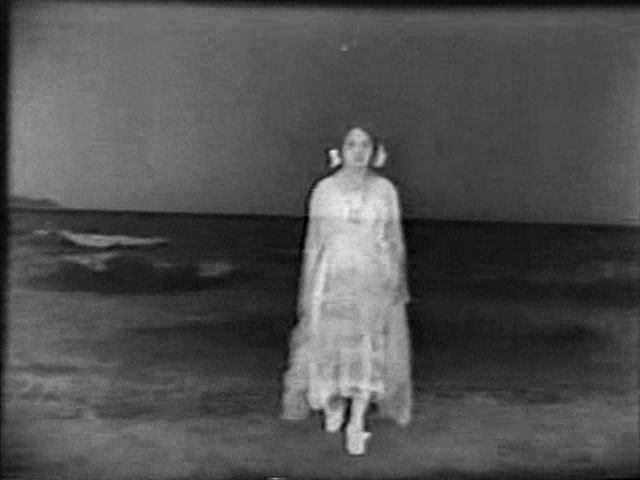
Oramunde (1933, Emlen Etting)
Woman in a too-long white dress dances on the rocks to express her sadness. Made me sad so I guess it’s pretty good.
image

Hands (1934, Ralph Steiner & Willard Van Dyke)
Hands, falling, against black, doing stuff. Montage of hands doing stuff on location. Hands getting money for doing stuff. Hands buying stuff, taking vacation, getting married to other hands. Counts as propaganda somehow.
image