In the 1880’s, writer Gilbert and composer Sullivan are discontent. The reviews aren’t great for their new show, and each is considering going his own way. Then Gilbert sees a Japanese culture exhibit and is inspired to write The Mikado. The theater owner books it, the actors prepare, and the play is a big hit.

And the whole thing is an exercise in futility to me, because the movie seems to presuppose that I know/care anything about Gilbert, Sullivan or The Mikado, which I do not. It’s all superbly acted, and meticulously designed. Some of the performance scenes are wonderfully filmed. I was marvelling at one in particular, detached, realizing that I have no desire to see this scene filmed, but if somebody must film it, Leigh is doing a bang-up job. Seems like it’s all a ton of fun, but the fun isn’t infectious. Maybe it was just the mood I was in, but for now, this is the rare film I admire but don’t enjoy.

Broadbent with his large, frowny eyes:

Sullivan (Allan Corduner of Me Without You, De-Lovely) is ill, but still manages to attend the opening of his Princess Ida at the Savoy Theater. After seeing the response, he runs around telling everyone he wants to write a grand opera instead of these “topsy-turvy” musicals. Gilbert (Jim “Inspector Butterman” Broadbent) is crotchety and complainy, having problems at home with his depressingly childless wife. There are parties and rehearsals. I noticed the great Shirley Henderson as one of the actresses, but didn’t recognize Andy “Gollum” Serkis, Kevin “Tommy in Trainspotting” McKidd or Lesley “every Mike Leigh movie” Manville.

I am into Shirley Henderson:

A. Taubin:

The film takes its shape from the characters, their relationships, and the abundance of historical information about the world they inhabit—and the ways in which it’s both distant from and close to our own. When Gilbert uses one of the first telephones in a private home in London to talk to D’Oyly Carte, what’s delightful is not only the look of the phone itself but that he has to work out an entirely new etiquette of communication. Sullivan drops into a casual conversation the tidbit that his relatives, the Churchills, have a handful in their headstrong eleven-year-old son, Winston.

Sully conducts his… masterpiece?

The one bit that sucked me in was when lead Mikado actor Timothy Spall’s solo song gets cut for pacing on the night before the premiere, and the cast holds a nervous stairwell confrontation with a humorless Gilbert, who agrees to reinstate it. That part got me because I felt the tension; I’d hate for anything bad to happen to Timothy Spall.

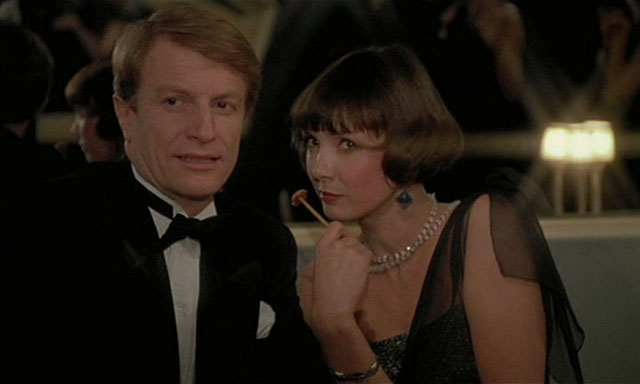
Set in 1926. The same cast as Love Unto Death – again putting Sabine Azema together with Pierre Arditi. This time they are happily married until Andre Dussolier comes around to visit, in a half-hour dinner-conversation opening scene. Sabine beins a passionate affair with Andre, her husband’s old classmate at music school, now an accomplished violinist. Unlike Love Unto Death (which I think I prefer), the only music we hear is played by the characters.

A red curtain declares the start of act 2. Pierre is sick, has been sick for a couple weeks, and cousin Fanny Ardant calls a doctor one day while Sabine is away. This is trouble because he starts asking questions, like what are the drops that Sabine has been giving her husband ever since shortly before he became ill. On top of Pierre’s illness, his wife is becoming hostile, disappearing for long periods of time.

Red curtain, act 3. Sabine killed herself three years earlier and her cousin Fanny has married Pierre, and knows about her cousin’s affair with the violinist. She tries to keep the secret from Pierre but he suspects, visits Andre and challenges him. Andre holds his own, never admits the affair, and Pierre drops it. Movie seems to end on a hopeful, reconcilatory note as they play music together.

A small-scale, controlled film, with theatrical staging (just a few locations) but thoughtful camera work. The girl cheating while her man is performing his music reminds me of To Be Or Not To Be (or Unfaithfully Yours). Sabine and Pierre won Cesar awards, but Resnais lost to Alain Cavalier and Therese.

I was going to choose something to quote from J. Rosenbaum’s 1988 article on the film, reprinted in Placing Movies, but it’s such a long and thoughtful piece, I don’t feel like chopping bits out of it.

Rivette was working on this from 1957-1960. In ’57, Chris Marker did Letter From Siberia. In ’58 we had Le Beau Serge, Elevator to the Gallows and a couple shorts. ’59 brought Pickpocket, Hiroshima Mon Amour and The 400 Blows, then Breathless and Shoot the Piano Player were in 1960. So Rivette might have started everything, in a sense, but by the time he’d made his statement public (in ’61, along with Cleo From 5 to 7 and Last Year at Marienbad), the whole “new wave” was in full swing in the theaters.

Betty Schneider (of Mon Oncle) is young innocent Anne with brother Pierre (Francois Maistre, later of a buncha Bunuel films). She meets theater director Gerard (Giani Esposito of French Cancan), paranoid American Philip (Daniel Crohem) and mystery woman Terry (Francoise Prevost of Rivette’s 1981 Merry-go-round). Movie gets more disturbed and paranoid (as well as loose and rambling) as it progresses, ending with the deaths of a buncha characters. Somewhat like The Dreamers. Incidentally, “Paris Belongs To Us” would’ve been a better title for that movie.

Interesting parallels with Out 1, both being about theater groups and city-wide conspiracies. In this one, we never find out if the conspiracy even exists, and in Out 1, the group does exist and is partially uncovered, but the group has no sinister purpose, never even did anything together and have been long dormant.

Much is made of the cameos by Godard, Chabrol, Rivette and Demy in the promo material, but I can’t say I noticed any of those.

Michael Rowin in Reverse Shot calls it “a fascinating disappointment”.

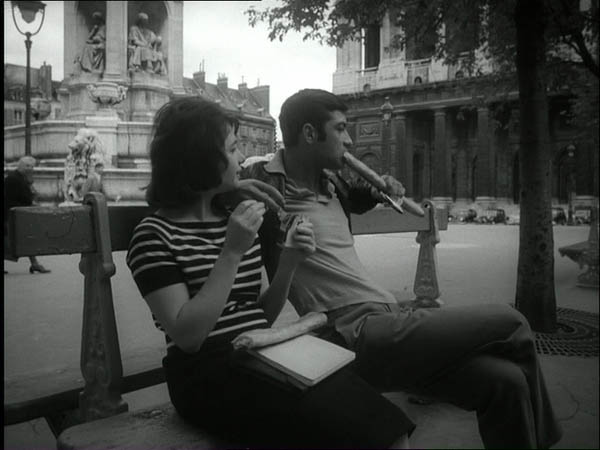
the calm:
image

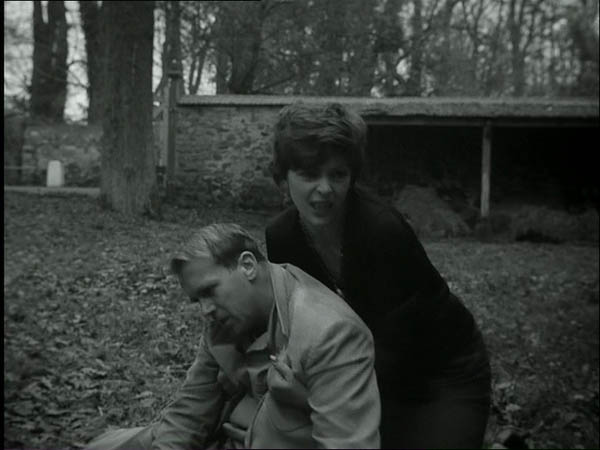
the storm:
image

the intrigue:
image