Okay, okay, billions of rabid fans, you win. It’s a good movie, and Heath Ledger is great in it. He plays insane like no one else, and when he walks out of the hospital in a nurse’s uniform stabbing at his remote control prompting a cliched huge explosion while he casually keeps walking, it’s one of the awesomest things at the movies all year. But… top-selling film of all time and #1 on IMDB or not, I still find it the third-best Batman movie. Full of episodic cliffhangers (maybe as tribute to the comic books?), which is the only way in which it reminded me of Fantomas. Batman/Wayne, as a character, is almost absent, replaced by gadgets and friends and a dead girlfriend (Maggie G.) whom he mourns for all of four seconds before going on to kill two-face and take the blame for two-face’s crimes himself, so the sucker public will go on believing in Harvey Dent, the district attorney who almost cleaned up this town before going insane and killing a buncha people. Some role model. Now Batty is on the run from Commissioner (finally) Gordon and I think Morgan Freeman quit his gadget-man job and neither of us can remember if the Joker died (which is a bad sign – nobody forgets how Nicholson’s Joker ended up – and while I’m in these parentheses, the soundtrack was no Batdance neither) and the Hong Kong financier is dead (burned alive on a pile of money = irony) and I guess the mob is in control of Gotham again, just with less money.

Batman has banding issues:
image

I dunno, might have to see again sometime when expectations are gone. I spent a lot of the runtime complaining about stuff, either in my head or directly to Katy.

Watchmen trailer looks cool, anyway.

I’m gonna get this out of the way:
“It’s like Kafka meets Lovecraft in Ingmar Bergman’s Nosferatu!”
Criterion can feel free to quote me on the upcoming blu-ray edition of Vampyr.

Not an official 1930’s Month selection since I watched it by myself while Katy was enjoying reality TV in the other room. I don’t have a hella lot to say about this movie other than it is a masterpiece of mood and weirdness, a slow, trippy phantom dream of a vampire flick. Love how three of my favorite movies are by Dreyer and those three are almost nothing alike.

Allan Gray, dreamer and occultist, drifts into town, gets a room, starts seeing weird things right away. Old guy comes in, gives Allan book on vampires, says “she must not die” then goes home and dies himself. “She” is probably one of his two daughters, Leone, who gets bitten. With help of the frozen-faced other daughter, blank-faced Allan goes off into the world of shadows… but unlike most movie heroes, he never actually does anything. The thankless house servant discovers that the lead vampire is a woman named Marguerite Chopin so he opens her tomb and stakes her, releasing the spirit of the dead father whose ghostly head scares the doctor’s henchman into falling down the stairs, while Allan himself is busy having out-of-body experiences while his body is carted off in a coffin. The death of the vampires fixes everything, Leone wakes up happy and Allan and Gisele stroll together into the sunlight as the doctor drowns in flour, trapped in the mill by the house servant. If that doesn’t all make sense, well, I don’t think a straightforward storyline was the point of this film.

an evil doctor drowning in flour:
image

Assorted gems from the Tony Rayns commentary:

What Vampyr has in common with Penelope: distributor shelved it for a year before release (Tony didn’t phrase it that way).

Main dude who played Allan Gray was no actor, but a fashion journalist, a rich baron who financed the movie. “I think Dreyer makes astute use of his blankness in this role.”

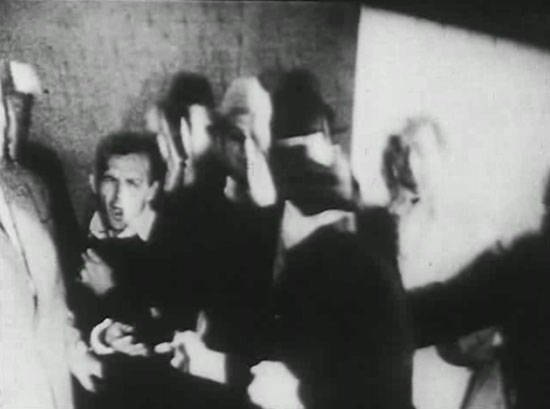
Allan Gray as a blank-faced corpse:
image

Allan Gray as a blank-faced ghost:
image

On the film’s style: “it’s full of disjunctions; it’s full of unorthodox editing, unorthodox framing and unorthodox cutting. None of it fits together in the way that one has come to expect classical storytelling in film to do… constant dislocations.” Has a lot to do with subjectivity, opening titles introduce Allan Grey as an occultist, a dreamer. Film came hard on the heels (eww) of L’Age d’Or and Blood of a Poet – indie weirdo films were briefly in fashion in Paris at the time.

At the nineteen minute mark – “etc., rendering indistinct and uncertain the offscreen spaces of the film,” he’s still going on about how weird a film it is. Like I know.

Lead vampire Marguerite Chopin talking with the Doctor (who may also be a vampire) around 19:30 is the first scene not directly witnessed by Allan Gray, but by an animated skull on the dresser. Hmmm. Allan himself is out with “the grave undigger and the world of shadows,” awesome.

Like The Passion of Joan of Arc, made up of many short shots, also many close-ups, but Joan was extremely planned, each detail carefully chosen, Vampyr by contrast is a very cluttered film, but every detail counts. Reading that again, I’m not sure that I see the difference he’s talking about.

Sybilla Schmitz (below) who plays daughter Leone (one of the only pro actors here) had a small part in Pabst’s Diary of a Lost Girl – her real-life story of morphine addiction was the prototype for Fassbinder’s story Veronika Voss.
image

Three choice quotes:

– “It’s almost like a Mike Leigh film in a sense in that people are passing cups of tea.”
– “It’s a kind of anti-Griffithian cross-cutting – but let’s not get too film-theoretical about this.”
– “He’s informing himself how to slay vampires. This, needless to say, is more than seven tenths of a century before Joss Whedon and Buffy. The modus operandi for slaying a vampire hasn’t changed all that much.”

Commentary mentions why Vampyr was a long-coming follow-up to Joan of Arc (legal/financial battles), but why was it over a decade before Dreyer’s next proper film, the hugely excellent Day of Wrath? Oh, IMDB says everyone hated Vampyr so he went back to being a journalist after that. Also there’s whole documentaries on the DVD so I should not blame the commentary for lack of stuff.

His spirit released, the old man’s head seeks vengeance:
image

Cast/crew photo. I think that’s Dreyer on the left with his hand up. Dig how Allan Grey stays in character, haha
image

Didn’t know that Pál “Lonesome” Fejös did a remake of Fantômas – it came out the same year as this and featured the actor who played the murdered master of the house in Vampyr (Maurice Schutz, below, also of Passion of Joan of Arc).
image


From the Casper Tybjerg doc/essay:

He pronounces it sorta like “Vam-pure”. I’d been wondering.

Dreyer: “I just wanted to make a film different from all other films”

All films shot on actual locations. Movie was shooting as early as April 1930.

Art director Hermann Warm also worked on Caligari, some early 20’s Murnau films, and Lang’s Destiny.

Two overtly Christian scenes were removed before the film’s release. And German censors had him tone down the staking scene and remove some shots from the drowning-in-flour scene – they’re restored in this documentary.

image

I don’t know much about Bette Davis, seems she was a big star in the 30’s and this was her comeback picture (was supposed to be Claudette Colbert but she got sick). Anne Baxter had been in The Magnificent Ambersons, later starred in I Confess, The Blue Gardenia and The Ten Commandments. Movie is over-narrated by both George Sanders (Moonfleet, Rebecca, Voyage to Italy) as a gossip columnist and Celeste Holm (High Society, Three Men and a Baby) as Bette Davis’s best friend. The friend’s husband is “writer” Hugh Marlowe (Earth vs. the Flying Saucers, Day the Earth Stood Still) and Bette’s beau and eventually husband is “director” Gary Merrill (of noir Where the Sidewalk Ends). Marilyn Monroe, a year or two before stardom but already showing her signature persona, has a small part as an aspiring actress.

Nice cinematography by Milton Krasner, who worked nonstop through the 30’s, shot some good noir pictures in the 40’s, and worked with Wilder, Ray, Minnelli and Hawks after this. Mankiewicz made this the same year as No Way Out, five years before Guys and Dolls.

Um, right, what happened in it? Bette is kinda washed up, I mean still a huge-selling star of stage (not screen) for her celebrated director/beau and writer/drinking buddy, but all the parts are still for younger girls and she’s starting to stretch the definition of young. Enter Eve, superfan who has seen every performance of Bette’s new play. Flattered, they let Eve hang around, but she’s not the innocent thing she claims to be – has been lying about her past and getting cuddly with the two men, conniving to put herself in Bette’s shoes, which she has very successfully done by the end (errr, the beginning, since it starts at the end).

Got a record 14 Oscar noms (winning writing, directing and picture) and even some awards at Cannes, beating out Sunset Blvd. The Third Man took it for cinematography, though. Lots (lots!) of self-conscious swipes at Hollywood (even one at the Oscars) and a few at television. I thought it was a little clunky, a little long, a little dry, overall quite good but didn’t strike my passions. Didn’t see Thee Acclaimed Bette Davis for the most part until the end when she is freaking out, and I guess in a couple other parts (see candy-eating scene below). Katy and Dawn liked it, too.

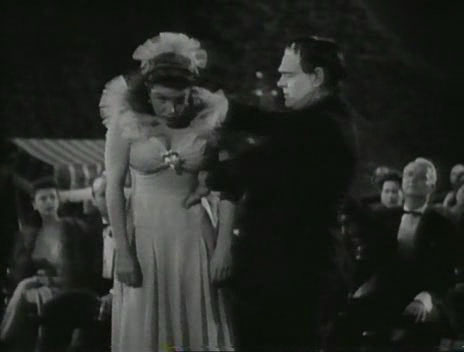
Who’s that on the right? Why, it’s the great Thelma Ritter, soon to be in Rear Window and Pickup on South Street. Center, facing Bette, is co-narrator and best friend Celeste Holm, and that’s one of the two male leads next to her, frankly they both looked the same to me:
image

I loved the bit during this fight at home when Bette is furiously eating candy instead of screaming at this guy:
image

Fey George Sanders with titular star Anne Baxter:
image

Awesome rear-projection shot. They are just pretending to walk, rocking back and forth in front of a screen. Why?
image

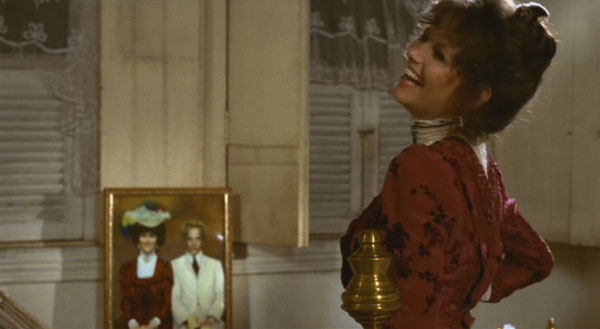
Terrific ending, with a new young hopeful who idolizes Eve and pretends (here, in a three-way mirror) to take her place, the cycle starting over again. This was the signature scene for small-time actress Barbara Bates, who never topped it and committed suicide twenty years later.
image

Great comedy, funny, I loved the hell out of it. Katy liked too.

Ruggles (large-faced auteur Charles Laughton) is a butler for the Earl of Burnstead (Roland Young: Topper in Topper and Uriah Heep in David Copperfield). The Burnstead family and the Ruggles family have been in the same Earl/butler relationship for centuries. Along comes the American New Rich to shake things up: wild-west Egbert (Charlie Ruggles, still recognizable by his eyes over the thick mustache) and his haughty wife Effie, who win Ruggles in a card game and move him from Paris to Red Gap, Washington, USA. Egbert treats Ruggles as a buddy rather than a servant and keeps calling him “colonel”, so when they arrive in Red Gap, Ruggles is mistaken for an important guest in Egbert and Effie’s house, and Effie has to keep up the charade to avoid embarrassment. Ultimately there’s no escaping embarrassment for stuck-up Effie, and Ruggles takes advantage of the goodwill he’s acquired in town and the sense of freedom imbued by the American West to open his own (assumed successful) restaurant, cuddle (implied) with his sweetie (also implied) boot his rival out the building, and get publicly applauded at the end.

Ruggles is a great character. He’s not exactly the typical stuffy butler who gradually learns to relax – he seems from the start to have an inner life, and he adjusts relatively easily from selfless servant to personable entrepreneur. Overall much funnier class commentary than in The Rules of the Game, yet you don’t hear Cahiers du cinema all calling this the best film ever made. Based on a play and filmed a few other times, including a silent with E. Everett Horton as Ruggles, and in technicolor with Bob Hope and Lucille Ball. McCarey directed this soon after a Marx bros. movie and before a Harold Lloyd movie. Appropriately, we watched it soon after a Marx bros. movie and before a Harold Lloyd movie (neither one by McCarey, sorry bud).

character Ruggles (left) with actor Ruggles (right):
image

Besides being a great director, Charles Laughton was in everything from Whale’s The Old Dark House to Kubrick’s Spartacus. Silent star turned successful comedy/drama character actress Zasu Pitts is Ruggles’ dark-haired love interest, and Leila Hyams (also a silent star, best known for playing the nice girl in Freaks) is a blonde singer, a hot young society gal. I wanna say that Lucien Littlefield (Scandal Sheet, The Bitter Tea of General Yen) played the asshole who tried to keep Ruggles down.

Les Miracles de la cene (1988, Pascal Aubier)

Jesus as cheap magician. The water-into-wine and one-loaf-into-many tricks impress the Last Supper crowd, but yanking out the tablecloth doesn’t work as well. Very short, wordless comedy – lovely.

image

Blood of the Beast (1949, Georges Franju)

Wowie, I’d put off watching this short doc because I figured it would be intense and horrifying. Then I had some time to kill at our hotel in Virginia, and there it was on my laptop, so I put it on… a slaughterhouse documentary, hours before going to a fancy restaurant with steak and veal dishes, stupid. So I had to order the fish. Movie has the same fascinating combination of beauty and horror, poetry and death which permeated Night and Fog. A classic, but not one to watch very often.

image

image

My taunting of Katy for complaining about long movies (“long” > 105 minutes) bit me in the ass today. After an hour delay the movie started, and after 2.5 hours I was the first to moan about how LONG that damned movie was.

The project may have been initiated by the country of Namibia, but it says Burnett wrote and directed, so I’m laying the blame at his feet. So what went wrong? The other Burnett movies I’ve seen centered around small communities, so maybe his style can’t support stretching out to epic scale with ten countries and a hundred characters. Katy points out that Danny Glover had the only character with any depth, and Burnett said in an interview that Glover’s character was fictional, a blending of three or four real people, so maybe Burnett has problems with writing history and his strength is in fictionalization. After the recent reissue of Killer of Sheep, every film critic fell over himself to declare Burnett an American treasure, so maybe the combined weights of feeling like he has to live up to his reputation and deliver a high-quality picture, and feeling like it’s his duty to truthfully deliver the story of Namibia to the rest of the world led to too much compromise.

Plot: Young Sam Nujoma grew up in “South West Africa” (aka Namibia), a country governed by nazi… i mean Germans and occupied by South Africa. Sam always dreamed of a free Namibia. He met some guys who also wanted that, and started a political/guerrilla movement called SWAPO. He went to church and met minister Danny Glover. Then he pissed off to the United Nations and stayed there for twenty years, finally returning as president of his newly-independent nation. Yay!

I didn’t realize that Carl Lumbly (who played grown-up Sam Nujoma in a series of fake beards) was also the easily-manipulated slacker Junior in Burnett’s To Sleep With Anger.

Quoting myself in an email:
Movie feels long, and yet each scene feels too short. Tries to tell the *entire* story of Namibia AND of [Nujoma] without leaving anything out, so it’s an epic and a biopic crammed into 2.5 hours. Script feels like a wikipedia article. And story problems aside, it’s full of traditional epic-sounding music, and traditional cutting and camerawork… doesn’t feel like the idiosyncratic artworks that the other Burnett films I’ve seen (Sheep, Wedding, Anger, the shorts) felt like. Disappointing. BUT it’s got some great shots and some fine acting, and the stories of Namibia and Nujoma are interesting, so it was at least worth sitting through. It’s not total crap (like Amazing Grace), just not the great movie I was hoping for.

Made in the middle of Capra’s streak of sincere, goodhearted dramas, a couple years before he ramped up for the war propaganda machine. I was excited to see this because I love Robbie Fulks’ song about loving Jean Arthur, but I didn’t end up loving the movie’s Jean Arthur more than I love the song Jean Arthur. Maybe Robbie was watching A Foreign Affair, or Shane, or a different Capra film.

A corporate-greed movie, pretty funny for a self-important serious-issues drama, but still feels a tad long and obvious. Jimmy Stewart is in love with his secretary Jean Arthur, but their parents disapprove. Jimmy’s very rich & proper dad owns the huge business of which Jimmy is vice-president, and Jean’s dad (Lionel Barrymore) is a giddy eccentric who lives in a house where everyone does whatever they please (which mostly means dancing and making fireworks). Ends up in jail, then in court, with Barrymore’s lifestyle on trial. Can the stuffy rich people learn to lighten up just a bit, and can the nutty eccentrics learn to conform just a bit, so that their star-crossed lover children can be happy? Of course!

Lionel Barrymore is swell as the good-hearted old commie, but better is Donald Meek as a formerly repressed corporate bookkeeper who goes to live in Barrymore’s house, gleefully inventing and exploding things. Also cool is Russian dance instructor Mischa Auer (seen almost twenty years later in my second-to-last screenshot in Mr. Arkadin) whose strict manner clashes comically with the rest of the Barrymore house.

Lionel Barrymore (right, of Tod Browning and Lubitsch movies, later in Duel in the Sun and Key Largo) shames Edward Arnold (left, in the movies since 1916, played Webster in The Devil and Daniel Webster)
image

Donald Meek is charmed by Lionel Barrymore:
image

Small-headed Mischa Auer with God’s Jean Arthur.
image

Okay, so I went overboard in saying this was better than Across The Universe, but I did find it surprisingly tolerable and entertaining and I enjoyed looking at the cool lighting and listening to the songs and watching Meryl Streep whenever she was around, and my mind wandered whenever she wasn’t. There was one great song (not counting the camp greatness of Pierce Brosnan’s awfully earnest singing), and the rest were pretty so-so. Movie is getting mad hatred from web-based critics, fans of good films and classic musicals, but I didn’t go to the screening expecting a good film nor a classic musical so I left unoffended. In that sense, it may not have been better than Across The Universe, but it was better than Indiana Jones 4.

The movie is so nihilistic and immoral, I wonder if it counts as pre-code comedy, if it would’ve been allowed three years later. Aha, IMDB says there are some bits that were lost in ’35 during a post-code re-edit, including the meaning/punchline behind the guys delivering blocks of ice to the apartment of the “college widow”.

I didn’t even know there was a straight-man Marx Brother: Zeppo, here playing Groucho’s son, a student who has spent twelve years at college hanging out with the “college widow” (apparently a common term back then after Archie Mayo’s 1927 movie The College Widow, which Horse Feathers is partly parodying).

Director McLeod (who also made comedies with Cary Grant, WC Fields, Bing Crosby, Bob Hope and Harold Lloyd) did a fine job taking strings of unrelated scenes and jokes and stitching them together into what passes for a movie. The mad energy and nonstop jokes still make it a highly successful comedy. None of the four credited writers bear the name of Marx, so I wonder how much the Marx Bros. brought to the table besides acting. No real sense in a plot summary, since the movie itself doesn’t seem to give a damn for plot. No sense in recounting the jokes either, cuz it’s a goddamned fun flick and I’d rather forget most of it so I’ll enjoy it as much the next time.