I still don’t like John Travolta and I still don’t have a clear handle on who Olivia Newton John is (I thought she was famous for doing workout videos in the 80’s, but now I realize I’m getting confused by her hit song “Let’s Get Physical”). But they’re both pretty cute in this movie, which was more of a chick-flick than I was prepared for. None of the other musicals we’ve seen have seemed quite as chicky as this one. Not that I disliked it, hey, I’m in touch with my chick-side, just didn’t expect such a giggling pillow-fight of a movie.

J-Trav is the coolest guy in a lame gang of guys without motorcycles or even cars (okay, one car), and Olivia NJ is a cute transfer student. They spend the summer together at the beach, but once school starts, he can’t hang out with her anymore because he has to stay cool, and I guess cool guys don’t date cute transfer students. Amazingly, NJ understands this, and shows up at end of movie with her clothes all gang’d up, coincidentally right after J-Trav has decided that he loves her and is gonna hang out with her anyway, cool or not. It’s like the gift of the magi. Well no it isn’t.

The “greased lightning” song is pretty happenin’, and I liked “summer nights” even if I can’t remember the tune so well now. Both of the hits are back-to-back at the end of the film: “we go together” (the changetty-chang-shoo-bop song) and “you’re the one that i want”, for the post-graduation-carnival scene. I was surprised at how functionally shot (or visually unexciting) the whole thing was, but I guess director Kleiser (big top pee-wee) and DP Bill Butler (Omen II, Rocky II, The Sting II) did the best they could for what looks more like a low-budget cult sensation than a big extravagant musical.

Followed by Grease 2, which lands a full 3.5 points lower than the original on the scale of IMDB voting. IMDB has nothing interesting to say about Grease 2, besides that it was popular 1940’s supporting actress Eve Arden’s final film.

Katy likes it. If I wasn’t so concerned with acting super cool around all my film buddies, I might say I liked it too.

I’ve already done enough damage with this one, so I’ll be brief.

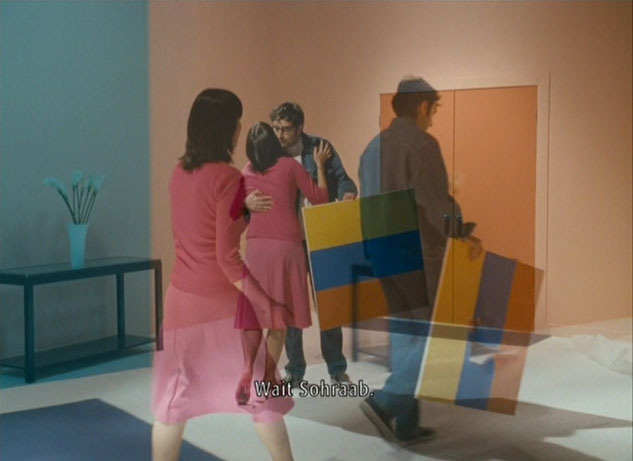
Golly-gee Omar used to date his punker racist friend Johnny (Daniel-Day Lewis in his first good role?), sees him again in a dark scary tunnel and they get back together. Help run O’s uncle’s laundromat, paying for renovations by stealing from uncle’s actual business, drug-running. Omar’s father is spaced-out-and-dreamy sick old man Roshan Seth (Monsoon Wedding, Temple of Doom) and uncle is Saeed Jaffrey (man who would be king). Omar gets on power trip, has some “reverse” racist moments with Daniel-Day, and flirts with a female cousin.

Something seems off throughout – nobody is quite behaving normally, and the camera work is slightly absurd (clean, shining, colorful images), and there are soap bubble sound effects on the soundtrack. I didn’t know what to make of it all.

Writer Hanif Kureishi was also the source of Patrice Chéreau’s Intimacy.

Jan. 2013:
Watched again on blu-ray, including the scenes I missed last time. Things I forgot: they are all addicted to painkillers and cough syrup, Owen acts like he’s in charge of the others and when they finally corner their real mom she speaks just like Owen. Not the most terribly interesting Wes Anderson movie but the colors and camerawork are just wonderful.

—————-
Missed part of the movie for being ill, including the river rescue scene, which I like to imagine was shot like the shaky-cam action bits in Life Aquatic with a drum solo soundtrack.

—————-
ME: Had no idea Bill Murray would be in it. Me, I love the wes-anderson visual style and the music was nice, and the actors are funny, so I had an alright time… will rent sometime to see what else happened. Certainly not a disappointing movie, now that I’ve come to accept life aquatic, heh. Wes probably thinks this is unlike anything he’s ever done before (a road film! in india! with adrien brody? outrageous!) and doesn’t notice that all his movies are about three people (rushmore: 1 person) with father issues. The money issues were notably gone from this one.

P: I felt like the characters were pretty empty.. maybe it IS because all
his movies are the same, and the guys with father issues are now
caricatures instead of characters, but i think its deeper than that.

ME: I asked Katy if there were any postcolonial/racism problems herein and she said ohhhh yes there were, and told me all about ’em, but I have to get to a meeting so I’ll tell you later.

P: really? i mean, outside the whole white people traveling thru india on
a “journey”, which i imagine is the most common sight of white people
there, and which you have to kind of accept and ignore to watch the
movie, i didnt see much else. theres the christian missionary mom
(jarringly cameod by yoda in an anjelica houston mask), but they did
seem to treat the funeral scenes with respect.
i guess the entire film is indian-fetishism, so i didnt really pick up
on the specifics of it..

ME: Lemme see, I forget now, but I remember her saying that even in the small town where the funeral happens (I missed the whole river scene, btw) more people would speak more words of english, and it’d more likely be the older fellas than the kids who speak it, so the whole “we can’t communicate with anyone” thing was an untruthful narrative convenience. Oh, and she went on about the sexualization of the foreign “exotic” women, esp. on the train. Those two and the “journey” spirituality thing might cover it… but the spirituality thing is true. Not true necessarily that India is such a spiritual place, but true that white people consider it so and go there to get in touch with their inner hippy selves.

An attractive movie – fun musical to start with, gets more serious as it progresses. Shoulder-dancing Topol (of Flash Gordon, heh) is a poor milkman trying to get good husbands for his three daughters and stick to the all-important traditions. But he’s a smart fella and knows that traditions must change with the times. Some daughters want to marry for love instead of through matchmakers, unheard-of! Finally the police chief is commanded by higher-ups to force Topol’s whole Jewish community off their land. Topol does what he’s gotta.

Most amusing part is that one daughter is briefly engaged to a man named Laserwolf. Laserwolf! Then she marries a dude named Motel, a huge step down if you ask me.

The matchmaker was in Cannonball Run 1 & 2, Topol’s wife Golde was on television, and none of the daughters were really in anything else. Shot by Oswald Morris (Lolita, Oliver!, The Wiz). Orchestrated and conducted by John Williams.

A quality movie, affecting and with very good music and camera work. Liked it better than My Fair Lady.

Watched at work, fullscreen (from 2.35!) but uncensored. Even though I was paying close attention to the dialogue (to capture sound clips for a Lifetime promo) and picture (to capture iconic images for the same), I failed to follow the plot and character business.

It seems Emilio Estevez is in love with an older and attached Andie McDowell, and this is back when stalking was totally fun and romantic, not creepy and scary. Longhair rebel Rob Lowe wishes he was back in college. Demi Moore is overloading on drugs and men and teetering on edge of nervous breakdown. And I got confused by Judd Nelson’s name, so thought for a while that Andrew McCarthy was Judge Reinhold. I think McCarthy is an aspiring writer, and big cheater Nelson wants to marry Ally Sheedy, but McCarthy’s in love with her too.

The music sux0red, the pan-and-scan sux0red, movie was forgettable.

Where Are They Now: Andrew McCarthy in the remake Kingdom Hospital, Judd Nelson suddenly in a bunch of horrors, Mare Winningham recurring role in Grey’s Anatomy, Andie MacDowell in commercials for makeup or something.

I’ve had free screenings before, but this is the first one here that I was paid to watch.

From the director of “Pet Sematary”, Madonna’s “Like a Virgin” video, and “Pet Sematary 2″… cinematographer of “Smoke Signals” and editor of “Ernest Goes To Jail”. The girl from “How To Get Ahead In Advertising” is a nurse who saves the life of the guy from “Lost”, who is very rich and collects guns. They marry then she meets his son, a horse-riding house-building soap-opera hottie and falls for him instead.

image

Dad comes to the house toting an antigue gun, where son tosses him off an unfinished deck onto the hard, hard rocks below. The wife/stepson affair comes out during the trial, but the son totally gets away with it, then the girl catches on and there’s a fight and the son falls off the same railing. He doesn’t die though, lives on as a paraplegic in a plot twist that IMDB users are calling “horrible and confusing”, “in bad taste”, or at least “certainly silly”.

image

Between this and “Wicked Minds”, the other stepson/stepmom illicit romance I watched at work today, I figure I earned about $75. Not too bad.

The Kiss – The raciest, most controversial film of its time.
image

Serpentine Dances
image

Sandow
image

Comic Boxing
image

Cock Fight – some early animal cruelty from our man Edison, who would later outdo himself with the classic “Electrocuting an Elephant”.
image

The Barber Shop – Can’t imagine the appeal here, watching someone get a shave. One of the earliest films ever made and the “latest wonder” is a cheap/quick shave, not the motion picture itself?
image

Feeding the Doves
image

Seminary Girls
image

Swimming in the Sea
image

Children Digging For Clams – the best short for watching children dressed in silly period garb
image

Loading a Boiler, or, “the one where nothing happens”.
image

Dragoons Crossing the Sâone – dragoon: noun, cavalryman, a member of a European military unit formerly composed of heavily armed mounted troops.
image

Promenade of Ostriches – actually only one ostrich, also a camel and some elephants
image

Childish Quarrel
image

Lion, London Zoological Garden – more animals getting taunted for the camera
image

Photograph
image

Transformation by Hats
image

Carmaux: Drawing Out The Coke – coke: noun, the residue of coal left after destructive distillation and used as fuel.
image

Poultry-Yard – an inferior remake of Edison’s “Feeding the Doves”
image

Arab Cortege, Geneva – first appearance of a black person in the cinema?
image

New York: Brooklyn Bridge
image

New York: Broadway and Union Square
image

Policeman’s Parade, Chicago
image

Dude who looks an awful lot like Leo Dicaprio and will soon star in Speed Racer plays Chris, who abandons his rich dysfunctional family (Marcia Gay Harden: Tim Robbins’ wife in Mystic River, William Hurt: the killer brother in A History of Violence, Jena Malone: Donnie Darko‘s girlfriend) and heads into the wild. Along the way he makes himself a new family, two hippie parents (some dude and Catherine Keener), grandfather Hal Holbrook (star of Creepshow: The Crate), and a sister (the girl from Panic Room). Then he lets them all down by failing to eat properly out in the Alaskan wilderness.

An emotional movie, full of warmth and humanity, but not enough of either for our main character who leaves it all behind to pursue his Alaskan dream. According to the movie/diary he hoped/intended to return before he was sidelined by an impassible river and some poisonous veggies.

Movie walks the line between putting Chris forth as a hero, a role model, a visionary who got a few details wrong vs. a deluded kid whose family drove him to self-destruction, maybe slanted towards the latter. Some quick editing, lots of askew close-ups, foreground in a corner of the frame with something blurry happening in the large looming distance. A strange, interesting look to the movie with artistic intentions to be sure. An ambitious picture, almost all successful. I liked it a lot, but I have to say Grizzly Man still has the edge.

ADDENDUM: thanks to the Golden Globe award nominations, I am now remembering to mention that the Eddie Vedder songs were distracting.

My new hero Nathan Lee of Slate on this movie:

I immediately and powerfully sympathized with the questing hero — I, too, am a privileged young man undergoing an existential crisis! — but as his quest went on (and on and on and on and on), I found myself less and less invested. The trajectory of the movie proved emotionally frustrating but ethically acute: My gradual alienation from the “hero,” our ostensible audience surrogate, was replaced by empathy with all those marvelous supporting characters he encounters on his journey, a set of alternative families he briefly joins then abandons. Into the Wild is a conventional treatment of the same theme contemplated through kaleidoscope in I’m Not There. Both movies celebrate the thrill of personal reinvention while simultaneously attending to the spiritual toll of perpetual escape. Neither film is hagiographic; neither odyssey ends up feeling very heroic. If I’m Not There packed the greater wallop for me, it’s probably because I connect on a deeper intellectual and emotional level to Haynes’ mega-meta technique than Penn’s nostalgic naturalism.