Salman Rushdie came better prepared this time. He’s a fan of John Huston in general, but after programming the long-unseen Wise Blood last year for his “great adaptations” series, he turned out not to like the adaptation very much. This one he talked about as if he’d just watched it.

It’s quite a strange movie, and seems profoundly appropriate as a great action/adventure director’s final film. Opens with some friends arriving at a small party hosted by a couple of older women, spends ninety minutes at the party, then a short cab ride home with Anjelica Huston (oscar-winning for her previous John Huston film) and her husband Donal McCann (obviously not a huge film actor, was in Rawhead Rex the previous year, and not even in the lead). She confesses to her husband about a boy who loved her when she was in high school, who loved her with a passion her husband has never known, who died when she left town. And after she falls asleep, he looks out the window, his thoughts in voiceover are the James Joyce story’s celebrated final paragraph.

Ebert has a really wonderful write-up on the film:

The Dead ends in sadness, but it is one of the great romantic films, fearless in its regard for regret and tenderness. John Huston … had an instinctive sympathy for the kindness with which the guests at the Misses Morkan’s party accepted one another’s lives and failings. … Gabriel is the witness to it all. An early shot shows the back of his head, regarding everyone in the room. Later he will see his wife, finally, as the person she really is and always has been. And he will see himself, with his ambitions as a journalist, the bright light of his family, the pride of his aunts, as a paltry fellow resting on unworthy accomplishments. Did these thoughts go through John Huston’s mind as he chose his last film and directed it? How could they not? And if all those sad things were true, then he could at least communicate them with grace and poetry, in a film as quiet and forgiving as the falling snow.

The only actor I recognized (besides Huston, of course) was Colm Meaney in a minor role. Also in the room here Dan O’Herlihy (Buñuel’s Robinson Crusoe), Donal Donnelly (of Richard Lester’s The Knack) as a drunk, Helena Carroll (The Friends of Eddie Coyle) as one of the hostesses (don’t know if she’s the one in charge or the one who sings a song who McCann imagines dead in the final monologue) and Marie Kean (Barry Lyndon’s mother).

Very nicely assembled space doc, a tribute to the Apollo missions. Some 16 years after we stopped going to the moon, Reinert montaged audio interviews and film records from the flights into a concise movie with some familiar imagery (still good to see it in well-restored HD) but plenty of new stuff for a space novice like myself.

Lots of anti-gravity play, and talk about music. I was impressed that one astronaut took the 2001: A Space Odyssey soundtrack into space, forgetting that the film predated the first moon landing. And speaking of music, I liked the documentary’s music without paying much attention, didn’t realize until the end credits that it’s all by Brian Eno. Nor did it really occur to me until more than halfway through the short feature that multiple missions were being shuffled without comment. These are two things I’ll have to focus on next time. Turns out Reinert cowrote that Final Fantasy movie I hated, but I can’t hold that against him now.

T. Rafferty:

What he does in this project, editing millions of feet of film and hundreds of hours of audio recordings into an eighty-minute feature, is treat the whole Apollo adventure as a single, epic trip to the moon, peopled by a crew so anonymous that it seems to represent, well, all mankind. … [Nobody] is identified by name. The film simply proceeds, with serene inevitability, from one fiery liftoff to one gentle splashdown, not troubling itself to distinguish any individual mission from any other and never interrupting the hypnotic flow of otherworldly imagery with a shot of a talking head. At first, when one of the offscreen voices says something unusually poetic, or funny, you wonder whose voice it is, but after a while you stop wondering. It doesn’t seem to matter. It’s everybody’s voice.

Reinert:

I began interviewing the Apollo astronauts in 1976. They were mostly retired astronauts by then, changed men. Over the years I taped nearly 80 hours of interviews with those original extraterrestrial humans, and excerpts from the tapes constitute the major part of the soundtrack of For All Mankind. The movie thus speaks with the intimate voice of personal experience.

For All Mankind is the firsthand story of a great mythic adventure. Touching the Moon was by definition a work of inspired imagination and high art, and scarcely requires further embellishment. It speaks for itself more eloquently than it can ever be interpreted: an age-old dream that at long last was fulfilled.

Rafferty again:

It takes enormous daring to make an avant-garde movie about people as determinedly square as the scientists, technicians, and pilots of the Apollo team; where this journalist, who had never directed a movie before, found the inspiration for that unlikely project is—like so much in the film—unfathomable. … In the late nineties, HBO aired a twelve-part docudrama series called From the Earth to the Moon, to which Reinert contributed two scripts. (The series is less exciting than it should have been—it tries too hard to be stirring—but its history is pretty reliable.) Reinert also had a hand in writing Ron Howard’s Apollo 13, which effectively (if, again, a bit too strenuously) dramatizes the 1970 mission … But For All Mankind is irreplaceable: one of a kind and likely to remain so. It is, formally, among the most radical American films of the past quarter century and, emotionally, among the most powerfully affecting.

For a while there, I dismissed all Italian movies. Their horror is badly acted and makes no sense, 98% of their movies have awful lipsync and among the higher-quality pics I’ve seen are The Leopard (which I hate) and flicks starring Roberto Benigni. Sure, I admit Antonioni and Fellini can be great, and I liked Suspiria a whole lot, so I figured I’d give the country another shot this year via poster-boy Rossellini. Rome, Open City was wonderful, but before moving on to Paisan I took a pit stop with L’Amore, wanting more Anna Magnani – and what a pit it was.

L’Amore is actually a film and a half, or an hour-long feature preceded by a short. First off is The Human Voice, a one-woman play written in 1930 by Jean Cocteau. I’d heard it performed before, on an LP by Ingrid Bergman recorded sometime after her divorce from Rossellini and return to Hollywood. So two Rossellini lovers recorded the same French monologue – coincidence? The play is pretty straightforward, a woman who’s been dumped awaits a call from her ex-guy, talks to him through a failing connection, going through various levels of grief. Should be a showy actresses’s dream role. The Bergman LP sold it better, as far as I’m concerned, sounding more like an actual phone call, all the visuals imagined. Rossellini’s version adds straightforward visuals – an unkempt Magnani on the phone in her room, with no fancy editing or showy camerawork. The biggest problem is the sound, distractingly out of sync (distracting even for me, who was busily reading subtitles), harsh and shrill, Magnani’s whining getting on my nerves until I finally turned the volume waaay down. You’d suppose a one-person movie in a single room would have been a good chance for the Italians to try recording synchronized sound for the first time ever, but even the pioneering Rossellini didn’t think to try that.

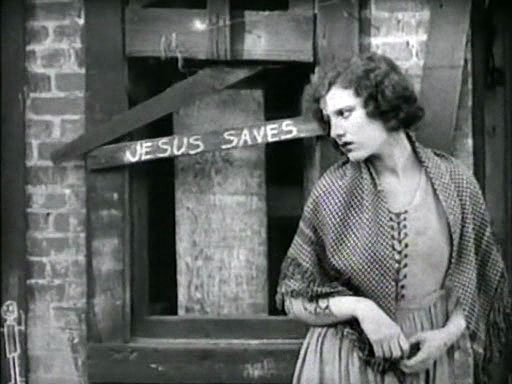
In the second part, The Miracle, from a story by Fellini, simple Nanni has a religious mania. While up in the mountains herding goats, she meets a lone dude, whom she welcomes as Saint Joseph (as in the stepfather of Jesus). They share some wine and she wakes up later, wanders back to work. A few months later she’s pregnant. Neighbors taunt and joke with her, a devilish midget throws her from her “home,” which looked like a pile of clothes in a plaza, then literally the entire town comes out to throw her a fake parade then throw stuff at her. So she flees up the mountain, delivers the baby herself.

G. Moliterno: “… largely made, as Rossellini himself acknowledges in the film’s epigraph, to showcase the consummate acting talents of Anna Magnani.”

He also mentions that the Human Voice segment was shot in Paris during prep for Germany Year Zero. “A clear indication of Rossellini’s greater than usual attention to visual style here is given by the pronounced presence of mirrors throughout the film in order to underscore the ongoing fragmentation of the self.”

And if I may overquote from the same source:

[Nanni] clearly anticipates the characters of Gelsomina and Cabiria in Fellini’s La Strada and Nights of Cabiria, but Magnani channels an animistic vitality into the role that makes the poetry of Fellini’s two later creatures appear wan in comparison. And in fact, despite Fellini’s own appearance in the film as the silent and mysterious vagabond who prompts Nanni’s religious delirium… Nannì brings to mind the “durochka” or holy fool, of Andrei Tarkovsky’s Andrei Rublev. … [Appeals against the film’s banning in the States] also overturned the Court’s own decision in 1915 which had for decades denied films the status of self-expression and thus protection under the First Amendment. Part of the miracle of Il miracolo, then, turned out to be its role in initiating the beginning of the demise of film censorship in the United States.

A handsome young man with always-perfect hair and a boring, sickly widower father meets a vivacious girl from a turbulent household. And they fall in love, run off together, and it’s perfect. Or it would be, but the movie sticks with them long enough for her to get pregnant, forcing an eventual return to civilization, at which point she makes herself useless, sleeping around while he slaves to make a living and tries to save for their future. It does not end well for the couple. But at least they’ve got their health.

Beautiful, amazing looking film shot by cinematographer Gunnar Fischer, who shot all of Bergman’s most famous films in the 40’s and 50’s. Harriet Anderson would appear in some more Bergman films as well as Dogville and The Day the Clown Cried (really). Harry (Lars Ekborg) wasn’t as excellent as Monika was, and thus was only rewarded with a small role in The Magician.

Released in the States in 1956 as an hour-long edit retitled Monika, the Story of a Bad Girl, which is the version that hit U.S. arthouses like a bomb, shocking people who’d gotten used to boringly chaste homemade product like From Here to Eternity, leading horny adults to start frequenting foreign films, which continued until home video destroyed the trend since now we could see all the bare breasts we wanted at home.

D. Micevic:

It happens near the end of the story, after an idyllic summer between two young lovers, Monika and Harry, has turned sour and they awake from their idealistic dreams to an existence of poverty and acrimony. Monika sits in a café smoking a cigarette, about to bed another lover. The camera closes in on her face—Bergman’s calling card of extreme close-ups during moments of intense personal anguish. Yet, in an instant uncharacteristic of the director, Monika looks directly at the camera as everything surrounding her fades to black. The shot holds for nearly a minute, preventing our escape as Monika stares us down, challenging us to pass judgment on her. It would be easy to scorn her decision, but Bergman provides us with no pedestal from which to condescend. If we are to reprimand her, we must confront her directly. It’s unnerving and brilliant, and this moment alone is worth consideration for anyone even slightly familiar with the director.

Bergman: “I have never made a less complicated film than Summer with Monika. We simply went off and shot it, taking great delight in our freedom.”

Another in an unplanned series of taboo-breaking sexy movies from different time periods. This one is set in a burlesque theater and has sexy dancers being murdered by a g-string strangler. Must’ve been seriously hot stuff in the sexless 40’s. Katy and I had a hard time believing this was such a late Stanwyck film, coming after Remember the Night and Ball of Fire, because the print was in such rough shape it felt older. Backstage drama popping with fast-talking slang for the first half, becomes a slave to its murder-mystery plot by the end. Barbara Stanwyck ends up with a clown named Biff (Michael O’Shea of Fixed Bayonets). One of the girls appeared three years later in something called Queen of Burlesque, which also features strangled bodies found in trunks.

Watched one of the most romantic films of all time, recommended by TCM Essentials, on valentine’s day, only to find it neither romantic nor essential. In fact, I didn’t like it much at all, and am dismayed that Zinnemann won a directing oscar over Wilder, Wyler and Stevens. Adapted from an extremely popular, gritty and pessimistic James Jones novel (I found his Thin Red Line tedious and overlong), the adaptation is from a weird time in film history when movies wanted to be gritty and pessimistic themselves but weren’t allowed to by the censors. So the message is muddled, beloved characters from the book brought to life only to behave against their nature, which may explain why I got so little out of it.

But it doesn’t explain the lack of romance, and here I’m not blaming the film but its reputation. One shot of Lancaster and Kerr clinching on the beach as a wave hits has become shorthand for eroticism in pre-60’s cinema – but it’s a shot, not a scene. Immediately after that shot, they stand up and bicker. Kerr hates her husband, is cheating with Burt, who leaves her because he’s “married to the army,” while a drunken Monty Clift falls for prostitute Donna Reed (that’s from the book – in the film she’s a chaste hostess paid to smile politely, talking and dancing with soldiers, a career I’m not convinced has ever existed) then dies stupidly, so after the harbor is bombed Reed sails home alone and Kerr stays with her now-disgraced husband whom she still hates. Some great romance.

The dialogue was generally unmemorable, the cinematography nothing special and the editing sometimes distracting. The actors all seemed decent, not award-winningly spectacular. Clift was more energized than his surroundings, an early Method proponent who’d get drunk to play drunk (then again, I hear he also got drunk to play sober). And I wouldn’t be such a valentine humbug, attacking every facet of the movie, if Katy had at least enjoyed it, which she did not.

Some CAST:
Lancaster: a few years before Sweet Smell of Success
First movie I’ve seen with Monty Clift: he did Hitchcock’s I Confess the same year.
Deborah Kerr: six years after Black Narcissus and looking quite different, almost anonymous without the nun’s habit
Donna Reed: the year after Scandal Sheet
Earliest movie I’ve seen with Frank Sinatra, who was wiry and good in this
Philip Ober acted with Burt again in Elmer Gantry
early film for Ernest Borgnine, who played another bad guy in Johnny Guitar the next year.

Remade as a massive miniseries in 1979 with Kim Basinger as Reed, Natalie Wood as Kerr, William “Who?” Devane as Lancaster, and Peter Boyle (the monster in Young Frankenstein) in the Borgnine role.

One of my most beloved 80’s horror movies, possibly because it’s never been very popular, nor has it been spoiled by sequels (part 2 wasn’t so bad) or remakes (though Bill S. Preston, Esq. has his eyes on one). I watched it again and again on TV, and since it’s not rated R, I probably didn’t miss much. Thanks much to the Plaza and Splatter Cinema, I have now seen it in an actual cinema on actual film. It’s kind of a kids movie, and I still take issue with a giant earth-conquering demon from hell being defeated by a kid with a model rocket, but otherwise perfectly enjoyable.

I’d forgotten some details: a couple of valuable geodes pulled from the hole early on, friend Terry’s dead-mother issues and his collection of moths in a jar. Also didn’t realize how kids’ toys are woven into the movie. There’s the rocket of course – I’d misremembered the devil-thwarting “pure love and light” being a marketing slogan on the rocket’s box, but the shabby, dollar-bin-design box just has a rainbow on it. I guess it’s Dorff’s belief in the rocket as a symbol of love/light that wins out, like the kid in Stephen King’s It spraying monsters with his inhaler while shouting “this is acid!” More child’s play: the hole is initially opened far enough to let those awesome ankle-biting micro-demons out when the kids read words formed by the geode on a toy writing tablet, evil demon-Terry is stabbed with a barbie doll, and the secret of demon banishment is discovered by playing a record backwards. That one is especially fun in a subversive way – parents used to worry that kids would pick up secret satanic messages from metal albums, and this one teaches them how to fight evil, not how to summon it.

Director Tibor, as has been discussed here already, made the pretty cool I, Madman, then Gate II, and went slowly downhill towards the truly stinky Christian Slater movie Lies & Illusions. Writer Michael Nankin is directing respectable TV shows (and CSI) these days. Dorff’s big sister Christa Denton never made it out of the eighties, acting-wise (although one of her slumber-party friends later starred in Candyman 2), and tragically, neither did Louis Tripp, who played Terry, except for a rumored cameo in a late-90’s Edward Furlong comedy.

After watching Henri-Georges Clouzot’s Inferno, which documents the director’s experiments with visual effects and attempts to integrate them with his stories via dream sequences, then reading at the end that he later used all these effects in The Prisoner, what could I do but run straight out to watch The Prisoner.

And boy did he ever put those effect experiments to use. It is full of light and color and lines and boxes, reflections and refractions. Real tight framing and editing, very clockwork in a wonderful way, with outstanding music, acting that seems unexceptional at first, but gets better. I’ve liked all the Clouzot movies I’ve seen, but have heard nothing about this one, so figured it’d be a dull late-career entry (it was his final released film), but no, he went out with a bang.

Gilbert (Bernard Fresson of Z and Street of No Return) is an artist who specializes in mass-produceable objects with geometric patterns that cause optical illusions when you spin them round. Stan (Laurent Terzieff of The Milky Way) runs a gallery where Gil and other guys are putting on a show. And Josée (Elisabeth Wiener of Duelle) is Gil’s girl, who jealously spies her man Gil talking to a reporter in a hall of mirrors, and so strikes up a chat with leering Stan, going back to his place to look at photos of “handwriting”.

The only thing I remember of Josée’s day job is that she spends some hours looking at interview films on an editing table, commenting that she can’t understand submissiveness and masochism in women. Of course this is a setup, and when she’s at Stan’s place she “accidentally” spies a slide of a naked girl in chains, which fascinates and excites her. Oh of course, it’s just another thing Stan dabbles in, photographing nude bondage sessions, but Josée is now obsessed, insists on attending the next one. Maguy (Dany Carrel, returning from Inferno) poses, Stan photographs and Josée watches anxiously.

Josée soon agrees to be photographed herself, and starts a heated affair with Stan. This was one year after Belle de Jour (and given Clouzot’s pacing, he might have written this film before Buñuel even dreamed of his). Clouzot’s picture is both less and more extreme than Buñuel’s – it’s surely more passionate and less clinical, when considering two directors I would’ve expected the opposite. The photographic sessions, even Maguy’s first one with minimal nudity, are erotic as hell, the height of sexy editing. It may be ultimately more tame than Belle de Jour though, with overall less to say about societal norms and sexuality.

Husband vs. lover, splendidly shot through a half-reflecting window:

Stan has a more poetic penchant for suicide than did the desperate, more tragic Dominique in La Vérité:

Interesting to watch this in the same month as Lady of Burlesque (1943), From Here to Eternity (1953), Monika (1953 but released in the U.S. in ’56), The Apartment (1960), Knife in the Water (1962) and even The Girlfriend Experience (2009). Half were (or at least were intended to be) sexually progressive films when released, all seem very of-their-time, and only The Apartment and this one still seem capable of shocking anyone today.

I loved the camerawork – mobile, but always with a specific goal, a plan to paint a picture through time. Clouzot, 60 years old, a widower with heart trouble, doesn’t seem quite up to the task of smashing a complacent society and visual expectations to bits with his camera, but he has no trouble smashing his lead actress to bits with a train, something he attempted earlier in Inferno.

D. Cairns:

And as a final note of strangeness, the film ends with a woman in a hospital bed calling for the wrong man—the very same ending as Richard Lester’s seminal Petulia, released the very same year. No possibility of one film influencing the other. Instead, both films must be hooked into something, something out there in the ether. Cinema can do that.

Very good doc on the film Clouzot almost made between La Vérité and La Prisonnière, starring Romy Schneider (of Welles’ The Trial) and Serge Reggiani (just off Le Doulos and The Leopard). The couple is on their honeymoon, or maybe just on vacation, in a small town shot in black-and-white, and Reggiani becomes increasingly wildly jealous of everyone his wife has contact with, his state of mind represented with color fantasy sequences and optical-illusion effects. Decades after the film fell apart (mainly because the writer/producer/director’s overreaching ambition clashed with his own perfectionism for details, wasting time and money and tiring the cast and crew) the script was filmed in the 90’s by Claude Chabrol, which I believe was the first of Chabrol’s movies I ever watched, too long ago for me to compare the finished movie with the Clouzot fragments.

Clouzot got some great cinematographers and effects people, including Claude Renoir, Rudolph Maté (The Passion of Joan of Arc) and Andreas Winding (Play Time). It was also the first credited film work by William Lubtchansky, who is one of the main interview subjects. The documentary is very excellent, showing much of the never-finished film (the color footage in particular looks amazingly vibrant, like it was shot yesterday), and not getting into irrelevant sidetrack stories. Interiors (and therefore most of the dialogue scenes) were never shot, and there’s no surviving sound recording from set, so two actors read from the script on a black stage, providing missing context.