Hoarders Without Borders (2018)

Shows us what it’s gonna do before it does it. First the camera faces down with fixed focus as drawers of rock samples are pulled into view, the higher they get, the clearer the image. Then real-time view of the process of putting the rocks and their identifying notecards in front of the fixed camera. Then a blast of time-lapse, every rock in rapid succession. A couple of suspect frames (a can of fruit?) to investigate later.


Wasteland No. 1: Ardent, Verdant (2017)

Lightplay on circuit boards, rapid slideshow of circuit boards, then red fields of flowers, then alternating circuit boards with red flowers, a surprisingly pleasing combination. Silent.


Wasteland No. 2: Hardy, Hearty (2019)

More intense than number one, this overloaded my eyeballs, alternating green plants and their brown roots, loose dirt on a white background, with flowers frozen in ice cubes. For a while there in the middle I seemed to see the green plant falling through space, constantly shifting because of a sustained attack by the flower-cubes.


Wasteland 3: Moons, Suns (2022)

Less strain on the nervous system than part two, this is time-lapse of flower arrangements melting from their frozen-in-ice states, with no rapid flicker elements.

Sound That (2014)

The Cleveland water department searches for underground pipes by putting their ears to a long rod stuck into holes drilled in the ground. Payoff at the end when they settle on a location and the caterpillar rips up the street so they can access it.


Brown Thrasher (2020)

I was hoping this would center on a brown thrasher, but of course it’s people, it’s always people with Everson. Red-shirted birdwatchers with binoculars, being watched themselves by a jittery, vibrating camera.


IFO (2017)

The soundtrack is the thing in this one – spoken reports of UFO sightings, first in a taxi, then a military helicopter, then the same taxi again. The visual montage of people outdoors looking to the sky and air-traffic graphics seem secondary, though the people get some breathing room to themselves after the long helicopter story, and I love the extreme film grain on the grey sky.


Traveling Shoes (2019)

A great one, interviewing members of The Brown Singers and playing the title song, their record, with some obvious visuals (the record spinning on a turntable) and some less obvious (a girl holding the record in a dramatic pose, way out of focus).

A Dream Walking (1934, Dave Fleischer)

The soundtrack makes good use of the title song as Olive goes sleepwalking across rooftops into a construction site, while P and B beat each other up for the chance to be her rescuer. P “wins” and takes credit, but O gets home safely on her own. Some good 3D movement through the girder grid. Wimpy’s voice is different than I remembered it.


Adventures of Popeye (1935, Dave Fleischer)

Something different, a live-action child holding a Popeye comic gets beat up by the local bully, Popeye jumps out of the book and runs a clip show of action scenes from previous shorts, the kid gets the message, eats his spinach and pummels the bully.


Minnie the Moocher (1932, Dave Fleischer)

Betty thinks her parents are cruel for making her eat sauerbraten, so she runs away with Bimbo. They hide in a cave where Cab Calloway and his band perform the title song (they appeared in person over the opening titles but an animated walrus is his stand-in here) and this scares them into returning home. Anyway we’ve learned that Betty’ parents are German immigrants, so the name Boop might’ve been an Ellis Island misspelling of Boos or Rupp or Hoppe.


The Merry Musicians (1936, Aleksandr Ptushko)

Puppet animation: four old mistreated animals run away from home and form a traveling band, playing the same song over and over. Needing a place to stay, they find a house of thieves in the woods and scare away its residents, and live happily ever after. Not as much fun as it sounds.


The Barber of Seville (1944, Shamus Culhane)

I haven’t seen one of these in a while – is Woody meant to be chaotic evil? He goes into a barber shop to get a Victory Haircut to support the troops, but the shop is vacant so he takes over, terrorizing anyone who walks in. He does sing Figaro in the last scene.


Who Killed Cock Robin? (1935, David Hand)

How many Disney murder mystery musicals are there? A lady wren seems like a Mae West caricature. The cops respond to the crime with a wave of random brutality (actual lyric “We don’t know who is guilty so we’re gonna hang ’em all”). Turns out Cupid shot the robin, who was only dazed, wakes up to kiss Mae Wren in court. Travis Wilkerson later made a film with the same title. Oscar nominated, beaten by the same director/studio’s Three Orphan Kittens.


The Band Concert (1935, Wilfred Jackson)

Another orchestra toon, people were really into orchestras back then. Mickey’s conducting the William Tell Overture, and an early-model Donald interferes, as does a bumblebee and finally a tornado. Much violence ensues, excellent animation. The first technicolor Mickey, won an award at the third Venice Film Festival.


Clock Cleaners (1937, Ben Sharpsteen)

Literally clock cleaners, like with feather dusters on a clock tower, none of them especially competent. A nesting stork interferes. Some better aerial antics than the Popeye sleepwalking thing.


The Brave Little Tailor (1938, Bill Roberts)

A misunderstanding has Mickey appointed the town giant slayer, offered millions of “pazuzas” and the hand of the princess if he succeeds. I must’ve seen this short a hundred times as a kid, one of the few readily-available Disneys. MM getting swallowed is still a cool scene, and the giant swatting at MM in the same way that MM was swatting flies in the opening scene is nice. Our guy prevails, and the town harnesses giant-snores for wind power. Another oscar-nominated Disney short that lost to a rival Disney short, the far inferior Ferdinand the Bull.


Night on Bald Mountain (1933, Alexander Alexeieff)

Animated engravings? Ah, it’s pinscreens, invented by the director and his wife. Blobby 3D rotations, back-and-forth repetition, transformations, what looks like a photographed miniature town. This goes in a bunch of different directions, all set to familiar music. Can’t say I got what it’s going for (ghosts rampant on the mountainside?) but it’s a change of pace from the Disney stuff.


Fétiche / The Mascot (1933, Ladislas Starewicz)

No subtitles, but a feverish kid is haunted by the roomful of dolls he’s resting in, seeing them come alive in glorious stop-motion. A wizard conjures an orange, fought over by a cat and monkey.
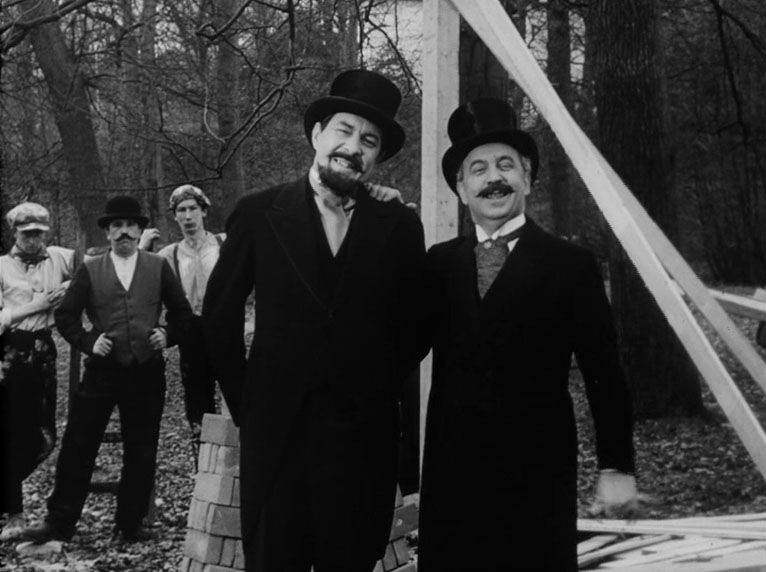
Dollmaker mom takes the dolls out to the city, presumably to sell, but if you’re sewing together evil dolls with souls, it’s a mistake to create a knife-wielding thug. He arranges an escape from the moving car, but rather than a fun Toy Story 2 romp through Fontenay-sous-Bois, they get trashed and broken and lost, only the cute dog surviving to the shop, though he escapes his buyer immediately and then it does become Toy Story 2. The blending of controlled puppetry and live-action chaos is beautifully done. Suddenly the devil is there, resurrecting the skeletons of eaten animals, summoning creatures made of paper and shoes and vegetables to his lair, where they party all night. Our doggy comes too, with his prize orange, which he never bites into, so it keeps getting stolen. Some of his old housemates are there helping cause havoc. The devil tries to sow discord and provide entertainment but gets his ass beaten to death – as does everyone else when puppet cops with clubs start brutalizing the innocent. The dog makes it home with his two uncredited-actor people (while Ladislas, who appears for ten seconds in the film, gives himself a prominent opening credit).


L’Idee (1932, Berthold Bartosch)

Guy has a good idea – his idea is for a miniature naked woman he can hold. He puts her in an envelope and mails her to the society of overdressed men, who don’t appreciate her at all, wishing her to be overdressed. The dreamer reimagines her fullsized then goes to town square to convince others that his naked-woman idea is good, but they are dicks and have him arrested and killed. A creepy guy who hangs out in crypts rediscovers the idea in the modern era and has her mass-produced on paper, and this idea givess an overdressed guy a new idea: that he should send people to war in order to get rich. Thousands die, while the original idea re-merges with the cosmos. Dour black and white animation, hard to tell what technique was used from my low-res copy, but the wikis say it’s multiple layers on glass with paper backgrounds.


The Little Match Girl (1937, Arthur Davis)

The barefoot girl’s matches are battered by a merry bustling new year’s crowd. She finds a quiet spot and starts lighting matches in a futile attempt to stave off the cold. From other versions I’ve seen, I don’t remember her lovely fantasies (having shoes and a doll and a parade of naked angels, etc) getting destroyed by a violent storm as she dies.


Galathea (1935, Lotte Reiniger)

An excellent followup to L’Idee, about a guy who sculpts a naked woman who comes to life, to the distress of his wife. He assumes he’s got a new sex slave, but Galathea trashes his studio and runs off. When the sculptor hears that she’s carousing at the pub he brings her home, where the wife tries to solve the problem by putting clothes on Gal, but that doesn’t go well. While everyone’s fighting, Gal transforms back into a statue and all the town’s women get their men back. Shadow-puppet animation of course, nice and crisp looking.


Daffy Duck in Hollywood (1938, Tex Avery)

Daffy causes chaos at a movie studio, then cuts a bunch of random pictures together onto a single reel, driving an Italian pig director insane.

Apprivoisé (2017, Bertrand Mandico)

Music video with unsubtitled intro. Flamboyant feather-boa skeleton-hand guy is set loose on a dinner party, his frost breath bestowing jeweled rings and necklaces and cocks upon the guests, but he cannot be stopped, and dismembers their host. Extremely great, obviously.


Niemand (2019, Bertrand Mandico)

Another music video, this time sung in German, the story about a woman who keeps getting in car crashes, after which neon-eyed cannibal angels steal and eat whatever body part she’s injured.


Fou de Bassan (2021, Yann Gonzalez)

Checking in with Mandico’s buddy Yann. This is a bit of free-for-all perversity, a misty night scene lit by spotlights and artificial moon.

When Anthology Film Archives first opened in 1970, its inaugural screening – presented during a private event on November 30 – showcased four highlights from the foundational repertory cycle that would come to be known as the Essential Cinema Repertory Collection … The four films represented a short survey of film history, spanning from the turn of the century all the way up to the (then-)present day.

Voyage Across the Impossible (1904, Georges Méliès)

The hand tinted color is supremely excellent, the handcrafted, cardboard-looking sets and props very nice, and I couldn’t care less about the slapstick steampunk nonsense plot. More or less a sequel to A Trip to the Moon, this time to the sun. Jules Verne died the following year, so could potentially have seen this. When some passengers accidentally freeze into an ice block in the protective cooler car, their guide hurriedly warms them up by starting a fire with some hay… on the sun. I like the copyright notices hidden in plain sight, on cliff walls and the sides of trains and submarines.


The Midnight Party (1940s/1968, Joseph Cornell & Lawrence Jordan)

Stock Footage: The Movie. Sometimes the shots are flopped or frozen or repeated, with flashes of intertitles in between. The whole thing feels like it was made by mistake.


The Canaries (1969, Jerome Hill)

Canary songs and chirps are visualized as color blobs, which finally form new canaries made of pure sound and light which float away from the cage, visiting lovers on the beach. I wish I’d thought of this one.


Film No. 11: Mirror Animations (1956, Harry Smith)

I just watched this last year, probably my favorite of all the Harry Smith films I’ve seen.

One long-weekend in June, I watched a bunch of shorts, beginning with a bunch by New York/Berlin artist Henrot. Currently separated from my issues of Cinema Scope so I can’t revisit the article that first put her on my radar.

Million Dollars Point (2011)

Movie kinda fades in and out, as if showing excerpts. Hawaiian Christian on the soundtrack, preaching and singing. the visuals alternate between touristy Hawaiian dance scenes rephotographed off an SD TV, and beautiful undersea nature over the dumping grounds of human vehicles.


Strife of Love in a Dream (2011)

Manufacturing pharma – Atarax – but playing doom-drone music instead of KG+tLW’s “Ataraxia.” Long line of people winding up a mountain towards some event that involves fire and military control… an ornamental theatrical performance… and flash shots of snakes, which eventually take over the film, snakes in all forms, in life and art.


Grosse Fatigue (2013)

I loved Strife but this still feels like a huge leap forward. Narrator/singer rapidly goes through the history of the universe, the gods, mankind, as the visuals spring from a simulated mac desktop, windows overlapping, heavy on animal images. About 200 more dead birds in this than I would’ve liked, but still kinda great.


Saturday (2017)

No dead birds here except in the news ticker, but they’re replaced by close-up medical body-horrors. Fun experiments in rotoscoping, certain footage elements remaining in the foreground of the news ticker (which multiplies, its news becoming less informative) or breaking through the letterbox bars. The main topic is televised/radio call-in religious shows and baptism.


Film Spatial (2008)

“You have to learn not to understand everything.” She’s interviewing an older artist while camera roves around a busy house or studio in closeup. Lot of partially seen artworks and books, frequent visits to the dog on the floor. “In a really good film, it’s not just the content that’s important, it’s the visual impact … The content, in a way, is the pretext.”

Cool movie by Unsubtle Paul, opening with a spider on a crucifix. Writer Jeroen Krabbé (in a couple Soderberghs before going hollywood) is an absolute mess and an asshole to everybody. He’s haunted by his imagination, scenes tripping in and out of fantasies. He meets Spetters star Renée Soutendijk at a speaking engagement, and things get obsessive and weird. She brings home hunky new fella Thom Hoffman (who starred in Paul’s Black Book a couple decades later) and Jeroen suspects they’re both trapped in a murderous plot.

The writer is a religious nut hooking up with a killer widow, this is the Paul Career Template Film, following standard procedure of making you go “wowowowow” every ten minutes. Shot by Jan “Speed” de Bont. I am amused to realize that this week I also watched The 4th Man’s rhyming film The Northman. A letterboxd reviewer notes this “doesn’t work as a sequel to The Third Man.”

Toxic Roxy is young and blonde, frees buried criminal Kate Bush, who murders all Roxy’s friends then escapes, leaving the whole community angry at Roxy and her hairdresser mom. This all takes place on another planet, populated entirely by women who shun electronics and chemistry, after the earth became uninhabitable… well, only shunning these things to a point, since they have guns and androids (both named after fashion brands). While waiting for Kate, Roxy and her mom (Elina Löwensohn of course) bond with Kate’s fancy rich neighbor Sternberg, with her male android Olgar 2 and weirdo bounty-hunter bots Keifer and Climax.

Extremely horny sci-fi, Roxy masturbating at every opportunity, with dreamy visuals. We got zombie horses, geode-faced creatures, energy weapons, a pubic third eye, hats and fur coats everywhere, and everything is slimy or dripping and cross-faded onto everything else. I felt bad about not liking The Northman last night, then today I double-featured this with Mad God at the Plaza, and now I am feeling much better.

Opens unpromisingly despite Ethan Hawke… actors laboriously declaiming portentous dialogue in fake accents. It does start to get trippy, with more CG than expected (incl. cartoon-ass animals), and at the “years later” jump the tedious-to-thrilling ratio is 50/50. Subwoofer cinema, a sonically unpleasant movie – I should’ve played the Harriet Tubman album again. Alexander Skarsgård (Florence Pugh’s fake bf in Little Drummer Girl) swears revenge, loses his way, meets Björk, swears revenge again, kills Fjölnir’s son and refuses to say where he’s hidden the heart. Lotta people get chopped up with swords. Three good performances in this: Björk > Skarsgård > Dafoe

Willow Maclay argues there are four good performances:

Nicole Kidman also gives one of her best performances in some time as an incestual madwoman, driven berserk by the times, and dripping with salacious fury in her scene of revelation. This contrasts with her elegant work as a Queen and mother, and suggests that a proper feminine presentation can be hiding a cannibalistic fury behind doors.

Michael Sicinski:

Virtually every landscape is CGI’ed to the point of absurdity. The Northman strives for the painterly but more closely resembles those 4K test images they show on the TVs at Costco.