“Such protests are registered only in the minds of their participants, bypassing any transformation of social structure.” Dense sentences on voiceover with dense images flickering by. When it switched to a table of young guys discussing collective economies, I got tired real fast.

Sound and picture editing are hyperactive and wandering, some segments repeating, and clarity of the voiceover is sometimes sacrificed to the random sfx. Not random though – the movie has a particular look despite all the jumping around. A fascinating object, though the VO is too academic to follow for any length of time, reading political essays aloud. Sometimes even the movie itself tires of the narrator and fast-forwards her. And when the essays go on too long they start to overlap and destroy themselves, the visual flitting from swans to mathematics to abstractions to vibrators to legos.

Freedom and power… AI vs. the human mind… the meaning of work. The politics are advocating for three-day weekends, and given that I had time to watch the movie because of a three-day holiday weekend, I would agree. Other works this reminded me of: All Light Everywhere, Ken Jacobs’ Seeking the Monkey King, the less narrative Adam Curtis docs.

Phil Coldiron in Cinema Scope speaks of the difficulty of watching this in the covid era, and pulls the movie into editing software to analyze it further.

Though its pace and intensity will be familiar to those who have followed Medina’s earlier work, Inventing the Future marks a major step forward in terms of density and, in turn, musical or motific intricacy.

Loner sailor Farrel takes shore leave when his gigantic ship docks in Tierra del Fuego, Argentina, and sets off to look for his mom. He catches a ride to his family’s town, drinking heavily, passes out in a shed and is carried to the family home, where his dad berates him. Mom is alive but far gone, doesn’t recognize him. He gives a younger girl (Scope says this is his abandoned daughter, not a little sister like I’d thought) some money and a souvenir trinket, then “I’m off,” but the movie stays with the girl. Minor evolution from the laboring guy in La Libertad to the journeying (and daughter-seeking) guy in Los Muertos, but it barely can predict the new textures of the (journeying, daughter-seeking) Jauja (and I haven’t caught up with the movie theater-set Fantasma).

Alonso in Cinema Scope 36:

Liverpool is the result of throwing the ingredients of Fantasma into La Libertad and Los Muertos … I think that simply filming someone is the best way to demonstrate what I think about the human being – about his lack of communication, his isolation, and his incomprehension about himself and the world … I’m very interested in describing characters’ environments. I think that these environments may even be more important than the characters themselves.

It’s strange to see space alien Bruno S. playing someone besides Kaspar Hauser. Here he’s playing a version of himself, as are many of the actors, who autobiographically collaborated with Herzog on his hastily-written Germany-to-USA adventure. Reformed criminal/music lover Bruno helps Eva Mattes (Petra von Kant‘s daughter) while she’s on the run from her thug pimps (one of whom would later play Vigo in Ghostbusters II). The thugs barge in, assault Bruno and break his accordion. The neighbor who looks after Bruno (Kaspar Hauser fan-favorite Clemens) is leaving for Wisconsin, so Bruno and Eva join him.

Bad luck right off the bat as customs confiscates Bruno’s mynah bird (using its real voice, which is a big deal for birds in cinema). Werner discovers Weird Wisconsin immediately, filming two neighboring farmers on tractors with rifles. Bruno’s house is taken away for non-payment… not making enough cash as a waitress, Eva returns to prostitution and runs off with some truckers… and Clemens is arrested for robbery (the bank was closed so he robs the barber next door). Everything around him going to hell, poor Bruno wanders a live-bird amusement park then kills himself on a ski lift.

The credits thank Errol Morris, Les Blank and the documentarian who discovered Bruno in West Berlin. Supposedly Ian Curtis killed himself right after watching this movie, and yeah it’s a downer, but one night earlier I’d coincidentally watched New Order’s live set from Coachella 2013, and after seeing what a crank Bernard Sumner can be, I wouldn’t be so quick to blame the film.

Jackie Chan is Wong Fei Hung, a versatile character last seen as a child in Millionaires’ Express, and previously in Once Upon a Time in China. Here he’s a prankster and scammer who needs to be taught discipline by his great drunken uncle. Jackie is put through weeks of tedious strength-training exercises, doesn’t see the point in it all until the final fight when he has internalized the teachings of the Eight Drunken Gods and he gets wasted and destroys the bounty hunters trying to murder his dad over a land deal. Karate Kid was a sober teen remake.

Wonder if I am the first person of 2022 to unsuspectingly watch this movie after buying the Party Dozen single.

New kid Jackie had started getting star roles in ’76. His drunken master Red-Nosed Su is the director’s dad Yuen Siu-Tien, also of Come Drink With Me and other films with drunky titles. Powerful hit-man Thunderleg is Hwang Jang-Lee of Game of Death II, and Jackie’s dad Lam Kau was in As Tears Go By.

How to Live with Regret (2018, John Wilson)

Before the TV series he made a few standalone shorts, which I must find. His metaphors go on for too long and get lost sometimes, and there are a few classic film clips, otherwise basically a shorter, more tightly topic-focused version of the series. He interviews a guy who writes down all his regrets, and gets distracted by the guy’s screensaver, then talks with a friend whose apartment burned down (the multiverse is mentioned).


Autoficcion (2020, Laida Lertxundi)

Short 4:3 doc scenes, and some staged shots of a woman being dragged around. Subtitled interviews with Los Angeles-area women whose lives feel unstable. Repeated play of the song “Time Is On My Side.” Not more exciting than her other films, but I can spare 15 minutes per year for these.


Prometheus (2021, Dominic Angerame)

Spark showers, sometimes frame-in-frame, pure whites on black. Perhaps the camera was wearing a welders mask. Dom playing improv music on bells.


Austrian Pavilion (2019, Philipp Fleischmann)

The most filmy-lookin’ film I saw all weekend (on my TV), a hitching blue-tinted flicker down a hallway to some trees, the edges of the frame closing in.


The Newest Olds (2022, Pablo Mazzolo)

City buildings across the river, gently flicker-vibrating from a few angles with street dialogue, then moves inland to fields, still flickering, cool colors, people discussing unusual sounds on the audio, back to the city, this time with the sounds of recent protests. Would’ve been a perfectly fine a/g movie full of cool vibrations, why’d he feel the need to insert photos of dead birds?


Ruka/The Hand (1965, Jiri Trnka)

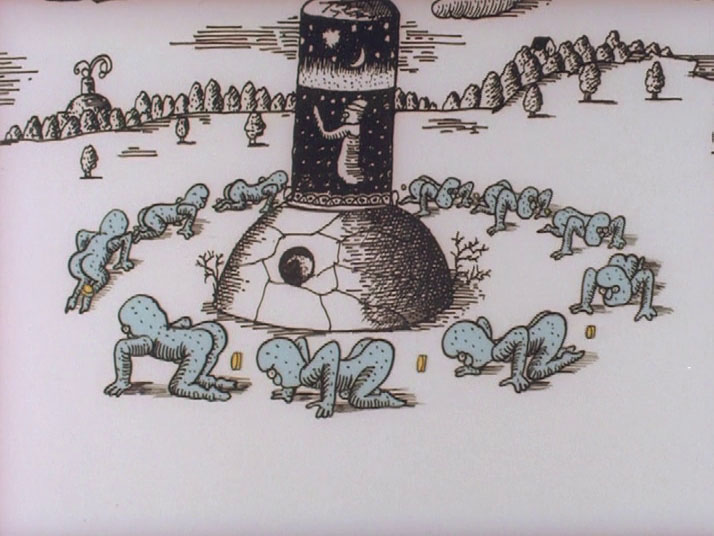
Watched this again in the latest video restoration, super. The hand uses sex and money and TV and newspapers and bribes and intimidation and imprisonment, then after all the man’s refusals the hand still claims him as a champion after he dies.

States (1967)

I’ve watched this one before… was hoping I got a higher-quality copy, but nope. Sometimes the water is a torrent, sometimes slight drips that look like sparks. Fully white-on-black with no grey in between, all elements given the same visual character. Unfortunately that character is destroyed with standard-def interlacing, the horizontal artifacts interrupting the all-vertical movements. Silent, so I watched with a couple of Craig Taborn piano tracks from the Avenging Angel album, which accounted for at least 75% of my enjoyment of the experience.


Apparatus Sum (1972)

Color fields, sometimes gently crossfading, sometimes strobing. Lingers on red for a long time. then, holy shit, is that a dead body, or what is happening? Freaky little movie, the second one in a row affected by low video quality (this time compression artifacts in the color fields), but I’ve run out of films from the beautiful Criterion blu-ray, so you get what you can get.


Not the First Time (1976)

A pier, shore birds, a person in red on the beach, always double-shot and superimposed out of sync, like a misaligned 3D camera, with frequent cuts to pure white. Short, silent.


Cadenza XIV (1977-80)

Prolonged marching band beat over black…
then… a smokestack with a laugh track
As the camera lingers on the flame atop the smoke stack, the obvious loop point of the repeated laugh track makes me wish for the return of the marching band.


Mindfall I & VII (1977-80)

Cartoon sfx as the camera goes, I dunno, just all over the place. Jittery footage of nature and architecture and what not. Wipe/iris transition mattes standing on their own between shots – like it cuts from the footage to the transition, instead of the footage itself wiping or irising. Between the video effects and the sound effects library and the single-frame flash edits before cuts to black, it feels like a prank, and one that last almost a half hour too long. I spaced out somewhat, reconsidering that dream of attending a complete screening of Frampton’s Magellan project. At least it has a closing shot that isn’t just a random rock or cactus, but approaching the shadow of the filmmaker on the side of a building. Sicinski liked this one, anyway.

Circle in the Sand (2012)

Two guys trash a campsite, a third guy is blindfolded in a tent, sound of gunfire in the distance. Three women burying and unburying things on the beach. Each scene involves someone reading haltingly from a book. These two groups have been separated by a concrete tunnel reading “off limits” – when they hear the signal, the women walk through. One beach girl is taken away, the others dig up a jambox then destroy it after it plays a plangent indie song, then create pinhole galaxies in pages of a People magazine. One of the women psychically merges with the blindfolded man, and dirty knives begin materializing nearby. The subtitled text from the beginning reappears: “We wanted to destroy knowledge, but from within knowledge.” I don’t get it, but it’s well put together, with excellent sound design (probably helped that I switched to headphones for this one).


These Hammers Don’t Hurt Us (2011)

Extremely jeweled ornamental clothing while a woman speaks of fertility. We go inside a pyramid where a women peers through a secret panel and sees… Michael Jackson’s “Remember the Time” video – bizarre stock footage juxtapositions, combining the midcentury feature film, the music video, the jeweled clothing and the pulsating 3D pyramid graphics. Finally the Robinson strobing effect arrives, and it’s beautifully done, with restful black pauses in between.


Mad Ladders (2015)

When I first saw his Full House short I was mostly annoyed, but the more of these I watch, the more I appreciate his cultural recycling and mutations. This one is structured with a voiceover by a woman explaining a dream or vision. Sounds like a MIDI version of Tori Amos’ “Crucify” at one point.


Polycephaly In D (2021)

“There isn’t an anchor in the drift of the world.” Two men, in desert and water settings, speak psychically from a distance about encounters among earthquakes and landslides, each speaker represented by different colored subtitles. Brief montage of famous film shots of characters looking into camera. Music video imagery and a kinda Clash of the Titans thing. Unexpected Robin & Marian/King Kong mashup at the end, with some Muppets thrown in. I’d started to write this one off as lesser Robinson, then a robot monkey strobing tsunami titan freakout made my heart beat double-time.

Pandemic-era photo montages.

Messages 1

Utterly delightful, just a slideshow of Pat’s excellent photographs from a lifetime of travels through North America with droll voiceover descriptions, one after the other, no time to waste.


Messages 2

This is the one where he’s interrupted by explosion sounds.


Messages 3

I love how he photographs partial or partially destroyed signs, and reads them aloud to create new meaning from the half-words and phrases. Some New Jersey scenes in this.


Messages 4

These just get better. I don’t know who Pat O’Neill is exactly, but I want to hang out with him.


Messages 5

He has great recollection of these photographs and the locations and situations when they were taken
All these were edited by Martha Colburn.

Again, I’m away from my Cinema Scope collection, but this time the Michael Sicinski article that put me in touch with Silva’s work is available online.


In The Absence of Light, Darkness Prevails (2010)

Chintzy dance music plays over astronomical images perverted by interlaced video screens. Reverse monochrome of baby sea turtles heading into the ocean. Some kind of costumed street event. Weedwhacking the jungle. The camera playing with a campfire. And so on, the sound design ranging from innocuous to annoying. Shock ending, the camera suddenly escaping the planet through a hole in the ground!

Per MS, this was filmed in Brazil and “examines human and animal experience at multiple levels of abstraction … this is the film in which the subjective element in Silva’s work is fully incorporated into a total way of seeing, one not bound to individual history or biography.”


The Watchmen (2017)

Naked man in a field, then a pulsing light, lasting for just long enough that I assumed the rest of the movie would be the pulsing light, but no. Prison yard, prison wall, abandoned prison, prison guard tower – so there’s the title. Various hot dog places. Return to the naked man and the pulsing light, with a voiceover about the watchman. Very mysterious.

MS:

The Watchmen takes as its subject Illinois’ now-defunct Joliet prison, perhaps best known for being featured in 1980’s The Blues Brothers … Silva stands at the heart of the prison and starts spinning his camera, faster and faster, describing the curved walls of the panopticon; not coincidentally, the flicker and blur of this accelerated image, with flecks of light disrupting the darkness, forms a combination camera obscura and phenakistoscope.


Ride Like Lightning, Crash Like Thunder (2017)

A perversely looped version of “Pale Blue Eyes”… a bird trapped in an apartment… the title card made from a Metallica album cover. A guy plays us the intro to Prince’s “Let’s Go Crazy.” A red-coated birdwatcher gives an unexpected callback to Brown Thrasher. Reappearing scary hands creep from behind objects.

Hey look, it’s what I hope to get out of watching these shorts:

Hey look who’s in this:

MS:

Ride Like Lightning, Crash Like Thunder was Silva’s final film before embarking on the Rock Bottom Riser project … A return of sorts for Silva to the Hudson River region of New York, where the filmmaker’s alma mater Bard College is located, Ride Like Lightning is not explicitly about experimental filmmaker (and Bard professor) Peter Hutton, but shares with Hutton’s work a keen fascination with the Hudson River area, its landscape and shifting seasonal character.