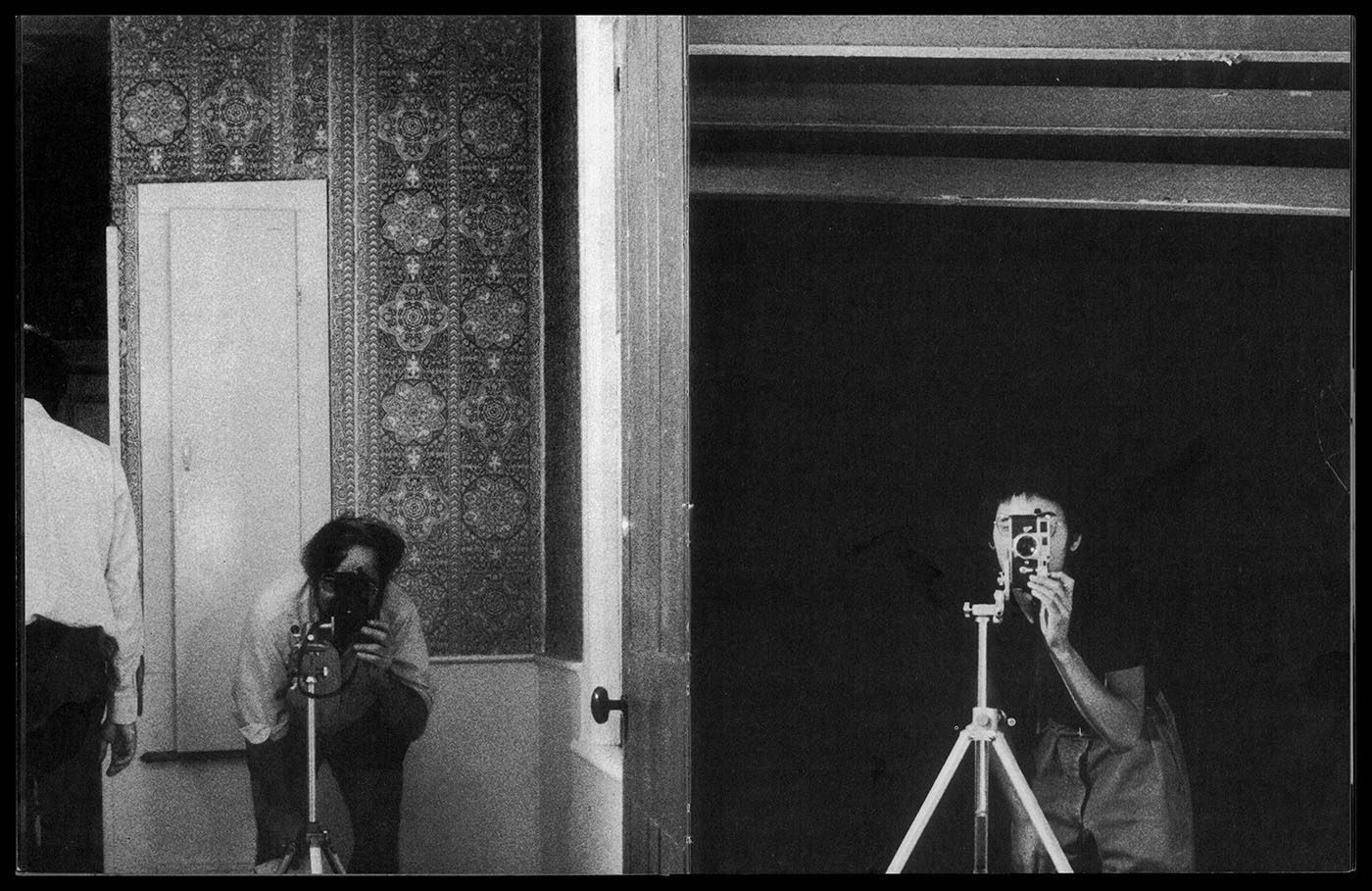
RIP Michael Snow. I’ve seen his Wavelength on film and disrespected it, watched a horrendous home video copy of La Region Centrale and loved it… had fun with Presents and *Corpus Callosum, Sshtoorrty and Cityscape. It’s not so easy for a mid-country dweller like myself to watch his works, but I assume I’ll be watching them (or trying to) for a long time. One thing I can access is his book… which reads very much like a movie, a split-screen tracking shot. It has fade-ups, for god’s sake. It’s not all continuous motion – there are scene changes using page-turn effects (pages held and rephotographed mid-turn, then printed on new pages). The book contains itself, like a movie about its own making.


Reprint publisher Primary Information:
Never bound by discipline, Snow has remarked that his sculptures were made by a musician, his films by a painter. Flipping through Cover to Cover, which is composed entirely of photographs in narrative sequence, one might describe it as a book made by a filmmaker. Snow himself has called the piece “a quasi-movie.” … an elegant, disorienting study in simultaneity that allows the viewer to enter the work from either end.
Martha Langford has a good write-up, and a whole free PDF book on Snow
Chris Fite-Wassilak in ArtReview on the book’s cinematic precedent, which I’ll probably never see:
Snow … made Cover to Cover as a book artwork in 1975, shortly after his film Two Sides to Every Story (1974), the product of two cameramen filming each other from opposite sides of a room, was completed. In the resulting two-part projection (each part projected onto opposite sides of the same aluminium sheet) we can choose to watch, from either of the camera’s perspectives, a woman walk between them and, at one point, spraypaint a green circle onto a piece of clear Perspex. The technique gives a materiality to the projected image, as if trapping it within the plates of a microscope slide ready for examination … Reading Cover to Cover is much like watching one of Snow’s films: visually quite mundane, where what happens isn’t as important as how it’s being shown to you, with a sustained focus that sits with a relatively simple idea for longer than you might think.

Among everything else, Snow was a jazz guy – a music enthusiast, pianist, recording artist. We see his hi-fi setup in Cover to Cover. I spent the day listening to his works available on UbuWeb…
“Short Wavelength” from 2 Radio Solos is a 1980 live DJ performance, Snow on the shortwave radio dial, tuning between different stations and statics. Snow claims no other sound manipulation, but he’s been known to lie on his album descriptions, and many of the sounds here have clearly been sped up (like reeeeal clearly). It tried my patience, then I stopped listening closely and got tied up in work, then it ended and I thought “hunh, it’s already over?”
“Conference: Subject: 3 Inches = 77 Milimeters = 3 Min. 30 Sec.” from Hearing Aid (2002) is three guys making mouth noises, commenting that three inches makes a difference, with synth coming in at the end, an avant-stand-up comedy-garde performance. This chaos continues in the “Interview” track that follows, interviewer Doina Popescu asking straight questions in German and getting pained groaning sounds in response. The 20-minute “Discussion” track might even be a proper discussion – postponing listening to the rest of that.
“Left Right” from Music For Piano, Whistling, Microphone and Tape Recorder (1975) sounds simply lo-fi at first, but what has he done with the microphone to make the piano sound like this? Excellent minimalist music to work to, then it gets hyper towards the end. Alan Licht calls it “pretty brutal”:
Snow alternating notes and chords in the bass and treble registers in a very repetitive stride piano pattern. The sound is intentionally distorted and a metronome and telephone are heard … many of Snow’s films are concerned with lateral movement (especially BACK AND FORTH and PRESENTS), which makes the title (and the use of a metronome-get it?) a pun on his own art.
“Falling Starts” also from the 1975 album… Licht again: “a tape of a piano melody first played back at hyperspeed, then slower and slower until it becomes recognisable before transforming into a thunderous, quivering bass boom.” This sounded like it would be good work music, and sure enough. I played the first half.
Sinoms (1989) – One voice at a time reads a list of Quebec mayors, like teachers taking roll. Ten minutes in, it starts getting playful, combining different voices speaking the same mayor name at once, then layering in different stereo patterns. The voices are English or French native speakers with some pronunciation hurdles. After a while in headphones it gives the pleasant feeling of working in a busy cafe surrounded by conversation, but without the distraction of following people’s conversations or phone calls. Ends abruptly.
Discogs says there’s a three-CD collection of piano works out there. Allmusic’s discography is incomplete and mixes him up with another Michael Snow, but bringing things back (and forth), they use a page from Cover to Cover as the artist photo.


