Another beautifully composed and assembled cavalcade of sweet sadness. I’d been over-adequately warned about all the sadness, so had to feel bad about myself afterwards for not feeling sad enough. Somehow I’d not been warned at all about the awful music – maybe it’s an acquired taste for over-loud choral arrangements – nor about the warm humor that weaves around all the sadness.

Casey Affleck (I know who he is now, thanks to The Assassination of Jesse James by the Coward Robert Ford) is Lee, who lives a life of lonely bar fights in self-imposed exile after accidentally killing his three kids in a fire years earlier (revealed gradually in flashback). His big brother Kyle Chandler dies of heart failure, leaving teenage Lucas Hedges (The Zero Theorem) to Casey, who acts properly responsible towards his beloved nephew, but also tries to rid himself of the responsibility as fast as possible and return to his basement-dwelling solitude.

All the actors are terribly, achingly good, each experiencing their own version of grief. Especially terrible is the scene where Casey’s ex Michelle Williams confronts him, and he responds with quietly stuttering denial. Reading this back it sounds like I don’t love the movie, but I mean “terrible” in a good way, and I hope all the attention it’s getting (best actor at the globes, six oscar nominations) makes up for Margaret‘s mistreatment.

Skipped the Golden Globes and watched this non-award-winning Rohmer movie instead. Rohmer’s lead characters aren’t always cool cats. In this case, kinda obsessive, immature Francois sees the ex of his girlfriend Anne (Marie Rivière, star of Autumn Tale) leaving her apartment, then runs into him again later and stalks him to the park. While inexpertly following this guy (Mathieu Carrière, a German who appeared in some Volker Schlöndorff movies and India Song) with another girl, clueless Francois runs into super-cute (too young) Lucie, who figures out what he’s up to and helps out as a laugh. Francois stays on the trail after they part, finds out the ex was just walking around with his sister, goes to meet his fellow spy but catches Lucie with her boyfriend and sends a postcard instead. So the title refers to the ex (a pilot), whose wife isn’t even in the movie.

Lucie:

“It is impossible to think about nothing.” The first of the six-film Comedies and Proverbs series. Pretty fun little adventure, but not sure that I got anything meaningful out of it, least of all an illustration of why it is impossible to think about nothing.

Ebert:

The story … reveals little of the texture of this film, which Is about how goofy, sad and driven we can be, especially when our hearts are fueled by self-made loneliness. There’s a lot of talk in this movie … There needs to be a lot of talk, because The Aviator’s Wife isn’t about actions but about reactions, speculations, false leads, hurtful suspicions and romantic insecurity. We need to live within these weaknesses for a time in order to understand them. … The ending, in which the hero chooses alienation over the simplicity of accepting happiness, is sad, and sadder still in that we immediately identify with it.

Francois and Anne:

Lead guy Philippe Marlaud had been in a Maurice Pialat film, died at 22 in a camping accident a few months after this opened, and the young Anne-Laure Meury would return in Rohmer’s Boyfriends and Girlfriends.

First-person movie with barely-seen narrator/protagonist. It’s kind of an essay film about revisiting the city where he grew up after being gone thirty years, noting the changes. But it’s also an interesting new thing – a noirish murder/mystery played out mostly in audio, with the visuals in the same style as the essay-documentary sections, almost as if the footage was shot and then the filmmakers belatedly decided to make a completely different kind of movie.

Guerra da Mata:

We do have several references, like from Josef von Sternberg’s film Macao … One of the first shots of our film is a travelling shot by boat, like in the beginning of the Sternberg film. We liked the idea of having documentary images introducing a plot that was actually shot in a Hollywood studio.

Rodrigues: “And we decided to do the opposite: inventing a plot mostly shot with documentary images.”

A couple of lipsync musical performances (one in the opening, presumably performed by noir-figure Candy, another in the middle by a canal boater) help tie the threads together. Unexpectedly, the noir story ends up involving a bird cage containing a Kiss Me Deadly-style glowing secret (it turns people into animals). So I followed the movie with pleasure, though after the fact I think I admire it more than love it.

Things I didn’t get because I don’t know my film history: Candy was performing Jane Russell’s song from the movie Macao in the introduction. This gets discussed in the film itself for us clueless types, as does some Macao history – it was occupied by the Portuguese for centuries then handed over to China in 1999.

Second appearance of Astro Boy today, after spotting him in Yi Yi. First movie I’ve seen by either of these Joãos, who also made To Die Like a Man and The Ornithologist together.

Great interview in Cinema Scope. They got funding for a Macao documentary then decided to make something else based on Guerra da Mata’s memories of living there, but they still only had the budget of a documentary.

Rodrigues:
“We wanted our film to be playful, and I think that this is a really wide range: Chris Marker, James Bond, film noir … sci-fi.”


Alvorada Vermelha / Red Dawn (2011)

I think the directors mentioned that making this short led to Macao, so I had the bright idea of watching them together. No spoken words, opens with a shot of a high-heeled shoe on the road, which could easily be from the other film (which also opens with a shoe close-up), and both movies share a glimpsed mermaid character… but for the most part, this is a documentary set inside a slaughterhouse where lots of fishes and chickens are killed and cut up, thus it’s kinda no fun to watch.

I missed the evening show of Manchester by the Sea because I misremembered the start time and got caught up watching Black Mirror episodes. But I still wanted to get bummed out watching a long Casey Affleck movie, so fortunately I had The Assassination of Jesse James by the Coward Robert Ford handy. I don’t remember Casey from the Oceans trilogy or Interstellar, so this served as a reintroduction before Manchester, and both turned out to be stunner movies with great lead performances. If anyone is working on a Timothy Carey biopic, I nominate Casey as lead.

I’ve seen this story before, in Sam Fuller’s I Shot Jesse James, in which The Coward Robert Ford shoots his hero/boss Jesse in the back, then lives the rest of his short life as a famous outlaw-killer, reenacting his crime onstage. This movie fleshes out the gang much more, showing a Robert as a starstruck, excitable kid, the runt of the Fords, and Jesse as paranoid and dangerous.

After one last train robbery, the gang lays low. Jesse has a family with wife Mary-Louise Parker, lives in a forest house near Kansas City under a fake name, never got caught. Ol’ Frank James (Sam Shepard) and Charley (Sam Rockwell) make the weasely, weak-sounding Robert feel bad about his Jesse James hero-worship, but Jesse recruits Robert when the rest of his gang starts falling away and he gets nervous that someone will sell him out for reward money, visits old friend Garret Dillahunt and kills him. Meanwhile, Paul Schneider and Jeremy Renner are none too bright, compete for the attention of a teen girl, eventually have a huge falling out and Bob kills Renner and calls the cops on Schneider. Late appearance by James Carville as the governor, Nick Cave as a troubadour and Zooey “She” Deschanel.

Casey and Carville have a psychic battle:

Dominik and DP Roger Deakins don’t overdo the stylistic quirks, allowing the story and actors to do their thing against gorgeous landscapes, but the movie’s got its share of flair – shots with edges blurred like old-timey photographs, an occasional omniscient narrator.

Casey of the Clouds:

A. Cook:

On one side it mythologizes the transitionary period of American history via the fable-building narration and dreamy photography, and on the other it slowly and methodically demystifies the characters that populate it and the falsehood of celebrity. It is this contradiction that is perhaps the most fascinating aspect of the film and mirrors the inner-conflict of Robert Ford and his complex relationship with Jesse James.

Kind of Maddin’s most difficult film and his most purely comic one at the same time. Behind the scenes on the filming of great Canadian war epic Hyena Road, Guy reflects on being an extra (dead body in the desert) and subverts his other job as EPK flunky, while the effects-minded Johnsons toy and screw with the footage. I happened to watch Cuadecuc Vampir a few days earlier, one of this film’s most obvious predecessors.

N. Rapold in Film Comment:

The closest these flagrantly uninformative digressions come to a standard featurette is a couple of outtakes of a producer doing a walk-and-talk TV-ad bumper. While earning Maddin some needed cash, this supposed promotional project burlesques the look of a seamless studio-grade war movie — and its very notion. It’s like any number of subversive reappropriations of mainstream genre cinema, except with the added nose-thumbing of having been done with full permission, during the production. But if Maddin expresses some frustration or resentment about Gross’s comparatively big-budget illusionism, he also can’t help but see the playful, bizarre, and beautiful possibilities in these expensive toys.

Denzel goes all-in on his performance of an oversized, talkative, opinionated garbage collector and family man who speaks mainly in baseball metaphors. I wondered near the beginning why his wife Viola Davis, who barely gets a word in, was getting awards talk for this. Then after Denzel grabs a couple of major personal victories – demanding and winning a promotion from his employer, and succeeding in crushing his son’s dreams of playing football – he reveals that he’s gotten another woman pregnant. And after that woman dies in childbirth, the long-suffering Viola steps up. “This child got a mother, but you a womanless man.” So for the second time in a row (Blackhat: “Am I being tangible… Gary?”) Viola has the year’s best line delivery.

The movie retains most of the cast from a recent stage production – and you can tell it’s based on a stage production. M. D’Angelo explains better than I can:

Really hammers home the fundamental difference between theater and cinema, showing that the difficulty in translation is more than just a matter of “staginess.” Washington uses the camera expressively, in an appropriately subdued way; every shot and cut has been carefully thought out, accentuating the performances while giving full weight to the environment surrounding them … Formally, this is very much a film. Nonetheless, it still feels like a play, because Wilson’s magnificent, musical dialogue is expressly designed for that particular medium.

Denzel’s best friend since his prison days (long story) and his trashman coworker until Denzel’s promotion leaves him behind is Stephen Henderson (a church guy in Red Hook Summer). Denzel and Viola’s high-school son is Jovan Adepo (The Leftovers) and Denzel’s older son, a jazz musician, is Russell Hornsby (Grimm and Eater). His highly symbolic trumpeter brother Gabriel with a plate in his head from WWII is Mykelti Williamson (Don King in Ali). Set in the mid-1950’s with an early 60’s postscript after the shell-of-his-former-self Denzel has passed away and the family reunites for his funeral.

I appreciate Ehrlich’s continuation of the baseball metaphors: “If Fences doesn’t quite knock it out of the park, it’s still a clutch double at a time when black stories are struggling to even get on base.”

Troy is at once both a disposable member of the underclass and a category five hurricane of humanity. His only way of reconciling those two wildly different feelings is to transmute his deficiencies and regrets into the stuff of myth — he might be the picture of the American everyman, but he’s also locked in a duel with Death, itself.

I’m finally getting to this, Demy’s feature follow-up to Lola, still in his talky black-and-white period before exploding into song and color the following year. The story of an easily led young man (Claude Mann of Army of Shadows and India Song) who gets hooked on gambling by his friend (Paul Guers) then spends a week in Monaco with excitingly self-destructive career gambler Jeanne Moreau.

“If I loved money I wouldn’t squander it. What I love about gambling is this idiotic life of luxury and poverty. And also the mystery – the mystery of numbers and chance.”

Moreau is a sympathetic outcast – not just a single mom, but one who has abandoned her family for her own freedom, something unimaginable at the time. Claude isn’t so sure about the lifestyle, is inclined to hoard his winnings and wants to get back to normal life eventually, but he immediately falls for Moreau enough to forgive her recklessness and infidelity. She disappears more than once – they do end up together in the final shot, but who knows after that.

T. Rafferty:

Bay of Angels takes place, as Demy’s movies always do, in a kind of Wonderland, where the rules of ordinary life seem to have been suspended for a while. (And like Lola, The Umbrellas of Cherbourg, and 1967’s The Young Girls of Rochefort, the setting is near water, in port towns, where everything feels provisional, a stop on the way to somewhere else) … The gambling scenes are montages cut to a quick tempo, using mostly dissolves, and pass by in a dreamlike blur, the wheel turning, the players betting and watching, the croupiers brisk and impassive. In every other scene, the takes are long and fluid, without many cuts — they have a wandering, leisurely rhythm. The alternation of styles gives the movie a tension that has nothing to do with conventional suspense. In Bay of Angels, as in no other movie about gambling, whether the players win or lose feels fundamentally irrelevant. The experience is all that matters.

Hard to believe I haven’t seen a new Kiyoshi Kurosawa movie since the great Tokyo Sonata. Starting to catch up, but I hope that’s worth doing. I enjoy a slow-boil movie, but this one just kinda stayed lukewarm. Interesting stylistic choices for a 2013 ghost movie – from a director who has sometimes over-relied on horrid digital effects, this uses none. Ghosts appear as regular people, no indications of who is living or dead, and their appearances or other otherworldly happenings are signaled by slow lighting changes.

Lonely piano teacher Mizuki (Eri Fukatsu of Atlanta Boogie) is visited by her long-missing husband Yûsuke (Tadanobu Asano of Bright Future and Last Life in the Universe) who explains that he drowned at sea three years ago. He says it was a long trip back to her, and people helped him along the way, and he’d like them to revisit those people together.

At Shimakage’s house, pre-collapse:

Yûsuke in teacher mode:

First is Mr. Shimakage, who is dead and does not realize this. Yûsuke’s visit with Mizuki brings back memories of his wife, which allow him to let go and disappear, his house becoming decrepit overnight. Next, the Jinnai family, who are alive but have a sad ghostly relative psychically tied to their piano. Then Mizuki meets Tomoko, with whom Yûsuke was having an affair while alive. Then at a village where Yûsuke had been a teacher, Mizuki briefly meets her dead father, and their host Kaoru briefly meets her dead husband (who was flown in from a darker, more interesting movie).

Mizuki and the Dead Father:

I’m pleased that a shy Japanese piano teacher would listen to Sonic Youth:

M. D’Angelo:

I’d planned to write at least a few words about Kiyoshi Kurosawa’s almost surreally boring Journey to the Shore, which multiple critics here have dubbed Journey to the Snore. Trouble is, just thinking about the film makes me nod off, making it difficult to formulate any thoughts.

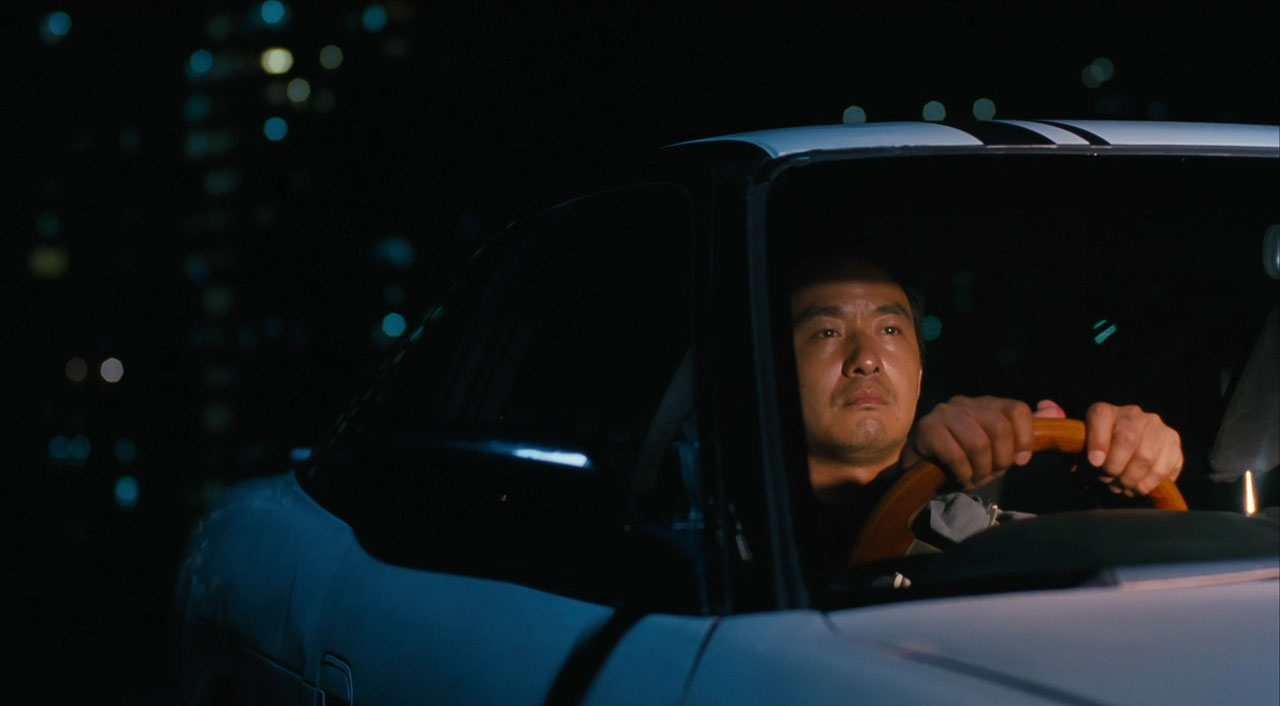
I probably say this about every Resnais film, but this has got to be the most wonderful Resnais film. One of his late-period intersecting-lives ensemble pieces, it’s a tribute to Dennis Potter, so the characters lipsync classic pop songs – but despite the fun tunes it’s ultimately a downbeat drama about depression.

Written by two of its lead actors: Jean-Pierre Bacri (balding Nicolas, back in Paris after years away and looking for the perfect apartment) and Agnès Jaoui (Camille, a tour guide who reminds me of Anna Kendrick).

Resnais faves Sabine Azéma (Camille’s sister Odile) and Pierre Arditi play husband and wife – though he’s cheating, and is trying to tell her that he’s leaving.

Odile with her husband:

Odile with her sister:

André Dussollier is a realtor showing flats to Nicolas, stalking Camille on her city tours, and working for Marc (Lambert Wilson), who begins dating André’s beloved Camille while showing larger flats to her and Odile.

Camille and Marc:

Camille and André:

Ultimately at least Camille, Nicolas, André and Pierre are somewhere between generally unhappy and clinically depressed. Odile buys a place from Marc and at the housewarming party Arditi plans to walk out (after closing on a new house?) and André turns on his boss.

When things start to go bad at the party, sea creatures appear over the picture:

Favorite tunes included Marc’s confident women-chasing theme song “J’aime Les Filles” by Jacques Dutronc and Nicolas’s whiny hypochondriac theme song “Je ne suis pas bien portant” by Gaston Ouvrard.

A hit in France, it won seven César awards, though Resnais lost the director award to Luc Besson of all the damn things. Played in Berlin with Jackie Brown and The Big Lebowski.

Nicolas with his estranged wife Jane Birkin:

Marc all alone:

Resnais in the NY Times:

Potter was extremely pessimistic. His are films of a man who has suffered a great deal, who creates characters who are paranoid. The songs are in total contrast with the situations in the film. We tried to have the song always come from inside the head of the character, to reflect the moment.