Inspired by Douglas Sirk movies, and inspiration of the song “Frontier Psychiatrist”. An extreme example of the normal person pushed-to-the-brink genre, and starring Divine (not even a normal person). Everything that can possibly go wrong does so all at once – she turns to alcohol as her pornographer husband leaves, daughter is pregnant by her delinquent boyfriend (Stiv Bators of The Dead Boys, writer of Sonic Reducer), son is a foot-fetishist sex criminal, and the family is being protested by the neighbors. Divine’s still got her friend Cuddles, her former housekeeper who recently inherited great wealth, and starts to recover in the company a sexy stranger (Tab Hunter of Track of the Cat) – but it turns out he’s actually dating Divine’s mom, and the romance was a plot to get money. After all this pain (even if it’s over-the-top comedy-pain), Waters allows some lightness (even if it’s murdery lightness). The son is reformed, the delinquent is killed, Cuddles’s chauffeur/fiancee Heinz runs down the mom and Tab, and all (who remain) live happily.

Divine’s superpower is her keen sense of smell, hence the Odorama cards (which we didn’t get, alas). The Ross played it off an average-quality DVD, but it’s a good movie to watch with a crowd. My head exploded when the movie had a profitable highbrow drive-theater showing a Marguerite Duras triple-feature. It also featured the same tasteless lawn jockey that my landlords have. Department of Redundancy Department: an imdb user calls it a “mainstream overground non-underground movie.”

Felt like a good time to watch this since I’d recently seen Purple Noon, and The American Friend is more or less a sequel. I don’t know how things worked in the book series, but besides some art forgery at the beginning, I’d easily believe that they’re unrelated and Dennis Hopper’s character just happens to be named Tom Ripley.

Movie connection #2: Joe vs. the Volcano. Bruno Ganz, who’s the real star of the film over Ripley/Hopper, is sick and short on money, but it turns out his doctor is exaggerating Bruno’s health problems so he’ll be desperate enough to accept a mission as assassin. This despite the fact that Bruno works in a frame shop and is not normally a killer (naturally, the working title was Framed).

Bruno, making it literal:

Movie connection #3: Barton Fink. Bruno takes an instant dislike to Hopper at a (fraudulent) art auction at the beginning, refuses to shake his hand. At the end, Hopper confesses this is why Hopper put Bruno through it all, the doomed medical prognosis and three murders.

Movie connection #4: Rushmore, via the Kinks song “Nothing In This World Can Stop Me Worryin’ ’bout That Girl”.

Cool movie, with real suspense to the spy/murder proceedings, and a visual theme of magic lanterns and other illusions. Terrific lighting, color and cinematography (by Robby Müller, natch), as far as I could tell on my DVD copy. And of course it features both Nicholas Ray (as Hopper’s painter of fakes) and Samuel Fuller (as head target “The American”, eventually thrown down stone stairs).

Ray:

Fuller:

Hopper:

Can’t say I fully understood Ripley’s involvement in the whole plot, nor why Bruno has to die at the end (Wenders loves when everyone dies at the end). Ebert says it’s not important. Dave Kehr says that’s the whole idea: “The plot, laid out baldly, gives only a thin impression of the film itself. For one thing, Wenders has systematically eliminated most of the purely expository scenes (purposefully, after shooting them). … We already know the story, having seen its variations in a hundred films.”

Film Quarterly says it cost more than Wenders’s previous five films combined. Won best editing and direction in Germany and played at Cannes along with 3 Women, The Duellists and Padre Padrone.

Hopper’s follow-up to Apocalypse Now, which wouldn’t be released for two more years. Bruno was between The Marquise of O and Nosferatu. As his wife: Lisa Kreuzer of Radio On and Alice in the Cities. Gerard Blain (star of Chabrol’s Les Cousins and Le Beau Serge) is the guy who gives Bruno his assignment, and Lou Castel (star of Fists in the Pocket and Beware of a Holy Whore) is his driver/overseer. Semi-remade a couple times, once with Malkovich as Ripley and once with Barry Pepper.

It has been a while since I watched some Orson Welles.
And hey, the voices are in sync, so we’re off to an unusually good start.

“Give me the spare men and spare me the great ones.”

While King Gielgud is off ruling the country, his son Prince Hal fucks around, drinking and robbing and having fun with his low-life friends including Falstaff, an overweight self-obsessed clown played by Welles. Falstaff was apparently a running secondary character in three overlong Shakespeare plays, here stitched together to make him the main player, the royalty drama becoming the background story. A good Welles movie, with fun editing, grotesque close-ups and nice compositions.

I’m not too good with the timelines of English kings, but this is the early 1400’s, Henry IV (Gielgud) having recently killed Richard II. Of course the true heir Mortimer has been locked up somewhere else, as is always the case (at least in Shakespeare), and his friends plot the current king’s overthrow. Hal returns to his dad the king and joins in a victorious fight against the Mortimerists (not their real name), personally killing their leader, which cowardly braggart Falstaff attempts to take credit for.

Falstaff thinks this is all in fun, that his group will be friends forever, and when Henry dies and Hal becomes King Henry V, Falstaff is overjoyed, thinking he’ll become rich beyond belief, but instead is banished from the court by the newly serious Hal, returning home to die (offscreen) of grief. I was amazed that Welles wouldn’t give himself a big, talky death scene, but I suppose he wasn’t adding new dialogue to the Shakespeare.

King Gielgud:

King Falstaff:

King Hal:

Ebert says the battle scene is “edited quickly, to give a sense of confusion and violence — providing an ironic backdrop for the frightened Falstaff himself, running from tree to tree to hide from the combatants” in the comically large and round armor Welles has made for himself. Being a Shakespeare drama about kings and thieves, there’s not much screen time for women, but Margaret Rutherford (Blithe Spirit) runs the pub/inn and Jeanne Moreau (just after Diary of a Chambermaid) plays a friend/prostitute. This played at Cannes alongside Dr. Zhivago, The Nun, The Round-Up and Seconds.

W. Johnson in Film Quarterly:

The vastness of the film’s spaces serve to deepen the sense of nostalgia. The tavern, for example, is enlarged beyond probability in much the same way that a childhood haunt is enlarged in one’s memory: this is how Falstaff, the perpetual child, would remember it. Similarly, the wide horizons of the film’s outdoor scenes (actually shot in Spain) evoke the spacious, innocent Olde Englande that Falstaff imagined he lived in. Naturalistic settings would have called attention to the costumes, the archaic language, the theatrical structure of the scenes, everything except what’s really important – the characters and their changing world. Welles’s exaggerations give the film its human perspective.

As portrayed by Shakespeare, Falstaff is not only lazy, gluttonous, cowardly, lecherous, dishonest and the rest but also a great innocent. He is devoid of malice or calculation; no matter what is done to him, he remains open and trusting. He lives in a dream world where there are no politicians or policemen or pedagogues; and when Hal destroys that world by rejecting him, he does not adjust to reality but dies.


The Fountain of Youth (1958)

Welles himself calls it “a wacky little romance” in his intro, which seems both accurate and too humble. It’s a jokey little story with a predictable twist ending, but the way its told and shown is thrilling.

Glamorous actress Joi Lansing marries scientist Dan Tobin “the gland man,” but leaves him for tennis champ Rick Jason. The gland man has his revenge, claims to have discovered a 200-year youth serum, gives them a single dose and lets them fight over it.

Orson interrupts the action and talks over it, blocking the picture with his body and voicing the characters himself. Instead of editing he’ll use sudden lighting changes. It’s all a charming trick.

Rosenbaum calls it the only completed film besides Citizen Kane “over which Welles had final and complete artistic control” which “even begin to qualify as Hollywood products,” as opposed to his independent works.

Since so little has been said about this cool little movie, I’m going to overquote from an article in his book on Welles:

In The Fountain of Youth, Welles’s first television pilot – an adaptation of John Collier’s short story Youth From Vienna that begins as an essay on the subject of narcissism – the dialectic is given a new pattern. For once, the narrating Welles persona is intermittently visible as well as audible; he begins the show, in effect, as a slide show lecturer, and reappears periodically to remind us of his privileged position. … By speaking for the characters as well as about them – literally lip-synching Joi Lansing, Dan Tobin, and Rick Jason, his three stars, at certain junctures to mock their roles as puppets – his moral fallibility (that is to say, his narcissism) becomes identified with theirs, and the implicit nastiness of Welles’s amused, glacial detachment consciously boomerangs.


Too Much Johnson (1938)

JR: “The only copy of the film was lost in a fire .. in August 1970.”

Apparently not! I watched Scott Simmon’s new 34-minute edit. Three sections, to be screened between acts at a Mercury Theater play. Mostly they are goofy chase scenes. In the first (and longest), mustache villain Edgar Barrier (Journey Into Fear, Macbeth) chases Joseph Cotten (The Third Man / Ambersons / Kane star) across city rooftops over a girl. In the second, they board a ship bound for Cuba, continuing the chase, and in the third they’re both chased around the island by Howard Smith. It probably would’ve worked better in context.

Simmon:

It feels to me as if Welles and the Mercury theater were working toward some reenactment of a history of American film up to that point: Silent film comedy interspersed with 1930s screwball stage dialogue. In any case, the revised play, in its tightest last revision, has a spirit far from the Gillette original — with rapid-fire exchanges in place of relatively longer speeches.

Writer-director’s follow-up to Once, looks shinier and has movie stars (Keira Knightley and Mark Ruffalo) instead of musicians. Watched out of morbid interest. Not entirely bad, though I wasn’t feeling the magic.

Keira K is a fresh new singer, dumped by her rock star boyfriend after he got famous. She sings a blandly pleasant tune at open-mic where formerly powerful label exec Ruffalo is having a Very Bad Day. He hears her and it turns his pointless life around, as he dedicates himself to finding blandly pleasant arrangements for her songs to record “guerrilla-style” around the city with help from Cee-Lo Green’s backing band and Ruffalo’s estranged daughter on electric guitar.

With Mos Def as Ruffalo’s business partner, Catherine Keener as his ex-wife and Hailee True Grit Steinfeld as his guitar-rockin’ daughter.

Watched a couple new Marker-related shorts,
and rewatched some older ones in shiny new copies.


Sunday in Peking (1956) in lovely high definition


Letter from Siberia (1957)

Forgot how amazing this one is.
Songs and animation and opera, owl-led advertisements and imaginary newsreels.

“Since you can never tell how a bear will react to a camera, we were offered the protection of an armed policeman. But since we’re much more frightened of policemen than we are of bears, we politely declined.”

The Irkutsk Dam, “sitting on its own reflection like a station in outer space”:


Le Chant du Styrene (1958, Alain Resnais)

Mostly shots of the factory, with few humans.
Forgot about the rhyming voiceover.


Broadway By Light (1958, William Klein)

From Marker’s intro: “Each evening, in the centre of New York, an artificial day rises. Its purpose is to announce spectacles, sell products, and the producers of these adverts would be amazed to know that the most fascinating spectacle, the most precious product made by them, is the very street transformed by their signs.” Klein shoots the lights of Broadway, scored by cartoon-jazz music that matches the editing and light movement. Wonderful, would like to put this and some Joris Ivens and Bert Haanstra shorts on an infinite loop in my office. Klein’s first film (I only knew his Mr. Freedom before), edited by Alain Resnais.


A Valparaiso (1963, Joris Ivens) from the 2008 restoration


Junkopia (1981)

Uses the sort of electronically-processed sound he’d be featuring in his next full-length film, Sans Soleil.


Eclipse (1999)

On a day when everyone is looking at a solar eclipse through special glasses, Marker watches the watchers instead. First half has live sound at a hippo sculpture park, then he switches to slow motion and electronic music and goes elsewhere (the zoo? there are owls).


Description of a Memory (2007, Dan Geva)

I didn’t rewatch my terrible-quality copy of Marker’s Description of a Struggle, but instead tried this doc, the second feature-length film I’ve seen this year made in response to a Chris Marker-related film. Geva shows the Marker film and stills to locals, asks about the people who appeared in the original. Reminds me of Marker’s friend Agnes Varda, her periodic returns to previous films through documentaries and shorts and DVD extras. Geva is investigating images and memories a la Marker and Varda, turning out a worthy follow-up to the original feature.

Of the happy kid riding a cart down a hilly street: “British policeman bashed his head with an iron rod. Gone a bit mad since.

“Noah Rosenfeld, who fulfilled his dream to become a chess champion.”


More Marker:
Far From Vietnam is out in HD. The Confession is also out, and includes the Arthur London short. Mémoires pour Simone still lacks subtitles, as do most of the 1969-1970 shorts. Oh, and it looks like new copies of Description of a Struggle and Blue Helmet just came out – will save those for another day.

Arthouse crapola.

And I don’t say that lightly. I didn’t much enjoy Serra’s Cervantes movie Honor de Cavelleria, so wouldn’t have high hopes for his Casanova-meets-Dracula movie either, except that it made the cover of Cinema Scope issue 56 and ever since Profit Motive, a CS cover recommendation is sacred to me.

Did Casanova even meet Dracula? I don’t know for sure, because either the movie or my video copy of it (possibly the same thing, since Serra shot Honor de Cavelleria on DV) was too dim and low-res to make out most details. But surely Casanova was a character in the movie – and it’s a good thing I read his Wikipedia before watching this or I would’ve got even less out of the movie. He published a book about his escape from prison (Story of My Flight) and an epic posthumous autobiography (Story of My Life), so that’s where this movie’s title comes from, though as far as I can tell he doesn’t die in it. Dracula may be a character in the movie (the Dracula novel was written a hundred years after Casanova’s death, but Dracula is immortal so I’ll forgive this). He isn’t named, but he bites a woman’s neck, and there’s a bunch of neck biting in the last half hour, either killing or vampiring the three women and/or Casanova’s friend Sancho Panza.

I think Serra is a historian and philosophy scholar and that’s fine but I don’t get his point. The most notable scenes feature Casanova shitting (then wiping himself, sniffing his hand and eating a biscuit) and having sad sex with some girl right before a window breaks. This beat Short Term 12 and Our Sunhi and When Evening Falls on Bucharest and Exhibition and What Now? Remind Me and The Strange Color of Your Body’s Tears for the top prize at Lav Diaz-led Locarno. Fellini’s Casanova is probably not very similar, but I should watch it soon since I’ve read the whole wikipedia article on the real Casanova in prep for this thing. Peranson mentions “over 440 hours of material,” gah!

Slant describes further:

Split into relatively discrete halves, each possessing its own distinct style, it slips from a bawdy, jovial tale of rumpled courtesans and layabout poets to one fixated fully on doom, immured in shadow-clogged compositions within the ancient, chilly darkness of the Carpathians. .. Positioning each [Casanova/Dracula] as the standard bearer for a specific philosophy, the film functions on a macro level as classical allegory, animating the late-18th-century shift from the rational to the romantic.

Serra, from the Cinema Scope cover story that convinced me to watch this:

Where do the characters find the actual satisfaction for their desire? In the mundane side, in the light side of Casanova, or in the more dark side of Dracula? And in the end it looks like Dracula wins, and people feel more pleasure in the pain, or in the guilty things, and perhaps the film is ultimately about the dark side of our lives. I wanted to make a film about the night, and what happens in the night, when real desires appear.

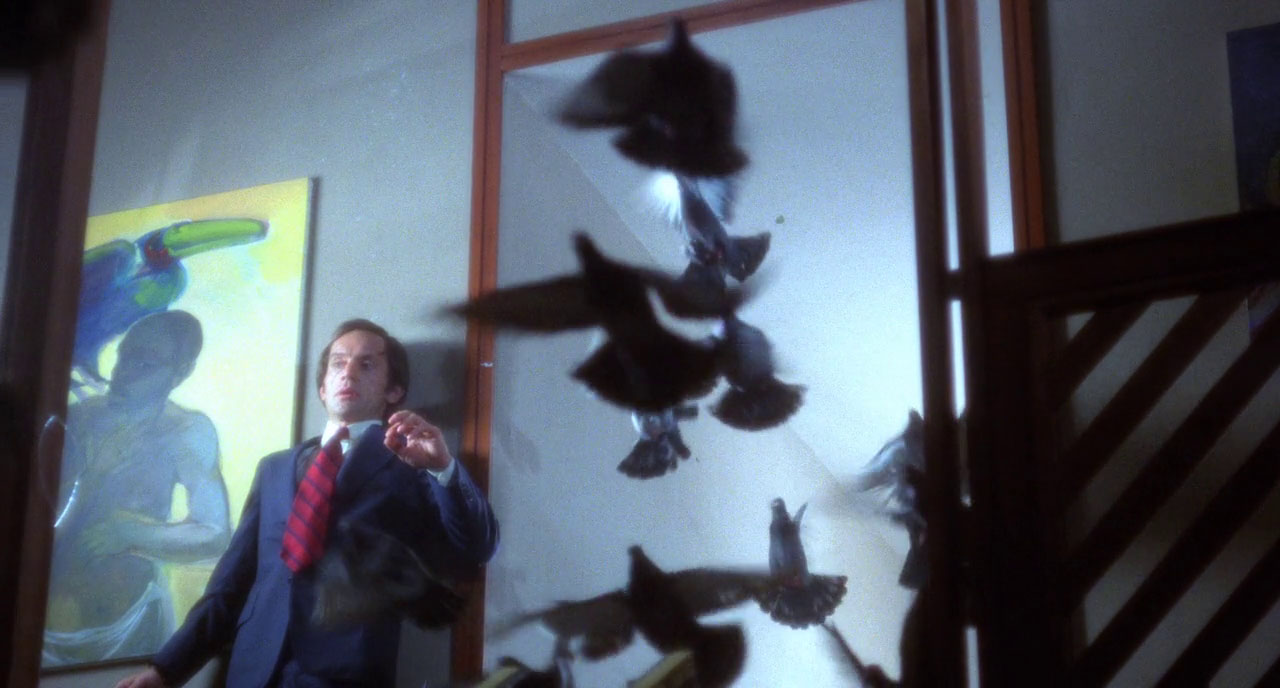
I live-rifftraxed the screening to my audience of birds. Possibly my copy WAS too dark, making the difference between “glamorously underlit” and “woefully underlit,” but that shouldn’t account for how little I enjoyed the movie compared to the rave critical reviews. At least Cahiers called it “as pretentious as it is insignificant,” and claims “Serra filmed in 1:33 and then reframed it in Scope – result, it’s ugly.”

N. Pinkerton’s review was the most fun to read:

As for the Casanova Meets Dracula setup, it’s something from the Jesús Franco reject pile, though Franco had more of an eye for peasant pulchritude, a better connection for castle rentals, and could do dreamy without drifting into the cataleptic. The movie begs comparisons, practically all of them disparaging – and Serra doesn’t help matters by likening himself in interviews to Pasolini.

Serra:

In the art world you have more freedom, and you can do whatever you want … because there nobody knows anything and there is a great amount of confusion there as to what is good or bad, or what is important or not, so I realized that I feel at home there.

Simao loves neighbor Teresa and Teresa loves Simao, cousin Balthasar also loves Teresa, servant Mariana loves Simao, Joao loves his daughter Mariana, and all these loves are doomed, doomed, doomed. Simao and Teresa’s families hate each other, Simao kills Balthasar and is sentenced to prison, old enemies of Joao kill him, and finally Teresa wastes away in a convent, Simao dies on a prison ship and Mariana jumps into the ocean during his sea burial.

Teresa:

So it’s quite unhappy, and reminiscent of Mysteries of Lisbon since they’re by the same author, but also an idiosyncratic movie, with different stylistic tics than the Ruiz. Some notes I took:

– Mirror dissolve to scene of mythology
– Lots of mirrors
– Narrator, rushing through backstory
– Tadeu stomps around yelling insults but all we hear are his footsteps
– Night scenes are just a black screen with subtitles
– Letters are filmed, narrated in their entirety, or their writer will recite into camera
– Flatly delivered dialogue
– Sometimes narrator tells us what would easily have been shown
– Actors stand by patiently waiting for the narrator to finish, like in a Peter Watkins movie.
– Narrator describes Simao killing Balthasar right before it happens

Simao kills Balthasar:

Set in the early 1800’s. Each episode opens with Simao’s younger sister Rita summarizing the previous episode into camera. There are other characters and events – Simao’s brother Manuel, who runs off to Spain with a married woman, and Simao’s mom, a former queen’s lady who misses the splendor of her old life and pulls strings to get her condemned son preferential treatment, and Joao, who gleefully murders Balthasar’s men in order to help Simao – but these are secondary to the whole doomed-love thing.

I used to think of convents as good places before this and Mysteries of Lisbon, The Devils, Mother Joan of the Angels, The Nun, Les Anges du peche, Don’t Touch The Axe, Black Narcissus, and so on. There’s little religion in the convent where Teresa is committed by her family – she’s immediately told not to trust the mother superior, and all the nuns run around gossiping about each other.

There have been at least eight film adaptations of Doomed Love, plus there’s a mysterious 2006-07 series on IMDB with Branco as writer, listing all the Doomed Love characters as well as Father Dinis, Angela and Eugenia from Mysteries of Lisbon – a Branco Universe crossover?

Mariana with Simao:

J. Rosenbaum called it “The Masterpiece You Missed” in his review, reprinted in his collection Placing Movies, which I read at the beach thirteen years ago and I’ve been seeking this movie out ever since. I’m still seeking it… hopefully a better copy surfaces on video someday. I think there are different versions, and I saw the television (color) miniseries. The great Oliveira died between my watching this and finally writing it up, but I’ve got about forty more of his films to watch, so his art lives on.

Rosenbaum:

Intricate dovetailings of narration and dialogue produce some elegant displacements and overlaps in and on the sound track. When the heroine’s father shouts at her in close-up, the sound of his voice ceases at the precise moment that the male narrator announces that the (off-screen) daughter doesn’t hear him because she’s left the room. Much later, the imprisoned hero responds in person to the narrator’s off-screen report of Mariana’s blacksmith father’s announcement (visible but not heard) that his daughter is delirious — a scene much easier to follow than to describe.

Watching this classically wrought example of controlled madness for 270 minutes … I was reminded once again of the battles between narrative and nonnarrative cinema that used to be waged in this room. (Today the battles are over, the warring tribes shipped off to separate schools or summer camps, and a mongrel like Doomed Love, doomed by its own integrity, has to walk the night without the sponsorship of either ghetto.)

Duarte de Almeida of City of Pirates and Past and Present as the ship captain:

P. Cunha in Senses of Cinema:

In Portugal, the film’s critical reception was very hostile. It was also devastating for its director, who was accused of wantonly producing the most expensive Portuguese film made with public subsidy at a time of serious financial crisis. Oliveira was also criticised for moving away from the naturalistic language mandated by television, undermining the legacy of author Camilo Castelo Branco, and not being concerned with the reality of the class struggle Portuguese society was undergoing in the aftermath of the socialist revolution. The debate about Oliveira’s work was so intense that it was even discussed in the national Parliament and inflamed arguments about public financial support for Portuguese cinema.

Doomed Love belongs – along with [Past and Present, Benilde and Francisca] – to the “tetralogy of frustrated loves”, a series of four films that are adaptations of works by some of Oliveira’s favourite literary authors (Vicente Sanches, José Régio, Camilo Castelo Branco and Agustina Bessa-Luís).

A Generation was a pessimistic film about the young resistance movement during WWII nazi occupation and Kanal was an extraordinarily pessimistic film about the near-total destruction of the resistance movement at the depths of WWII nazi occupation. Naturally this third film is a completely pessimistic film about the remnants of the resistance movement at the very end of WWII when the soviets were taking over. Wajda has become less sympathetic to the resistance fighters as the films have progressed, from the idealistic, lovestruck youth of A Generation to the murderous Maciek here, a sunglasses-sporting hit man, who will finally kill his intended target after destroying a few innocent lives.

Maciek (Zbigniew Cybulski, the Polish James Dean in the aftermath of this film, later star of The Saragossa Manuscript) takes orders from his more serious friend Andrzej, who works for the bald Major, who works for some vague remaining idea of the resistance army. Maciek, then, is far removed from any real authority, feels more like a freelance gangster than one of the desperate young soldiers of the previous films. Further complicating the alliances, Maciek’s Russian target shows up at his sister-in-law’s house where the Major is plotting to kill him in the next room. The movie goes out of its way to humanize the Russian – and to give Maciek a way out, as he meets a girl named Krystyna and contemplates leaving the dying resistance behind. Eventually Maciek does get his man, and is immediately hunted down and shot, dying like a dog in the street.

Andrzej, at right, mistakenly reporting mission success after killing the wrong guys, as their intended target strolls in at center of frame:

Krystyna with Maciek:

Set on the last day of WWII. Sam Fuller was also interested in what happens on the final day of a war: see Run of the Arrow and The Big Red One. There’s more humor and fun in this one than the others, despite the grim subject matter. Played in Venice along with fellow war-resistance film Il General Della Rovere, also The Magician, Night Train, Some Like It Hot and Come Back, Africa.

D. Gerould:

Until 1958, it had been impossible for a Polish artist like Wajda to make a film in which an opponent of the new society was presented as a tragic victim. The Stalinist period in Poland from1949 to1953 had brought open terror, arrest and torture of members of the Home Army, as well as enforcement of Soviet cultural models. The Thaw in 1956 resulted in a more independent Polish Communist regime. Finally the arts, liberated from Soviet-imposed socialist realism, were allowed to return to the Polish tradition of poetic metaphor and political allusion. During long years of dismemberment and foreign occupation, literature and drama in Poland had always kept alive belief in the nation’s revival. In Ashes and Diamonds, Wajda continues this tradition, posing the question of Poland’s postwar identity.

I’ve avoided Pasolini because I began with Salo and have never been a huge fan of Italian cinema in general. But explorations of Fellini and Rossellini have lately got me looking at the artistry beyond the sound sync problems, so fourteen years after cringing through his nazi shit-eating movie, and in the wake of Ferrara’s new film about him, it seemed time to give ol’ Pasolini another chance.

A factory owner has just transferred ownership to the workers, who are being interviewed by the media. This is a fantasy dear to the hearts of leftist French filmmakers like Godard and Marker, and I was worried it’d get all Tout va bien, but then we flash back a few months to the factory owner’s home with his wife, daughter, son and maid, beginning with a wordless b/w intro section. The magnetic Terence Stamp (same year as Toby Dammit) comes to stay with them, soon sleeps with everyone in the household, then abruptly leaves.

Stamp:

Family portrait:

The first half of the film is a long seduction (sometimes the action stops entirely, the Ennio Morricone music keeping the film alive), then in the second half each person deals with Stamp’s disappearance. Most spectacular is the maid, Laura Betti (the domineering Brunelda in Class Relations, also of 1900 and Pasolini’s Canterbury Tales), who barely speaks a few words in the movie. She leaves the house and returns to her home village, where she sits quietly in the courtyard, eating only boiled weeds and performing miracles. The rest of the family behaves in more normal (or at least movie-normal) ways: mother Silvana Mangano (of a bunch of movies set in ancient times: Oedipus Rex, Barabbas, Ulysses, Dune) starts driving into the city picking up random men and daughter Anne Wiazemsky (Au Hasard Balthazar) loses her mind and becomes catatonic. Son Pietro rents a loft and starts painting, becomes obsessed with creating new abstractions “where previous standards don’t apply… Everything must be presented as perfect, based on unknown, unquestionable rules.”

Am I crazy, or is the maid shown multiple times back at the wealthy house even after she has left for the village? Dad Massimo Girotti (Ossessione and a couple of early Rossellini features) has the last word. He gets naked in the train station on his way to work, presumably gives away his factory (it doesn’t repeat scenes from the beginning) then appears walking across a volcano, shouting in rage. We’ve seen the volcano before, an unworldly mist blowing across it, in frequent cutaways from the main action. I thought it was meant to remind us of Stromboli or Voyage to Italy, but perhaps the Italians film on volcanos all the time – Pasolini shot part of the following year’s Porcile on the same volcano, Mount Etna.

Part of Pasolini’s “Mythical Cycle” with three other films. IMDB claims Miike’s Visitor Q is a remake. Played the Venice Film Festival alongside Partner, Faces, Monterey Pop and Naked Childhood. Italy tried to censor it, of course. The catholics had mixed feelings, first giving it an award then changing their minds. I discovered the word “bourgeoise” is much better in Italian, pronounced bohr-GAZE-ee like the filmmaker.