Ah, I was right when I watched Scars of the Sun and assumed that it wasn’t Miike’s primary focus of 2006. This movie (AKA 4.6 Billion Years of Love) is where all the innovation went. After all, the man himself called this his masterpiece.

Opens with a clapboard, a guy reading poetry about light and the past and the five senses, an older fellow telling a kid about homoerotic rites of manhood, then suddenly Masanobu Ando is doing a frenetic dance against a white background. Later there are intertitles, crazy sets, unusual CGI, and an animated segment of someone frying on the electric fence.

image

Masanobu Ando also starred in Kids Return, played a villain in Battle Royale:
image

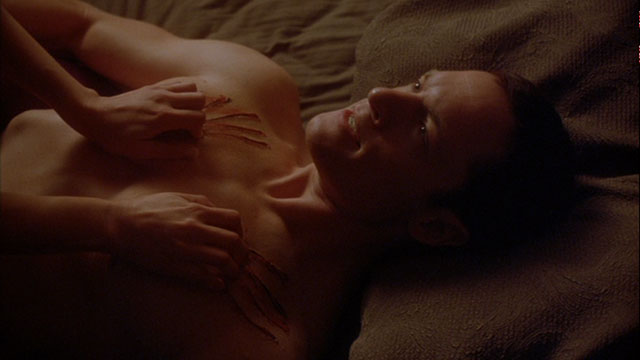
Once you unlock the story from all the craziness, it’s about two guys sent to prison together – tattooed tough-guy Kazuki (Ando) and weak, sensitive, gay Ariyoshi. K likes A and looks after him, but doesn’t quite warm to his sexual affections. Both are frustrated, yearning for escape (symbolized by their long conversation in an imaginary outdoor field in front of a pyramid and a space shuttle).

Ryuhei Matsuda (Ariyoshi) is the guy on the poster of Oshima’s Gohatto and the star of Nightmare Detective:
image

At the end it turns into a whodunit, as Ariyoshi is suspected of strangling Kazuki to death. He’s caught in the act, and tells everyone he did it but nobody believes him capable so the investigation continues.

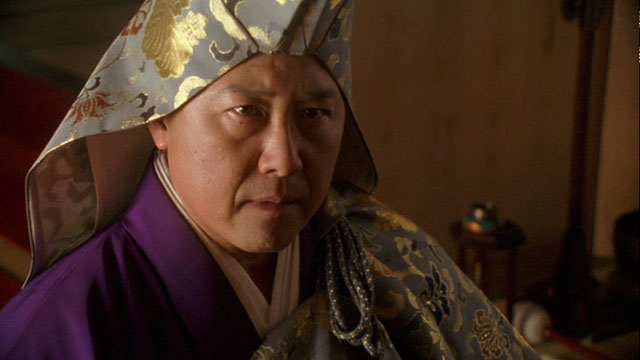
Warden Takatsu is Ryo Ishibashi, star of Audition, recently seen in Suicide Circle:
image

But it’s not the kind of whodunit where the audience participates and could possibly guess the culprit. We’re just left to wonder “Did Ariyoshi kill him, and how?” because the other inmates don’t get much to say until after the investigation is underway. I figured Kazuki could’ve let A. kill him, a la In the Realm of the Senses, but no – it was giant Tsuchiya who works in the infirmary and regularly summons A.’s co-worker from laundry duty for sexual liasons. Even Tsuchiya didn’t think he could take Kazuki – he attacked him as a way to commit suicide, and when K. let himself die, T. took his own life a couple days (hours?) later.

image

Sounds like kind of a sad story, but the filmmaking is so invigorating there’s no time to be bummed out.

D. Kalat from TCM (?):

For a film whose premise is a homoerotic romance set in a prison, Miike has studiously avoided the obvious, the cheap, and the cliché. The prison itself is not so much a set as an abstraction—the architect appears to have run out of ink and paper before he got around to designing the usual attributes of a prison: cells, bars, walls.

image

Tom Mes:

There is a lot of meditation in Big Bang Love, Juvenile A too. It’s perhaps one of Miike’s most meditative films ever. Oddly, on the one hand, because it was produced by Hisao Maki, responsible for Silver, Family and several other of the most thick-headed turkeys in Miike’s career. Not so oddly, on the other, because it was scripted by the great Masa Nakamura, writer of Dead or Alive 2, The Bird People in China, Young Thugs: Nostalgia and several other of the very finest films in that same career. The big bang of the title is also the clash between the two furthest extremes in Miike’s filmography and the spectacle of its scattering stardust is one to behold.

Yes, but is it any good? This is a Takashi Miike film. It will make you wonder, curse, marvel, tremble, scratch your head, grow bored, and awaken rudely. Celebrate it.

Unfortunately, I’d already heard that Isaach is a hitman. So when he has a quizzical conversation (opening with “You don’t speak Spanish, right?” “No.”) is given a matchbox with a coded message on it then flies to Madrid, I knew this was the first step in his assignment to kill someone. Then this happens again, and again, a train ride, and again and again, a guitar changes hands, and again and again before reaching his assignment. Along the way I forgot the comparisons I’d read (Dead Man, Le Samourai and Point Blank) and let my mind synch with the rhythm of the film, occasionally wondering if Isaach gets enough to eat or if he has taken a shower. The main interruption/alteration is the naked girl who lives with him for three days, even sleeping at his side while he remains fully clothed. Her presence (and subsequent death and imagined reappearance), the repetition of story elements, the paintings and music, black helicopters and abductions, the foreboding background score (by Boris) and the continual spoken and written phrases about life being meaningless began to build until, during a flamenco dancing scene, I wondered if this all wasn’t some kind of Lynchian nightmare. Maybe it’s Dead Man taken a step further; Isaach is dead, having some kind of hallucination (peyote is mentioned in dialogue), reliving the day-to-day life of his profession and of Jarmusch’s profession: the broken flowers on the street, pigeons on the rooftop. But then he reaches the end of his journey, finds a powerful American in a bunker, gets himself inside (the movie’s biggest joke: after all that workaday buildup it doesn’t show us how he gets inside – “I used my imagination”), strangles him, escapes, changes out of the suit and re-enters the world.

The other day I thought about telling Katy that Jarmusch is a feminist in order to get her to watch the movie with me, but I couldn’t come up with any evidence for that… in fact, all I could think of was evidence against. The only woman in Dead Man is a dead prostitute… the only one in Ghost Dog is a troublesome slut who indirectly causes the hero’s death… and I think the title of Broken Flowers refers to Murray’s damaged ex-girlfriends, who get progressively more depressing as the movie progresses. So I thought about that during this movie, figuring the very presence of Tilda Swinton should change things, but then there’s the nude girl, and Tilda is cool but gets kidnapped, which leaves the driver and a bunch of men.

A day later I’m more forgiving. It’s hard to fault any movie for artistic indulgence when you’re thrilling to the latest Takashi Miike mind-fuck. The civilized, art-loving europeans vs. shadowy, violent americans plot isn’t subtle but the movie is also too pleasurable to write off.

Isaach De Bankolé is a wonder to behold. The guy is an obvious movie star, and watching his impassive face for two hours is no problem at all. I admit I was excited that the ice cream man in Ghost Dog is starring in a film, but he was better in this role than I could’ve imagined. Black guy speaking French at an airport in the first scene was Alex Descas, a Claire Denis and Olivier Assayas regular. Girl on the train was Youki Kudoh, one of the Japanese leads in Mystery Train. Everyone else I was either already familiar with (white-wigged Tilda, foul-mouthed Bill Murray, guitar bearer John Hurt, guitar appreciator and inexpert spy Gael Garcia Bernal) or I’ve at least seen before and don’t recognize, like the naked girl was in Cider House Rules a decade ago but nobody can be expected to remember that.

When Isaach is given a new assignment, he’ll go to the art museum and study an appropriate painting. So the instruction “wait for the violin” had him studying a painting featuring a violin, etc. At the end he’s given a black piece of paper and no instructions so he visits the museum and studies an artwork featuring a large white sheet, maybe to clear his mind and ease himself out of his mission.

Kaurismäki’s La vie de bohème is pointedly mentioned. Anything in this movie that is mentioned is done so pointedly. I misunderstood the constant pointed warning “he who tries to be bigger than all the others should go to the cemetery to understand a little bit better what life is: a handful of dust” to be directed at Isaach, but they were talking about Murray

This has been compared to Primer, and the Hollywood remake machine is already rolling over it, so I thought it’d be a better time-travel movie to watch than Terminator 4 this weekend.

image

Hector is settling into his new house with his wife – one day sees a naked girl in the distance, goes to check it out and is attacked by a man with a bandaged head. This being a movie called TIMECRIMES I figure the bandaged man is Hector himself come from the past or future, and I’m right, but the movie doesn’t hide this for long, and there’s more to enjoy than just trying to guess the future/past. Doesn’t tell the story in real chronological order, but follows Hector’s own personal chronology as he is tricked by a scientist (played by the director) into entering a time machine and beaming into the past a few hours. Now Hector 2, he gets in an accident and bandages his face, goes around stalking himself and trying to figure how to get out of this. The bit I didn’t see coming is when he beams himself 30 seconds earlier than he did before, becoming the behind-the-scenes manipulator Hector 3 who ensures that the woman who falls to her death (causing Hector 2 to become Hector 3) is the poor previously-naked bicyclist who tried to help him, and not his beloved wife. Back in the normal flow of time, he sits with his wife as night falls.

image

Also checked out the shorts on the disc. Nacho is the king of the clever concept.

7:35 In The Morning (2003) is a musical – guy (Nacho himself) sings a song for a girl he sees every day at the diner and gets everybody there to participate. Thoroughly unexpected finale when she calls the cops and he turns out to be strapped with dynamite.
image

Crash (2005) is hilarious – guy (Nacho again, imagine that) out with his girl wants to ride the bumper cars just like old times, but he gets increasingly frustrated, angry, embarrassed and injured.
image

From the director of… I’m not sure. The writers won an oscar for this, beating their own screenplay for Operation Petticoat as well as beloved classics North By Northwest (admittedly the writing isn’t the best thing about NxNW) and The 400 Blows and Wild Strawberries (disadvantage: foreign).

image

Kinda surprising, because it’s just your standard gimmicky romantic comedy. I mean, we liked it and all, I’m just saying I wouldn’t have thought “best writing of the year.” Doris Day (in between her Hitchcock film and her Tashlin films) and Rock Hudson (a few years after Written on the Wind and Magnificent Obsession) share a phone line (because the phone company doesn’t have enough!) and hate each other. The problem is that she occasionally needs the phone for business, but he’s always chatting up some woman – always a different woman. Day, a serious businessperson with no need for a man in her life, resents him and makes rules and starts fights.

Katy said Doris Day isn’t pretty. Insanity!
image

So Rock disguises his voice when he meets her in person and romances her as hard as he can as a practical joke, leading to lots of fun visual innuendo…

image

And more, even saucier innuendo!

image

She learns what he’s up to and takes revenge as only a professional interior decorator can – by redecorating his apartment. Ho! But of course they fall truly in love at the end.

I’d assumed Thelma Ritter would be my favorite actor in this movie, but that turned out to be Tony Randall. Maybe after Pickup On South Street I hold her to unrealistically high expectations… all she does here is drink and then act hungover, albeit hilariously. That was still enough to get her a fifth oscar nomination.
image

Tony “Rock Hunter” Randall is a rich guy who’s always after Doris. He thinks he might end up with her there at the end, but he’s just her fallback guy while she works out her feelings for Rock. Poor Tony.
image

Sho Aikawa starred in Kiyoshi Kurosawa’s Eyes of the Spider and Serpent’s Path, which felt like revenge-drama genre-killers, then he starred in Miike’s Dead or Alive series, which felt like an action genre-killer, now here he is starring in a by-the-books actioney revenge-drama for Miike. How quickly we forget. Or how quickly undistinguished screenwriter Toshimichi Ohkawa forgets, anyway. I get the feeling that Miike’s heart was in Big Bang Love this year, and Scars of the Sun was a standard studio flick a la One Missed Call.

image

Not that it’s bad – just standard, well-made but with no particular flair or invention. Sho Aikawa’s hardworking architect hero is perhaps too blank of a character, though his acting is thoroughly excellent. Sho stumbles across some kids beating a homeless man senseless, moves to intervene and gets attacked himself, so he beats hell out of the youngsters then is surprised when the cops let them all go and tell him he’s in trouble for pummeling underage kids. The screenwriter wants us to know that youth crime is a problem in the city and that the laws aren’t equipped to deal with it. This is best expressed by having an unrepentant 15-year-old, shamed from having been beaten by Sho, kidnap and murder his young daughter. Better still would be if the ensuing media circus finds out about the earlier incident and portrays Sho as a bully who drove the kid to crime. And best of all, since we don’t want to accidentally end up with long scenes exploring the relationship of parents dealing with loss a la In The Bedroom, have the wife (Miho Ninagawa of Dream Cruise) kill herself straight away (we see her on a rooftop, then we see Sho walking past a car. Camera stops moving and I know the body will hit that car two seconds before it does).

image

Three years later the murderous kid (Kamiki) is out of prison. Sho tracks down Kamiki’s parole officer Mayumi (above left), his slimeball lawyer, and his ex partner-in-crime, trying to find Kamiki and meet him face-to-face. The movie hammers its theme of criminal youth being coddled by the justice system as Kamiki is left free to create a new gun-toting youth-crime syndicate while Sho is treated as a dangerous criminal and watched closely. Finally Sho goes on the run, takes out the kids with guns, is jumped by Kamiki, shoots the parole officer by accident, then kills the hell out of Kamiki. Sho is either dying or going to jail, but the movie doesn’t tell us which, as he calls his sister’s cop boyfriend and tells him to take care of her, then roll credits.

I thought Kamiki was a girl for a while:
image

The one cool stylish part: since Sho seems incapable of expressing emotion facially (not in general, just in this movie), Miike connotes his inner trauma cinematically, fading to black and white as he watches his wife die, and suddenly snapping back to color three years later after he’s returned to his old neighborhood to find Kamiki, a dripping faucet bringing back the memory of his wife’s bloody death.

image

Based on the true story of James Reavis – however his wikipedia article sounds like the true story would make for a far less interesting movie than Fuller’s script. It’s got the pen-and-ink technicality (his forgery is discovered because he uses the wrong kind of ink), the marrying a trumped-up land heir, and the prison time, but it lacks the monastery, the gypsy camp and Reavis-Price’s completely solitary audacity of it all (the real Reavis had financial backers, co-conspirators and hired thugs). Also the guy who exposed the fraud was named Royal Johnson, not John Griff.

image

Vincent Price hadn’t found horror fame yet, but he acts up a storm in this – convincing as a showman, a lover, a silent conspirator and an enraged victim of mob violence (see below). His plan involves the U.S. government honoring Spanish land grants – he trumps up his young ward (later his wife, ew) as the sole living heiress of a previously unclaimed grant for the whole territory of Arizona, planting her fictional parents’ gravestones, engraving a proclamation into a giant stone, posing as a monk for three years to inscribe the false grant into the ancient records and getting some gypsies to help him break in where the copy of the records is kept.

image

For all that work he is very nearly killed by the angry villagers, but the government saves him in order to imprison him. His wife (Ellen Drew of Christmas In July, who again fails to make much of an impression) apparently forgives him for giving her a false identity and roping her into his land-grab scheme, picks him up from prison at the end.

image

Fictional-historical adventure-romance-dramas aren’t exactly what Sam Fuller is known for, but he pulls it off. I guess he was one of the few writer/directors out there at this time, and The Steel Helmet wasn’t far behind. The only bit that doesn’t work for me is the silly framing device of old men smoking cigars and reminiscing about the Baron’s crazy scheme. At least Sam worked cigars into the story somehow.

image

That’s Reed Hadley as Griff, the government’s expert fraud analyst who manages to debunk Price and help him escape the angry crowd. Within a couple years of this, Hadley played both Jesse James (for Fuller) and Jesse’s brother Frank, and appeared in two MST3K-bait films.

image

A useful doc if you haven’t heard of raw foods, bovine growth hormone, solar energy, biodiesel, compact fluorescent lightbulbs, or Woody Harrelson. I’ve heard of these things, so it was just a pleasant entertainment.

Best part is Project Ruckus or Camp Ruckus, a protester boot camp.

Had animated bits between sections, but not as many as in Tales of the Rat Fink.

Recommended listening: Blade of Grass by the Asylum Street Spankers

Opens with the title “Are you for or against the abolition of the death penalty?”

image

Movie gets straight to the point. After reading Tony Rayns say about In the Realm of the Senses that “there is no thing as the Oshima style,” I thought I’d check out one of his earlier films and see for myself. Sure enough, this has nothing in common with it or with Empire of Passion – it’s bonkers in its own particular way.

Oshima in 1964: “An artist does not build his work on one single theme, any more than a man lives his life according to only one idea. Foolish critics, however, want to think that works have just one theme running through them. Then when they find something that contradicts that one theme, they immediately say that they don’t understand the work. Our work has nothing to do with these foolish critics. We want to put into it everything we are thinking and experiencing now; if we didn’t, creative work would have no meaning for us.”

image

R., a rapist and murderer, is hung but seems unhurt. Since his body won’t die, they rule him demented – but now he can’t be killed because a demented man can’t realize his guilt and understand punishment. The surly chaplain says they can’t even pray for him because last rites have already been administered. R. seems to have amnesia, so the men in the room (prison officials, doctor and so on) act out his crimes to jog his memory. They tell him his history, convince him he is Korean, awaken his mind and memory in order to kill him again.

image

They get really into their re-enactments – the education minister (above) imagines that he has actually killed a girl on the roof of a building and the others think him hysterical – then one by one they begin to see the dead girl – then she’s not dead at all, rises up and starts to talk with R, says she’s his sister. The men are upset because R never had a sister, but that falls by the wayside, and eventually she and R are lying on the floor apparently naked under a sheet while the men all argue and cry and hallucinate around them. It’s that kind of movie. With its loooong shots and loose, imprecise framing, single location and shouty characters, it could’ve easily been done as a play.

Akiko Koyama, an Oshima regular, as the mysterious Korean woman:
image

Oshima 1964: “Unless you see people living in their own country, their true identity escapes you. The tragedy thus grows clear; the Japanese and Koreans have superficial and uncertain views of each other, and cannot see things in their true light.”

1968: “Death By Hanging had as its starting point the events set in motion by the criminal Ri Chin’u, perpetrator of the Komatsugawa High School incident. In my opinion, Ri Chin’u was the most intelligent and sensitive youth produced by postwar Japan, as demonstrated by the collection of Ri’s letter edited by Boku Junan, “Punishment, Death and Love.” Ri’s prose ought to be included in high school textbooks. Ri, however, committed a crime and was sentenced to death. I had been thinking of devoting a work to Ri ever since he committed his crime in 1958. … We created R, a character who did not die after execution.”

1974: “In ancient times, revolutions began with the destruction of prisons. No, history called the uprisings that were strong enough to destroy the prisons “revolutions.”

R (left) with the priest played by Toshiro Ishido, the writer of Oshima’s Night and Fog in Japan:
image

“Death only has meaning if we know it is coming.”

“I don’t want to be killed by an abstraction.”

image

Recommended listening: That Man Will Not Hang by McLusky

I don’t get 99% of his references, and I lose about 90% of his trains of thought, but I like these books anyway. Some good bits:

My goal is to show that certain germinal images or instant fictions are the best starting point for a film that wishes to have a poetic pretext.
On many occasions I have been asked whether: “All types of cinema must necessarily be poetic. Might a simply narrative cinema not be possible in our times? A type of cinema for which things are simply interesting as peripeteias?”
Yes and no.
I have already said this before: cinema is condemned to be poetic. It cannot but be poetic. One cannot ignore this aspect of its nature. For poetry will always be there, within out reach. If so, then why not use it?
Although it is true… that in most films poetry is incidental, more often than not it’s there partly due to the fact that it has been ignored; nor is poetry really found in so-called beautiful things: rivers, landscapes, mountains and sunsets. Rather, we find it in the haphazard intersecting of sequences, in the instances of narrative incoherence and in crossing sight lines.
Yet, it is there. It is.
From this point of view, poetry is endemic in cinema.

Describing the roles of different people on a movie set, “A lighting technician is above all a maker of shadows. Though nobody seems to notice.” He then suggests that movie studios could hire a philosopher “to destroy all that seems evident.”

Cinema ought to continually play with the harmony and lack of harmony that exists between narrative evidence and visual doubt (that which I have just seen- have I indeed seen it?)

Film is “a language, but composed solely of verbs.”

I don’t know what “this idea” refers to, and I read it twice.

In our field, in the practice of cinema, this idea… suggests the possibility of linking ideas, sequences and situations, which, though placed in different parts of the film, and despite what the distances between them may be (or rather, and I would be willing to say, the greater the distance the better), connect with each other, one reinvigorating the other. Not only because they participate in the same intensity, but also because they have the same ‘sequence of durations’. Five or six shots remind us of another five or six shots from another film and they feed each other by means of an effect that I call ‘mirrors of duration’. It’s not that these shots last the same amount of time. Rather, here we have two intensities, which I am tempted to call states of fascination, producing the effect of emotional detachment.

After beginning to describe the plot of an imaginary film:

Up till this point we’ve had a film about justice, about the act of judgment. A film about. And I seem to recall having mentioned that I find it hard to tolerate and, above all, to make films about … (We should remember that the first question that the average American viewer will pose when confronted by a film that perplexes him is: “What is this film about?”).

He swears the following is “not lacking in all good sense or reason as it might seem initially”:

A few days ago, together with some friends, we played with the following idea-situation: if we accept that what Hitler really wanted was to take possession of Vienna, then it would have been enough for him to stroll through the city’s streets, walk every now and then into one of the cafes, observe the people, breathe in the contradictory odours that escaped from the city’s chimneys. However, it seems that it was indispensable for him to be accompanied by an army and that he be worshipped by the dumbstruck masses. When we enter a film, we would like somehow to appropriate it ourselves, we wish to invade it, we would like for it to adhere to our expectations.

Oooh, a promised third volume:

In the third volume of the Poetics of Cinema, I will be much more explicit, more generous, regarding analyses of specific cases and in proposing exercises.

Ruiz notices his own book’s roundabout nature:

I would like to write: “Yet we shall develop this theme later”. But the translators, who at this very moment are rewriting my words into inadequate and foreign tongues, have already made me realise that each time I have said “but this theme will concern us later”, I have, in fact, forgotten it forever.

WTF:

How does one represent all men, Jedermann, as king of the world? As a lonely man? As the dictator who strolling through the palace of ten thousand mirrors confuses himself with his 200 doubles? Or as one who, smiling under the rain, is condemned to smile even in his coffin, for they are always filming him? The image-man, let’s say Tony Blair (NB A. Blair, the Prime Minister of Great Britain as the first edition of this book was in print, deceased two years later).

On metaphors:

Often, and at times immodestly, I have made use of metaphors in order to approach intuitively certain ideas; many of which could best be described as images and half-glimpsed visions. I hope that among them it is the angelic smile rather than the sardonic irony or the biting impetuousness that has the upper hand. ‘Metaphor’ is a word that has a bad reputation among theorists. To use it implies that one does not have clear ideas, and in that case, the best thing to do is to remain silent. That may be so and I regret it. Yet, in the present state of the arts: does anyone have clear ideas?

image