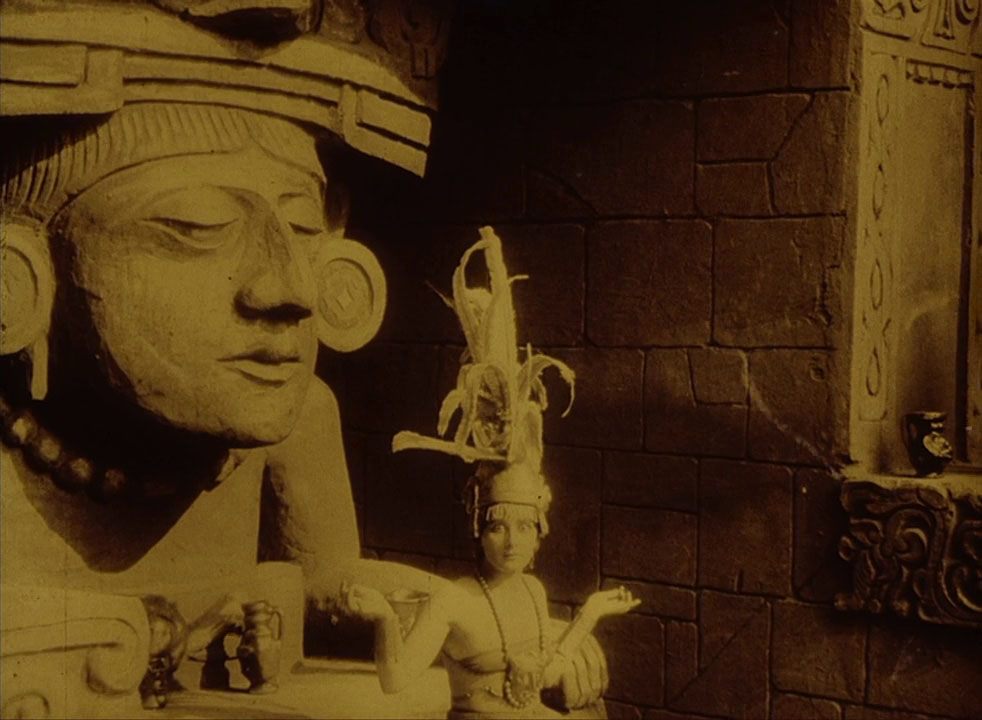
Artificial, stagy-looking, stylish, with great transitions between scenes. Everyone has different speaking styles, not flattened into a single form. Kathryn Hunter obviously MVP, good to see Stephen Root and Harry Melling (Julie Taymor’s Puck). Most importantly, there are more birds in this version than in any other.

Superman (1941 Dave Fleischer)

Wait, everyone on Krypton had superpowers, and Superman was raised on Earth in an orphanage? Mr. White is the newspaper boss. Lois flies a plane, is the only person investigating the letter they got saying an electrothanasia ray would cause devastation at midnight, the villain a mohawked creep, vaguely popeye-voiced, with a pet vulture. “This looks like a job for Superman,” Kent says casually the next day, after Lois is kidnapped and many people are dead, goes out and punches the electric ray into submission (and unforgivably, saves the girl and the villain but not the vulture). A silly story, but check out these colors.


The Mechanical Monsters (1941 Dave Fleischer)

These have a catchy theme song. Another rich mad scientist, this one in a purple suit and twirlable mustache, has developed drone technology – radio-controlled bank-robbing robots. Haha, when Lois and Clark are present at the next robbery, Clark steps into a booth to “phone this in” and… he phones it in! He just calls the newspaper office… it doesn’t occur to him to use the booth to become Superman until later. Lois is of course kidnapped, dangled over a smelter. I suppose all of these stories end the same way, with rescued Lois’s cover story in the paper the next day while Clark winks at the camera.

Everyone on Krypton also sports a Magic Cape:


Let’s Sing with Popeye (1934 Dave Fleischer)

Oh no, this was a two-minute short where Popeye punches some of his own stuff aboard a boat, then sings his theme song in a low, disinterested voice with follow-the-bouncing-ball lyrics.


Betty Boop’s Crazy Inventions (1933 Dave Fleischer)

Opens with fireworks with live cats inside, so it’s gonna be good. Betty and friends are at a giant trade show under a circus tent, showing off different impractical inventions. She and Bimbo escape after a haywire sewing machine goes on a rampage, presumably hundreds of people are dead.


In the Future (2019 Phil Mulloy)

Absurd shadow-characters discuss the future. Very short, and a quarter of the runtime is a guy peeing. Phil has been out there since the 1970’s, making a pile of shorts and some features.


Endgame (2015 Phil Mulloy)

Two guys leave the city for some weekend war games and get more war than they bargained for. Stick figure art, the roughly drawn backgrounds include random-seeming numbers and figures. I was with it until the gang-rape joke.


Peter & the Wolf (2006 Suzie Templeton)

Great birds in this: an emotional support duck and a crow tied to a balloon, and terrific camera perspectives and stop motion work. Peter just wants to play in the backyard with his friends, help the crow with bad wings pretend to fly, and skate on the frozen pond, but grandpa wants him to stay indoors because there’s a wolf out there. The boy traps the wolf after it eats his comfort-duck, but frees the wolf at the end rather than hand it over to the ruffian townies. No dialogue, so it premiered with live orchestra accompaniment, and won the oscar, obviously.


My Love (2006 Aleksandr Petrov)

Another half-hour movie based on a Russian story featuring ducks, a cat in a tree, and some good birds. 16-year-old gives a crystal duck to a girl he likes, is figuring out what love is. He dreams of marrying his family’s poor maid, also starts worshipping a hot neighbor, but he is finally weird to the neighbor and when he becomes sick with brain fever the maid leaves to become a nun. My DVD copy isn’t high-res enough to get the full effect, but this is lovely – painted frames, smearing the backgrounds as the characters move past, exploding into fantasy scenes in the kid’s imagination. Feels too wordy, watching so soon after Peter & the Wolf. Petrov’s followup to his great Old Man and the Sea.


The Pied Piper of Hamelin (1981 Mark Hall)

It took a minute to even realize this was stop-motion; my copy’s contrast is off. The opposite of the Petrov in that the wordless animation moments are alright but it comes to life when the narrator is going off – he is Robert Hardy of the 1970’s version of The Green Knight, reading the original poem. Obviously not a movie to explore unless you’re ready to see hundreds of stop-motion rats. Jiri Barta also made a version, which would be worth digging up. A good effort for England, who still had ten years to wait until Wallace & Gromit. Hall was a British TV veteran, working on Danger Mouse among others.


Who Would Comfort Toffle? (1980 Johan Hagelback)

Toffle is alone and scared with nobody to talk to when the night monsters come, so he ditches his house and wanders to find somewhere new. Limited storybook animation with a rock musical soundtrack. The Hemulens are giant things outside that are maybe moomins? Real kids stuff, cute – you don’t see a lot of Swedish mythology cartoons.


The Chimney Thief (1944 Paul Grimault)

A thief who steals lightning rods and uses them to pole-vault across the rooftops is a pretty great idea. What ever happened to lightning rods anyway? You don’t see them around much. The scene where he distracts a guard dog with a wind-up mechanical bone is simply odd, all the character animation timing wonky. Their stretchy rubber-band bodies seem Boop-inspired. Nothing more to it than a rod thief outsmarting two identical cops chasing after him, some typical chase scene bits, but remarkably good use of 3D space. Grimault worked with Jacques Demy and made some other widely-acclaimed works that I’ve meant to find.


Birds/Ptakhy (2012 Mykyta Liksov)

Unlike the Blackbird short, this movie called Birds is about birds – this is all I ask for. The birds dance through the air, form couples and nests on the last above-water structures of a flooded Earth, except for one who swims underwater in search of a fallen spouse and finds a glowing egg in the irradiated wreckage of human civilization. I was already enjoying this before its all-timer end-credits sequence.


The Baby Birds of Norman McLaren (2014 Mirai Mizue)

Aha, someone is into maximalist mutations, colorful patterns, and bright pop music. Someone watched the entire McLaren DVD set and took away all the correct lessons, turning in a fun, short, snappy piece with tributes to Norman’s different animation and sound sync styles.


The Big Snit (1985 Richard Condie)

Squiggle-vision cartoon about a domestic squabble over a scrabble game while nuclear war is beginning outside. Between the two Ukraine-related shorts and this one, I hadn’t meant to get so topical tonight. The couple reconciles just in time to be vaporized, a happy ending. This and Condie’s La Salla are maybe over-acclaimed, but I like his very random sense of humor, and he also produced The Cat Came Back.

Trauma drama in which a high schooler dies in a diving accident. I’d always been curious about this one for winning the Palme d’Or over Mulholland Drive, The Piano Teacher, Va Savoir, et al. Quality movie, mostly about the performances and the coping. Dad is a psychiatrist, catches abuse from his patients then abruptly quits the business. Eventually the family latches onto a girl who knew their son briefly, tries to befriend her and help her out, go on a spontaneous road trip together. It’s unusual to hear an Eno/Roedelius/Moebius song in a movie. Mia Madre feels like a superior remake, but this was good.

A movie about slackers and fuckups, shot with usually-in-focus handheld with little dodges and zooms. The soundtrack is the most professional part – an Of Montreal song follows a Spoon song. The legacy is that this was a key mumblecore movie along with Mutual Appreciation – movies about difficult nobodies which are discussed more for their very low budgets than for any craft.

I didn’t hate the story, but started to hate codirector Mark as he finally loses his shit over the difficulties involved in buying and retrieving a puffy chair for his dad over the internet. Tagging along is his brother Rhett Wilkins, whose open and impulsive character nicely balances Mark’s. And Katie Aselton (recently of She Dies Tomorrow and Synchronic) as “the girl.” I dunno about mumblecore, but if She Dies Tomorrow was the end result then I’m happy to pay respects to its roots.

The movie ends up where all movies must: driving into Atlanta

Famous lecturer Jean Desailly (of a couple Melville films) picks up stewardess Francoise DorlĂ©ac (a couple years before Cul-de-sac) and talks endlessly about Balzac at the bar. He falls for her, but is married, and the whole movie is about how hard it is to have a secret affair. It’s even harder because he’s well known, but he acts like Francoise has no other options, and is a pain in the ass to her for almost their own relationship, so when he finally proposes, she breaks up with him. And then his wife finds out.

The music took the whole thing seriously from the start. It’s a suave, smooth looking movie, each scene patiently revealing. A jump cut or two just to remind us this is the FNW, overall more admirable than any fun to watch.

Cute low-budget movie, black and white with star wipes, the sound cutting out during close-ups. Leo (played by our director) is an out-of-work stylist, picking up men online for money (guy at a cafe says he wants to be pissed on this tuesday, and won’t pay much) while her mom (played by her mom) stays home and puts curses on her enemies.

When they go out, mom shoplifts and puts meals at the titular restaurant on the tabs of local politicians. Leo flirts with Chen Zhou (The Cloud in Her Room), goes home with him, then finds out he’s married. Both women have their pains and need pampering, seem like fun little frauds though they are in real trouble, basically homeless. Mom doesn’t tell her daughter when the police finally come for her.

Watched this for being Vadim Rizov’s reported highlight of Sundance 2021. That’s the one I “attended” fourteen months ago, tho it seems longer. What would be my highlights… mostly the obvious choices:

Summer of Soul
In the Same Breath
Strawberry Mansion
All Light, Everywhere
Cryptozoo
Faya Dayi
In the Earth
The Sparks Brothers
Passing

Still want to see:
The Pink Cloud
I Was a Simple Man
On the Count of Three
The Cursed / Eight for Silver
Judas and the Black Messiah
The World to Come
Users
Flee

Lie Lie Lie (2007 Martha Colburn)

Animated music video, cutout characters with swivel limb joints are always grabbing each other and falling from heights. Judging from his wiki photo, the male lead in the video is based on musician Serj Tankian (System of a Down).


O Black Hole! (2020 Renee Zhan)

Wow, pencil and watercolors on Rejected textured paper gives an intro story on how a woman who couldn’t let go of anything became a black hole, then we go inside to a stop-motion tower and a girl (“the singularity”) who has to climb to the top and free the entrapped people and seasons and planets. So it’s a reverse Mad God – climbing out of the darkness. The paint-swirl black hole transitions into the stop-motion world are nice. And it’s a musical. Presented online by Locarno in February, even though the festival’s in August.


Journey to the East (2021 Eve Liu)

The start of a three hour(!) Metrograph shorts program that I didn’t feel like tackling in its entirety. A Chinese-American Western, had good lighting, and finger jewelry, and Ashes of Time-style slow-mo. Feels like an ad, I dunno for what, maybe for itself.


Daffy Doodles (1946 Robert McKimson)

A full-bodied Daffy, all his parts in sync, is a mad graffitist, painting mustaches on all posters and pig cops. Some unusual 3D perspective stuff, good gags and a daffier Duck than normal – I approve.


On Memory (2021 Don Hertzfeldt)

The new piece for the World of Tomorrow blu-ray is a Don monologue on exactly that, placing his voice into characters from his past films, and wonderful new ones. “A movie is something that will eventually spend more time living in our heads than the time we took to experience it.”


Voyage of a Hand (1985 Raoul Ruiz)

Europeans fondle their African art. A mustache man with two souls communicates through whistling. A guy says that all human voyages take the form of a hand, then he screams in pain. Others look at the man’s hand and see maps and patterns. He later travels carrying his own severed hand as a magic talisman, then sews his eyes shut, relying only on the hand to see the world. Obviously needs further study – should be watched annually, alongside Dog’s Dialogue, Zig-Zag, Le Film a Venir, and The Gift.

Only 70ish minutes (watchable on the plane), but Slow Cinema, with no dialogue for 15 until a red jacketed woman notices Oro hasn’t picked up his lunchbox. Oroslan is discovered dead at home. Later, his brother tells the story of the discovery scene we just saw. Finally, neighbors tell happy Oroslan memories for ten minutes, fulfilling the official description (“re-creating his image through their tales”) but this is too little too late. Another quizzical Locarno feature.

Fulci’s twenty-somethingth film is the second-earliest one I’ve heard of. Super stylish with a fun, twisty plot. Great black-void backgrounds and jumpcut editing in the dream sequences. Also it’s so poorly dubbed that even the inspector’s eerie whistling looks lousy – how do you fuck up dubbing whistling?

Our buttoned-up lead is Carol (Florinda Bolkan of Investigation of a Citizen Above Suspicion), obsessed with her hedonistic neighbor (Anita Strindberg of Your Vice Is a Locked Room), who soon turns up murdered. Carol’s husband Frank is having affairs (Jean Sorel, Belle de Jour‘s husband, that seems relevant) and seems suspicious, and his daughter Joan (Ely Galleani of Five Dolls for an August Moon) seems sympathetic. We’ve also got a lead inspector (Losey regular Stanley Baker), his main crony Brandon (Alberto de Mendoza of Horror Express), and Carol’s therapist (George Rigaud of All the Colors of the Dark).

Carol and Frank:

Some procedures are askew here in London, Italy. The cops allow neighbors to walk right into the murder scene, and the psychiatrist plays the cops tapes of Carol’s private sessions. Carol gets locked up in a clinic while the grown-ups try to straighten things out. The psych thinks Carol did it, has a split personality that places symbolic clues in her dreams. Carol’s dad takes photos of her husband Frank with Hotgirl Deborah (Silvia Monti of the previous year’s hippie murder film Queens of Evil), accuses Frank of the murder and having based the details on Carol’s dream journal to frame her, then finally blame falls on the dad, who kills himself.

Meanwhile some pale hippies (Penny Brown of City of Women, and a guy who looks like Irish Peter Fonda’s Ghost) are chasing people around. Little Joan fancies herself a private investigator and gets herself murdered. Of course the simplest explanation is that Carol did commit the murder, having been sleeping with the neighbor.

Joan and Hippie (who paints using throwing knives):