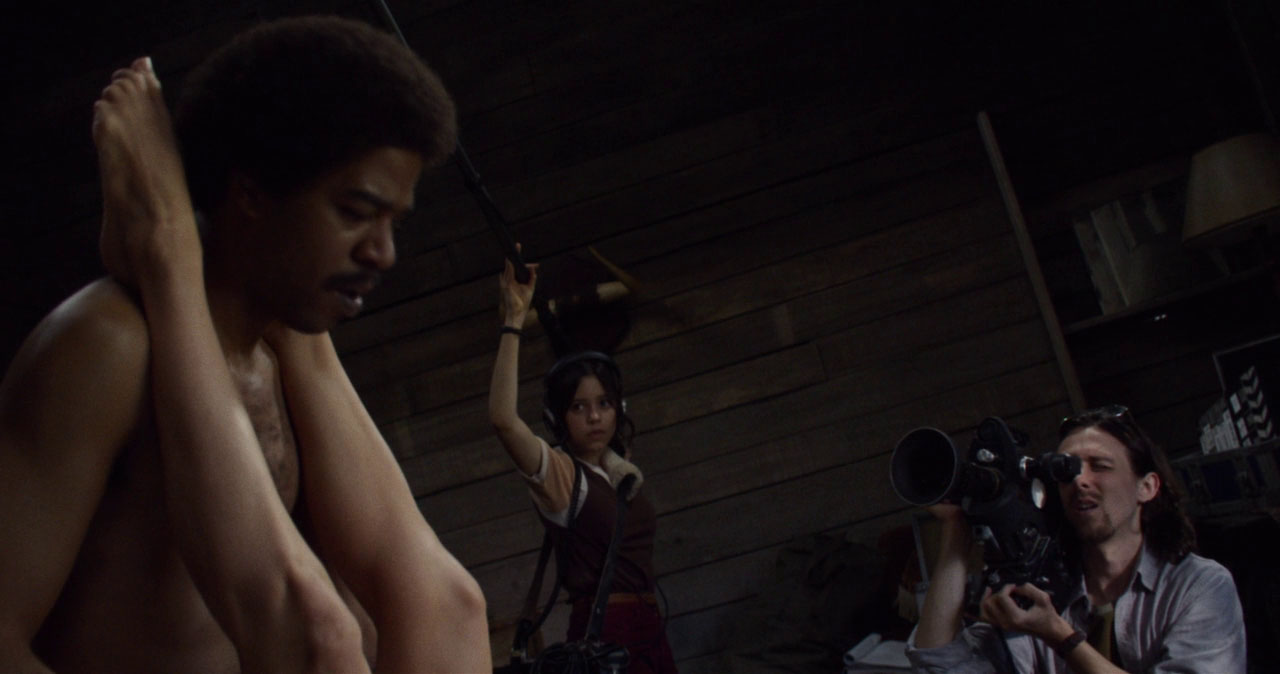
I watched all the shorts I could find called The Letter,
and some related shorts that were on the same DVDs.


The Letter (2008 Gael Garcia Bernal)

“Achieve universal education” – this is from an anthology in which overqualified filmmakers (Sissako, Wenders, Gaspar Noé) created little issues dramas. Bernal had made one feature before this and never really took off as a director. Mustache man Ingvar Sigurdsson (lately star of A White, White Day, soon to be seen in The Northman) is working in Iceland. He helps his son with homework, reads to him. Any time he’s not talking with his kid, a narrator is speaking, and none of this is in English or subtitled on my disc, so I dunno, but the man seems to be divorced and the only letter they receive is a credit card bill.


The Water Diary (2008 Jane Campion)

From the same anthology as the Bernal. Drought caused by climate change causes a farming town to fall apart. The little girl at the center loses her horses, loses her uncle to suicide, spends the day pretend-galloping with her cousin through the dry riverbed. The neighbors tell each other their dreams of rain, and imagine that if the prettiest girl in town plays her viola atop a hill, the clouds will gather and weep. Second movie I’ve seen in a year where people collect their tears in jars. Lovely short, even on DVD, with some unusual visuals. The lead girl later played opposite Elle Fanning in Ginger & Rosa.


The Letter (1971 James Gore & Adam Beckett)

Silent freeform animation, the figures constantly transforming, returning to a striped-shirt character writing then mailing a letter. Besides the figure mutations (just while addressing and stamping the letter, the person becomes a stick figure, a mouse, a bird, a pig and a wolf) we spend some time inside the letter itself, a blue-on-blue field of growing and folding shapes.


Sausage City (1974 Adam Beckett)

Single-color pen drawings of mutating geometries, gradually becomes more 3D as colorful blobbos appear and begin taking over the image, a chaotic jazz combo underscoring the whole thing. This for a while, then it zooms out and a man jumps into the drawing table, where he’s transformed into a hip mouse creature. Music by “Brillo”


The Letter (2002 Vladimir Leschiov)

Man sitting under tall apple tree is writing a letter. Plays around with scale, and the nature of apples. Nice pencil-looking drawing style, with soft music that adds fx and transforms along with the visual scene. Leschiov is described as the most famous of Latvian animators, though he made this in Sweden.


Lost In Snow (2007 Vladimir Leschiov)

A man leaves his shack for some ice fishing and a drink. But the man begins multiplying, differently dressed ice fishers in different nearby spots, as the ice sheet cracks and they all float around each other. Prompted to watch this after we went to the lake today, saw some ice fishers and got very close to a bald eagle. The movie loses points for featuring no eagles, but there is a penguin at the end


The Letter (1998 Michel Gondry)

A boy with a photography hobby is anxious about Y2K and wanting to kiss a girl he likes. His older brother tries giving him advice, the boy dreams that he’s unable to connect with other humans because his head has become a camera, the girl writes a letter saying she likes his older brother. B/W with some nice photochemical effects, I think this was Gondry’s first narrative work that wasn’t a music video.


The Letter (1968 Jacques Drouin)

Only a minute long, simple animation on white background of a person attempting to write a love letter, the words of the discarded drafts appearing onscreen and self destructing.


Pismo aka Letter (2013 Sergei Loznitsa)

Cool jump-cut on a thunderclap, and there is a cow. Either this town is in heavy mist or the film is fogged. This goes beyond Slow Cinema into Sokurovian smear-cinema, without even a pretense at story or characterization, the camera too far from whatever daily menial activities are going on. There’s a four-hour Loznitsa playing True/False next month, and the guy’s not convincing me that’ll be time well spent [edit: a month later, after reviews and global events, now I’m dying to see the T/F feature]

Official description:
“A remote village in the Northwest of Russia. A mental asylum is located in an old wooden house. The place and its inhabitants seem to be untouched by civilization. Over 10 years ago, Loznitsa shot astounding black-and-white footage at a psychiatric institution in a forgotten corner of Russia. Since then it has resided in his archive.”


The Letter (2018 Bill Morrison)

A young man falls for a nurse. Her friend reads alarming news in a letter. A maid is being harassed by her employer. Is Bill a great preservationist, showing us the remnants of old films before they’re physically corroded away? Or is he the cause of the corrosion, has he realized that 1920’s studio pictures of well dressed people having conversations in rooms are inherently uninteresting without an added Decasia effect, and he’s out to document his chemical destruction of silent film history? I like my theory, gonna run with it, though now I see this was made from the Dawson City films.


The Letter (1976 Coni Beeson)

Big keyboard music, voiceover fragments of a man’s breakup letter while a blonde woman in a robe is montaged through all different scenarios, some of them nude. Her voice responds, “what if I change, what if I stop” as the movie deteriorates into hippie-manson-orgy territory with prominent ankhs. She achieves some kinda (still nude) peace at the end. The official description mentions “a symbolic rape by the Devil.”


The Letter (1970 Roman Kachanov)

Daddy’s off at war, and wifey gets very mopey when he hasn’t sent a letter lately, to the concern of their kid. Cute stop-motion.

Parallel Mothers (2021)

Ho-hum, another year, another exceptionally wonderful Almodóvar movie. Two hours with zero seconds of wasted time – this guy can just make a movie that’s about relationships, but actually about mistaken identity and mourning, but actually about mass murders in wartime. Shot digitally I’m guessing, has a sponsored-by-Apple feel.

Photographer Penelope Cruz and archaeologist Israel Elejalde:

Parallel mother Milena Smit:

Rossy:


The Human Voice (2020)

The least-talky version of this play ever produced, and maybe the shortest movie to ever play Phipps on its own. Absolute luxury mixed with staginess/artificiality.

The Apple sponsorship continues:

Labor of Love (2020 Sylvia Schedelbauer)

Visuals of pure pulsing hypnosis, a voiceover speaking of a cosmic pagoda, “portals within portals.” Highly colorful, ever-pulsing visions of an eye and then a brain, through water waves, into pure geometry, the voice falling away leaving only loud ambient music.

Inspired by a Paul Clipson film, in fact the only one of his I’ve seen. This must count as some kind of animation – not sure how it was done, but the official site says “16mm archival footage and HD Video” and recounts inspirations and sources and intent.


By Pain and Rhyme and Arabesques of Foraging (2013 David Gatten)

I’ve watched a few of his, and he does love filming old texts. I made the mistake of playing a song from Craig Taborn’s Avenging Angel that matched the movie’s length – it might’ve played better silent, since the cutting is so rhythmic, steadily editing between handwritten letters, a typed description (“an experimental history of colours”), and R/G/B colored objects, the camera often gliding slowly, as when it creeps all the way up a telescope. Abrupt switch to monochrome, and a new page on dreams (“folly and madnesse”), a tinted study of water on glass, still cutting back and forth but with more frequent cuts to black.


Matchstick (2011 Jeff Scher)

Wow, speaking of colours, Jeff’s painted animation of lines and dots, rapidly growing and shifting, soundtracked by a good song by an electro-psych-rock band.


Social Skills (2021 Henry Hills)

Hills is still making these. Filmed for a month, barely pre-pandemic at a Belgian dance workshop, then presumably edited for a year. The music is chopped clips and loops from old songs, plus cartoon sound effects and a Zeena Parkins piece. Large number of dancers in a room doing every sort of exercise and movement. Besides cutting rapidly (but not so rapidly that we don’t get a sense of each motion) he’s also using masks to highlight parts of the image. Wonder how long Henry had been in edit-room pandemic lockdown when he added the audio clip about “practicing the fantastic intelligence of touching people.”


Whistle Stop (2014 Martin Arnold)

No longer torturing poor Judy Garland and Gregory Peck, Arnold has moved to cartoons. Also demonstrating his erasure techniques from Deanimated, here he’s taken a manic Daffy Duck scene, isolated each of Daffy’s body parts in different layers, and as he scrubs the audio three steps forward, two steps back, the body parts play the scene out of sync with each other.


Happy Valley (2020 Simon Liu)

Like a John Wilson episode, a montage of unusual signs filmed off the street, but instead of voiceover commentary there’s layered decaying noise loops, recalling my Brave Trailer Project (which I’m guessing Liu hasn’t seen). Nice complex sound mix, but apparently the Negativ(e)land film lab in Brooklyn has no relation to the music group, too bad.

Looked up Liu after reading the Phil Coldiron story in Cinema Scope… he calls this and Signal 8 “Liu’s most lucid works to date, emotional reports from an imperiled homeland [Hong Kong] that continue his effort to give memorable and engaging form to personal experience while broadening the scope of what this experience entails.”

In the back of my mind I figured I’ve seen this years ago and just forgotten most of it, but nope, I couldn’t have forgotten this – a jaw-dropping sci-fi story (with funky music). Humans are pests and pets, the planet controlled by blue gill-eared giants. A highly-placed alien child calls his pet human Terr, which grows up and starts playing pranks and spying, eventually defecting to lead the tiny human revolution. Truce is called after the humans build miniature rockets, travel to the Wild Planet and laser down the alien sex statues.

Michael Brooke for Criterion:

Over four decades after its May 1973 premiere, it remains more or less unique. Its peculiar universe, designed by Roland Topor and realized by a team of Czechoslovak animators in Prague, is instantly recognizable from virtually any freeze-frame, and the film as a whole is so rich, strange, and sui generis that nothing has emerged since to retrospectively blunt its impact … [Topor] cofounded the Panic Movement with Fernando Arrabal and Alejandro Jodorowsky, named after the god Pan and intended to make surrealism as shocking as it had been in the 1920s, before its imagery and ideas were co-opted and diluted by the mainstream … he wrote the 1964 source novel for Roman Polanski’s disquietingly paranoid The Tenant (1976), appeared in DuÅ¡an Makavejev’s Sweet Movie (1974) and Werner Herzog’s Nosferatu the Vampyre (1979, as the lunatic Renfield).


Les Temps Morts (1965)

I’ve seen Laloux’s earlier Monkey Teeth short, but this is when he teamed up with Topor. A grim little anthropological study of man’s propensity for murder. I think their sensibility worked better when applied to a fictional scenario – and the animation is in very rough form here, illustrations cross-faded in sequence, drawings shuffling Gilliam-style, but mostly the camera panning around stills. Some sharp stills, though – if you cut the live-action atrocity footage it’d make a good picture-book of horrors.


Les Escargots (1966)

A different kind of apocalyptic movie, this one really takes a turn. Farmer realizes his crops will only grow if he cries on them, so he walks around the field holding cut onions, reading sad books, and wearing an ass-kicking machine. The giant plants attract snails, which also grow giant, slide over to the nearest major city and utterly destroy it. Little Shop of Horrors may have been an influence.

Watched in prep for the director’s True/False movie. An archival doc of Reagan footage, ok. Doesn’t go as far into the off-air camera-setup territory as Adam Curtis does, and we weren’t very interested in Reagan, but it was either this or Bigbug.

Opens with Lydia’s kidnapping pervert child abuse story – I appreciate that childhood trauma lasts a couple minutes then we’re straight into NYC punk. But we spend maybe ten minutes on her music career, then follow her around just goofing off. I love how loose it is. I cringed when Richard Kern came up, but he seems kinda normal now. Weird how this movie explains the cycles of sexual abuse better than any scripted film ever has – and unlike those movies, this one’s got Jim Foetus, Donita Sparks, and a cartoon of Lydia pissing in a stairwell.

There were some beats I actually know in this, including some by Liquid Liquid, whose music was ancient when this takes place, the reissues still a couple years off. Two loser kids, a dark mophair with downturned mouth called Johnno, and fuckup Spanner with a drug-dealing bully brother, just wanna go to raves, at the time when Britain is trying to make dance music illegal. The notorious law-loophole soundtrack with no repetitive parts comes into play. Black and white except for the little red lights on stereos, and psych-freakout imagery when the kids take their pills.

There’s violence and breakups and hurt feelings and reconciliations – the whole coming-of-age teen period drama isn’t my thing, but I kept watching for the cool accents. The kids finally have their party, a moment of bliss, but the cops and the drug dealers are both descending, the plot needing to pummel the vibes, making it no better than the government order to punish ravers. It’s got nothing on the Michael Smiley episode of Spaced. Spanner ended up on Bridgerton and Johnno’s on some kinda submarine mystery.

Speaking of Dance: Meredith Monk (1996 Douglas Rosenberg)

An absolute monologue, MM’s head against black, talking about her personal history and what she’s aiming for in her work. For those of us who don’t know her work and watched this program to find out, it’s boring – but the clips of her actual dance and vocal performance work are neat, aand much more exciting than the couple of CDs I’ve heard.

Meredith invents dabbing:


Max Richter’s Sleep (2019 Natalie Johns)

Los Angeles performance of an all-night composition during which the audience is allowed/encouraged to sleep. Neither composer nor audience speaks very well about what this is or what it means, the filmmaker going for artsy widescreen shots for whatever purpose, making the Meredith Monk doc less pretty but more informative. I slept through the middle section myself, which only seems appropriate. The audience applause after a ten hour performance feels well-earned, and the last 15 minutes is music as underscore while everyone raves about how much they love Max. Apparently the shots with heavy film grain were from previous Sleeps and provided by Richter’s collaborator Yulia Mahr.

The director, in Mubi:

What happens when we begin to dream all together? When we are vulnerable, together? Even as a documentarian of real life, I’d never actually filmed anyone falling asleep in front of the lens before. So one of the biggest challenges of the film would be to make it without disrupting its sleeping audience, who are, in Mahr and Richter’s words, “an extension of the work.”

A storytelling movie, with lots of warnings and reassurances – I was drawn to it by Vikram’s AV Club mention of Rivette. I didn’t follow the timeline structure and just took each scene on its own, so I’m missing the overall purpose, but it’s all fine. A better Rotterdance pick than Nowhere Inn.

Stephanie is as close as we get to a lead character – a blonde Swedish actress doing a Texas accent for a role. Due to a roommate situation, she hangs out at Eleanor Friedberger’s practice space. She keeps running into Gerard, who claims to be a gov’t counterterrorist hit man. Redhaired Scott Shepherd should be good at this from his Wormwood experience, but it’s hard to realistically deliver dialogue this confidently paranoid. Stephanie is also friends with Chloe Sevigny for some reason. Scary stories are told, Gerard either dies or disappears, and it’s all very film grainy, with some light flares at the end of scenes.