A movie Katy says could not have been made in the last decade, which is possibly why I enjoyed it so much. You don’t often see a comedy about high school social strata that includes so much gleeful murder. Christian Slater (same year as Name of the Rose) is the dreamy psycho-killer who drifts into town with his dad, and Winona Ryder (between Beetlejuice and Edward Scissorhands) is a new recruit to the prom-queen-level social class shared by three girls named Heather. Ryder falls for Slater and semi-unwittingly helps him kill some people, but when he plots to blow up the school, staging it as a mass suicide, she fight back and Slater blows himself up instead.

Writer Daniel Waters went on to help ruin the 1990’s with Hudson Hawk and Demolition Man and director Lehmann (also responsible for Hudson Hawk) did his part with Airheads and My Giant, dragging it out into the 2000’s with 40 Days and 40 Nights and Because I Said So. Lately he’s worked on about ten different well-liked TV series. One Heather, the one who made a brain tumor joke, died in 2001 of a brain tumor, and another costarred in Mallrats. One of the murdered footballers appeared in Ghoulies III and the other in Night of the Demons. So, not a supporting cast that went on to fame and fortune. Good to see Otho from Beetlejuice as a preacher presiding over the wave of teen funerals.
Kind of like Sideways – a good-enough (but never great) drama about cheating (and now death) with an immensely appealing lead actor (was Giamatti, now Clooney). A very emotional journey for the characters involved, if not for us.

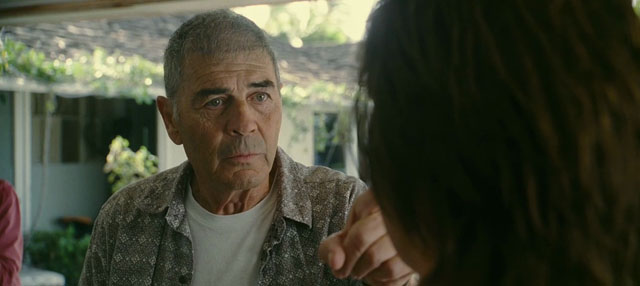
Robert Forster is going to hit you:

Hawaiian one-percenter Clooney takes care of 17-yr-old misfit daughter Shailene Woodley (star of an ABC Family drama) and 10-yr-old budding-misfit daughter Amara Miller (plus Shailene’s surfer-grinning friend). While his wife is dying in a coma, Clooney tries to find the realtor (Matthew Lillard of Hackers and 13 Ghosts Remake) who’d been having an affair with her. More wackiness as Clooney deals with a father-in-law (Robert Forster) who never liked him, and work with his co-inheritor cousins to decide what to do with a huge plot of unspoiled land (obviously they’ll keep it in the end). Except none of these things are wacky – it’s all played for sadness and empathy, which is fine if I’d been feeling it.

Large-faced actor Jason Segal had a dream to resurrect the Muppets on the big screen, full of celeb cameos and musical numbers so he called up Flight of the Conchords (not Jemaine – he must’ve been busy on Men In Black 3). Proven cutey musical lead Amy “Enchanted” Adams is a love interest, Chris Cooper a villain, and Jack Black an unwilling celebrity guest.

And it worked! Good movie, full of the same self-referential humor and silliness as the originals. Plot revolves around Segal’s friend (brother?) Walter, who is a muppet, idolizes the 1970’s Muppets and convinces them to reunite to hold a fundraiser to save their old studio from an evil oil baron. Two of the voice actors/puppeteers are from the original Muppet Show (and Fraggle Rock too) – including Gonzo. So why is Gonzo barely in the movie? (edit: oh it’s because of Muppets From Space) This one was Kermit and Fozzie-heavy, so maybe they’re saving the others for the next movie.

My favorite bit from the IMDB trivia: “Bret McKenzie taught Chris Cooper how to rap.”

We open on five mumbly hoodie youths mugging a white woman – and the youths turn out to be the protagonists. So I was on the movie’s side from the start, but it only gets better. After an alien from a freshly-landed meteorite claws Moses, the mini-gang-leader, he kills it and takes it to Nick Frost’s weed room. But a hundred more meteors land, carrying far more dangerous creatures – pitch-black hairy wolf-bears with glowing teeth, looking for the slain female. So the kids mount a defense against rampaging aliens using knives, swords and fireworks, joined by the still-irritable white woman (Jodie Whittaker, title character in Venus) and opposed by cops and a mad drug dealer.

Despite all the bloody death, the movie is mostly an action/comedy – the rare successful one. It builds to one of the sweetest minutes of film I’ve seen all year, Moses carrying the group’s full arsenal racing towards a gas-filled apartment, leaping over the blind beasts under a shower of slow-motion sparks.

Luke Treadaway (one of the twins from Brothers of the Head) plays a stoner nature-channel enthusiast who helps figure out the aliens’ motivation. Writer/director Cornish goes way back with Edgar Wright and just cowrote Spielberg’s Tintin movie, so this is his big year.

Saoirse Ronan is raised by her rogue-spy dad (Eric “Hulk” Bana) in the woods with emphasis on survivalism and attack skills – specifically the skills to attack Cate Blanchett, who killed Ronan’s mom. Was she Ronan’s mom, or was Ronan genetically engineered to be a supersoldier in a lab somewhere? Not important. What’s important is Joe Wright has remade himself as a slick-ass music video director and filled the movie with pumping Chemical Brothers music to distract our minds from the implausibility of the story. Even the implausibility of each individual scene – for example, the one where Hanna is in a manhole, army trucks are driving over her without slowing down then suddenly she’s hanging from one Cape Fear-style, when it seems like the move required to get her into that position in a split second would’ve ripped her arms off. Oh, and she’s never seen electricity before, but sits right down at a computer and within 15 seconds she’s reading up on her mom’s death from google news. In many respects, Attack the Block was the more realistic movie.

Rushmore‘s Olivia Williams plays the hippie mom of Jessica Barden, who steals the show for a while as Hanna’s first friend. But apparently Hanna’s superspy dad never emphasized secrecy, because Hanna tells the kids where she’s supposed to meet her dad, ultimately getting him killed. The movie is just as violent as PG-13 will allow, so he’s killed offscreen, and we never see what happens to the Olivia Williams Family after their interrogation by rogue spies.

Katy didn’t watch the whole thing but rightly points out that the more interesting movie would’ve been about what happens after Hanna has killed Cate Blanchett. A girl with no friends or family, few social graces, no sense of empathy and mad fighting skills who is probably still being hunted by the government – what now?

Katy’s first time watching this, and of course she liked it (though she complains that Edward ends up alone, the tearjerker snow-story somehow not enough to compensate for a romantically unhappy ending).

I thought I knew Kathy Baker, the housewife who tries to seduce Edward, but I guess it’s just her resemblance to Katey Sagal. 1980’s mainstay (and director-substitute in Synecdoche, New York) Dianne Wiest is excellent as Edward’s host mother. Anthony Michael Hall is strangely cast as Ryder’s miscreant boyfriend.

The movie lost its only oscar nomination, for best makeup, to Dick Tracy – a movie I don’t remember having an Avon lady trying to make a scissor-scarred artificially-pale boy look normal, so I call bullshit on that.

I last watched this in theaters so my memory was fading. The first thing I forget about a movie is the ending. So I know Spider (Ralph Fiennes) is in a post-asylum halfway house remembering his childhood, when his mom was killed by his dad (Gabriel Byrne) and replaced by a new woman he picked up at a bar, but after that gets hazy.

John Neville (Gilliam’s Munchhausen), who plays Spider’s fellow patient, died the day before I watched this:

Miranda and her two Spiders:

Well, both women are Miranda Richardson, and young Ralph (often shown with the ghostly presence of full-grown Ralph following behind, peering through a window or hiding around a corner) takes matters into his own hands, tying his spiderweb-strings to the oven knob and turning on the gas after the new woman has passed out. But the woman who lays dead when the emergency crew arrives is Spider’s own mum, his dad weeping over her, uncomprehending.

My favorite comic-relief scene:

The central mystery of the movie seemed to be “how did a seemingly normal, if quiet and string-obsessed, boy turn into this mumbling, shuffling schizophrenic?” and one presumes it has something to do with his dad killing his mom. But the ending reveals that Spider was unhinged from the start. This is the kind of ending that makes you want to rewatch the movie with the thought that Spider’s POV is unreliable as both child and adult, but I blew it by rewatching having forgotten the twist.

The story is a heavy-handed melodrama, but the filmmaking is light and fun with a surprisingly mobile camera. It goes down a slide at the fair! Shot by Henry Sharp (Ministry of Fear). Wow, this had a sequel in the sound era called My Daily Bread (the only other Vidor movie I’ve seen, though I don’t remember it).

Johnny is born on the 4th of July, 1900, is given every opportunity by his parents, has a big future ahead of him – but his dad dies when he’s twelve. Camera at the top of the stairs with the doctor, fifty neighbors gathered below, Johnny steps out from the crowd and walks upstairs towards the camera, almost in 3D.

John moves to New York City, gets a job as one of Jack Lemmon’s office-mates in The Apartment, a menial accountant but still studying at night because he’s gonna be someone big.

He meets a girl named Mary at Coney Island – they get hitched immediately

The couple heads out towards Niagara Falls aboard a train. You don’t see many 1920’s movies that address the pre-wedding-night virginal jitters. Apparently I’m the only one who noticed, since all the IMDB trivia items focus instead on a toilet visible in the couple’s apartment.

Honeymoon’s over – John and Mary bicker about every little thing. Her condescending family comes to visit on Christmas eve, so John ducks out and goes dancing at his coworker Bert’s place. During one blow-up fight Mary reveals that she’s pregnant, and her husband gets all emotional and promises to be a better man.

Crabby in-laws:

John gets a slight raise, while Bert gets a major promotion. He wins $500 from a slogan contest (after this and Christmas In July, I figure slogan contests used to be a major source of income for Americans) but their second child is killed by a truck.

John having number problems:

“The crowd laughs with you always, but it will cry with you for only a day.” Depressed and anxious, John quits his job, almost kills himself while taking junior for a walk, but is re-determined to support his family, gets a menial new job. They go to the movies and the camera pulls out, losing John in the laughing crowd.

The movie stars James Murray, whose career took off with this picture until he turned drunk/homeless/suicide after a few years, and Eleanor Boardman, Vidor’s wife and star of Souls for Sale and Borzage’s The Circle. John’s friend/boss Bert is Bert Roach, an original Keystone Cop. This was the movie beaten by Sunrise for the first “artistic” best picture oscar, Vidor beaten by Borzage (for Seventh Heaven) for the first best director.

At first it’s a weird mix of the universe-history sections of Tree of Life with the shaky-cam family drama of Rachel Getting Married, but then it starts to come together. Oh actually before that is one of Von Trier’s typically outstanding opening sequences (think the sex/death of Antichrist and the musical watercolors of Dancer in the Dark). Here he uses the extreme slow-motion style of Antichrist, creating motion portraits of what seem like Justine’s depressive dreams, with stylised versions of images we’ll see later: Claire’s yard, the new planet above Earth, pictures from art books.

Part 1: Justine
Kirsten Dunst (last seen in Marie-Antoinette, again playing spoiled and detached) just married Michael (Alexander “son of Stellan” Skarsgard), heads to the lavish reception thrown by her sister Claire (Charlotte Gainsbourg of Antichrist; has any other Von Trier lead actress ever returned to work with him again?) and husband Kiefer Sutherland at his Marienbad-like estate. But despite the smiles in public, Justine keeps returning to her ultra-depressive funk, disappearing outside or to other rooms for long periods, leaving the guests waiting, much to the frustration of wedding planner Udo Kier (“she’s ruining my wedding”) who dramatically averts his eyes from the bride whenever he passes.

More drama: the girls’ dad John Hurt is pretty reasonable, but their mom Charlotte Rampling couldn’t be more awful. Justine’s employer Stellan is bugging her – at her own wedding reception – for some tagline for a client, sends round-faced new employee Brady Corbett to follow her. Laboriously, Justine makes it through all the stages and events of her wedding reception, but fucks Brady Corbett instead of her groom. I don’t think he finds out (I ran to the restroom) but nobody is happy with her at the end of the night – father and husband leave without her.

Part 2: Claire
Sometime later (the husband and parents are never mentioned again) Justine is having a crisis, summoned to Claire’s house so her sister can take care of her with homemade meatloaf. The world is all excited that a previously unknown planet has appeared from behind the sun and will pass very close to Earth – various conspiracy theorists say the two planets will collide (one of the images we saw at the start of the film). Kiefer is vocally sure that Earth is safe, and Kirsten is silently sure that it’s doomed – Claire is caught between them.

Of course it is doomed, because what better ending to a Lars Von Trier movie than the destruction of the planet, the fiery obliteration of every character we’ve met? Claire superstitiously stocks up on suicide pills and Kiefer scientifically stocks up on generators and candles and fresh water, but when Kiefer realizes that planet Melancholia has doubled back after its fly-by, he sneaks off to the stables with the pills, leaving the sisters and his son to face the end of the world together.

All set at a single location, a rich family detached from the rest of society. Interestingly IMDB says the advertising image that Stellan has assigned to Kirsten is based on a famous painting, “an unflattering portrayal of excess and spiritual emptiness in a mythical land of plenty.” Kirsten is unusually tuned-in to planet Melancholia, and seems to brighten up as it gets closer. Either she’s perversely pleased by the idea of the planet collision or is spiritually in-tune with the planet, or the cosmic intensity of her depression has summoned the planet in the first place.

C. Wisniewski:

Things go from bad to worse in ways that never seem to reflect real human behavior. … the confusing structure of Melancholia’s first half exposes Trier’s inability at approximating emotional realism. Justine is believably depressive and damaged, but nothing that happens around her has even a whiff of authenticity, first frame to last. I struggled through the wedding sequence to make sense of it all: how she knew her husband or how well or long they’d known one another; why she had agreed to marry and then why she’d decided to sabotage her wedding; and how all of this could possibly happen in one night. Episodic in the worst way, part one plays like a shrill and repetitive run-on sentence authored by someone who has a clear idea of what he wants to say but hasn’t adequately structured and packaged those ideas.

Trier’s world … seems like a lousy, sad, miserable place. I’m glad he got a chance to blow it up.