Scorsese’s first major non-DiCaprio feature in a decade.

After the films of Georges Méliès aren’t popular anymore, he burns his props, donates his precious drawing robot to a museum and opens a trinket shop in a train station. Museum worker Jude Law takes the robot home to repair it then dies in an explosion. Museum man’s son Hugo, secretly the station’s clock-winder since his drunk uncle (Sexy Beast star Ray Winstone) has disappeared, repairs the mechanical man and, Amelie-like, presents it to Georges Méliès, rekindling his hopes, dreams and love of cinema. Help comes from Méliès wife (Helen McCrory: Tony Blair’s wife in The Queen, Malfoy’s mum in Harry Potter), an author of a book on cinema (Michael Stuhlbarg, star of A Serious Man) and Chloe Moretz, who seems to have gotten younger since her last few films.

Some side plots are loosely integrated – they must be leftovers from the novel. Inspector Cohen has a crush on lovely flower girl Emily Mortimer (of Shutter Island) but is embarrassed by his mechanical leg brace, Christopher Lee is a forbidding/kindhearted book seller, and Richard Griffiths (uncle Monty in Withnail) is doing something or other with Frances de la Tour (in charge of the Albert Finney’s Head science project in Cold Lazarus) and her dog.

Set at the Gare Montparnasse train station where the famous photograph of the train derailment was shot – Hugo must’ve seen the photo because he dreams himself causing it. Some good cinema-reference, a few lovely bits of 3D (and some 90 minutes where I barely noticed the effect), and a nice performance by Ben Kingsley, but ultimately I couldn’t shake the feeling that it’s just a well-made kids movie.

Matt Damon-looking Christopher Gable (Strauss himself in Dance of the Seven Veils) plays Eric Fenby, an energetic young composer who volunteers to help one of his heroes, Frederick Delius (Max Adrian of The Boy Friend), dying slowly of syphillis and unable to work. Fenby (who co-wrote and scored this movie forty years after the portrayed events) persisted through Delius’s cranky fits and constant illness, coaxing a bunch more completed works out of him, offering his own advice and corrections.

Fenby is constantly on call in the secluded house with no social life of his own, chatting with Mrs. Delius (Maureen Pryor, Glenda Jackson’s mum in The Music Lovers), reading Huckleberry Finn aloud for Delius to fall asleep. Once an energetic Percy Granger shows up (David Collings: Cratchit in the 1970 Scrooge), grabs Delius’s wheelchair and races it around the yard – but usually life is dull and frustrating.

A visit from Percy:

Back-story: Delius used to be a huge cheater, doesn’t believe in love or church. His wife used to have girlfriends, paint nudes. Delius attacks Elgar and Mahler, among others who would appear in Russell films. It’s a classy picture, handsome and not over-long at 70 minutes. Russell is in tune with the music, films waves and seagulls in rhythm with the sound.

Excerpt from a J. Rosenbaum article, graciously explaining what the film was about:

The first text, read by Huillet, is an excerpt from a letter written by Friedrich Engels to Karl Kautsky describing the impoverished state of the French peasantry on the eve of the French Revolution … we see the various places in France that are described as they appear today … The second part of the film, roughly twice as long, uses a more recent Marxist text about the Egyptian peasants’ resistance to the English occupation prior to the “petit-bourgeois” revolution of Neguib in 1952 – a more journalistic text by Mahmoud Hussein, author of Class Struggles in Egypt. In both sections, it is suggested that the peasants revolt too soon and succeed too late. Once again, the locations cited in the text are filmed by Straub-Huillet … the sites of revolutionary struggle, again mainly rural.

I wish I’d read that right before watching, instead of afterward. But even if I completely missed the filmmakers’ intentions until I researched it later on, I did enjoy the movie. It’s peaceful to watch, and I had fun trying to compare it to other films. I considered Chantal Akerman (From The Other Side) and even Michael Snow (La Region Centrale), but I slowly realized it’s a huge influence on Profit Motive and the Whispering Wind.

After the two long sections, it ends with stock footage and a radio announcer, again bringing to mind Profit Motive with its street-march finale.

Near the beginning, the camera whirls around a traffic circle while we hear something about revolution (get it? circle? revolution?) and the bourgeoisie, then on to other towns and cities. “Out of 130 families there are 60 which are impoverished.” Much space between blocks of narration, giving me time to attempt understanding of the directors’ politics. The narration itself is sometimes not much help – I wish they’d have checked to see if John Hurt had a couple free hours instead of recording it themselves.

Notes I took:
– colonialist readings of Egyptian history
– Peasant revolts vs. French occupiers
– A couple of revolts are put down, old power prevails
– Narration is directly giving us information, but so slowly
– Second narrator is better
– Ferocious repression in Egypt
– Imprisonment, military rounding people up and searching them

At least now I understand the long horizontal-pan establishing shot in Manfred Blank’s documentary that I watched with Class Relations – it’s a reference to this movie.

The longest-held static shot:

After around ninety-five minutes, the camera follows a man with a donkey cart – the first time it’s followed any living thing all movie.

“But it is the reformist petit bourgoise forces sprung from the army who took the initiative of the coup d’etet of 1952”

“And from 1955 to 1967 the mass movement would be dismantled and (courted?) by a new ruling (caste?) inheriting all the vices of the old and betraying the national dignity which had served its ascension.”

More from Rosenbaum – this is excellent:
“The very slow pans, according to Dave Kehr, always move in the same direction as the wind, and it is largely the sense one has of the film’s profound attentiveness to the material world that makes the film so singular a documentary – calling to mind the three living quotations cited by Straub before the screening of the film at the Collective for Living Cinema on April 30, 1983:”

D. W. Griffith at the end of his life: “What modern movies lack is the wind in the trees.”

Rosa Luxembourg: “The fate of insects is not less important than the revolution.”

Cézanne, who painted Mont Saint-Victoire again and again: “Look at this mountain, once it was fire.”

I actually kept up with all the plot confusion, so better write this down while I still remember it. Thief Maurice (Serge Reggiani, would-be star of Clouzot’s Inferno) kills and robs his fence/friend Gilbert (Rene Lefevre, Monsieur Lange in The Crime of Monsieur Lange), goes home to girlfriend Therese, hangs out with friends Silien and Jean, then gets caught robbing a house the next night, kills a cop who knew Silien and Gilbert, and gets arrested for both killings, neither of which can be proven.

From another POV (with a few holes), as soon as Maurice leaves Therese’s house robbery, buddy Silien (Jean-Paul Belmondo, one of three Melville movies he did between Breathless and Pierrot Le Fou) runs in, ties up Therese (smacking her around first) and asks her where the robbery is taking place. Cops cars arrive just as Maurice’s partner has started drilling the safe – the partner and the cop are killed, and Maurice faints with a bullet wound, picked up by persons unknown in a car. Belmondo visits the police station, a known informer, and offers to call around the bars looking for Maurice – they catch him in one, and he’s arrested. Meanwhile, Therese turns up dead in her car at the bottom of a ravine. Looks like Belmondo has locked up Maurice for offing his cop friend, and killed his girlfriend too. On top of that, Belmondo finds the buried jewels, cash and gun from the Gilbert killing (Maurice had left Therese a map, in case anything happened to him). In jail, Maurice (who’s as much the star of the movie as the over-the-title-credited Belmondo) hires a dude to kill Belmondo once they get out.

But Belmondo turns out to be a true friend who’s extremely good at covering for Maurice’s crimes. Belmondo killed the girl for ratting, saved Maurice at the scene of the heist, met up with his own ex-girl (Fabienne Dali of Kill Baby, Kill) and used the jewels to frame Michel Piccoli for the murder(s). So all is well… or it would be, but Maurice remembers that he’s got a hit man after his friend, so he races to Belmondo’s house and everybody gets killed.

So much twisty plot going on, I barely noticed anything else. Seemed like one of Melville’s more busy, exciting films.

A story of hot-blooded foreigners who come to France to work, getting in torrid love affairs then killing each other. Renoir beginning on a rare burst of pessimism that would lead to La Bete Humaine.

Toni (Charles Blavett of Stormy Waters and Manon of the Spring) is sleeping with his landlady Marie (Jenny Helia of La Bete Humaine), but has the hots for Josefa. She seems to like him too, but ends up sleeping with Albert, a supervisor at the quarry where Toni works.

Toni and Marie:

Toni and Josefa:

Two years later, Josefa has a kid, her husband Albert is cheating, and Toni still lives noncommittally with Marie. Josefa’s uncle Sebastian, a friend of Toni’s dies, and after Toni gets in a fight with Marie over whether he’s attending the funeral, she tries to drown herself.

Josefa can’t deal with her husband anymore, so plots to escape with her cousin Gabi (“Andrex” of Hotel du Nord), with whom she’s been cheating for years. But the escape goes wrong – Josefa kills Albert, Gabi flees on his own and Toni takes the fall, gets shot down as a train full of new immigrants arrives to take his place.

Eureka provides context:

Based on a police dossier concerning a provincial crime of passion, it was lensed by Claude Renoir on location (unusually for the time) in the small town of Les Martigues where the actual events occurred. The use of directly-recorded sound, authentic patois, lack of make-up, a large ensemble cast of local citizens in supporting roles, and Renoir’s steadfast desire to avoid melodrama lead to Toni often being labeled “the first ‘neorealist’ film”. Renoir himself disagreed. Although Toni is acknowledged as a masterly forerunner of neo-realist preoccupations and techniques he wrote: “I do not think that is quite correct. The Italian films are magnificent dramatic productions, whereas in Toni I was at pains to avoid the dramatic.”

M. Campi:

Renoir continues his investigations of depth of field and the moving camera and makes painterly use of the natural landscapes to counterpoint the drama. He delights in establishing landscapes from foreground to the distance with his characters weaving through diagonally. The organization of the movement within the frame is breathtaking but never straining for effect or obvious. Like nature itself, these elements flow effortlessly, belying the care and attention that has inspired them.

T. Milne:

Toni is not a shapeless mass of observed reality – in fact it is as strictly formalised as any Renoir film. It has a circular construction – the arrival of a batch of immigrants is repeated at the end. This suggests that the events we have just witnessed, though shattering to the lives immediately touched by them, have left no lasting mark on the social milieu. … The fundamental structuring element is the way Renoir contrives to impose the slow serene rhythm of Provence on each scene, so that the urgency of passion or despair – Josefa and Toni laboriously pushing a handcart down a leafy lane while, she tries to make him act upon his love for her, Marie drifting across the lake to stage her suicide – is absorbed by the tranquil, passive landscape.

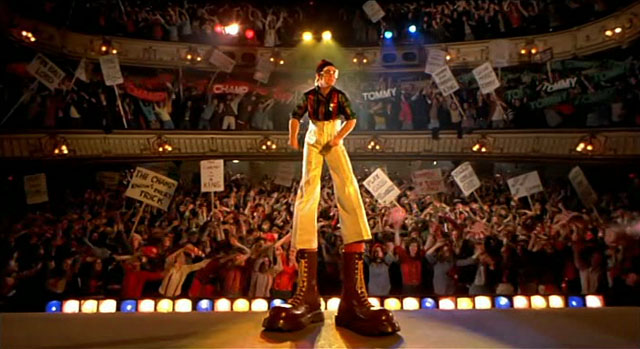
“Tommy is the only rock opera ever made” – Ken Russell

Sad Ann-Margret’s husband is killed in the war. Some time later she goes on vacation and meets Bernie (Oliver Reed) at a resort. He moves in, but one night the husband returns, disfigured from a plane crash, and Bernie kills him in front of little Tommy, who’s told that he didn’t see anything, didn’t hear anything, won’t say anything. And so he doesn’t ever again.

Tommy grows up to be curly-haired space-cadet Roger Daltrey. He’s not healed by attending Eric Clapton’s church of Marilyn worship, nor when Bernie gives him a night with extreme drug fiend Tina Turner (filling in for David Bowie), nor when he’s left with psychically abusive babysitter Paul Nicholas or sexually abusive Uncle Ernie (Keith Moon), nor from a visit to Dr. Jack Nicholson (filling in for Christopher Lee).

But one day Tommy finds something he’s good at. After defeating Elton John (who agreed to be in the movie provided he got to keep these boots) at a pinball championship, he becomes famous and attracts hundreds of groupies.

At home, mom celebrates their new wealth by throwing a bottle of champagne through the television and writhing in the bubbles, baked beans and chocolate that pour forth from the damaged set.

Tommy breaks through his mom’s mirror and starts speaking again, becomes a messiah to kids everywhere, his symbol a cross with a pinball on top. Mom is his biggest supporter, and stepdad Bernie is the financial wizard, plotting to set up Tommy camps everywhere and sell merchandise everywhere else. But their prefab religion backfires and the kids revolt, killing Tommy’s parents. But he lives to bathe in waterfalls and climb mountains with a big cheery grin.

It’s a ridiculous story, a twisted excuse for lots of music and celebrity cameos. Russell was never a huge fan of rock music (I’m not a big Who fan myself, really only enjoy “I’m a Sensation” from this soundtrack), had written a follow-up to The Devils called The Angels about false religion, which he couldn’t get off the ground. When offered to direct a movie with sympathetic ideas to his own, which Russell could help mold (he got Pete Townshend to write additional scenes and change plot details) with a pre-sold celebrity cast – a batshit-crazy musical story that needed visual accompaniment – how could Ken say no? It might not be Ken’s purest personal vision, but I double-featured it with Song of Summer as memorial screenings when I heard he’d died.

Unsurprisingly produced by Robert Stigwood, who produced Jesus Christ Superstar (and later Grease). Oliver Reed (of The Devils, of course) was doing Richard Lester’s Musketeers movies around the same time. Daltrey would be back with Russell on Lisztomania, which I need to see. And Ann-Margret needs to be much more popular – she was fantastic in this.

Jean Gabin (the year after Port of Shadows and La Bete Humaine) lives atop the Seventh Heaven apartment building. He shoots a guy, the cops arrive and shoot back. Barricaded in his room, Gabin embarks on a 90-minute flashback while waiting for the sunrise.

Gabin through a fractured window:

He was a factory worker, met lovely Francoise. But she’s sneaking away to see Valentin (Jules Berry of Renoir’s Crime of Monsieur Lange), a stage performer. Jean follows her to the theater, meets Valentin’s disillusioned girlfriend/sidekick Clara (Arletty, star of Children of Paradise) who quits both those positions and hooks up with Jean instead.

Francois and Francoise through the mirror in happier times:

But Jean still wants Francoise and vice-versa. Valentin says he’s not Francoise’s lover but her father. She says that’s bullshit. Valentin just wants the girl but he can’t have her because she’s in love with Jean. He comes to Jean’s place with a gun, gets plugged instead. Back in the present, a hopeless Gabin kills himself to end the standoff. Sad movie.

Gabin and Valentin, another mirror:

Notable for its long flashback dissolves. Remade with Henry Fonda and Vincent Price eight years later.

Antonio Banderas (first movie of his I’ve watched since Once Upon a Time in Mexico) invents an insect-and-heat-repellent artificial skin, which he’s tested on a beautiful woman who seems to be imprisoned in a room of his house. But the artificial skin is a distraction from the real story – the fact that the girl may be fireproof is sadly not integrated into the plot. Mainly the movie wants to tell us more about Vera, the woman in the room (Elena Anaya of Mesrine), and how she got there, with bonus sub-plots about Dr. Antonio and his family.

Firstly, his housekeeper/chef (Marisa Peredes, star of Flower of My Secret) is secretly his mom, and her misfit son Zeca comes to the house dressed as a tiger, ties up his mom and rapes the girl upstairs before Antonio comes home and shoots him to death, while mom watches on the monitors downstairs. Some of the most intense shots in the movie involve those monitors, Antonio, his mom and Zeca interacting with Vera’s image.

Backstory: Antonio became obsessed with artificial skin after his wife was disfigured in a burning car (crashed by Zeca, with whom she’d been cheating) then threw herself out the window to her death in front of their young daughter, who became a psychological wreck from the experience. Years later Antonio takes his daughter Norma on a rare trip outside her mental hospital to a party, where she’s nearly raped by party-crasher Vicente in the garden. Soon the daughter commits suicide and Antonio kidnaps Vicente, gives him an unwilling sex change and alters his whole body to resemble that of Antonio’s dead wife before her accident.

So, back in the present, it’s no wonder that soon after Antonio starts letting Vera/Vicente leave her room, she starts planning revenge – grabs a gun from his desk and kills Antonio and his mom. Movie ends with a tearful reunion, the beautiful Vera in her family’s shop for the first time in six years telling her mother “I’m Vicente.”

Almodovar will never top the Caetano Veloso interlude in Talk To Her, but he gives us a couple of passionate performances by Concha Buika, just one of the details that lifts this movie above its sordid story.

I meant to rewatch Eyes Without a Face before going to this, but forgot.